
Transitional and prelim IM years are not “basically the same.” That’s something people say when they do not understand how program directors actually use them.
From the inside, they serve very different political, educational, and service functions in a hospital system. And if you do not understand that, you can very easily end up in a miserable year, or worse, with a gap before your advanced spot.
Let me walk you through what really happens in the back rooms when these spots are created, filled, and later evaluated.
What These Years Really Are (Not the Brochure Version)
On paper:
- Transitional Year (TY) = broad-based, rotating internship with relatively more electives; commonly used by radiology, anesthesia, derm, rad onc, ophtho, etc.
- Preliminary Internal Medicine (Prelim IM) = 1-year IM internship, often at a categorical IM program, used as the required clinical year before advanced specialties.
That’s the ERAS definition. That’s what you already know.
Inside the hospital, they’re something else:
- They’re cheap labor to cover nights, admissions, cross-cover, and scut… without committing to you for 3+ years.
- They’re political currency used by advanced specialties to reward (or appease) specific IM departments or chairmen.
- They’re audition platforms—sometimes—for people they might want to “steal” into categorical spots when someone quits.
And here’s the first uncomfortable truth:
Most institutions value transitional and prelim IM years very differently, even if the schedules look similar on paper.
How Program Directors Think About TY vs Prelim IM
Let’s start with who actually “owns” you.

| Step | Description |
|---|---|
| Step 1 | Hospital GME Office |
| Step 2 | Internal Medicine PD |
| Step 3 | Transitional Year PD |
| Step 4 | Advanced Specialty PDs |
| Step 5 | Prelim IM Intern |
| Step 6 | Transitional Year Intern |
Who owns a Prelim IM?
Prelim IM interns belong to the Internal Medicine program director.
That PD’s job is to:
- Staff the wards, ICU, clinic, and night teams
- Maintain ACGME requirements
- Protect the experience of their categorical residents (who are their real investment)
How do prelims fit in? Simple. You backfill the unpleasant, high-volume, or service-heavy blocks so categorical residents can have continuity clinic, electives, research time, and less brutal call.
What PDs will not say on interview day:
“If I can put a prelim on a brutal admitting night float instead of a PGY-2 who might quit over it, I’m going to do that.”
Who owns a Transitional Year?
TY interns technically belong to the Transitional Year PD, but that PD is often politically subordinate to the big revenue-producing departments: IM, surgery, neurology, etc.
Transitional years are usually created:
- Because anesthesia, radiology, derm, etc., insisted on having them
- As part of a deal: “We’ll send you X advanced residents if you give them a decent intern year”
- To make the hospital more attractive to competitive specialties
So a TY PD is constantly balancing:
- Making the year “cushy enough” to keep advanced specialties happy
- Not angering IM / surgery by under-staffing their services
- Avoiding TY becoming known as a dumping ground for weak residents
This is why you’ll see huge variation: some TYs are borderline chill gap years, others are indistinguishable from a hard IM prelim year with a slightly nicer brochure.
How Advanced Specialties Actually Use These Years
This is where the politics kick in. You’re not just picking a year; you’re picking who really advocates for you when stuff goes wrong.
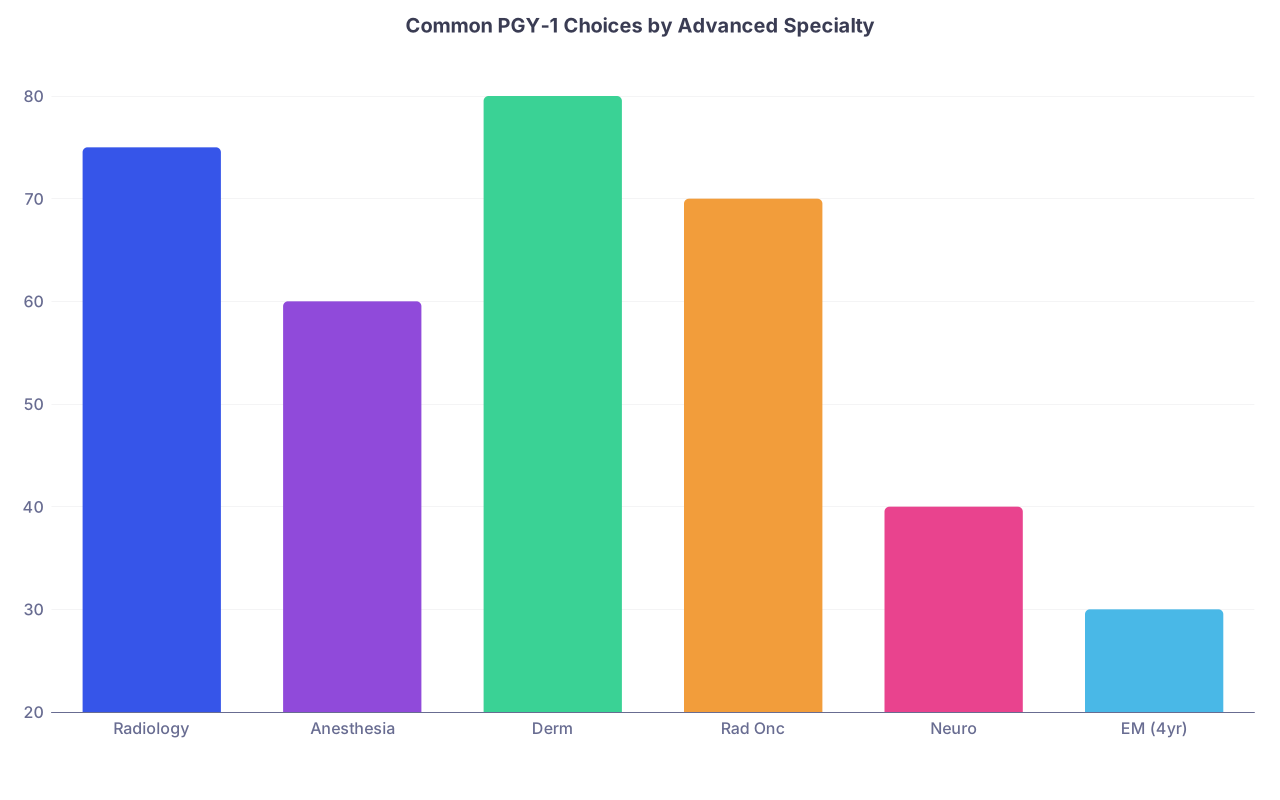
| Category | Value |
|---|---|
| Radiology | 75 |
| Anesthesia | 60 |
| Derm | 80 |
| Rad Onc | 70 |
| Neuro | 40 |
| EM (4yr) | 30 |
(Values above are approximate % using TY or prelim IM or similar; pattern matters more than exact numbers.)
Radiology, Derm, Rad Onc, Ophtho
These specialties hate when their residents get chewed up by malignant medicine or surgery years. They complain to GME. They threaten to stop sending residents. And in many hospitals, they win.
So for these groups:
- A strong TY is a selling point when recruiting applicants
- They often have a say in the TY structure: more electives, ICU exposure, but fewer soul-crushing ward months
- They quietly steer their favorite students toward specific TYs they know are humane
I’ve literally heard a radiology PD say in a faculty meeting:
“If they’re doing six months of night float and cross-cover as a prelim, they’re useless to me when they show up as a PGY-2.”
They’d rather you do a balanced TY with real patient exposure, a bit of wards, some ICU, but still time to breathe and remember why you picked radiology or derm.
Anesthesia and Neurology
These are more split.
- Some anesthesia PDs like prelim IM because it’s heavy on medicine and sick patients, which actually translates well into the OR and ICU.
- Others push for a structured TY that includes MICU, SICU, ED, and some wards without burning you out.
Neurology can go either way. Urban academic neuro programs often tolerate prelim IM; smaller or more lifestyle-focused programs love TYs.
The critical behind-the-scenes detail:
When advanced PDs sign off on your PGY-1 year, they care about what you learned, not how many cross-covers you survived. And they absolutely notice which hospitals send them shattered interns vs. functional ones.
Emergency Medicine with Required PGY-1
Four-year EM programs (or some that prefer it) often like:
- Prelim IM if they want you strong on medical decision-making, ICU-level sick patients
- TY if they want more ED exposure and balanced rotations
But EM PDs talk. They know which prelim IM years basically weaponize interns as admit note machines and which TYs create residents who can function in a chaotic ED from day one.
What Your Day-to-Day Actually Looks Like
On paper, both TY and prelim IM can say “13 blocks of 4 weeks” with “ward, ICU, elective, ED” sprinkled in.
In reality, how those blocks are used is very different.
Typical Prelim IM Experience (Unvarnished)
I’ve watched this pattern at multiple mid- to large-size academic centers:
- You do more front-line ward coverage than categorical interns.
- You’re overrepresented on:
- Night float
- Admitting days
- Cross-cover-heavy rotations
- You get less clinic than categoricals (they need clinic for continuity requirements).
- Your electives are real but often scheduled in a way that bails out service needs.
Translation: elective becomes “elective-ish” when someone is sick or they’re short.
You’re the flex buffer of the residency. That’s the part no one spells out.
Typical Transitional Year Experience
Good TYs are designed with an explicit promise to advanced specialties:
“We won’t break them.”
Pattern you’ll see in legitimate, respected TYs:
- 4–6 months of real inpatient (IM, maybe a month of surgery, maybe ICU)
- 1–2 months ED
- 4–6 months of true elective time
- Usually one clinic half-day a week, but not hardcore continuity demands
You’re still up at 5:30. You still get called at 3 am. You still hold pagers and manage sick patients. But:
- Your service to education ratio is better.
- There’s intentional protection of electives and vacation.
- The TY PD actually fights when other departments try to cannibalize your schedule.
The ugly side: some “TY” programs are transitional in name only. Same call as IM. Same wards months. Electives vaporize whenever census spikes. Those programs exist to recruit advanced spots, not to protect you.
How Categorical IM Programs Quietly View Prelim Interns
Here’s the part most students never hear.
Internal medicine PDs and chiefs often sort residents into mental categories. They won’t say this publicly, but you see it by who gets the best rotations, research introductions, and letters.
Rough buckets:
- Core categorical IM residents – the investment. The pipeline for fellowships. Protected.
- High-yield TY interns rotating through IM – sometimes future radiology/derm/onc colleagues, politically relevant.
- Prelim IM interns – necessary to run the machine; some will be treated as valued members, others as disposable.
The difference is not universal. I’ve seen phenomenal programs where prelims are completely integrated and treated like family. But I’ve also seen:
- Prelims excluded from resident retreats because “budget”
- Prelims not getting invited to certain noon conferences (protected for categoricals)
- Prelims finding out late that they’re ineligible for certain internal awards or research tracks
You notice it when a patient thanks the “team,” and attendings name every categorical by first name and then tack on, “and our prelim.” It’s subtle. But it tells you exactly where you stand.
How These Years Affect Your Future Options
Everyone asks the same wrong question:
“Is a TY or prelim IM better for fellowship?”
For most advanced specialties (rads, anesthesia, derm, ophtho, rad onc), the answer is: they don’t really care which you did—they care about your performance and your Step 2/3 / letters.
The real questions you should be asking:
- Who will write me strong letters?
- Will I survive this year mentally and physically?
- Does this year actually prepare me for my PGY-2 specialty?
Let’s be concrete.
| Factor | Transitional Year | Prelim IM Year |
|---|---|---|
| Service load | Moderate to high, variable | High, often front-line work |
| Elective time | Usually more, but variable | Limited, easily cannibalized |
| ICU exposure | 0–2 months typically | 1–3 months common |
| Relationship to IM dept | Indirect or partial | Direct – you are IM workforce |
| Burnout risk | Lower in good TY, high in bad TY | Frequently high |
| Letters/mentorship | Can be excellent if structured well | Often limited by service demands |
If You Ever Might Pivot to Categorical IM
If a small voice inside you says, “If derm/rads/ophtho doesn’t work out, I might be okay as an internist,” then:
- A prelim IM in a strong program can absolutely help you slide into a categorical spot when someone drops out.
- TYs can do this too, but much less directly; you’re off in multiple departments, not embedded in IM.
Behind closed doors, I’ve watched PDs say:
“We have an R2 spot opening. Do we have a solid prelim we’d be comfortable upgrading?”
If you’re a prelim and you’ve shown up, done the work, and proven you’re serious about medicine, you can absolutely be that person.
Transitional interns are considered more tangential. It happens, but less often.
Red Flags and Green Flags When Choosing
If you’re not looking for the fluff answers, here’s what actually predicts your experience.
Red Flags (for both TY and Prelim IM)
- Prelim interns don’t show up to the interview day to meet you. Ask yourself why.
- You get vague answers to: “How many months of night float do prelims do vs categoricals?”
- Residents say: “We all suffer together” with a weird, forced laugh.
- Nobody can clearly tell you how many true elective blocks prelims or TYs actually get vs “elective coverage.”
- A PD says: “Our prelims work just as hard as our categoricals” and treats that as a selling point.
Green Flags
- Prelims/TY interns are in leadership roles (chiefs, committees, QI projects).
- They can list specific alumni who matched derm, rads, anesthesia, etc. through their program, with real stories.
- The PD has clear, written policies on:
- Maximum consecutive nights
- Backup coverage expectations
- Protection of electives and vacation
- Advanced specialty PDs at the same institution openly recommend that TY or prelim year to you.
If the categorical seniors are trying to quietly warn you with their eyes, pay attention. Residents are notoriously bad liars when talking to med students off-script.
The Hidden Scheduling Games
One more behind-the-scenes issue: schedule manipulation.
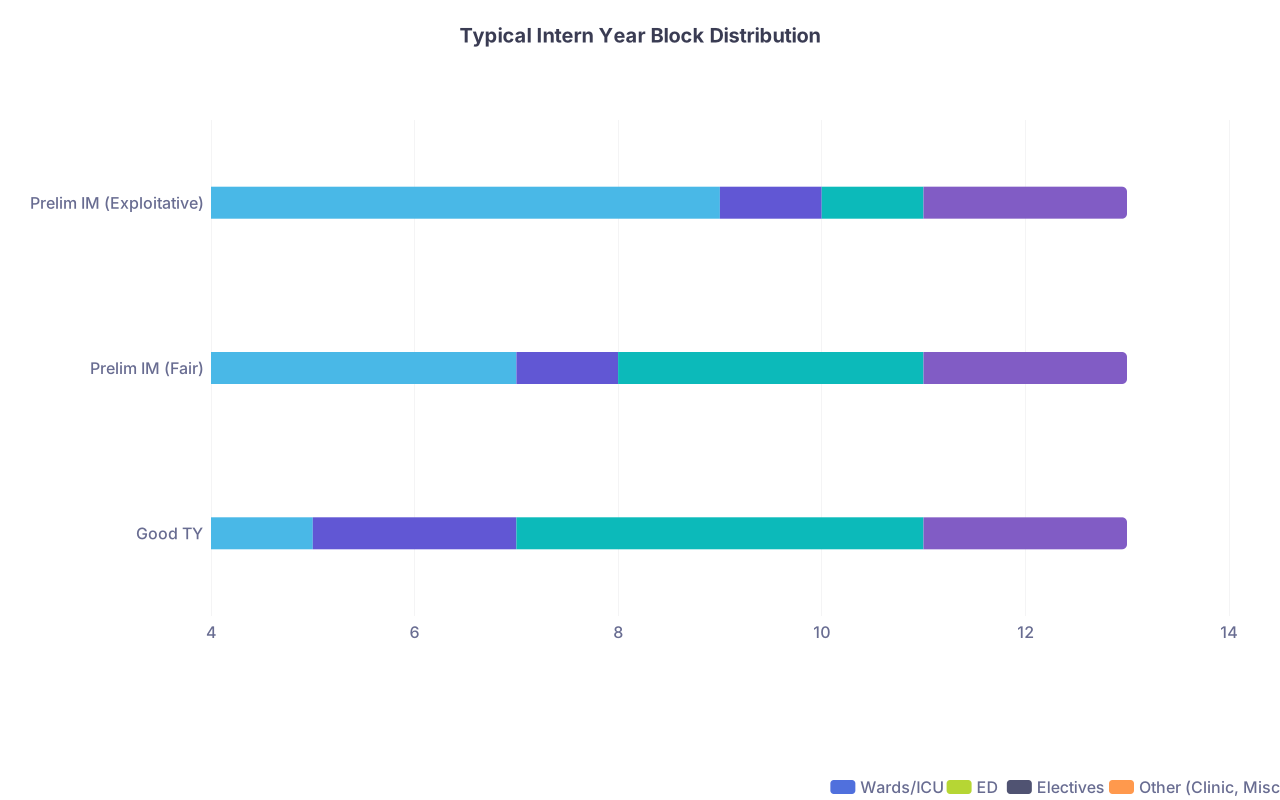
| Category | Wards/ICU | ED | Electives | Other (Clinic, Misc) |
|---|---|---|---|---|
| Good TY | 5 | 2 | 4 | 2 |
| Prelim IM (Fair) | 7 | 1 | 3 | 2 |
| Prelim IM (Exploitative) | 9 | 1 | 1 | 2 |
Here’s how it actually plays out:
- Fair programs: Everyone shares the ugly rotations. Prelims and categoricals get roughly similar distribution; TYs have a defined, reasonable floor of service.
- Exploitative programs: Prelims and sometimes TYs get stacked with:
- July/August wards
- Holiday coverage
- Heavy winter admit months
- Disproportionate night float
Why? Because in July of next year, you’re gone. You’re not going to be there to complain to new applicants. Categorical R2s and R3s are.
I’ve watched chief residents literally move prelim names around a schedule and say, “We can always put this on the prelims; they’re not here next year.” No malice, just cold calculus.
How to Decide: TY vs Prelim IM for You
Strip away the noise. The decision generally comes down to three questions:
- How strong is your advanced spot?
- If you’re already matched into a solid anesthesia, rads, derm, ophtho, or rad onc program that you trust, they often have preferred TY or prelim sites. Start there. They know who treats their people well.
- What kind of doctor do you want to be on day one of your PGY-2?
- If you want to be rock-solid with crashing medical patients, a good prelim IM can sharpen you faster than a cushy TY.
- If you want to arrive as a human with intact sleep, some hobbies, and balanced experience, a good TY is better.
- How much suffering can you trade for marginal benefit?
- Over and over, EM, rads, derm, and anesthesia PDs have told me: “I don’t care that they did 8 months of medicine as an intern; I care that they learned something and didn’t burn out.”
A brutal prelim IM year at a malignant place does not make you a hero. It just makes you tired.
A Quick Word on SOAP and Unmatched Scenarios
If you end up in SOAP, you’ll see a flood of unfilled prelim IM and some TY spots.
Inside baseball:
- Programs sometimes intentionally leave prelim spots unfilled, knowing they can plug SOAP candidates into them as cheap labor.
- Some SOAP-only prelim/TY spots are so service-heavy that even normal Match applicants avoid them in favor of waiting a year.
If you’re staring at a list of leftover prelims and TYs during SOAP, your question should not be “Which is better on paper?” but:
- Where will I physically and mentally survive?
- Which PD sounded like a human being on the phone?
- Where did current interns sound like they were barely holding it together?
I’d rather see someone SOAP into a solid, mid-tier TY that respects boundaries than into a name-brand academic prelim that eats people alive.
Visualizing the Path: From Match to PGY-2

| Step | Description |
|---|---|
| Step 1 | MS4 Match |
| Step 2 | Rank TY and Prelim Programs |
| Step 3 | SOAP into TY/Prelim or Reapply |
| Step 4 | Transitional Year |
| Step 5 | Prelim IM Year |
| Step 6 | Start Advanced PGY-2 |
| Step 7 | Possible Switch to Categorical IM |
| Step 8 | Matched Advanced Spot? |
| Step 9 | IM PD Likes You? |
This is the real branching tree. TY vs prelim doesn’t just determine how tired you are. It shapes who knows you, who might rescue you if your plans change, and how you show up to your actual specialty.
FAQs
1. If I’m going into radiology/anesthesia/derm, should I avoid prelim IM altogether?
No. A well-run prelim IM year at a humane program can be fantastic preparation and earn you strong letters. The problem is bad prelims, not the concept itself. If your future advanced PD strongly recommends a specific prelim partner and you trust them, that can be a great choice. What you should avoid is a random, malignant IM prelim with a reputation for chewing through interns just to protect their categoricals.
2. Does doing a TY vs prelim IM change my chances for fellowship later?
For most advanced specialties, the answer is: almost never in a meaningful way. Your fellowship or job prospects will depend more on your PGY-2+ performance, in-service scores, research, and letters than on whether your PGY-1 was called “TY” or “prelim.” Where it might matter is if you later decide to pivot into IM or a medicine subspecialty—then having been a strong prelim IM at that same institution can open a door into categorical IM more easily than coming from a loosely connected TY.
3. Are transitional years really “cushier,” or is that a myth?
Some are absolutely cushier. Some are indistinguishable from hard IM years. The myth is that all TYs are chill. The reality is that TY quality is wildly variable. The best indicator is talking to current TY interns (not just the hand-picked ones) and asking detailed questions about call schedules, night float, and how often their electives get hijacked for service. A TY with 5–6 months of wards, 2 months ICU, and frequent elective cancellations isn’t “cushy” in any meaningful way.
4. If I might want to switch into categorical IM, is a TY a bad idea?
Not necessarily, but a prelim IM year plugs you directly into the IM system and makes an internal transfer much smoother. TY interns do sometimes switch into IM—especially if they rotate heavily through medicine and impress people—but they’re one step further removed politically. If there’s a real chance you’ll pivot to IM, prioritize a strong prelim IM in a program you’d actually want to finish. That keeps the door wide open.
Key takeaways:
Transitional vs prelim IM is not just a label—it’s about who owns your time, who defends you, and how you’re used to staff the hospital. Good TYs and good prelims both exist; bad versions of each will grind you down. Talk to current interns, listen past the sales pitch, and pick the year that develops you without destroying you.