
The biggest mistake reapplicants make after a prelim-only year is assuming program directors see them as “basically a PGY-2.” They don’t. They see a risk that needs to be justified.
Let me tell you what really happens when your file hits the PD’s desk the second time around, with a prelim year in between.
What a Preliminary Year Actually Signals to PDs
Forget the brochure language. A “preliminary year” reads very differently depending on context, and that context is exactly what PDs argue about behind closed doors.
Here’s how they really categorize you:
- You matched prelim because you were aiming for a categorical but missed.
- You matched prelim as part of an intentional pathway (e.g., neurology, radiology, anesthesia, PM&R where a prelim or TY is standard).
- You only got prelim offers because your app was weak, your specialty was too competitive, or there were red flags.
On paper, those can look similar. On the PD side, they’re not.
In every rank meeting I’ve watched, someone asks, “Why are they reapplying? What actually happened last year?” That question drives everything. The prelim year is not automatically a plus. It’s a variable.
PDs are trying to decide one thing:
Will you be less work, or more work, than a fresh intern?
If your prelim year shows growth, reliability, and clear improvement from your med school record, you get bumped into the “asset” pile. If it shows drama, mediocrity, or stagnation, you slide into the “do not rank” or “only if we’re desperate” pile.
And yes, programs absolutely have an “only if we’re desperate” pile.
The Real Conversation in the PD’s Office
Let’s walk through what actually gets said in those quiet offices when your name comes up in rank meetings or when someone forwards your application as a reapplicant.
Picture this: Internal Medicine program. January. Rank meeting.
Your file pops up, labeled as PGY-1 at a local community hospital, prelim medicine.
The PD looks at the chief resident sitting at the end of the table and says:
“You worked with them. Are they a problem, or are they solid?”
That’s the first gate. Not your Step score. Not your personal statement. Not your “dedication to lifelong learning.”
Here’s what they’re really dissecting.
1. “Why Didn’t They Get a Categorical Spot the First Time?”
Every discussion starts here.
No PD assumes “bad luck.” They assume something didn’t add up.
People literally say things like:
- “If they were this strong, why didn’t they match last year?”
- “Why are they still without a categorical spot after a year of US training?”
- “Was it just overreaching, or is there a deeper issue?”
What they’re scanning for:
- Were you originally going for something like derm/ortho/ENT and now pivoting to IM/FM/psych? That’s seen as more understandable.
- Or did you apply to categorical IM last year and only got prelim? That raises more suspicion.
They want a convincing, coherent story arc:
- What you aimed for
- Why it didn’t work
- What you learned
- Why now you’re a safer, better bet than last year
If your documents do not clearly answer this, PDs fill in the blanks themselves. And they are not usually generous with their imagination.
2. “Did They Make Enemies or Allies This Year?”
This part is brutally simple.
PDs pick up the phone. They text other PDs. They call your chief. They ask one version of the same question:
“If you had an opening, would you keep them as a PGY-2?”
If the answer isn’t an immediate “Yes, absolutely,” that’s a problem.
Behind the scenes, you get sorted into three informal categories:
| Category | What PDs Say | Your Chances |
|---|---|---|
| Must Keep | "We’d take them back in a second" | Strong |
| Fine But Replaceable | "They’re okay, we wouldn’t fight for them" | Moderate |
| Would Not Rehire | "We’re fine with them leaving" | Low |
Nobody writes this in your MSPE. But it absolutely shapes how PDs discuss you.
If your prelim PD or chief gives lukewarm, hedged feedback—“they’re fine,” “they’re improving,” “they’re dependable with reminders”—the receiving PD hears: marginal, not worth the risk.
3. “Are They Actually Better Than a Fresh Grad?”
This is the harshest part.
Programs don’t just ask, “Are they good enough?” The real question is:
“Would I rather take this prelim PGY-1 or a brand-new grad I can shape from day one?”
Residents and faculty will chime in with comments like:
- “Prelim PGY-1s take less time to teach basic tasks.”
- “But they also come with habits from another program.”
- “If they’re not clearly excellent, I’d rather have someone green.”
Your prelim year must create clear separation between you and the average MS4:
- Clinical notes sharper
- Sign-outs organized
- Nursing staff trusts you
- No reliability drama
- No near-misses on patient safety
If you’re just “fine,” you lose to the unknown MS4 more often than you’d think. The unknown is easier to mold. The known, if mediocre, is hard to fix.
What They Comb Through in Your File (That You Underestimate)
Let’s walk through what’s actually getting dissected when a PD or selection committee member deep-dives your reapplication.
1. Prelim Year Evaluations
You think they’re all generic and fluffy. They’re not—when PDs read them, they look for subtext.
They zoom in on:
- Phrases like “requires frequent supervision,” “benefits from ongoing feedback,” “has made progress in time management” – all are code for “was a concern.”
- Specific rotations: ICU, nights, busy ward months. If your ICU eval is weak, that’s a glowing red warning light.
- Patterns: Were your first 2–3 months rough but the last 3–4 glowing? That’s a story they can work with—growth.
If the prelim year evals look suspiciously vague, PDs get nervous. Many will reach out informally to clarify, and those side conversations carry more weight than anything written.
2. Letters of Recommendation: Who Wrote Them and How
Reapplicants often overestimate the impact of adding “more US letters.” PDs don’t care about the count. They care who is willing to stick their neck out for you.
They ask:
- Is there a letter from the prelim PD?
- Is there a letter from a chief resident?
- Did anyone call you “one of our best interns” or “top third” or anything with a clear comparative statement?
- Did anyone hint that they’d love to keep you if they had space?
If your prelim PD didn’t write for you, people notice. The internal dialogue is:
“Why didn’t their own PD write? That tells me more than any generic attending letter.”
You need at least one letter that sounds like the writer would rehire you tomorrow. Anything less puts you in a soft, forgettable middle.
3. Gaps, Exam Timelines, and “What Did You Do With the Year?”
You’re being graded on how you used that year, not just that you survived it.
They look at:
- Did you pass Step 3, or at least schedule it? (For IM, anesthesia, EM, surg subs, this matters more than people admit. Passing Step 3 de-risks you.)
- Any unexplained LOAs, gaps, or “out of training” time around that year.
- Did you participate in QI, teaching, research? They don’t need you to publish in NEJM, but they like to see that you integrated.
An unstructured year where you “just worked” without any sign of initiative can work against you when compared with other prelims who clearly maximized the opportunity.
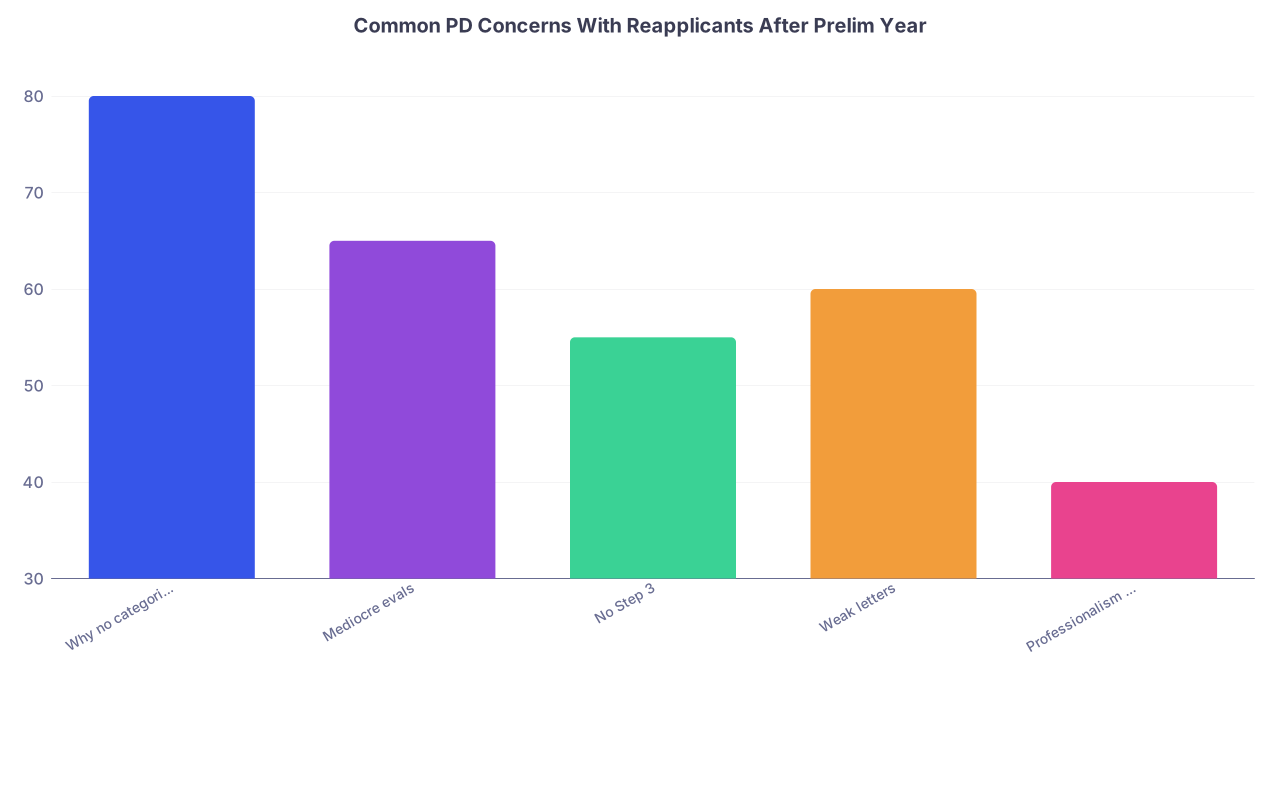
| Category | Value |
|---|---|
| Why no categorical spot? | 80 |
| Mediocre evals | 65 |
| No Step 3 | 55 |
| Weak letters | 60 |
| Professionalism concerns | 40 |
(Those percentages roughly match the frequency I’ve heard these concerns raised in actual committee rooms.)
The Five Quiet Red Flags PDs Look For in Prelim Reapplicants
No one tells you these explicitly, but they’re there, and they come up again and again.
1. No Strong Endorsement From Your Own PD
This is number one for a reason.
If your own prelim PD or APD is not clearly advocating for you, other PDs interpret that as: “They’ve seen them up close and don’t fully trust them.”
Sometimes the PD is just lazy or overwhelmed. But on the receiving end, we don’t assume that. We assume there’s a reason.
2. Vague or Conflicted Story About Specialty Change
If you’re switching from, say, surgery prelim to IM, the panel wants a clean narrative:
- “I realized I enjoyed longitudinal patient care more.”
- “I found ICU and complex medicine cases far more satisfying.”
- “My faculty in IM strongly encouraged this switch.”
What they don’t want to hear:
- “I still love surgery, but I just want a better lifestyle.”
- “I didn’t match last year in categorical surgery, so I’m applying IM now.”
- Anything that sounds like you’re settling or still undecided.
You must look decisive, not displaced.
3. Mediocre, Not Terrible, Performance
Weirdly, the “average” prelim may be worse off than the one who had a shaky start but obvious improvement.
Panels will take someone whose early evals say “struggled with time management early in the year but showed significant growth” over “solid, dependable, adequate” across the board.
Why? Because growth potential matters more than static adequacy. Residents are a 3-year investment at least; PDs don’t want someone who already looks like they’re at their ceiling.
4. Reputation With Nurses and Ancillary Staff
This one never shows up in your ERAS, but it absolutely pops up in side conversations.
When your name comes up, PDs and chiefs quietly ask:
- “Do the nurses like working with them?”
- “Are they respectful to staff?”
- “Do they disappear overnight?”
If you’ve got a reputation as lazy, dismissive, or MIA, it’s often known informally. Prelim year doesn’t hide that; it amplifies it. And once that label gets attached, it travels.
5. Match Behavior the Second Time Around
PDs notice:
- Did you shotgun 100+ programs in a panic?
- Did you show up more prepared, more humble, more realistic?
- Or did you present with the same arrogance or entitlement you had the first time?
I’ve seen PDs say things like, “They still think they’re above our program,” and that’s an instant rank-list death sentence.
How to Reapply in a Way That PDs Respect
You’re not powerless here. When you understand how those conversations really go, you can position yourself differently.
Own the Narrative—Before They Write One for You
Your personal statement and interview answers have one job: answer the quiet questions PDs are already asking.
You should directly (but concisely) address:
- What your original goal was
- Why you didn’t secure a categorical spot
- How your prelim year changed your skills and insight
- Why you’re now committed to X specialty and X type of program
The worst move is pretending the prelim year is just a “detour” you can gloss over. PDs hate that. It looks evasive.
A strong answer sounds like:
“I initially applied to categorical general surgery after falling in love with the OR. I matched into a preliminary position and quickly realized that what I loved even more were the complex medical issues our ICU patients faced and the satisfaction of following them through recovery. Over this year, my evaluations and feedback in ICU and ward medicine reflected that strength, and with the support of my PD, I’m reapplying to internal medicine, where I can build on that foundation.”
You’re not apologizing. You’re explaining, clearly.
Make Your Prelim PD an Ally, Not a Bystander
Behind the scenes, one strong, respected PD vouching for you can outweigh mediocre Step scores or a past failed attempt.
You want your PD to be able to say, when they get that inevitable call:
“Yes, I’d absolutely keep them if I had an opening. They’re one of our stronger interns.”
To get there, you need:
- Proactive check-ins: Midyear and near the end, ask frankly, “What would keep you from being able to strongly recommend me?” Then go fix exactly that.
- Visible initiative: Volunteer for a QI project, help with onboarding new interns, step up on rough services. PDs notice who plugs leaks without being asked.
- Mature self-reflection: Show that you understand your own growth areas and are actively working on them. PDs trust residents who are honest about limitations more than those who pretend to be flawless.
Use Step 3 as a De-risking Tool
Programs rarely say this out loud, but passing Step 3 as a prelim can bump you up a tier, especially if your earlier scores were marginal or if you had a Step failure.
From the PD’s perspective:
- You’re one major risk off their plate.
- You’re more likely to clear boards.
- You’re less likely to get buried in remediation during residency.
If you can reasonably fit Step 3 into your schedule without tanking clinical performance, it’s often worth it. Timing matters: have it passed or at least scheduled before interview season.
Paths That Actually Work After a Prelim-Only Year
Let me show you how PDs actually respond to different reapplicant profiles. I’ve seen variations of each of these.
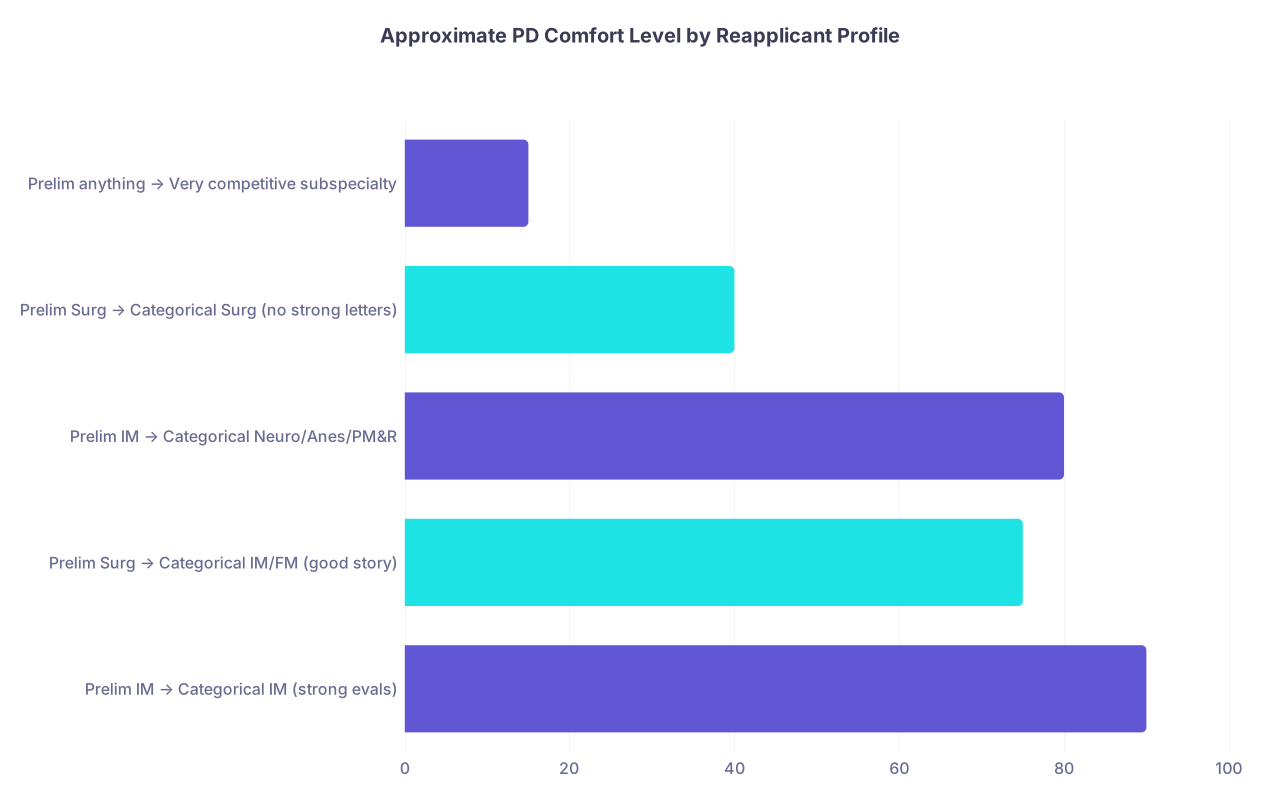
| Category | Value |
|---|---|
| Prelim IM → Categorical IM (strong evals) | 90 |
| Prelim Surg → Categorical IM/FM (good story) | 75 |
| Prelim IM → Categorical Neuro/Anes/PM&R | 80 |
| Prelim Surg → Categorical Surg (no strong letters) | 40 |
| Prelim anything → Very competitive subspecialty | 15 |
Numbers aside, here’s the translation:
- Prelim in the same field with strong evals and PD support? PDs are comfortable ranking you. You’ve basically done a live audition.
- Prelim in a harder field (e.g., surgery) moving to IM or FM with a clear narrative and strong performance? Many PDs like this. They know you’ve been through fire.
- Prelim IM going into neurology, anesthesia, PM&R? This is often the expected path; they mainly care about performance and letters.
- Prelim surgery trying again for categorical surgery with no standout letters? That’s rough. Surgery PDs are risk-averse, and the bar for “we want this person back as a categorical” is high.
- Prelim anything going for plastics, ortho, derm, ENT again after missing once? You better have done something extraordinary during that prelim year, or you’re dead in the water at most places.
The Part Nobody Admits: Some Programs Don’t Want Reapplicants at All
This is the ugly truth. Some programs have an unspoken (sometimes spoken) bias against reapplicants with prelim-only years, especially in competitive fields.
The thinking goes:
- “If nobody locked them down for a categorical by now, what am I missing?”
- “We don’t want someone else’s problem.”
- “If they were really that strong, their own program would keep them.”
You will never see this written. You’ll only hear it in hallways and closed-door meetings.
That means your strategy has to be realistic. You target:
- Programs that historically take prelims into categorical spots.
- Programs in regions where you already have ties and letters.
- PDs who know and trust your current PD or faculty.
When you see PGY-2 or categorical “unexpected vacancy” listings, those are often your best shot, because in those cases, your immediate readiness is an asset, not a liability.
FAQ: What PDs Think When You Reapply After a Prelim Year
1. Does a strong prelim year fully erase a weak med school record?
No. It doesn’t erase it. But it can overwrite the narrative. A weak med school record plus an outstanding prelim year with powerful, specific letters and growth can absolutely flip how you’re perceived. PDs will say things like, “They were a late bloomer” or “They really matured during intern year.” That’s salvageable. But if your med school record was shaky and your prelim year is just “fine,” you’re not changing your trajectory much.
2. Is it better to stay an extra year as a prelim or reapply right away?
If your prelim PD is offering to keep you as a PGY-2 (even unofficially) and is willing to go to bat for you, another year can help in some situations, especially if you need time to clean up evals, pass Step 3, or build a stronger CV. But if your evals are already strong, your PD is supportive, and you have a coherent story, most PDs would rather see you move forward than linger in limbo. Staying too long without progression can start to look like you’re stuck.
3. What single thing changes PDs’ minds the most about a reapplicant?
A direct, enthusiastic endorsement from a respected PD who’s actually worked with you. Not a generic letter. I mean a PD who, when called, says, “Take them. If I had a spot, they’d be mine.” That kind of advocacy has more weight than any line on your CV. Your entire prelim year should be built around earning that sentence.
With this lens, you’re not just “surviving” a prelim year—you’re building a case. The next step in your journey is making sure that, when your name comes up in that closed-door meeting, the room doesn’t say, “Why didn’t anyone take them last year?” but instead, “How fast can we get them into our program?”
How you engineer that outcome—that’s the work of the year you’re in right now.