Last July, I watched two new prelim interns walk onto the same medicine floor within 10 minutes of each other. Same school tier, similar Step scores, both allegedly “hardworking.” By the end of that first week, every attending on that service could tell you which one we’d fight to keep and which one we’d quietly hope would move on after the year.
You think people are waiting months to “get to know you”? They are not. Faculty start forming an opinion of you in the first 24–72 hours of your preliminary year. And that impression sticks longer than you’d like to believe.
Let me walk you through what we really see — what sets apart strong vs weak prelim residents, and how quickly that difference becomes obvious.
What a “Prelim” Really Is in Faculty Eyes
You think of prelim vs categorical as a contract nuance. Faculty don’t. We see three buckets the moment we hear “prelim.”

There’s:
- The prelim trying to match into something competitive (derm, radiology, anesthesia, ophtho, rad onc, neuro, etc.).
- The prelim who didn’t match categorical IM/EM/whatever and is regrouping.
- The “backup” prelim who landed here because the NRMP algorithm or their rank list went sideways.
We don’t treat these groups formally differently. But do we interpret their behavior differently? Yes.
Here’s the quiet truth: The label “prelim” lowers the bar in our heads on Day 1. We expect less clinical polish, less certainty, more insecurity. So when a prelim comes in strong, the contrast is dramatic. That’s why strong prelim residents can stand out faster than strong categoricals. The baseline expectation is different.
Your first month sets your brand. “That prelim who gets things done and doesn’t melt down” versus “that prelim who always looks lost.” This is how people actually talk about you in hallways, in workrooms, and in those “who should we go to bat for” conversations when letters and off-cycle opportunities come up.
The First 48 Hours: What We Clock Instantly
Nobody tells you this, but faculty and senior residents are profiling you from the moment you log into Epic and put on that badge. Here’s what we notice before the end of your first call shift.
1. How You Handle Not Knowing What You’re Doing
Every intern is clueless the first week. We expect that. What we’re watching is how you handle that cluelessness.
Strong prelim behavior:
- Admits uncertainty fast: “I haven’t done this admission order set yet, can I walk through it with you?”
- Takes notes — real notes, not vague bullet points you’ll forget by noon.
- Asks pointed questions after trying to think it through: “I see three options for rate control here — metoprolol, dilt, or dig. We’ve been using metoprolol mostly. Is that your general go-to unless XYZ?”
Weak prelim behavior:
- Fakes competence, nods along, then disappears at the computer for 45 minutes trying to figure out a basic order.
- Asks the same question three different days because they never wrote it down.
- Hides. Physically not in the workroom. Not at the nurse’s station. Just “somewhere” allegedly following up tasks.
We will forgive not-knowing. We do not forgive pretending.
2. How You Move on the Floor
Watch an intern on a busy ward for 60 seconds and you’ll know if they’re drowning.
Strong prelim:
- Moves with purpose. Walks like they know where they’re going, even if they checked the map 10 seconds before.
- Has a working “task stack” in their head: “I need to see bed 3 first because of oxygen bump, then 5 for dispo, then catch the family in 7 before noon.”
- Is visible. Not buried behind a monitor for hours.
Weak prelim:
- Wanders. You see them in three different hallways, doing nothing concrete.
- Has no prioritization. They’re writing a 2-page H&P on a stable cellulitis while an unstable COPD exacerbation hasn’t been seen yet.
- Always “about to” do something. About to call radiology. About to check that K. About to talk to the nurse.
We’re watching who looks like a doctor and who looks like they’re doing a med school sub-I cosplay.
3. How You Talk to Nurses and Staff
Faculty hear more about you from nurses in the first week than from your co-residents in a month.
Strong prelim:
- Introduces themself on Day 1: “Hi, I’m Dr. X, one of the new prelim interns. I’ll be covering beds 1–4 today.”
- Says “I’ll come see the patient now” when paged about something concerning, even if it seems minor.
- Circles back: “Hey, we upped his lasix. Let me know if UOP doesn’t pick up over the next couple hours.”
Weak prelim:
- Barely looks up from computer when nurses come to the workroom.
- Treats pages as interruptions rather than lifelines.
- Gets defensive when questioned: “Yes, I put in the order, I’m working on the note, okay?”
Faculty pay attention to which names come up in nursing complaints. And which names nurses quietly trust.
The Real Divide: Strong vs Weak Prelim Patterns
By week two, the novelty is gone. You’re no longer graded on the “new intern curve.” This is where the habits start separating you.
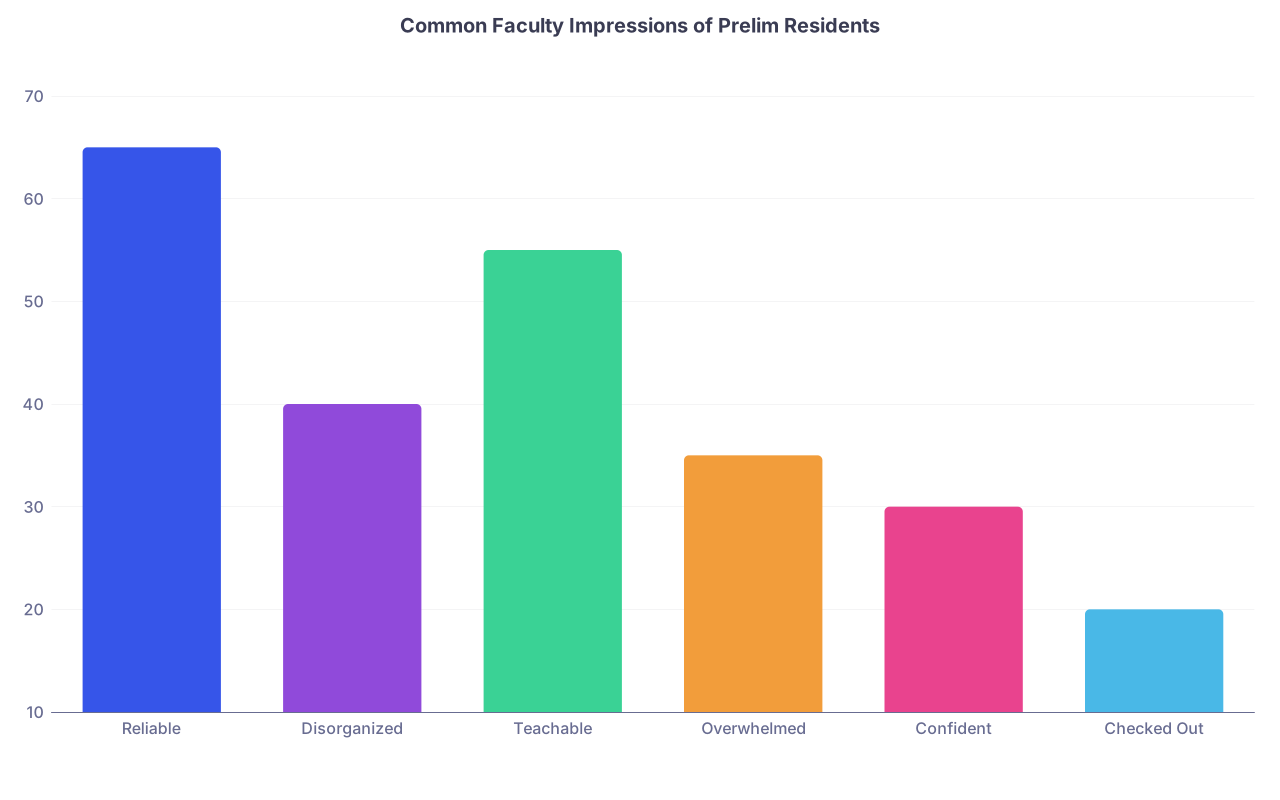
| Category | Value |
|---|---|
| Reliable | 65 |
| Disorganized | 40 |
| Teachable | 55 |
| Overwhelmed | 35 |
| Confident | 30 |
| Checked Out | 20 |
Clinical Reasoning vs Checkbox Medicine
You know who we remember six months later? The prelim who thought about the patients.
Strong prelim:
- During rounds: “Overnight they bolused him twice. Given his EF and borderline pressures, I’m worried we might be chasing the lactate instead of treating the underlying issue — could this be more cardiogenic than septic at this point?”
- Doesn’t give 10-line presentations stuffed with garbage. Gives a clear one-liner, salient events, then an assessment that shows actual processing.
Weak prelim:
- Reads the overnight events like a dictation service. No synthesis: “He was febrile. They gave Tylenol. Blood pressure was okay. Heart rate was around 100. Labs were ordered.”
- Plans sound like: “Continue current mgmt, follow up labs, monitor.” That’s not a plan. That’s a shrug dressed up as text.
We’re not expecting second-year cardiology fellow brilliance. We’re just expecting evidence you’ve thought beyond “check labs, continue same stuff.”
Owning Your List vs Being Dragged by It
Strong prelim:
- Knows every patient’s story without opening the chart. At least at the level of: “48-year-old with alcoholic cirrhosis, came in with GI bleed, now stabilizing but we’re working on diuresis and placement.”
- Updates the list proactively. Dispo column makes sense. Tasks are clearly written.
- When a nurse or attending asks, “What’s the plan for Ms. X?” they give a crisp, current answer, not “Let me check.”
Weak prelim:
- Uses the list as a crutch rather than a tool. Stares at it forever, doesn’t update it in real time.
- Constantly surprised: “Oh, she got transferred? I didn’t know,” at 11 am.
- Is the resident you can’t trust to know what’s going on with a cross-cover patient.
Your list is your brain. If it’s a mess, we assume your thinking is too.
Response to Stress and Volume
Here’s where prelims heading for competitive specialties either rise or expose themselves.
Strong prelim:
- Under a slam of five admissions, they say: “Okay, I’ll start with the hypotensive GI bleed, then the chest pain, then the stable failure to thrive. Can you grab ECGs and a lactate while I see the first one?”
- Voice may be stressed, but behavior stays goal-directed. They don’t freeze.
Weak prelim:
- Visible panic. Staring at the list instead of doing anything. Clicking in and out of charts.
- Keeps saying “I’m so behind” instead of “Here’s what I’ll do next.”
- Starts cutting corners in the worst places — not seeing the patient before putting in major orders.
We are not looking for calm robots. We’re looking for people who can function when things get ugly.
The Hidden Curriculum: How Faculty Actually Talk About You
You hear “no one expects you to be perfect as a prelim.” That’s half-true. They don’t expect perfection. They do expect trend lines.

Let me give you real phrases I’ve heard in evaluation meetings:
- “She’s a prelim but I’d take her as categorical in a second.”
- “Good heart, but he just never quite got it together. I wouldn’t send him to a high-acuity service alone.”
- “Technically fine, but constantly late and disorganized. I’d be careful putting my name on a strong letter.”
- “Slow start, but by the end of the month he was one of the more reliable interns on the team.”
Notice what’s missing? Step scores. Specialty choice. Where you went to med school. Nobody cares in those meetings. We care about three things:
- Would I trust you on night float?
- Would I send my family member to you?
- Would I sign my name to a real recommendation for you?
Those questions are answered by how you show up as a prelim. Daily. Not by the abstract labels on your CV.
The Prelim Trying to Match Something Competitive
Let’s talk specifically about you if you’re using this year as a stepping stone to derm, rads, anesthesia, ophtho, etc.
Here’s the harsh truth: most faculty know when a prelim is internally “gone” by January. They’ve got interviews, they’re emotionally out the door, and the quality of their work drops. Fast.
There’s a big difference between:
- The prelim who says, “I’ve got interviews, but I’m still going to show up and carry my weight,” and
- The prelim who mentally checks out by Thanksgiving, starts cutting corners, and treats floor work as beneath them.
We notice.
| Prelim Type | Typical Faculty Reaction |
|---|---|
| Competitive, still engaged | Will advocate, strong letters |
| Competitive, checked out | Distrust, guarded recommendations |
| Didn’t match categorical | Extra empathy but higher scrutiny |
| Backup prelim | Neutral until performance proves |
The best prelims aiming for competitive fields do something subtle but powerful: they never act like they’re “above” the work.
I remember a prelim going into ophtho who would still volunteer to help with ED admits at 2 am. Did she need to? No. But when it came time for letters, three attendings independently wrote some version of, “She worked like she was staying here forever.” That line matters.
Weak Prelim Red Flags That Are Obvious by Month 2
No one will tell you these to your face. But they come up over coffee, in call rooms, and in eval debriefs.
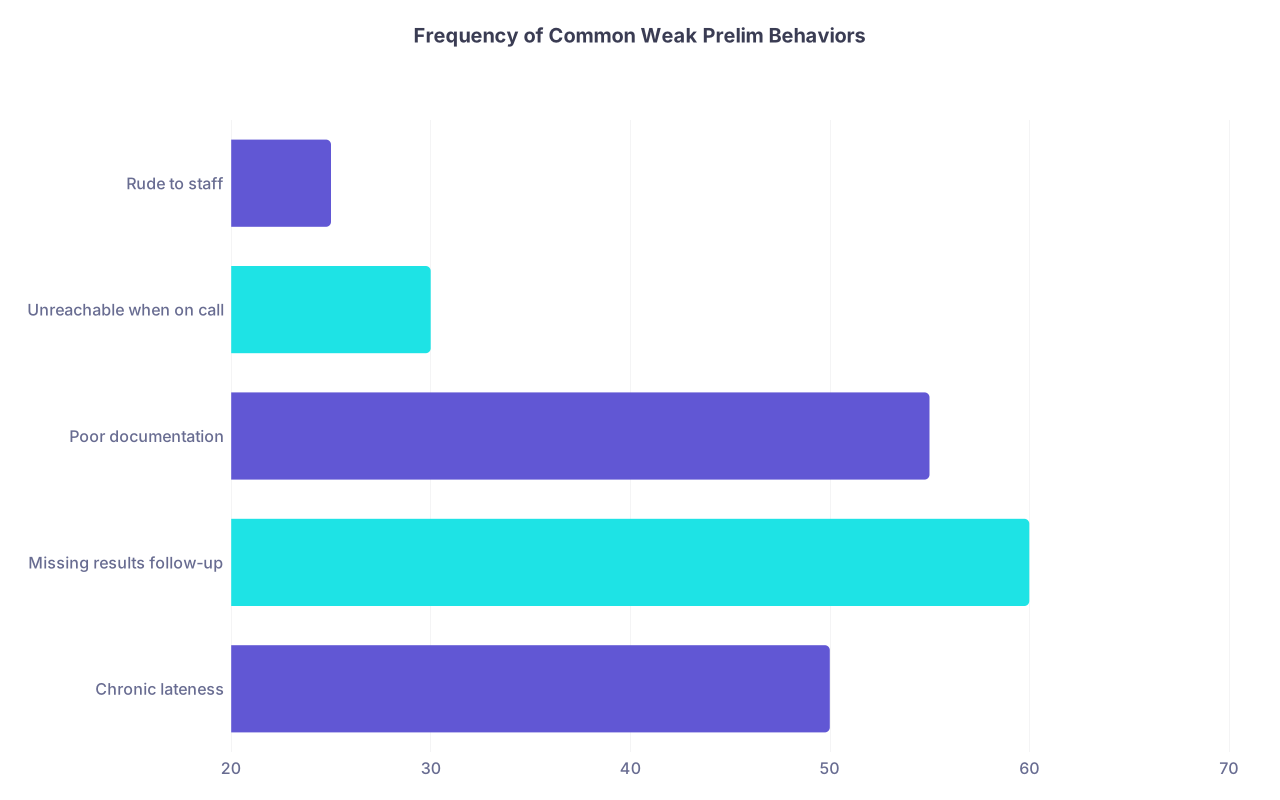
| Category | Value |
|---|---|
| Chronic lateness | 50 |
| Missing results follow-up | 60 |
| Poor documentation | 55 |
| Unreachable when on call | 30 |
| Rude to staff | 25 |
The big red flags:
- Chronic lateness. Not once. Repeated. Pre-rounding at 7:15 when everyone else is there at 6:30. The story becomes “Yeah, he always rolls in late.”
- Result amnesia. Forgetting to follow up that troponin. That CT. That K of 2.9. Once is forgivable. A pattern is not.
- Fantasy notes. Documentation that doesn’t match reality. “No distress” on a patient who was shivering and diaphoretic. We notice.
- Unreachable. Pager going off, you’re nowhere. Or “fell asleep” on a short nap and missed an urgent page.
- Disappearing act on tasks. “I’ll call GI” and then… nothing. Hours later the consult hasn’t been placed.
These behaviors are why prelims get quietly blacklisted from letters or glowing comments. Nobody writes, “This resident is unreliable and unsafe.” They just write a lukewarm, generic letter. Which might as well be a negative one.
Quiet Green Flags Faculty Love in Prelims
Here’s the other side: moves that make faculty and seniors say, “That one gets it.”
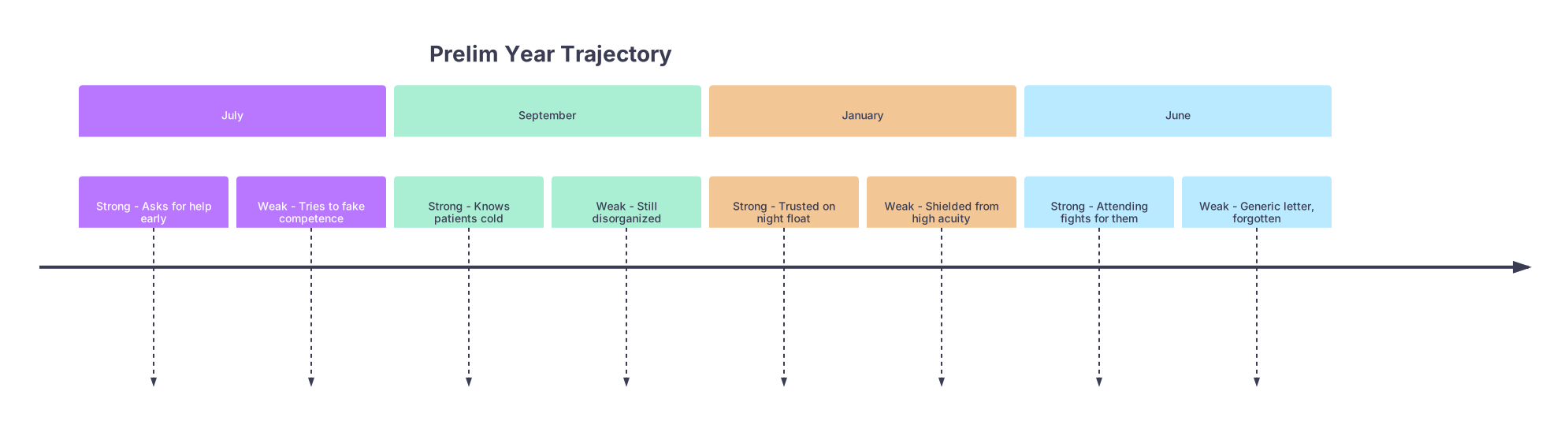
Things strong prelims do that stand out:
- Own mistakes fast. “I missed that lab. I’ve already called the nurse, I’m repleting, and I’ve set a reminder to recheck.” That builds trust, counterintuitively.
- Protect the team. Offers: “I can stay a bit late and finish this note set so you can get home,” to a co-intern who’s been killed all week.
- Set learning goals out loud. “I really want to get better at managing DKA and decompensated cirrhosis this month.” Then actually follows through by reading and asking targeted questions.
- Knows when to escalate. They’re not calling the attending for a Tylenol order. But they are calling when a borderline patient just looks wrong, even if vitals are okay.
You think this is basic. But we see maybe 20–30% of prelims consistently doing these things.
If You’re Starting a Prelim Year Soon: What To Actually Do
I’m not going to give you fluffy “work hard and be kind” nonsense. Assume you already know you should do that. Here’s the real playbook.

Decide on your brand in week one. Are you going to be “the reliable one,” “the fast note-writer,” “the calm in a crisis,” “the one who always knows the numbers”? Pick a lane and behave accordingly. Faculty remember one or two headline traits, not your entire personality.
Build micro-systems early. Copy good interns’ list formats. Steal how they track labs. Adopt a standard way of prepping for rounds. Don’t reinvent everything. Strong prelims shamelessly copy what works.
Protect your follow-up. Results tracking is where careers quietly die. Make it impossible for you to forget critical labs, imaging, and consult recs. Use whatever — sticky notes, electronic reminders, checkboxes on your list. But if you routinely miss follow-up, everyone stops trusting you.
Ask for real feedback by week 3 on your first rotation. Not “How am I doing?” Ask: “If I want to be someone you’d trust on nights by winter, what do I need to change in the next month?” Then do it. And say, “You told me to work on X, here’s what I did.”
Do not vanish into your application. If you’re applying out (derm/ophtho/rads/etc.), set boundaries with yourself: interview days are interview days, but on service days you’re fully present. The prelim who’s mentally half on VSAS and half on the floor fools no one.
The Bottom Line: What Faculty Notice Immediately
By the end of your first week as a prelim, most attendings and seniors already know which bucket you’re heading toward: the prelim we’ll go to bat for, the one who’ll be fine but forgettable, or the one we hope we never cross-cover with again.
What separates strong from weak prelim residents isn’t brilliance. It’s visible ownership, honest communication, and predictable follow-through under pressure. You control all three.
If you remember nothing else:
- We judge you fast — on how you handle not knowing, how you move, and whether you own your patients.
- Prelim status lowers expectations at first, which means you can stand out quickly by being simply reliable and engaged.
- Your daily behavior on the floor writes your letters long before anyone sits down to actually type them.
FAQ
1. I’m a prelim aiming for a competitive specialty. How much do internal medicine or surgery faculty really matter for my match?
More than you think. Program directors in competitive specialties read between the lines of your intern-year letters. A strong, specific medicine or surgery letter saying you were trusted with sick patients and carried your weight under pressure carries real weight, even if it’s not from your target field.
2. If I had a rough first month as a prelim, am I basically doomed?
No. Faculty remember trend lines. If you show visible improvement — more organized, more responsive, better presentations — people will actually mention that arc in your evals: “Significant growth over the year.” But you need to change fast and explicitly ask what to fix, then demonstrate you did it.
3. Do faculty treat prelims and categoricals differently day to day?
Formally, no. You’ll carry the same patients, do the same work. Informally, the only real difference is expectation: we assume prelims may be more anxious and more uncertain about their future. If you show up solid and engaged anyway, you’ll outperform the average categorical in how people talk about you.