

If your prelim program loses accreditation mid‑year and you just learned by email, your career is not over—but you can wreck it if you respond poorly in the next 2–3 weeks.
I’m going to walk you through exactly what to do, who to call, what to document, and how to protect your path—even if this feels like a nuclear bomb just went off in your PGY‑1.
This is ugly. It’s fixable. But not if you freeze or just “hope leadership will handle it.”
1. First, Understand What This Actually Means (and What It Doesn’t)
You do not need a full GME law course. You need the specific pieces that affect:
- Your ability to complete a valid preliminary year
- Your eligibility for advanced positions (e.g., Neurology, Anesthesiology, Radiology, Derm, PM&R)
- Your ability to transfer, get credit, or repeat time if needed
A few ground rules:
Losing accreditation ≠ your year suddenly “doesn’t count.”
The ACGME almost always sets a “withdrawal date” or “effective date.” Until that date, the program is still accredited. Time spent during accredited dates usually counts for training credit.There’s often a “teach‑out” period.
Sometimes the ACGME lets currently enrolled residents finish under an accreditation-withdrawal timeline. Sometimes they don’t. You need to know which.Your advanced program cares about one thing:
Did you complete an ACGME‑accredited prelim (or categorical PGY‑1 equivalent) that satisfies their board requirements? That’s it. Not your program’s politics. Not the hospital drama.There is usually more flexibility than programs will admit.
I’ve seen residents transfer mid-year and still get full credit. I’ve seen advanced programs accept 9–10 months as “sufficient” with a clean letter from the PD. But this only happens if you’re proactive and documented.
So your job in the next 72 hours is to get crystal‑clear answers to three questions:
- What is the ACGME’s effective date of withdrawal?
- Is there a formal teach‑out plan that includes my year?
- How much of this year will my advanced program and my specialty board accept?
2. The 24–72 Hour Game Plan: Stabilize, Then Document
You probably found out in one of three ways:
- Email from GME saying accreditation will be withdrawn
- Rumors that were finally “confirmed” in a meeting
- Your PD or chief awkwardly announcing it on a rushed Zoom
Do this in order.
Step 1: Stop guessing and get the actual facts
Within 24 hours, you should:
Pull the ACGME public program listing.
Go to the ACGME website, search your program. Look for:- “Continued Accreditation,” “Probationary,” or “Withdrawal – effective [date]”
- Any posted decisions or notices
Screenshot everything with timestamps.
Front page, status wording, dates. Save as PDF. This is your backup if the messaging later shifts.Check your institutional email carefully.
Look for:- Official statement from DIO (Designated Institutional Official)
- Any “FAQ” or plan for residents
- Mention of teach‑out vs. closure
Your emotional brain wants to spiral. Your professional brain needs data.
Step 2: Build your documentation folder
Create a dedicated folder (local + cloud backup) titled:
“[YourName]_PGY1_AccreditationDocs”
Inside, create:
- “ACGME_Screenshots”
- “Emails_Official” (announcements from PD, DIO, GME)
- “Personal_Notes” (dated summaries of oral conversations)
- “Contracts_and_Policies” (your residency contract, GME handbook pages, any guarantees)
Every time you have a meeting or call?
- Immediately write a 5–10 line dated summary:
“1/7/26 – Met with Dr. Smith (PD). She stated ‘You will receive credit for at least X months…’”
If this ever gets messy—which it often does—your contemporaneous notes are gold.
3. Who You Must Talk To (and What to Ask)
Do not just wait for “town halls.” Those are theatrical. You need specific, written answers.
Here’s your hit list.
A. Your Program Director (PD)
Schedule a 1:1, not a hallway chat.
Your script can be direct and calm:
“I’m trying to protect my ability to start my advanced program on time. I need to be very clear about what this means for my training credit and my future. Can I ask you a few specific questions?”
Questions to ask:
- “What is the ACGME’s effective withdrawal date for this program?”
- “Is there a formal teach‑out plan approved by ACGME? If yes, does it explicitly cover my PGY‑1 year?”
- “Will time worked here up to [date] count as accredited training?”
- “Will you be able to provide a letter stating I have successfully completed a full prelim year equivalent by [end date]?”
- “Is the institution planning to help residents transfer to other programs?”
Right after the meeting, send a short email:
“Dr. Smith, thank you for meeting with me today about the program’s accreditation status.
To confirm my understanding:
– The ACGME withdrawal date is [date].
– My time here through [date] will be considered accredited.
– You anticipate being able to attest to completion of a prelim year equivalent if I remain through [date].
Please correct anything inaccurate.
Best,
[Your Name]”
You are not being annoying. You are creating written confirmation.
B. Your DIO or GME Office
If the PD’s answers are vague or defensive, escalate.
You can email GME:
“Dear Dr. [DIO],
I’m a PGY‑1 in [Program]. I’m trying to understand the implications of the accreditation withdrawal on my ability to complete an ACGME‑accredited preliminary year and begin my advanced residency in [Specialty] on [date].Who is the best person to talk to about:
- The official ACGME withdrawal date and any teach‑out plan
- How much of this year will be recognized as accredited training
- Institutional support for transfers if needed
Thank you,
[Name]”
They may loop in a GME administrator. Fine. Keep everything in writing.
C. Your Advanced Program (if you already matched)
If you’ve already matched into an advanced spot starting next year (e.g., Radiology PGY‑2), you cannot wait. They need to know.
Within a few days (after you have basic facts), email your future PD or program coordinator:
“Dear Dr. [Future PD],
I wanted to inform you promptly about a development at my current prelim program.The ACGME has notified our program that accreditation will be withdrawn effective [date]. I am currently a PGY‑1 in [Program] and scheduled to start [Advanced Specialty] at your institution on [start date].
I’m actively working with our GME office to clarify:
– How long our program remains accredited (currently told through [date])
– Whether there is a formal teach‑out plan
– Whether I will receive full credit for a preliminary year equivalentMy goal is to ensure I remain fully eligible to begin PGY‑2 with you on schedule. Could we set up a brief call to discuss what documentation or minimum requirements you’ll need (e.g., letter from my current PD, minimum number of accredited months)?
I’ll keep you updated as I receive official information.
Best regards,
[Name], PGY‑1 [Program/Hospital]”
Most advanced PDs are more reasonable than you think. Their nightmare is being blindsided in June with “By the way, my prelim dissolved and I may not technically qualify.”
You’re doing the opposite.
4. Understanding Training Credit and Worst‑Case Scenarios
You’re probably wondering:
- “Will I have to repeat PGY‑1?”
- “What if I only get 8–10 months of accredited time?”
- “Will boards hold this against me?”
Here’s how this usually plays out.
How ACGME and boards typically handle this
Every specialty board has its own rules, but generally:
- They require 12 months of accredited clinical training before starting PGY‑2 in an advanced specialty.
- Some allow “up to 3 months” of non‑ACGME or research time within that year.
- A few are stricter and want 12/12 ACGME months.
The nuance:
If your program is accredited through June 30, and you finish the year, you’re probably fine.
If accreditation ends, say, March 31, you’ll have 9 months of clearly accredited time. Then:
- Some advanced programs + boards may accept this with an explanatory letter.
- Others may insist on extra months at another accredited site.
You need to confirm with:
- Your advanced program
- The relevant specialty board (or their published training requirements)
Do not rely on your PD saying, “It should be okay.” That phrase has buried careers.
What if you need more accredited time?
If you’re short accredited months, you have a few options:
- Transfer into another prelim or categorical PGY‑1 spot mid-year or for a partial year.
- Extend PGY‑1 by a few months at an accredited program and delay PGY‑2.
- Convert to a categorical spot elsewhere and re‑enter the advanced specialty later.
None of these are fun. They are all better than “start PGY‑2, then have the board deny eligibility two years later.”

5. Transfer vs. Ride It Out: Strategic Decisions
Once you have the facts, you face a choice:
- Stay and ride out the year under withdrawal/teach‑out
- Try to transfer to another prelim or categorical program
When it makes sense to stay
Staying can be reasonable if:
- Accreditation is guaranteed through June 30 or through completion of your PGY‑1
- Your advanced program confirms in writing:
“If your PD attests you completed a full prelim year while the program maintained ACGME accreditation through [date], we will consider you fully qualified.” - Clinical training is chaotic but survivable (you’re still actually learning how to be an intern)
In that case, the damage is mostly reputational to the institution, not to you.
When you should seriously consider transferring
You should actively pursue a transfer if:
- The ACGME withdrawal date cuts your PGY‑1 short by several months
- There is no clear teach‑out plan
- Your advanced program or specialty board cannot guarantee acceptance of your partial year
- Clinical training is obviously deteriorating: mass faculty departures, rotations canceled, supervision unsafe
Signs the ship is really sinking:
- Attending coverage regularly missing, residents function as de facto attendings
- Multiple resignations from core faculty and PD
- Rotations being replaced last‑minute with “clinic time” that doesn’t meet requirements
- GME office is evasive or hostile when asked about resident protections
If that’s your reality, you are not “being disloyal” by looking out for yourself. You are doing what any responsible physician would advise a colleague to do.
How to look for transfer spots without blowing yourself up
You don’t need a press release. You need targeted, quiet outreach.
Steps:
- Make a short, factual “situation summary” paragraph you can use in emails.
- Update your CV (include USMLE/COMLEX scores, medical school graduation date, current rotations).
- Quietly tell 1–2 trusted attendings you’re considering transfers and ask if they know nearby programs that might take a PGY‑1 or PGY‑2.
Programs that sometimes have mid-year openings:
- Community internal medicine programs
- Medicine‑prelim tracks at large academic centers
- Transitional year programs
- Less competitive specialties with chronic vacancies
You can also:
- Check AAMC/AMA sites listing “open residency positions”
- Watch email lists / specialty societies for position announcements
- Contact programs directly:
“Do you anticipate any PGY‑1 or PGY‑2 openings due to attrition or expansion?”
If you find a serious possibility, then you loop in your PD/DIO about release logistics. Not before.

| Step | Description |
|---|---|
| Step 1 | Receive Accreditation Loss Notice |
| Step 2 | Verify ACGME Status and Dates |
| Step 3 | Meet With PD |
| Step 4 | Email Summary for Written Confirmation |
| Step 5 | Contact GME or DIO |
| Step 6 | Contact Advanced Program to Confirm Acceptance |
| Step 7 | Explore Transfer or Extra Months |
| Step 8 | Quietly Search for Open Spots |
| Step 9 | Discuss Release and Transition Plan |
| Step 10 | Document All Agreements and Requirements |
| Step 11 | Accredited Through End of PGY1? |
6. Communication Templates You Can Actually Use
You do not need to craft perfect prose. You need clear, non‑emotional, documented communication.
Email to specialty board / AB** (if needed)
Subject: Question About PGY‑1 Accreditation Disruption
Dear [Board Office/Training Department],
I am a PGY‑1 in [Specialty/Prelim Medicine] at [Institution]. Our residency was recently notified that ACGME accreditation will be withdrawn effective [date].I am scheduled to begin an advanced residency in [Specialty] on [date]. By [date], I will have completed [X] months of training in an ACGME‑accredited program.
Could you please clarify whether:
- Completion of [X] months of ACGME‑accredited PGY‑1 training would meet the board’s requirement for entry into PGY‑2 in [Specialty], if supported by a letter from my program director; or
- Additional accredited months elsewhere would be required.
Thank you for your guidance.
Sincerely,
[Name], MD
PGY‑1 [Program/Hospital]
Screenshot and save their reply.
What to tell co‑residents
You’re all panicking, you’re all speculating, and half the group text is wrong.
Be the adult in the room:
- “I’m confirming ACGME dates & teach‑out, emailing our PD what I understood in writing, and reaching out to my advanced program. I’d recommend everyone get their own written confirmation. Then we can compare facts, not rumors.”
You don’t need to become the union leader. Just model sane behavior.
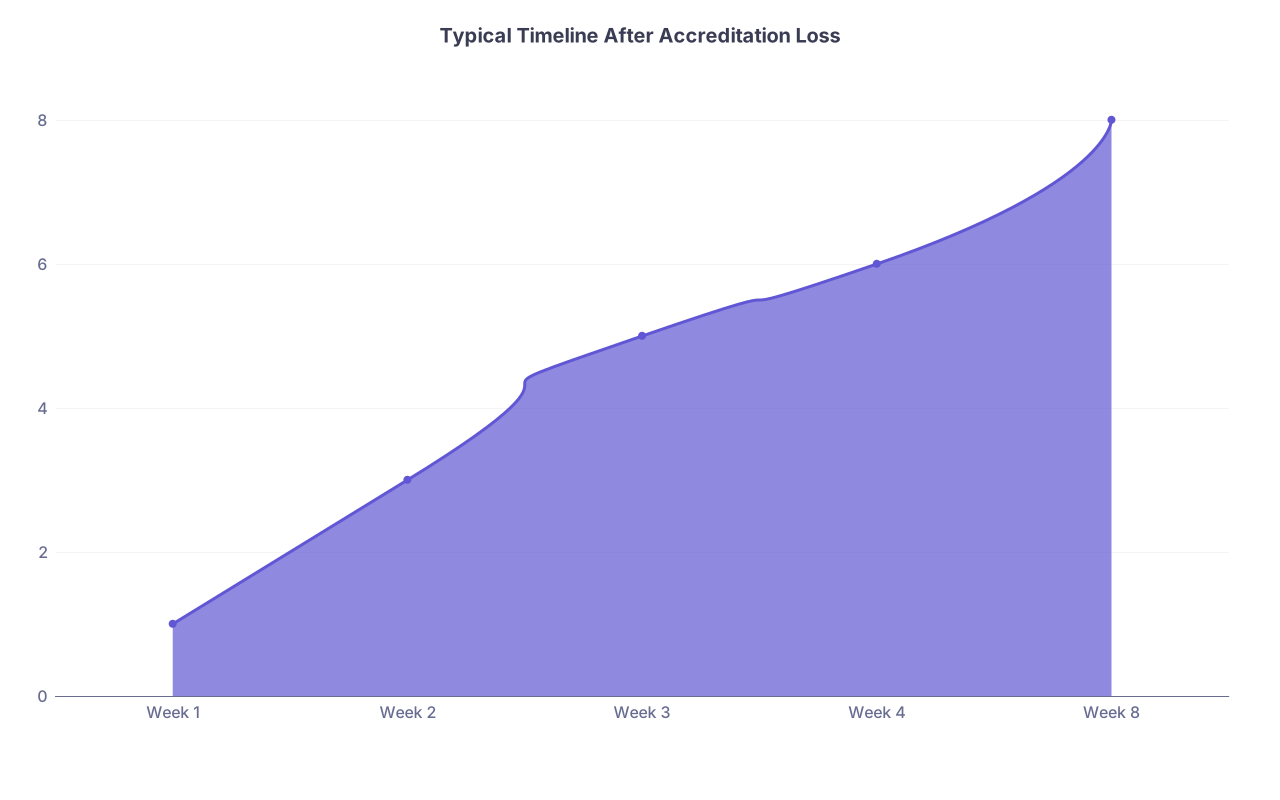
| Category | Value |
|---|---|
| Week 1 | 1 |
| Week 2 | 3 |
| Week 3 | 5 |
| Week 4 | 6 |
| Week 8 | 8 |
(Above: an example “stabilization” curve—by week 4–8 most residents either have a clear teach‑out plan or are actively pursuing transfer spots.)
7. Legal, Financial, and Mental Health Angles You Shouldn’t Ignore
You’re still a human being doing 28‑hour calls while this is happening. Some non‑obvious points:
Employment and contract
- Review your signed contract and GME policies. Look for:
- Early termination clauses
- Institutional obligations under program closure
- Any mention of “placement assistance” or guaranteed duration
- If they try to force you out earlier than contract end, or retaliate because you’re asking questions, talk to:
- Your medical school alumni affairs (they sometimes know who to call)
- State medical society
- Personal attorney if things get truly adversarial
Do not threaten legal action in your first email. Just quietly collect documentation.
Licensure
If you’re in a state requiring a training license or limited license:
- Check whether your license is tied to the institution or program
- If you transfer, confirm with the new hospital that your license can be updated or re‑issued smoothly
Again, this sounds bureaucratic until you’re 48 hours from starting a new program and credentialing says, “We’re still waiting on your license.”
Mental health
This situation is brutal. Residents blame themselves. They shouldn’t.
If you notice:
- You’re constantly doom‑scrolling ACGME gossip
- Your sleep tanks
- You’re snapping at nurses/co‑residents
At least do one of these:
- Use your institution’s EAP (Employee Assistance Program) for a few therapy sessions
- Talk to a therapist outside the hospital
- Confide in one trusted attending who is not in your program’s chain of command
You cannot make good decisions if you’re in full fight‑or‑flight all month.
8. If You Haven’t Matched an Advanced Spot Yet
Different scenario, different priorities.
If you’re a prelim without a secured advanced position, and your program loses accreditation mid‑year, your goals are:
- Protect your ability to apply and be taken seriously for advanced spots later.
- Maximize the amount and quality of accredited training you complete.
- Get strong letters that clearly separate you from the program’s dysfunction.
Steps:
- Double‑down on clinical performance. You need attendings who will say, “Our program had problems; this resident did not.”
- Ask 2–3 strong attendings for letters this year, before they scatter to other jobs.
- When you apply later, your story is:
“My prelim program lost accreditation mid-year for institutional reasons unrelated to my performance. I completed X months of accredited training there and then [transferred/completed remaining time]. Here’s a letter from my PD confirming this.”
Programs see this more than you think. You’re not radioactive if you present it cleanly.
| Contact | Why You Need Them |
|---|---|
| Program Director | Clarify training credit, letters, end date |
| DIO / GME Office | ACGME status, teach-out, institutional plan |
| Advanced PD | Confirm eligibility and needed documentation |
| Specialty Board | Final word on training requirements |
| Trusted Attending | Honest career advice, strong advocacy |
FAQ (Exactly 5 Questions)
1. Will this ruin my chances of getting a fellowship later?
No, not by itself. Fellowship directors care about your performance, letters, board scores, and what you did with bad situations. If you can show you performed well clinically, obtained strong letters, passed boards, and handled the accreditation problem responsibly, this becomes a footnote, not a scarlet letter. The only way it becomes a major problem is if you let it disrupt your training continuity or fail boards because you were never properly supervised.
2. Should I mention the accreditation loss in future personal statements or interviews?
In most cases, keep it short and factual, especially if asked directly. Something like: “My prelim program went through an ACGME withdrawal process during my intern year. I completed X months of accredited training there and then [completed the rest at Y / transferred]. It was a chaotic environment, but I learned how to maintain patient care standards despite instability.” Do not vent, name‑call, or gossip. Neutral, matter‑of‑fact, done.
3. Can my program prevent me from transferring if I find another spot?
They can make it logistically annoying, but outright blocking you is rare and looks terrible for them. They do have to agree to release you in the NRMP/ACGME systems if you’re moving to another accredited program. This is where involving the DIO/GME office helps—no PD wants a reputation for trapping residents in a sinking program. If you get real obstruction, that’s when external help (state medical society, legal advice) may be necessary.
4. Do I still get board-eligible if part of my PGY‑1 was in a now‑unaccredited program?
What matters is the accreditation status during the time you were training. If the program was accredited while you were there, those months usually count. Months after the official withdrawal date may not. That’s why you must confirm: (1) the exact withdrawal date; (2) your total accredited months; and (3) how your specialty board interprets those months. When in doubt, get the board’s answer in writing.
5. Should I try to organize residents to push for better support or legal action?
Maybe—but do that after you’ve secured your own plan. Resident organizing can be powerful, but it’s slow and political. Your licensing and eligibility timelines are not. Prioritize: (1) clarifying your training credit; (2) confirming your advanced program’s requirements; (3) identifying transfer/extension options if needed. Once your path is protected, you can decide how much energy you have to join or lead broader efforts.
Open your email right now and draft three messages: one to your PD, one to your GME office, and one (if applicable) to your future advanced program. Get those conversations started today—before this week’s chaos becomes next month’s crisis.


