
What happens if you’re in a brutal prelim year, exhausted and behind on notes, and you realize you have to reapply… but you can barely find time to eat, let alone rewrite your personal statement?
That’s the nightmare, right? You’re a PGY‑1, technically “in residency,” but actually still on the residency hamster wheel. Everyone around you seems laser‑focused on surviving, and you’re secretly opening ERAS on the workroom computer at 1 a.m., praying no one walks by.
Let’s walk through this mess. Honestly. No sugarcoating.
Quick reality check: what a prelim year actually is (and what it isn’t)
You probably already know this, but anxiety likes to mix facts and horror stories, so let’s separate them.
A preliminary year is basically a one‑year internship. It’s usually:
- Prelim internal medicine
- Prelim surgery
- Transitional year (if you’re lucky)
It’s not meant to be a full residency in that specialty. It’s meant as a required year before you start something else (like neurology, radiology, anesthesia, dermatology, ophthalmology, PM&R, etc.), or as a stopgap if you didn’t match categorical.
| Aspect | Preliminary Year | Categorical Position |
|---|---|---|
| Length | 1 year | Full residency (3–7 years) |
| Goal | Bridge / requirement | Complete training |
| Job security | Ends after PGY-1 | Continues to graduation |
| Reapply needed? | Often yes | Usually no |
| Stress about future | Very high | Variable |
Here’s the part your brain keeps circling:
You’re working as hard as everyone else. You’re carrying the same pagers. You’re getting yelled at by the same attendings. But your future is not guaranteed beyond June 30.
So on top of the intern chaos—cross‑cover, night float, admissions at 3 a.m., constantly feeling behind—you’re supposed to:
- Redo ERAS
- Redo personal statements
- Hunt down updated letters
- Schedule interviews
- Pretend you’re totally fine
You’re not stupid for being scared. This setup is actually brutal.
The big fears nobody says out loud (but you’re absolutely thinking)
Let me just name the monsters under the bed:
- “What if my program finds out I’m reapplying and blacklists me?”
- “What if my performance as a prelim is just… average? Will that tank me?”
- “What if I don’t match again and now I have a prelim year and nowhere to go?”
- “There is literally no time. How am I supposed to do full‑time residency and full‑time applications?”
- “What if my co‑interns find out and I’m the ‘failed match’ person forever?”
None of these are irrational. I’ve watched people sob in on‑call rooms over exactly this.
Let’s go piece by piece.
Can you actually reapply during prelim without imploding?
Yes. People do it every year. Some crash and burn, but a lot don’t. The pattern I’ve seen: the ones who manage it accept early that they’re basically doing two jobs at once for a few months.
Job 1: being a safe, solid intern.
Job 2: being an applicant again.
The mental trap is thinking you can “fit apps in when things calm down.” Things don’t calm down. Not in July. Not in October. Not in January. Something’s always on fire.
You need to treat applications like they’re a scheduled, non‑negotiable part of your workload, not an optional side quest if you magically have free time.
This will feel unfair. Because it is.
Timeline: what you’re up against
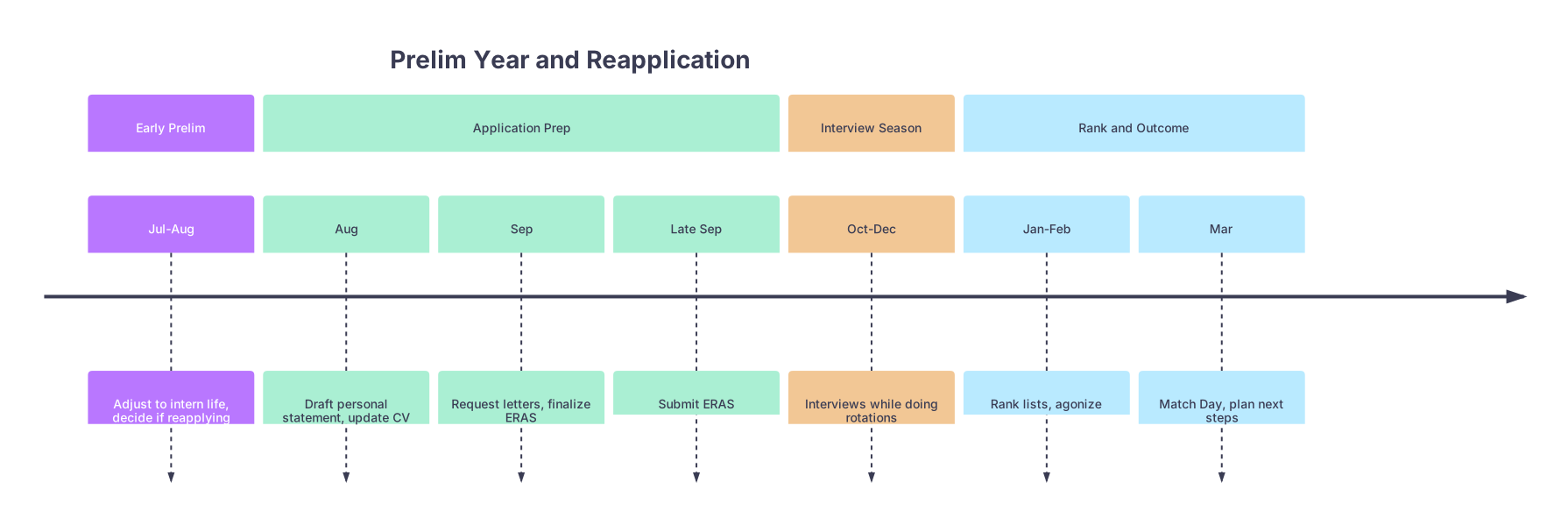
Here’s the rough reality of the reapplication timeline while you’re a prelim:
| Period | Event |
|---|---|
| Early Prelim - Jul-Aug | Adjust to intern life, decide if reapplying |
| Application Prep - Aug | Draft personal statement, update CV |
| Application Prep - Sep | Request letters, finalize ERAS |
| Application Prep - Late Sep | Submit ERAS |
| Interview Season - Oct-Dec | Interviews while doing rotations |
| Rank and Outcome - Jan-Feb | Rank lists, agonize |
| Rank and Outcome - Mar | Match Day, plan next steps |
The sick joke is that you’re supposed to do your heaviest application prep exactly when you’re still figuring out how to put in orders correctly and not miss critical labs.
So the question becomes: how do you do just enough to not blow either side up?
Balancing work vs applications: what actually works (and what doesn’t)
You already know the fake advice: “Use your free time wisely.” Cool, thanks.
Here’s what I’ve actually seen work for prelims who successfully reapply.
1. Decide your target early, even if it’s scary
The people who suffer the most are the ones who say, “I’ll see how the prelim year goes, and maybe I won’t reapply.” By the time they admit they do want to reapply, it’s late September, their ERAS is half‑done, and they’re exhausted.
You don’t need everything figured out. But you do need a working plan by August:
- Am I reapplying to the same specialty?
- Am I pivoting to something slightly less competitive?
- Am I opening a back‑up field (like IM, FM, psych) even if it hurts my ego?
Your brain will say: “But what if I change my mind?” You can tweak later. But applications don’t get built in a weekend, especially when you’re on wards.
2. Protect small, ugly chunks of time
Your schedule won’t magically open up. You need to pre‑steal time from your future exhausted self.
Think in terms of tiny, non‑negotiable blocks:
- 25–30 minutes early morning before shift
- 30–45 minutes after work on one or two specific nights a week
- 1–2 hours on one day off
That’s it. You won’t be writing novels. The goal isn’t perfection. The goal is “I opened ERAS and did something 4–5 times a week.”
Most prelims who fail at balancing this wait for a full free day to “do apps.” That day never fully arrives, and then they’re behind and panicking.
3. Fix your “I have no time” problem by being realistic, not heroic
You cannot:
- Be the superstar intern
- Read 2 hours of UpToDate every day
- Rebuild ERAS from scratch
- Exercise daily
- Sleep 8 hours
- Be emotionally stable
All in the same month. Pick what you’re going to be average at for this season.
The non‑negotiables are:
- Patient safety and being a reliable intern
- Key application pieces done by deadlines
Your notes might be shorter. Your pre‑rounding might be more focused. Your reading may shrink to “what can kill my patient today.” That’s fine. You’re not auditioning for a national award. You’re trying to not derail your future.
4. Use your prelim year strategically in your application
Your anxiety is telling you: “I’m just the person who didn’t match, now with more baggage.” That’s not the full story.
Done right, prelim year is ammo, not a stain.
You can show:
- You’ve functioned safely as a resident
- You’ve handled nights, cross‑cover, floor work
- You understand what residency actually feels like
- Attendings trust you with real responsibility
Your personal statement and letters should scream: “This person already works at the intern level and is ready to plug in.”
You are not a theoretical. You’re a known quantity.

Who do you tell? And what if they sabotage you?
This part is always the psychological horror movie.
You’re terrified your program:
- Finds out you’re leaving
- Dumps you from good rotations
- Refuses to write letters
- Labels you as “not a team player”
Here’s the pattern I’ve actually seen.
Programs usually fall into 3 buckets:
| Program Type | Attitude Toward Reapplicants | What It Feels Like |
|---|---|---|
| Supportive | Helpful, writes strong LORs | Rare but amazing |
| Neutral/Transactional | Fine as long as work done | Most programs |
| Defensive/Toxic | Guilt trips, obstructive | Unfortunately, some |
Most are in the middle. They don’t love losing bodies, but they understand prelims reapply. You’re not the first.
The key is who you tell and when.
- You almost always need at least one letter from a faculty member in your prelim year, ideally from the specialty you’re applying to (or IM if you’re pivoting there).
- Sometimes you’ll need your PD’s letter or at least their form completed.
If your PD seems reasonable:
Bring it up after you’ve shown you’re competent. Usually September-ish. Be straightforward: you’re grateful to be there, you’re working hard, but your long‑term goal is X, and you’d like their support in reapplying.
If your PD is volatile or clearly unsupportive:
You tread softer. You lean more on individual attendings. You may still need PD forms but you keep the conversation bland and professional.
No, this isn’t “ideal.” Yes, it’s political. Welcome to medicine.
The application pieces that matter most during prelim
You don’t have time to over‑optimize every tiny thing. Focus on:
Personal statement
It needs to answer:- Why this specialty now, given your path
- What you learned from the initial match outcome / prelim year
- Why you’re ready to plug in and not flake
You’re not writing a confession. No long self‑flagellation about not matching. One or two tight sentences acknowledging the path is enough.
Letters of recommendation
These matter more now than your med school dean’s letter. A strong, concrete letter saying “This person functions like our best interns” is gold.Push (politely) for specifics: “Could you speak to my reliability on nights / handling cross‑cover / communication with nurses?” Concrete beats vague praise.
Program list strategy
You cannot bank on “dream specialty at dream program.” You need a realistic spread. Especially if you’re coming off an unsuccessful match.That might mean:
- Including community programs
- Being flexible on geography
- Considering a parallel plan (e.g., applying to both neuro and IM)
Your ego will scream. Your future self will be grateful you were pragmatic.
Actually going to interviews while on service
Here’s the logistical hell part people underestimate.
During interview season, you will:
- Be on wards or nights
- Need random weekdays off
- Have to swap calls and jeopardy days
- Juggle flight times or long drives on minimal sleep
Programs know this is messy, but your prelim program isn’t built for you to miss 10 days in October.
What I’ve seen work:
- Start the conversation early with your chiefs or scheduling person. “I’m reapplying; can we cluster my easier rotations in the fall if possible?” You might not get everything, but sometimes you can avoid ICU + heavy interview month overlap.
- Use vacation strategically if allowed for interviews. Don’t burn all your days in July.
- Be honest but concise when asking for specific days: “I have a professional interview that day; is there any way to switch with someone on call / clinic?”
You will feel guilty. There will be grumbling. Your job is to be professional, not a martyr. Show up fully for the days you’re there, and don’t apologize for trying to secure your career.
| Category | Value |
|---|---|
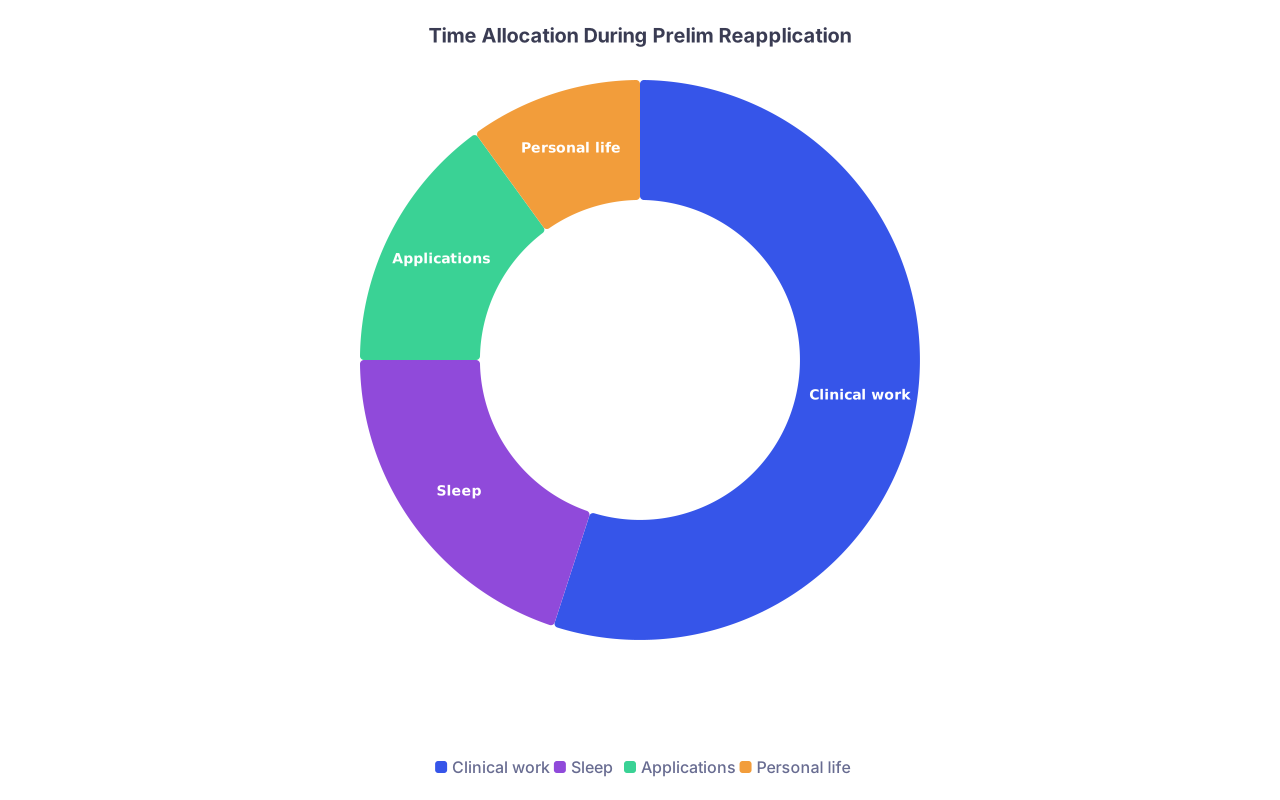
| Clinical work | 55 |
| Sleep | 20 |
| Applications | 15 |
| Personal life | 10 |
The worst-case scenario your brain keeps replaying
“I reapply. I work myself into the ground. I still don’t match. Then what?”
I won’t lie: this can happen. It’s rare if you’re thoughtful with your list and open to a range of programs/specialties, but it happens.
If it does, you’re not wiped off the map.
Common paths I’ve seen:
- Extending in the same department if they have open categorical spots
- Switching into a different specialty at the same hospital that has an unfilled PGY‑2 or extra position
- Taking a research year with strong mentorship and reapplying again
- Moving into a non‑residency clinical role temporarily (hospitalist extender, clinical instructor, etc.) while you regroup
Is any of that what you want? No. But the point is: even if you hit that ugly scenario, it’s not “career instantly over.” Your anxiety loves absolutes. Reality is messier and more flexible.
Your main job right now is to not let fear paralyze you into doing nothing.
How to stay mentally intact (or at least not completely shattered)
I won’t give you a wellness poster. Let’s talk about survival‑level stuff.
- Pick one person who actually gets it. Another prelim, a friend from med school, a partner. Someone you can text “I hate everything” after a brutal call and not edit yourself.
- Decide what you’re allowed to drop guilt‑free. Maybe your apartment’s a mess. Maybe you eat microwave dinners for 3 months. Maybe you stop pretending you’ll read full NEJM articles. Fine.
- Remind yourself: this is a season, not a permanent state. Prelim year plus reapplication is one of the densest stress periods in the whole training pipeline. It’s not supposed to feel easy.
And if you’re crying in your car in the parking garage at 6 a.m. because you finished night float and still need to work on ERAS later? That doesn’t mean you’re weak. It means this is actually hard.
FAQs (the stuff you’re probably still spiraling about)
1. Will programs judge me for not matching the first time?
Some will raise an eyebrow. But the ones you actually want to train in will care more about what you did with that setback. If your application now shows:
- Strong intern performance
- Good, specific letters
- A clearer story for why their specialty
you’re not automatically doomed. Many residents at solid programs re‑matched after a prelim. You probably just don’t hear their whole story.
2. Should I tell my prelim co-interns and residents I’m reapplying?
You don’t owe your entire story to everyone. I’d tell a small circle you trust, especially people who might help with schedule swaps. But you don’t need your whole residency class dissecting your rank list. Protect your peace. Once you match somewhere, people mysteriously become very supportive and “knew you’d do it all along.”
3. Is it a red flag if I apply to both my dream specialty and a backup?
Program directors know the game. Tons of people dual‑apply. What is a red flag is a sloppily tailored application where your “dream specialty” personal statement clearly looks generic and your backup specialty statement sounds like a last‑minute afterthought. If you dual‑apply, commit to making each side coherent and honest.
4. Do I need a letter from my prelim program director?
Often yes, especially for formal paperwork and verification of your year. But the “person who really knows you clinically” letter can come from a core attending who’s seen you on the wards or in clinic. If your PD is lukewarm but not hostile, you can still get an adequate PD letter and supplement with strong faculty letters.
5. How do I explain being a prelim in my personal statement without sounding like a failure?
One or two clean sentences. Something like: “After an initial match outcome that placed me in a preliminary internal medicine year, I’ve used this time to strengthen my clinical skills and confirm my commitment to [specialty]. Managing complex inpatients as a PGY‑1 has reinforced my desire to care for [population/conditions] in a focused way.” That’s it. No self‑dragging, no three‑paragraph apology tour.
6. What if my prelim performance isn’t amazing? Am I just done?
If you’re unsafe, chronically late, or blatantly unprofessional, yes, that will follow you. But most people who say “I’m not amazing” mean “I’m not top 5% superstar.” Residency is set up so everyone feels average. If you’re reliable, you own your mistakes, and your attendings generally trust you, that’s usually good enough to build on. Ask one attending you trust for honest feedback before you panic‑spiral about being “mediocre.”
Key things to hold onto
- Reapplying during a prelim year is brutally hard, but people do pull it off every year. You’re not uniquely doomed.
- You don’t need perfection; you need steady, small, consistent progress on applications while staying a safe, dependable intern.
- Your prelim year isn’t just a scar—if you frame it right, it’s proof you can actually function as a resident and are ready for the spot you’re chasing.
You’re tired, scared, and overloaded. None of that means you won’t make it through this.