
The biggest lie people tell prelim interns is: “Don’t worry, it always works out.”
Sometimes it doesn’t. And that’s exactly why you’re scared.
You’re worried you’ll finish this brutal preliminary year and then… nothing. No categorical spot. No clear path. Just an awkward gap on your CV, loans accruing interest, and you stuck explaining “what happened” at every interview for the rest of your life.
Let’s talk about that fear honestly—and then get very, very concrete about what your real options actually are.
What “Being Stuck After a Prelim Year” Really Looks Like
First, the nightmare in your head probably looks something like this:
You do a medicine prelim year at a big academic place. You reapply for categorical IM and maybe a couple of other specialties. The Match email comes. “We are sorry to inform you…” You go to SOAP. Nothing. By July, your co-interns are PGY‑2s, and you’re at home refreshing Gmail and Indeed, trying not to have a panic attack while your parents ask, “So what’s the plan now?”
Or you’re in a surgery prelim. You survived the 100‑hour weeks and the attendings telling you, “You’ll be a great surgeon someday.” Except the “someday” never arrives because you don’t match categorical. Again. No one really explained what a non-designated prelim meant. Now you’re terrified you’ve just burned a year and ruined your shot at anything competitive.
Here’s the part people don’t say out loud:
You can absolutely finish a prelim year and not have a categorical spot lined up.
That is real. I’ve watched it happen.
But here’s the other part:
You are not actually out of options unless you decide to be.
The options may not be glamorous. They may force you to pivot. They may be slower or more indirect than you wanted. But you are almost never truly “stuck in a void.”
What a Prelim Year Really Buys You (Even If You Don’t Match Next)
Let me strip away the motivational-poster nonsense and stay practical.
A completed prelim year gives you:
- A full, ACGME‑accredited PGY‑1 you can plug into other specialties that accept prior training (internal medicine, radiology, neurology, anesthesiology, PM&R, psych in some cases).
- A US-based clinical track record with actual attendings who can write, “This resident functioned at or above the level of our categorical interns.”
- Evidence you can handle residency: nights, cross-cover, pages, critical decisions at 2 a.m.
- Enough experience that program directors can imagine you as a PGY‑2, not just “a med student with a Step score.”
Is it a magic key to any specialty? No. You’re not doing a prelim surgery year and sliding into dermatology because you “worked so hard.” That’s not how this game works.
But compared to going straight from med school to reapplying, you’re not weaker. You’re usually stronger—if you don’t disappear and if you know how to leverage it.
Realistic Paths After a Prelim Year (Even If You Don’t Match Right Away)
Let’s go through the routes that actually happen—not the fantasy, not the horror story—the ugly, realistic middle.
1. The Internal Transfer / In‑House Categorical Spot
This is the one everyone whispers about:
“I heard at ___ they turn some prelims into categoricals.”
“I heard if you’re a top prelim they’ll find a spot for you.”
Sometimes that’s true. Sometimes it’s pure residency folklore.
Here’s how it actually works when it works:
- A categorical resident leaves, transfers, or fails out.
- The program suddenly has an open PGY‑2 spot (or even a late PGY‑1).
- They look first at people they already know: prelim interns who haven’t burned bridges.
This is very program‑specific. Some places never convert prelims. Others do it almost every year.
Your move:
During the year, you quietly make it clear to leadership that you’d love to stay if anything opens. That means the PD, APDs, chief residents, maybe a couple of key attendings. Not daily begging. Just clear, professional communication and then backing it up with good work.
Is it guaranteed? Absolutely not. You can be a star and still have zero attrition in the categorical class. You can’t control that part. But this is one of the realistic best‑case outcomes, and it does happen every single year.
2. Reapplying to the Same or Related Specialty (Now with PGY‑1 under your belt)
Let’s say you did a medicine prelim because you wanted IM, neuro, rads, gas, or cards eventually.
You finish the year. No categorical yet. You’re exhausted and humiliated and wondering if reapplying just makes you look desperate.
Here’s the truth: A prelim year can rescue an iffy application—if you present it right.
You go from:
“Graduated 2023, average Step, no recent clinical work”
to
“Completed ACGME‑accredited IM preliminary year at ___; strong evaluations; functioning at PGY‑2 level; now seeking categorical position.”
That changes how PDs view you. They’re less worried you’ll melt down the first time you’re cross‑covering 30 patients.
Common realistic flows I’ve seen:
| Prelim Year Type | Common Next-Step Targets |
|---|---|
| Prelim IM | Categorical IM, Neuro |
| Prelim Surgery | Categorical Surgery, IM |
| Transitional Year | IM, Neuro, Rads, Anes |
| Prelim IM/Surg | Anesthesiology (some) |
| TY + strong scores | Rads, Anes, PM&R |
Is it easier to match derm, plastics, ENT after a prelim? No. Those are still brutal. But IM, neuro, FM, psych, anesthesia, rads, PM&R—these are realistic.
The catch: timing. You may have to:
- Finish prelim year in June.
- Spend a year as a research fellow, hospitalist extender, chief prelim, or doing locums/clinical work.
- Reapply that fall with fresh letters and your full PGY‑1 in hand.
That’s where people spiral: “If I take a year, no one will ever take me.” Nope. Gaps with a story and clinical/research work are explainable. What kills apps is disappearing.
3. Finding Off‑Cycle / Unmatched Categorical Positions
This is the unglamorous, grindy option that a lot of people never hear about until they’re desperate.
There are always some programs that, for one reason or another, have unfilled PGY‑2 spots or lose residents mid‑year. They don’t go through the Match for these. They email listservs, post on the ACGME or specialty society websites, or quietly ask around.
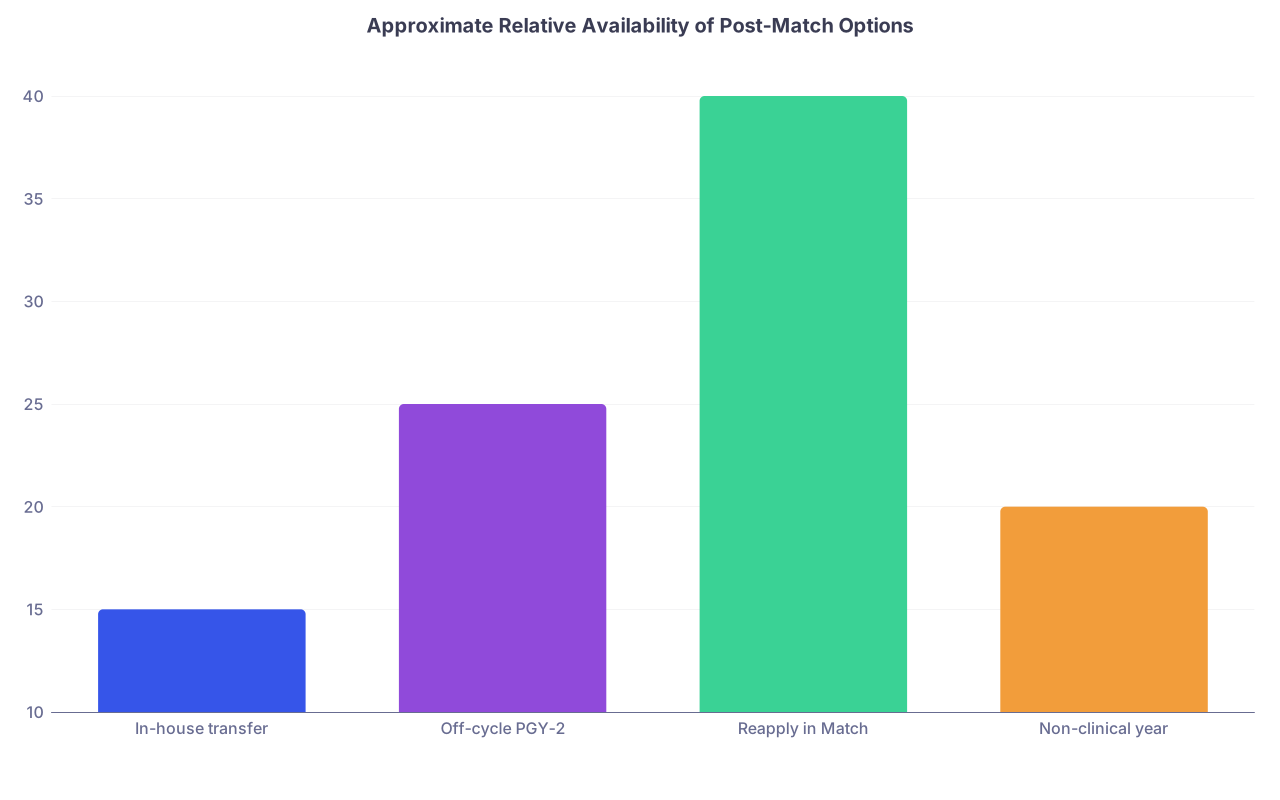
| Category | Value |
|---|---|
| In-house transfer | 15 |
| Off-cycle PGY-2 | 25 |
| Reapply in Match | 40 |
| Non-clinical year | 20 |
Rough reality:
- The positions are often at smaller, less famous programs. Community hospitals. Places you didn’t dream about in M2.
- The timeline is chaotic: “We need someone to start in 4–8 weeks.”
- You have to be watching constantly: specialty Facebook groups, program coordinator listservs, FREIDA updates, sometimes just mass‑emailing programs asking if they ever take PGY‑2 transfers.
It’s stressful and random. But I’ve watched multiple prelims land solid categorical PGY‑2 IM, neuro, and anesthesia spots this way.
Is it stable? Often, yes. Once you’re in and doing the work, you’re just another resident. The path there just looks messier from the outside.
4. Pivoting Specialties (The Move Everyone Secretly Dreads)
Here’s the scenario you’re probably afraid to say out loud:
You did a prelim surgery year because you wanted ortho or neurosurg or ENT. You didn’t match categorical. Twice. Your file is solid but not “top 5% of the country” solid. You are staring down the possibility that if you keep applying surgery only, you might never match.
So now the word “pivot” is starting to haunt you.
People actually do this. Surgery prelim to IM. IM prelim to neuro or psych. Transitional year to PM&R. Surgery prelim to anesthesia. Or even, yes, surgery prelim to FM.
Is it heartbreaking? Sometimes. Losing the identity you thought you’d have—“I’m going to be a surgeon”—can feel like a death. That grief is real.
But there’s a brutal reality: medical training doesn’t care about your identity crisis. It cares about numbers, positions, service needs.
A prelim year still helps you pivot, because you’re not coming in as a fresh grad. Programs like knowing you’ve already proven you can survive call, documentation, multidisciplinary teams. A “failed ortho applicant with a prelim year” is still often more attractive to IM than a totally untested grad who hasn’t seen a patient in 2 years.
I’ve seen some of these pivots turn out unbelievably well. People discover they actually like medicine, or anesthesia, or PM&R better than they liked holding retractors at 2 a.m.
Is it what they dreamed of at 21? No. But they’re not stuck in endless limbo. They’re attendings with lives.
5. Taking a Non‑Clinical or “Bridge” Year Without Disappearing
Worst‑case in your mind: you don’t get a spot. You’re out of training. You’re terrified that a year off is a death sentence.
It’s not—if you handle that year right.
Here’s what actually helps:
- A research fellowship in your target or adjacent specialty, ideally with clinical exposure and letters.
- A hospital job using your MD (clinical research coordinator with MD oversight, quality improvement, informatics, utilization review, etc.).
- Teaching roles: anatomy TA, med school instructor, OSCE preceptor—something that says, “I stayed in the game.”
What doesn’t help: moving home and doing nothing except “studying for Step 3” and doom‑scrolling SDN. That looks like you quit.
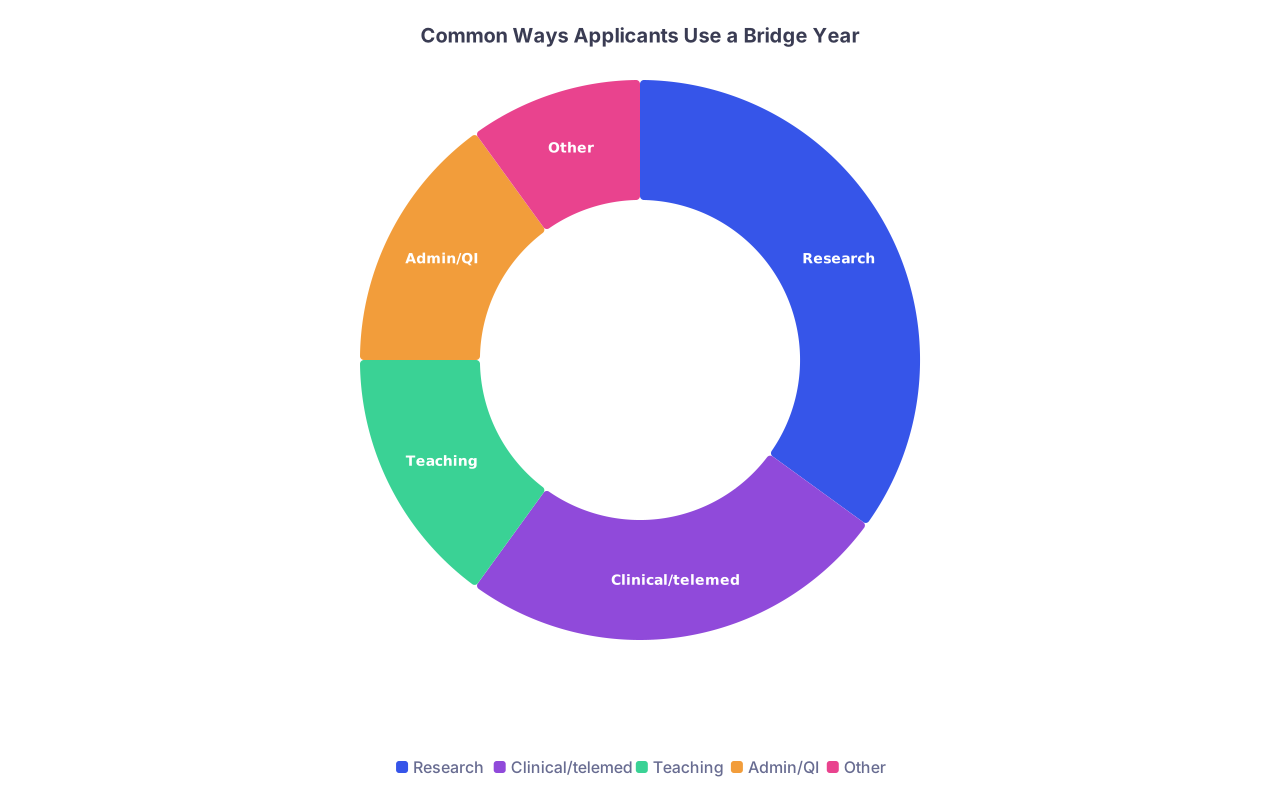
| Category | Value |
|---|---|
| Research | 35 |
| Clinical/telemed | 25 |
| Teaching | 15 |
| Admin/QI | 15 |
| Other | 10 |
Programs will ask: “What did you do between your prelim year and now?” If you can answer with something that sounds even vaguely like “I stayed in medicine and grew,” you’re fine.
How to Make Sure Your Prelim Year Doesn’t Quietly Sink You
Here’s the part that keeps me up when I think about anxious prelims: it’s very possible to work insanely hard and still sabotage your future without realizing it.
The people who get out of the “prelim purgatory” trap usually do a few specific things:
They tell the right people early what they want. PD, APDs, a few attendings. “I’m applying to categorical IM / anesthesia / rads next cycle and would be grateful for your support and feedback.” Not in a needy way. In a grown‑up way.
They collect strong, specific letters by late fall. Not, “X is a nice intern who works hard.” You want, “X is functioning like one of our strongest categorical interns; we would have been happy to retain them if we had space.”
They keep their record clean. This sounds obvious until you realize how easy it is to get a rep as the intern who can’t close loops, who irritates nurses, who vanishes post‑call. Remember: programs talk. Your prelim PD might be your biggest ally or your biggest obstacle.
They have a Plan B they’re actually willing to use.
Not just “I’ll consider IM if I don’t match plastics,” but “If plastics fails twice, I’m pivoting to X and here’s how.” That sounds harsh. But having no Plan B is exactly how people end up doing 3 prelim years and still nowhere closer to an attending job.
The Harshest Truth and the Biggest Reassurance
Harsh truth first:
Yes, it is possible to do a prelim year, fail to land a categorical spot, and need to fundamentally rethink your path. People do get stuck looping through applications or accepting options they didn’t want.
Reassurance that’s actually grounded in reality:
If you finish a prelim year, stay clinically active, and remain flexible about specialty and location, it’s extremely hard to be truly “done” in medicine.
You might not end up with the specialty or city you fantasized about in M1. You might have to carry the “I did a prelim year first” story your whole career. But you will, in all probability, have a career.
You are not the one doomed applicant the universe has singled out for total failure. You are one of many nervous doctors in a messy, numbers‑driven system.
And messy systems have back doors. Side doors. Weird stairwells that still get you where you’re going.

| Step | Description |
|---|---|
| Step 1 | Finish Prelim Year |
| Step 2 | Start Categorical PGY2 or PGY1 |
| Step 3 | Convert to Categorical |
| Step 4 | Find PGY2 Transfer |
| Step 5 | Bridge Year + New Application |
| Step 6 | Match in New Cycle |
| Step 7 | Progress to Attending |
| Step 8 | Categorical Match? |
| Step 9 | In-house Spot? |
| Step 10 | Off-cycle or Reapply? |
Tiny, Uncomfortable Homework That Actually Helps
If you’re in or heading into a prelim year and terrified of being stuck, here’s what I’d tell you to do this week, not “sometime later”:
Write down your realist Plan A and Plan B. By name. Example: Plan A – Categorical IM. Plan B – Neuro or Psych at any geographic location. If your Plan B is “or something,” it’s not a plan.
Identify 3 people at your program you want in your corner: PD or APD, chief, one attending who seems to like teaching. Figure out how you’ll show them your best work in the next 3 months.
Decide how you’d use a bridge year if it comes to that: research, teaching, hospital job. Not aspirational. Actual postings you could apply to.
Promise yourself you will not disappear from clinical medicine, even if things go sideways. Keep seeing patients in some capacity. That’s what makes you re-marketable.

FAQ: Being “Stuck” After a Prelim Year
1. If I don’t match a categorical spot right after my prelim year, does that permanently damage my chances?
It doesn’t permanently wreck you, but it does raise questions you’ll have to answer. Programs will want to know: why didn’t you match, and what did you do afterward? If you use that time well—strong letters from your prelim, continued clinical or research work, a coherent narrative—you can absolutely recover. Applicants who look “damaged” are usually the ones who vanish for a year or two with no clear explanation.
2. Is doing a second prelim year ever a good idea?
Occasionally, but much less often than people think. A second prelim year without a clear, realistic pathway to categorical starts to look like you’re just treading water. If a PD is explicitly telling you, “Do a second prelim with us and there is a high chance we’ll have an in‑house categorical spot,” that’s one thing. Doing random prelim after random prelim hoping for a miracle? That’s how people burn out and still don’t end up with a stable position.
3. Will programs in another specialty judge me for “failing” to match my original choice?
Some will, many won’t. What matters is how you frame it. “I realized over the course of my prelim year that what I loved was longitudinal patient care / critical care / neuro, and I’m intentionally pivoting” plays very differently than “I couldn’t match, so now I just want anything.” If your evaluations are strong and your story is honest and forward‑looking, plenty of programs will see you as more mature, not broken.
4. Should I apply super broadly, even to places I really don’t want to live, just to avoid being stuck?
If your top fear is being stuck outside of residency completely, then yes, geographic snobbery is a luxury you probably can’t afford. Tons of residents end up training in cities or states they never would have chosen and still build good careers and lives. You can always move later as an attending. Being overly picky about location is a common way people unintentionally box themselves into a corner.
5. Does a prelim year help if I’m trying for something competitive like derm, ENT, or ortho?
Not in the way people hope. For hyper‑competitive fields, a prelim year alone doesn’t suddenly make you a strong applicant. Those specialties live and die by research, connections, and truly top‑tier stats. A prelim can show you’re clinically solid, but if your core application isn’t at that level, the prelim won’t magically fix it. That’s where a serious reality check about pivots and alternative specialties becomes crucial.
Key points:
You’re not wrong to be scared of being “stuck” after a prelim year—but that fear is usually louder than the actual reality. If you finish your year, stay clinically active, collect strong support, and stay flexible about path and location, you almost always have real next steps. The outcome may not match your original fantasy, but it can absolutely still be a real medical career, not a dead end.