
What if March rolls around, you open your results… and you only matched a preliminary spot, with no advanced position? Did you just blow your career before it even started?
Let’s walk through that actual nightmare together, because honestly, a lot of people are quietly terrified of this exact scenario and no one really explains it without sugarcoating.
First: What a Preliminary Year Actually Is (And What It Is Not)
A prelim year isn’t a punishment. It’s a one‑year residency position, usually in:
- Internal medicine (prelim medicine)
- Surgery (prelim surgery)
- Occasionally transitional year (though those are usually categorical-style, but let’s park that)
You’re a real resident. On payroll, in the system, writing notes, admitting patients, getting yelled at by nurses, the whole thing.
But here’s the catch: a preliminary position is one-year only and doesn’t guarantee:
- A PGY‑2 spot at that same program
- A spot in the advanced specialty you want
- Any automatic path to a full residency
That’s the part that keeps you up at 3 a.m.: “So after this year… what if I have nowhere to go?”
Here’s the blunt version: matching only a prelim and no advanced spot is not the end of your career, but it does mean you’re signing up for an extra, high‑stress chapter you didn’t plan on.
How Bad Is It Really If I Only Match a Prelim?
Let me be honest: it’s not ideal. But it’s also not the catastrophe your brain is spinning it into.
To put things in perspective:
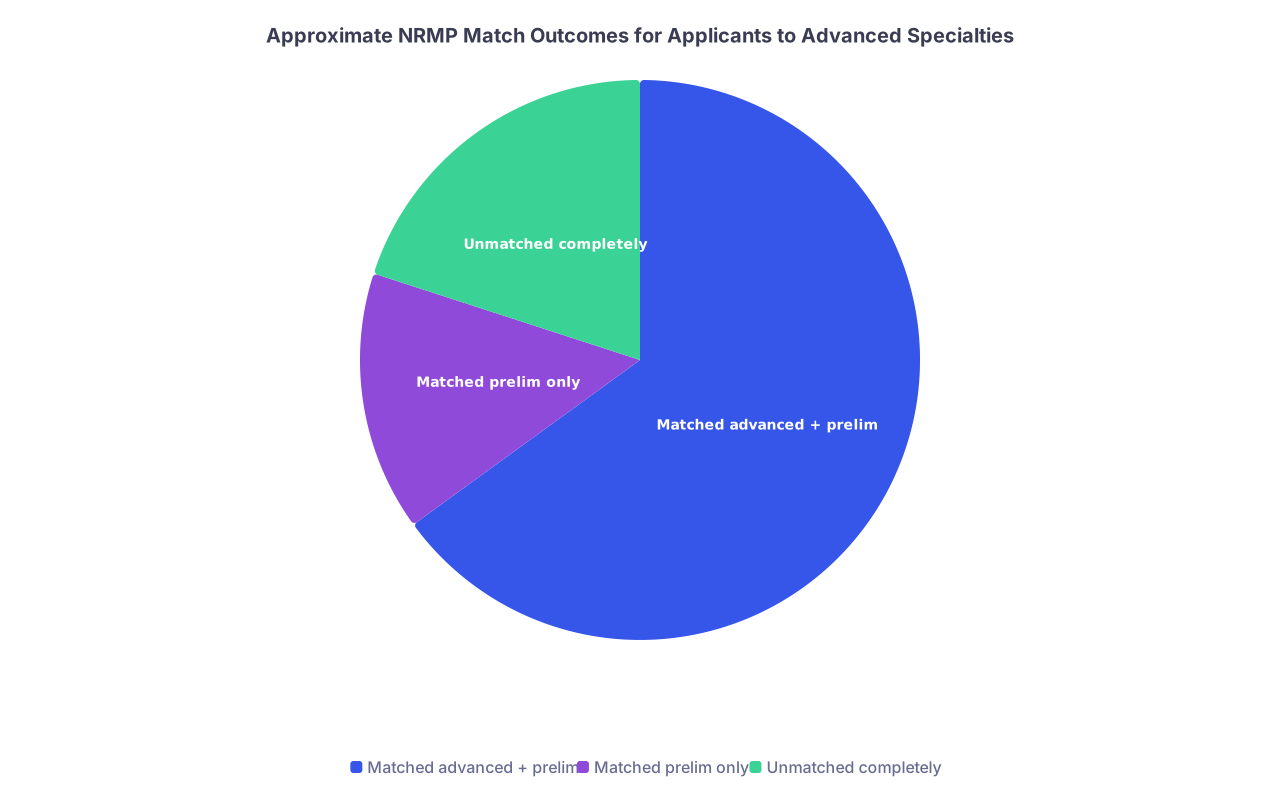
| Category | Value |
|---|---|
| Matched advanced + prelim | 65 |
| Matched prelim only | 15 |
| Unmatched completely | 20 |
Those numbers aren’t exact NRMP stats; they’re ballpark to show you something important:
“Prelim-only” people exist every year, across the country, and a good chunk of them do end up in full residency positions later.
Here’s what “prelim-only” means in practical terms:
Bad parts:
- You’ll have to apply again (and maybe again) for a categorical or advanced PGY‑2 position.
- You’ll be doing this while working 60–80 hour weeks.
- You’ll watch co-residents move on to stable multi‑year spots while you’re still in limbo.
Good parts:
- You’re not “unmatched.” You have a job. You’re training. You’re building real evaluations.
- You’ll have fresh clinical experience, US-based, with attendings who can advocate for you.
- Some programs will respect that you survived a hard prelim year. It shows grit.
So no, your career isn’t over. But yes, the path just got more complicated and emotionally brutal.
The Worst-Case Scenarios (Because That’s Where Your Brain Is Going Anyway)
Let’s actually say the quiet fears out loud.
Fear #1: “What if I finish my prelim year and still don’t get any PGY‑2 spot?”
This one hurts, but it’s a real possibility.
Possible outcomes if that happens:
- You spend a year (or more) in a research position while you reapply.
- You look for open PGY‑1 or PGY‑2 spots off-cycle (they do exist).
- You consider switching specialties to something less competitive.
- In the extreme, you rerun the Match as a reapplicant from scratch.
Does anyone love doing this? No.
Have I seen people do it and eventually land in a training program? Yes.
You’re not “blacklisted” from medicine after a prelim year. You may just need a longer route.
Fear #2: “What if programs see ‘prelim only’ and decide I’m damaged goods?”
Programs 100% will ask: “Why only prelim?”
But that doesn’t mean they’re out.
Your narrative matters:
- If you aimed super high (e.g., derm, rad onc, neurosurg), they’ll understand.
- If you had red flags (low Step, gap, leave), they’ll want to see growth and stability.
- Your prelim evaluations can either hurt you or rescue your application.
I’ve seen people with mediocre scores but killer prelim evaluations and strong PD letters get taken over higher-score applicants who have never stepped into a residency.
Fear #3: “What if my prelim is malignant and I burn out and bomb my evaluations?”
This is the scenario nobody wants to talk about, but you’re thinking it.
If your prelim is toxic:
- You’re more likely to make mistakes from exhaustion.
- You may clash with seniors/attendings.
- Your letters might be lukewarm or even bad.
This is why choosing your prelim (if you still can) matters. Some are brutal but fair; some are just brutal.
But even in a tough place:
- You can identify at least 1–2 attendings to “adopt” you and advocate for you.
- You can protect your evaluations by being proactive about feedback and documenting your work.
- You can get out with at least a few solid letters, even if the culture is awful.
What Your Life Actually Looks Like If You Only Match a Prelim
Think of your year in two overlapping tracks:
- Survive and perform as a resident.
- Quietly build your next application.

| Step | Description |
|---|---|
| Step 1 | Start Prelim Year |
| Step 2 | Clinical Work |
| Step 3 | Future Applications |
| Step 4 | Strong Evaluations |
| Step 5 | Letters of Rec |
| Step 6 | Update CV and Personal Statement |
| Step 7 | Apply for PGY 2 or Categorical |
Day-to-day, it looks like:
- Working wards, nights, ICU, ED depending on your program.
- Sneaking in ERAS edits, emails to program coordinators, and PD meetings during “free” moments.
- Asking your attendings for letters earlier than feels comfortable.
- Watching your co-interns who are categorical relax a bit because they have a guaranteed future, and you don’t.
It’s emotionally rough. You’ll feel “behind” even though you’re technically right on track in actual training time.
But the upside: you’ll be way more impressive on paper at the end of the year than you were as an M4.
Concrete Ways a Prelim-Only Match Can Help You Long-Term
Let’s be annoyingly rational for a second. There are real advantages buried in this mess.
You can use a prelim year to:
Fix your narrative.
“I had a rough step score, but my prelim evaluations show I perform at or above level. I’ve grown.”
That’s powerful, especially in IM, anesthesia, rads, PM&R, etc.Get US clinical experience (for IMGs).
Program directors love actual US residency experience more than some random observership.Prove professionalism and work ethic.
Showing up, owning your mistakes, handling cross-cover, managing pages calmly at 3 a.m.—those things matter.Network into spots you never would’ve seen.
Attendings know other programs. People leave. Spots open. You’d be shocked how many PGY‑2 positions are filled because “Hey, we have this really solid prelim who wants to switch over.”
Here’s what can happen after a prelim-only match:
| Path After Prelim Year | How Often I See It | Long-Term Outcome |
|---|---|---|
| Secures PGY-2 or categorical in desired specialty | Moderate | Ends up where they originally wanted, just 1 year later |
| Switches to a less competitive specialty | Fairly common | Happier, more realistic fit, still fully trained physician |
| Does research or gap year then reapplies | Occasional | Eventually matches, but with more delay and stress |
| Leaves clinical medicine entirely | Rare | Moves into non-clinical health/industry roles |
The “I did a prelim and then disappeared into the void” story is not the norm. It happens, yes. Usually when people disengage, get bitter, or let evaluations tank.
If You Already Matched Prelim-Only: What You Do Next
Let’s assume the worst has already happened: you opened your email, and it’s prelim only.
Here’s what you do this month, before July even starts:
Decide your actual priority specialty.
No more “I’m applying to derm, anesthesia, and maybe IM as backup.” That confusion kills your narrative.Reach out to programs now
Especially if you’re still interested in advanced positions that start a year later. Some programs track prelims specifically.Plan your prelim year strategically:
- Which rotations will give you exposure to attendings in your target field?
- When will you be able to work on ERAS? (Probably not on nights.)
- Who might be a PD-level ally at your prelim program?
Get your application documents updated before July:
- Draft a new personal statement reflecting your match outcome honestly but maturely.
- Update your CV with whatever you’ve done since MS4.
- Identify the 2–3 letters you need and when you’ll ask for them.
During the year, your priorities:
- Do not flame out. Don’t get labeled “difficult,” “lazy,” or “unreliable.” Those reputations spread.
- Ask for feedback early and actually use it.
- Get at least one glowing letter from someone who can credibly say, “I’d take this person in my program.”
If You Haven’t Matched Yet and You’re Afraid This Will Happen
You’re pre-Match and spiraling: “What if I end up prelim-only?” Fine. Treat that fear like data.
Here’s what you do now:
Apply realistically to both:
- Categorical positions in a broader range of specialties / locations.
- Preliminary positions if your specialty needs them (neuro, rads, gas, PM&R, etc.)
Stop playing “all or nothing” with hyper-competitive programs. You’re not weak for applying to community IM or prelim medicine. You’re smart.
When you rank:
- Put your dream advanced + linked prelim combos as high as you want.
- Then seriously consider ranking categorical backups before random unlinked prelim-only options… unless you truly accept the risk and extra hassle.
This is where a lot of people mess up: they build a rank list that essentially says, “I’d rather risk prelim limbo than be categorical in something slightly less shiny.” And then March hits, and suddenly “slightly less shiny” looks like heaven.
What About SOAP? Could That Have Saved Me?
If you’re reading this after getting prelim-only, you probably cleared SOAP (since you matched something). But mentally, you’re wondering if you blew it by not going after a categorical backup instead.
SOAP reality:
- If you had an advanced + prelim rank setup and only got prelim, odds are the categorical options in SOAP weren’t amazing or were ultra-competitive leftovers.
- Programs in SOAP are swamped and have seconds to skim applications. Prelim + future plan is not always an easy sell in that chaos.
So no, you probably didn’t “ruin your life” by not SOAP-ing into something else. You made the best decision with incomplete info. That’s everyone in SOAP.
Emotionally Surviving a Prelim-Only Match
No one really talks about this part, but it’s honestly the hardest:
You will feel:
- Embarrassed when people ask, “Where’d you match?” and you have to explain, “Just a prelim spot for now.”
- Jealous of classmates with 3–5 year contracts signed and set.
- Terrified every time someone mentions “next year” and you have no damn clue what your next year is.
Write this down somewhere you can see it:
You are not behind. You are on a different track.
Lots of attendings took weird, crooked paths. No one cares at year 10 what you did in year 1, as long as you’re competent and not an ass.
Try to:
- Find at least one co-resident who gets it and won’t feed your panic.
- Limit the comparison spiral with med school classmates (mute the group chat if you have to).
- Remember: a prelim year gives you actual clinical skills. You’re a better doctor at the end of it, period.
FAQ (Exactly the Stuff You’re Afraid to Ask Out Loud)
1. Am I less likely to ever match a categorical spot if I “waste” a year in a prelim?
Not automatically. In some cases, you’re more attractive after a prelim—especially if your original app had weak clinical exposure or average scores. What hurts you is not the prelim itself; it’s bad evaluations, lack of clear specialty direction, or no strong letters. A well-done prelim year is a net positive. A badly handled one makes things harder, but still not impossible.
2. Should I switch to a less competitive specialty after a prelim-only match?
Maybe. If you were aiming for something brutal (derm, plastics, ortho, neurosurg) with marginal stats, a prelim-only outcome is a loud signal: programs weren’t sold. You can either triple down (more research, networking, second application) or pivot to something you actually might enjoy and realistically match. That decision depends on your tolerance for delay, risk, and extra years of uncertainty.
3. Can my prelim program convert me to a categorical spot?
Sometimes, yes. People leave. Life happens—illness, visas, people quitting residency, switching specialties. If you’re strong, reliable, and a good fit, your prelim PD may advocate for you to slide into a vacancy. You absolutely should express interest early: “If any categorical spot opens in IM/anesthesia/etc, I’d be grateful to be considered.” Don’t be pushy, but don’t be shy either. A lot of “lucky breaks” actually started with that one honest conversation.
4. What do I say in my personal statement after a prelim-only match?
You don’t pretend it never happened. You frame it. Something like:
“I pursued [specialty] with a strong interest in [specific aspect]. In the Match, I obtained a preliminary internal medicine position, which has significantly strengthened my clinical skills and confirmed my commitment to [specialty]. During this year, I’ve managed complex inpatients, communicated across teams, and received feedback that I function at the level of a categorical resident. I’m now seeking a position where I can continue my training in [specialty] and bring the maturity and resilience I’ve gained from this experience.”
You’re not a victim. You’re someone who took a detour and kept walking.
Here’s one thing you can do today:
Open a document and write out a brutally honest 1‑page “timeline” of your next 12–18 months if you end up prelim-only—rotations, application tasks, who you’ll ask for letters, when you’ll update ERAS. Seeing an actual plan, even if it’s rough, will calm that “my life is over” feeling and turn it into “ok, this will suck, but I can get through it.”