
One harsh prelim evaluation will not destroy your Match chances—but how you respond to it absolutely can.
Let me just say the quiet part out loud: getting a rough evaluation in your prelim year feels like a career death sentence. Your brain immediately jumps to: “That’s it. I’m done. Every program will see this and blacklist me. I’ll be unmatched forever.”
I’ve watched people spiral over a single “below expectations” box checked in one rotation. I’ve also watched those same people go on to match into solid anesthesia, radiology, and neurology programs. So no, you’re not automatically doomed. But you also can’t just ignore it and hope nobody notices.
Let’s pull this apart like someone who’s actually seen these evals, the emails, the committee meetings, the PD side-eyes—and lived to talk about it.
What a Prelim Year Actually Looks Like on Paper
Here’s the part that feels unfair: your entire messy, sleep-deprived, learning-on-the-fly prelim year gets reduced to a few things programs actually see.
| Item | How Programs Use It |
|---|---|
| MSPE/update letter | Context + red/yellow flags |
| Prelim PD letter (LOR) | Big-picture performance |
| Rotation eval summaries | Pattern, not one-offs |
| USMLE/COMLEX timing | Consistency, red flags |
| Gaps or leaves | Need explanation, not fatal |
And here’s the key that nobody tells you clearly enough: programs look for patterns, not single data points.
One tough evaluation:
- On a notoriously brutal rotation
- With one specific attending who dings everyone
- Early in the year when you were drowning
…is not the same as:
- Multiple rotations saying “unprofessional”
- Repeated comments like “doesn’t take feedback”
- A PD letter that gives backhanded praise
They care way more about:
- What your prelim Program Director ultimately writes in their letter
- Whether your story is consistent and believable
- Whether the issue looks fixed or ongoing
Not whether Dr. Knifehands in July said you needed “significant improvement” in “efficiency” on day 3 of intern year.
How Bad Is “Bad”? Reading Between the Lines
This is the part where every word choice starts to sound like a code you’re trying to crack.
Here’s how I’d roughly rank the “uh oh” scale, from annoying to serious:
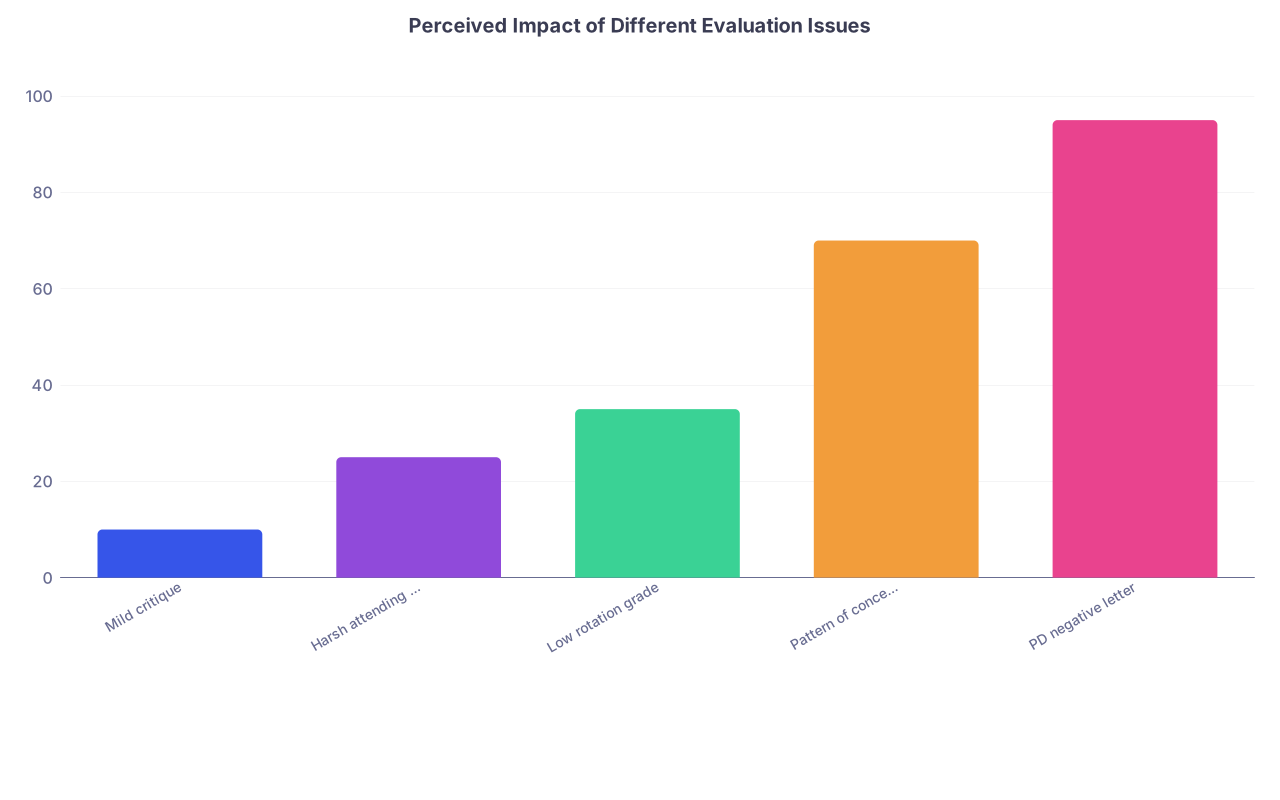
| Category | Value |
|---|---|
| Mild critique | 10 |
| Harsh attending eval | 25 |
| Low rotation grade | 35 |
| Pattern of concerns | 70 |
| PD negative letter | 95 |
Mildly painful, but survivable:
- “Needs to work on efficiency”
- “Could improve communication with nursing staff”
- “Occasionally late with notes”
- “Still developing confidence in clinical decisions”
These are almost boilerplate for many interns. They sting, but nobody’s rejecting you outright because of this. Honestly, some PDs roll their eyes and assume the attending is just particular.
More concerning, but still fixable:
- “Requires close supervision”
- “Organization and time management are below expected level”
- “Sometimes appears overwhelmed and misses details”
- Rotation grade of “borderline pass” or “low pass”
These need:
- A conversation with your PD
- A plan documented in your file
- Later evidence that you improved
You’re not out. You just now have homework.
Red-flag territory:
- “Unprofessional” appears anywhere
- “Dishonest,” “unreliable,” “inappropriate behavior”
- Documentation of patient safety issues
- Multiple rotations mentioning the same serious concern
These don’t automatically end your career. But you no longer have the luxury of “maybe nobody will notice.” Programs will notice. They have to.
This is where your PD’s letter and your own explanation can make or break you.
Prelim Year Reality vs Your Anxiety Brain
Your anxiety brain:
“One bad eval = every program will think I’m incompetent.”
Reality: Programs know prelim year is:
- Chaotic
- Sleep-depriving
- Full of bad systems, poor signout, and sink-or-swim teaching
- Staffed by attendings with wildly different standards
They’re not reading your evaluations imagining a fully polished PGY-3. They’re picturing an exhausted brand-new intern doing admissions at 2 a.m. and trying not to cry in the med room.
What they care about much more than your worst day:
- Did you show improvement over the year?
- Does your PD defend you? (“I’d gladly rehire them.” is gold.)
- Do your later attendings say, “Huge growth since July”?
- Are there clear, consistent strengths (work ethic, team attitude, teachability)?
Programs pick residents, not evaluation robots. They know some rotations are toxic. They also know some residents really do have major issues. Your job is to show which one you are.
Step 1: Don’t Pretend the Bad Eval Doesn’t Exist
The worst mistake I see people make? Denial.
“I’ll just hope it doesn’t show up.”
“It was just one attending, it probably won’t matter.”
“I’m too scared to talk to my PD.”
That’s how a small problem becomes your entire story.
You need to:
- Get a copy of the evaluation
- Read it once, then step away for a day before reacting
- Ask: “Is this about skills? Behavior? Judgment? Communication? Something else?”
Then you schedule a meeting with:
- Your chief (if they’re supportive)
- Or your APD
- Or your PD
And you don’t go in guns blazing. You go in like this:
“I got this evaluation from Dr. X. It really worries me, and I don’t want this to define my year. Can you help me understand how big of an issue this is and what I can do to improve and document that improvement?”
That sentence does a lot of work. It says:
- You’re aware
- You care
- You want to improve
- You’re not trying to hide it
PDs like this. Seriously. They’d rather write “had a rocky start, took feedback extremely well, now performs at or above expected level” than “perfect all year but a little passive.” Growth looks human.
Step 2: Build a Concrete “Redemption Arc”
You’re not trying to be perfect. You’re trying to show a trajectory.

| Step | Description |
|---|---|
| Step 1 | Receive harsh eval |
| Step 2 | Process emotions |
| Step 3 | Meet PD or APD |
| Step 4 | Create improvement plan |
| Step 5 | Targeted changes on next rotations |
| Step 6 | Request feedback early |
| Step 7 | Ask PD to address growth in letter |
Things that help a ton:
Follow-up feedback that clearly references improvement
Ask later attendings to comment specifically on whatever you were dinged for. Example: “Earlier feedback mentioned time management; on this rotation they’re organized and reliable.”Chief or senior backup
Chiefs who say, “Yeah, that attending is notoriously harsh; applicant has been solid on Night Float with us,” can cool down a lot of heat.Documented plan
If your PD emails you: “We’ll focus on X, Y, Z, and reevaluate mid-year,” program directors later see:- Not hidden
- Addressed
- Monitored
That’s so much better than, “We noticed this concerning evaluation and… never talked about it again?”
How Much Will This Actually Hurt My Next Match?
The annoying answer: it depends what kind of “tough” we’re talking about, and what specialty you’re applying to.
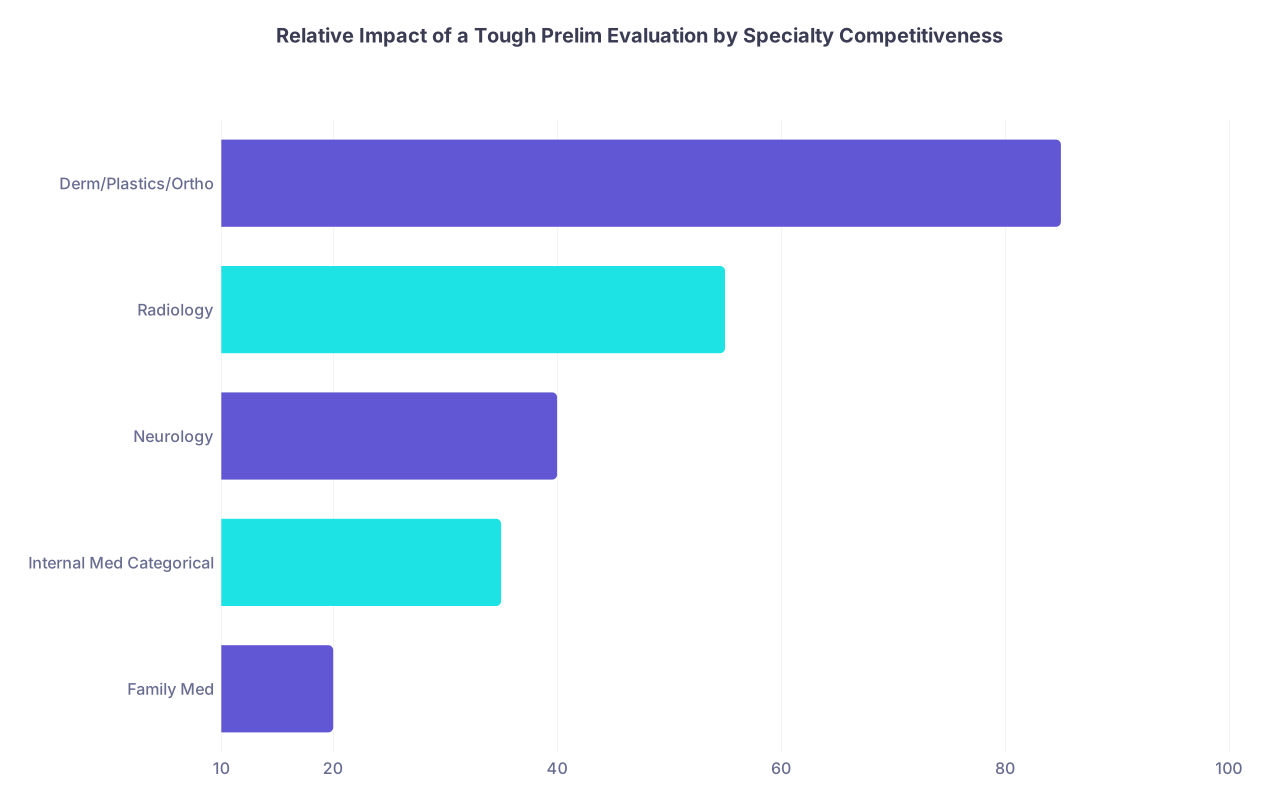
| Category | Value |
|---|---|
| Family Med | 20 |
| Internal Med Categorical | 35 |
| Neurology | 40 |
| Radiology | 55 |
| Derm/Plastics/Ortho | 85 |
Bluntly:
- For highly competitive specialties (derm, plastics, ortho, ENT): yes, any red flag matters more. These programs have the luxury of rejecting anyone with even a whiff of drama.
- For moderately competitive (rads, anesthesia, EM, gas/IM, neuro): they’ll look more at the pattern and PD letter. One bad eval isn’t fatal if the rest is strong.
- For less competitive or more holistic programs (FM, IM community programs, psych in many places): they’re used to “work in progress” interns. They’ll care more about your attitude, improvement, and fit.
Huge factor: Do you already have a home specialty backing you with a strong letter?
If you’re prelim IM applying to, say, anesthesiology and your anesthesia faculty love you and your prelim PD defends you? That’s very different from you being “just another prelim” with no strong advocate.
How to Talk About a Bad Evaluation in Your Application
You’re terrified you’ll say the wrong thing and torpedo yourself. That’s fair. But silence can look worse.
Places you might address it:
- PD letter (ideal place; they’re more credible than you)
- Interview, only if they ask
- Rarely in a personal statement—but if it’s a real red flag, sometimes you need to
If you do have to talk about it, follow this structure:
Briefly name the issue
“Early in my prelim year, I received feedback that my efficiency and organization on a busy inpatient rotation were below expectations.”Take actual responsibility (even if the attending was absurd)
“The feedback was difficult to hear, but accurate—I was overwhelmed by the workload and didn’t yet have effective systems in place.”Show what you did, specifically
“With my PD and chief, I developed a plan: pre-round checklists, tighter signout, earlier communication with nurses, and scheduled midday re-prioritization of tasks.”Show outcome
“On later rotations, attendings noted marked improvement in my time management, and my evaluations reflected that growth.”
What you never do:
- Trash the attending: “They’re known to be unfair.” (Even if true.)
- Sound defensive: “I disagree with their assessment.”
- Blame vague factors: “The system was broken.”
You can give context gently: “This was a high-volume service with limited senior support overnight,” but the core tone has to be: I got hit, I learned, I adjusted.
When It Really Might Ruin Things—and What Then?
Worst-case scenarios do exist. I’m not going to lie just to be soothing.
You’re in rougher territory if:
- Your prelim PD refuses to write you a strong letter
- You’ve got multiple documented professionalism issues
- Or a formal remediation/probation that didn’t resolve well
- Or you were non-renewed or terminated
That’s when doors start closing fast, especially for competitive specialties.
But even then, it’s not always: “You’ll never practice medicine.”
Sometimes it becomes:
- Shift in specialty to something more forgiving
- Applying more broadly and strategically (less brand-name chasing)
- Taking an extra year to rebuild your narrative with research, another role, or a different program
- Getting help from a mentor who understands “rehab” applications
I’ve seen people:
- Asked to leave a surgical prelim and later match into FM
- Put on remediation, complete it successfully, and later get a solid categorical IM spot
- Take a year in research, rebuild evaluations, and come back stronger
Is it harder? Yes. Is it over? No. The story just gets more complicated and requires brutal honesty and strategy.
The Part You Actually Control From Here
You can’t fix that evaluation’s wording. You can’t go back and magically be the hyper-efficient, never-fazed, perfectly documented intern you wish you’d been.
You can control:
- How fast you acknowledge the issue
- Whether you seek help or hide
- Whether your next few attendings know, “Hey, I really want feedback on X; I’m actively working on it.”
- Your daily behavior now—showing up early, being reliable, communicating, owning mistakes
Programs love the applicant who got hit, learned, and climbed. They’re scared of the one who never got real feedback until it was too late.
You’re in the first group if you choose to be.
FAQ: Tough Prelim Evaluation and Next Match
1. Do programs actually see individual rotation evaluations, or just my PD’s letter?
Most of the time, they see the PD (or APD) summary letter and any official transcripts/eval summaries your prelim program uploads. They usually don’t scroll through every single attending comment line-by-line unless there’s already a concern. That’s why your PD’s narrative and big-picture framing matter way more than one grumpy attending’s checkbox.
2. Should I ask my prelim PD to specifically address the bad evaluation in their letter?
Yes, but strategically. You don’t want the whole letter to revolve around that one episode, but you do want them to acknowledge it briefly and then emphasize your growth. Something like: “They had early struggles with time management on a demanding rotation, took feedback seriously, and are now functioning at the level of a strong PGY-1.” If they pretend it never happened and then a program sees it elsewhere, that looks worse.
3. Will a “low pass” or borderline rotation grade automatically red-flag me?
On its own, no. A single low pass—especially early in intern year or on a notoriously intense rotation—usually gets interpreted as “rough rotation, improved later.” It becomes a problem if: you have multiple low passes, the narrative comments mention big concerns, or it aligns with other red flags (poor Step timing, gaps, PD sounding lukewarm). Context and trajectory matter more than the raw label.
4. Should I bring up the bad evaluation during interviews if they don’t ask?
Usually, no. Don’t volunteer a full autopsy on every past mistake unprompted. But you should be prepared with a concise, non-defensive explanation if they do ask about your prelim performance or any specific concern. Let your PD’s letter carry most of the weight; you just need to show insight and growth when they give you an opening.
5. Is it better to delay applying a year so my file has more “distance” from the bad eval?
Only if: (a) the issue was serious enough that your PD currently can’t write a strong letter, or (b) you genuinely need time to show real, documented improvement. Delaying just out of fear, without a plan to strengthen your application, usually backfires. Programs want to see recent, up-to-date performance, not someone who’s been drifting for a year.
6. What if I think the evaluation was actually unfair or biased?
That happens. A lot more than programs admit. You still have to play this smart. First, document your concerns and discuss them calmly with your PD or APD. Sometimes they’ll contextualize it in your file (“Evaluator tends to be unusually critical”) or balance it with other input. Rarely, an eval can be amended, but don’t bank on that. When talking to programs, you can acknowledge that the situation was complex, but never go full scorched-earth on the evaluator. You’re trying to show judgment and maturity, not start a courtroom drama.
If you remember nothing else: one harsh prelim evaluation is a plot point, not your final scene. How you respond—own it, fix it, get backed by your PD, and show growth—that’s what programs are actually judging.