
The way most residents waste their preliminary year is borderline tragic. You are sitting on a one‑year audition with a built‑in army of letter writers and a PD who talks to other PDs every week—and most people treat it like a holding pattern.
You are not in a holding pattern. You are in a 12‑month campaign to manufacture high‑impact letters and program director support that can move the needle in a brutally competitive match.
Here is how you turn a prelim year into actual power for your next application cycle.
1. Understand what your prelim year really is (and is not)
A preliminary year is not “more fourth year.” It is a job with receipts.
Every day you are generating:
- Real-time evaluations
- Nursing and ancillary staff impressions
- Call performance memories
- Direct comparisons to categorical residents
- Data points PDs use when they talk to each other
You need to understand what matters to downstream PDs so you can engineer it.
What downstream PDs actually care about from a prelim year
They are reading one thing: risk.
They want to know:
- Will this person show up, do the work, and not implode?
- Is this someone my residents and nurses will hate?
- When things get ugly at 3 a.m., can this person handle it?
- Did another PD who knows what they are doing vouch for them?
Your prelim PD and key attendings are your credibility brokers. Your goal this year is to turn them into vocal advocates.
There are three outputs you are chasing:
- One excellent program director letter explicitly recommending you for your target specialty.
- Two to three strong attending letters that read like, “We would have kept this person as a categorical if we could.”
- Quiet but real back‑channel support—your PD answering emails and calls from other PDs with, “Yes, they are as strong as the letter says.”
Everything else (research, CV fluff, nice comments) is secondary.
2. First month: set up the campaign on purpose
You cannot fix a bad first half of the year with heroics in March. You need to get in front of this early.
Step 1: Be explicit with your PD—early
By the end of your first month (earlier is better), you need a clear conversation with your PD. Not a casual hallway chat. A scheduled, sitting-down, “I have a plan” meeting.
You walk in with:
- Your target specialty (e.g., anesthesiology, radiology, derm, ophtho, EM, rads-onc, etc.)
- Your current application profile: USMLE/COMLEX scores, med school, red flags
- A one-page CV
- A rough timeline for when you will be applying or reapplying
Then you say something like:
“Dr. X, I want to be transparent. My long‑term goal is categorical [specialty]. I matched here as a preliminary, and my priority this year is to be an asset to your program and to position myself for a stronger application. I am asking for your guidance on how I can perform at the level where you would feel comfortable strongly supporting me to your colleagues in [specialty].”
Do not dance around it. PDs are adults. They already know why prelims are here. You get respect by being clear and asking for standards.
Then you ask directly:
- “What specific things do you look for before you write a strong letter?”
- “What will differentiate me from an average prelim in your eyes?”
- “If I hit those benchmarks, would you feel comfortable supporting me with a PD letter?”
Take notes. Treat this like getting scoring criteria before an exam.
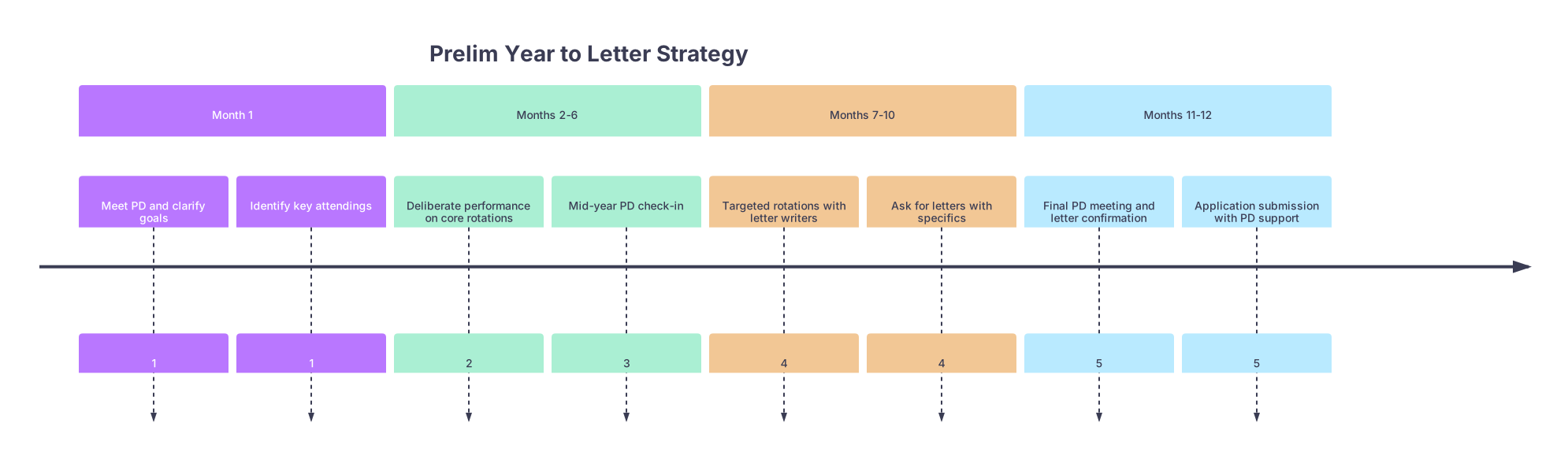
| Period | Event |
|---|---|
| Month 1 - Meet PD and clarify goals | 1 |
| Month 1 - Identify key attendings | 1 |
| Months 2-6 - Deliberate performance on core rotations | 2 |
| Months 2-6 - Mid-year PD check-in | 3 |
| Months 7-10 - Targeted rotations with letter writers | 4 |
| Months 7-10 - Ask for letters with specifics | 4 |
| Months 11-12 - Final PD meeting and letter confirmation | 5 |
| Months 11-12 - Application submission with PD support | 5 |
Step 2: Map your rotations to letter opportunities
You do not need letters from everyone. You need letters from the right people.
Identify:
- 2–3 attendings known to write strong, specific letters for prelims.
- 1–2 rotations where the PD or APD works closely with interns (night float, MICU, teaching wards, etc.).
- Any elective blocks where you could align with your target specialty (ICU for anesthesia, CT surgery for CT surg, neurology consults for neurology, etc.).
Write out a simple map of:
- Rotation
- Attending/leader
- Timing in the year
- Letter potential (yes/no/maybe)
Then deliberately plan to be exceptional where it counts and solid everywhere else. You do not need to sprint for 52 weeks. You need to peak where it shows.
3. On service: how to behave like someone worth writing about
Attendings do not write good letters for “nice, competent” people. That is baseline. They write for residents who are unambiguously making their lives easier and their team better.
You want to be remembered for concrete behavior, not vague impressions. That means operationalizing your days.
On wards: your minimum standards (that most people already fail)
Here is the honest baseline I use when I tell PDs, “Yes, this prelim is top tier.”
Pre-rounding is done and thoughtful
- Labs checked before you present.
- New imaging already read (by you, then radiology).
- Overnight events summarized into 2–3 key bullets per patient.
- Active problems prioritized: “These are the 3 things we have to fix today.”
Notes are not trash
- Assessment and plan show that you are thinking: no copy‑paste walls of nonsense.
- Every active problem has: “What is happening / Why do we care / What we are doing / What we will look for next.”
- Consultants can open your note and quickly understand the patient.
You are not the bottleneck
- Orders placed quickly after rounds.
- Pages answered.
- Discharges moving; you are not the reason patients are sitting.
You keep your attending updated without being needy
- Quick text or page: “FYI – patient in 514 had new chest pain, EKG without acute changes, troponin pending. I have nitro and ASA ordered, will call if troponin positive.”
- You escalate problems with a plan, not just a panic.
Nurses will notice. Senior residents will notice. Attendings will notice. This is what becomes: “This intern functioned at the level of a second‑year resident.”
How to make yourself letter‑worthy on a given rotation
On the first or second day with an attending who could write for you, you say something direct:
“Dr. Y, I know we are early in the rotation, but I want to be upfront. I am a preliminary [medicine/surgery/transitional] resident planning to apply to [specialty] this year. I would really value your feedback as we go, and if by the end of the month you feel you know my work well, I may ask if you would be willing to support me with a letter.”
This does 3 things:
- Signals that you care about performance.
- Invites real feedback before it is too late.
- Makes it easier later when you ask for the letter.
Then you operate like you are trying to be the best intern they have had in two years. Not ever—that bar is impossible. But top 10–15%. That is enough for attendings to remember you when they open ERAS.
4. Mid‑year: course corrections and narrative shaping
At 4–6 months, you need a “how am I really doing” checkpoint. Not the generic eval summary. Real talk.
Step 1: Mid‑year PD meeting
Schedule a second PD sit‑down.
You bring:
- A short list of attendings you have worked closely with.
- Any written feedback you have (good and bad).
- Your updated plan for the match cycle (what you are applying to, when, how many programs).
Ask three direct questions:
- “If you had to summarize my performance so far to another PD in one sentence, what would you say?”
- “Do you see any concerns that would make you hesitate to recommend me strongly?”
- “What do I need to do between now and the end of the year to get you fully behind my application?”
Then stop talking. Let them answer. If you hear vague language (“fine,” “solid,” “no major concerns”) and nothing about “outstanding,” you have work to do.
Step 2: Fix the weak spots, not your ego
If you get feedback like:
- “Night float evaluations mention delayed call‑backs.”
- “A couple of nurses said you seem rushed and short.”
- “Your notes are too long, and people cannot find the plan.”
You do not defend. You say, “Understood. Thank you for being direct. I will address those immediately.”
Then you go to the people affected:
- Night nurses: “I heard I was slow to respond to pages last month. I am working on that. Please let me know directly if I am missing something or if you think communication could be better.”
- Senior resident: “Can you watch me manage cross‑cover tonight and give me blunt feedback? I want to tighten this up.”
That kind of reaction gets back to the PD. They talk to each other. You are not just improving; you are visibly coachable. PDs write about that.

5. Engineering high‑impact letters (not generic fluff)
Strong letters have a few consistent features. You can make it easier for attendings and PDs to write them.
What a high‑impact prelim letter looks like
A real, high‑leverage prelim letter usually has phrases like:
- “Among the top interns in our program this year.”
- “Performed at or above the level of our categorical residents.”
- “I would have been thrilled to keep them in our program as a categorical resident.”
- “I recommend them without reservation for a position in [specialty].”
Your behavior this year is about making those sentences true and easy to write.
When and how to ask your PD for a letter
Timing:
- For the next‑cycle match, you should ask no later than late July–August of your prelim year if you are a “true prelim” applying out after one year.
- For people doing a gap research year after prelim, adjust earlier/later accordingly.
How to ask:
“Dr. X, we talked earlier in the year about my goal to match into [specialty]. Based on our work together and the feedback you have, would you feel comfortable writing a strong letter in support of my application? Programs in [specialty] put a lot of weight on PD letters, so I only want to ask if you feel you can endorse me confidently.”
If they say yes, you:
- Provide an updated CV.
- Send a short, bullet‑point “reminder” of specific things you did under them (cases, patient loads, crises handled, any leadership).
- Remind them of your target specialty and why.
If they hedge or say something lukewarm, you do not push for a letter. A mediocre PD letter can kill you.
Instead ask:
“Could you share what I would need to improve for you to feel comfortable giving that level of support? I want to make sure I address any gaps.”
Then double-down on other letter writers and fix weaknesses.
6. Getting your PD to advocate behind the scenes
The letter is one piece. The quiet emails and calls are just as powerful.
PDs text and email each other constantly:
- “Do you know this person from your prelim program?”
- “How did they perform for you?”
- “Would you take them in your own specialty?”
Your job is to make it easy for your PD to answer those questions with, “Yes, I would take them here if I could.”
Step 1: Make your PD’s life easier
PDs support residents who:
- Do not generate constant drama.
- Do not require weekly damage control emails.
- Are responsive when PDs reach out.
- Say “yes” to reasonable asks: schedule swaps, extra teaching, helping on interview day, etc.
When your PD asks for volunteers to:
- Lead intern orientation teaching
- Represent the program at applicant dinners
- Help quality improvement or M&M projects
Be the one who raises your hand when you can. Do not martyr yourself, but once or twice during the year, say yes and then actually do it well.
They remember who stepped up.
Step 2: Ask explicitly for advocacy
Once they have agreed to write a letter, and you are closer to interview season, you can ask more directly.
“Some programs in [specialty] have asked my prelim PDs for informal feedback. If you are contacted, would you feel comfortable telling them what you have told me—that you would have kept me as a categorical if possible?”
You are not scripting them. You are aligning the message.
If there is a particular program where your PD has connections, be honest:
“I am very interested in [Program Y]. If you know their PD or APD and feel comfortable doing so, I would be extremely grateful for any supportive outreach. I understand you only do that when you can truly endorse someone; I hope my work has earned that.”
Sometimes they will say yes and actually email or text. Sometimes they will not. Do not push after the first ask. You do not want them feeling used.
| Scenario | Interview Yield | Match Likelihood |
|---|---|---|
| Strong PD letter + advocacy | High | High |
| Strong PD letter only | Moderate | Moderate |
| Generic PD letter, no advocacy | Low | Low |
| No PD letter from prelim program | Very Low | Very Low |
7. Aligning your prelim story with your target specialty
Your prelim year cannot look like a random detour. You need to connect the dots for programs.
Build a coherent narrative, not excuses
Programs are tired of vague “I discovered my passion late” essays that look like cover stories for not matching.
Your story has to sound like:
- “I chose, or ended up in, a rigorous clinical prelim year that sharpened the skills essential for [specialty].”
- “I performed at a high level in that environment.”
- “Leaders there are explicitly endorsing me.”
Concrete examples:
- Applying to anesthesia: emphasize ICU care, hemodynamics, airway exposure, managing vasopressors, perioperative medicine.
- Applying to radiology: emphasize complex diagnostic reasoning, integrating imaging with clinical data, clear documentation, structured thinking.
- Applying to EM: emphasize triage, cross‑cover nights, rapid decision‑making with incomplete data.
Then your letters echo that. You can help by telling your writers:
“For my anesthesia application, it would help if any comments about my work with acutely ill patients, procedures, and rapid assessment can be highlighted.”
You are not demanding content; you are focusing them.
8. Salvage strategies if the year starts badly
Sometimes the first few months are already a mess. Bad evals, shaky relationships, maybe one really ugly incident. You are not out of the game. You just have less margin.
Step 1: Stop the bleeding
If you have any of:
- Written professionalism concerns
- Angry emails from nursing leadership
- Serious clinical mistakes
You need a sit‑down with your PD or chief as soon as possible.
You say:
“I am aware that my performance early in the year has not met expectations, and I understand this affects how I am viewed in the program. I want to improve and repair trust. Can we go over specific expectations and a concrete plan so that I can demonstrate growth over the rest of the year?”
The worst move is to go passive and hope it “blows over.” It does not. It calcifies into “problem resident” in the PD’s mind.
Step 2: Create a visible upward trajectory
Programs forgive early clumsiness more than persistent mediocrity. What they like:
- An intern whose first two months were rough but then systematically improved.
- A resident who sought extra supervision for a while, then gradually needed less.
- Someone with a good attitude during remediation.
You want your PD to be able to write, “Although their year began with some challenges involving [X], they responded maturely to feedback, sought supervision, and by the second half of the year were performing at or above the level of their peers.”
That is salvageable. “Continued marginal performance despite feedback” is not.
Step 3: Diversify your letter sources
If PD support will be lukewarm no matter what, you need other advocates:
- A unit director who loves your work in the ICU.
- A subspecialist you worked closely with on consults.
- A research mentor with a national name in your target field.
Make sure at least one someone with real specialty clout is in your application packet, especially if your prelim PD’s letter will be more factual than glowing.

9. Nuts and bolts: timing, ERAS, and logistics
High‑impact letters and PD support only matter if you deploy them correctly.
Letter timing and ERAS logistics
- Aim to have your core letters (PD + 2 attendings) uploaded before ERAS submission.
- You can add one or two more later (e.g., from a late ICU month) and assign them to programs selectively.
When you assign letters:
- Your prelim PD letter should be assigned to every program unless there is a very specific reason not to.
- Attending letters can be targeted: heavy ICU letter to anesthesia and EM, strong ward letter to IM, etc.
Make sure your writers:
- Know your ERAS ID and the exact letter type (PD vs. faculty).
- Are not using generic templates that scream “I barely know this person” (older PDs are sometimes guilty of this).
Coordinating with your specialty mentors
If you have mentors in your target field from med school or research:
- Tell them explicitly about your prelim performance and PD support.
- Share snippets of strong feedback (de‑identified) so they can reference your growth.
- Ask them to mention your prelim year in context, not as an afterthought.
The ideal stack for many applicants:
- 1 prelim PD letter
- 1–2 strong prelim attending letters
- 1–2 specialty‑specific letters from your target field
Then your personal statement and experiences section tie it all together. The prelim year is not an apology. It is Exhibit A that you show up and do the work.
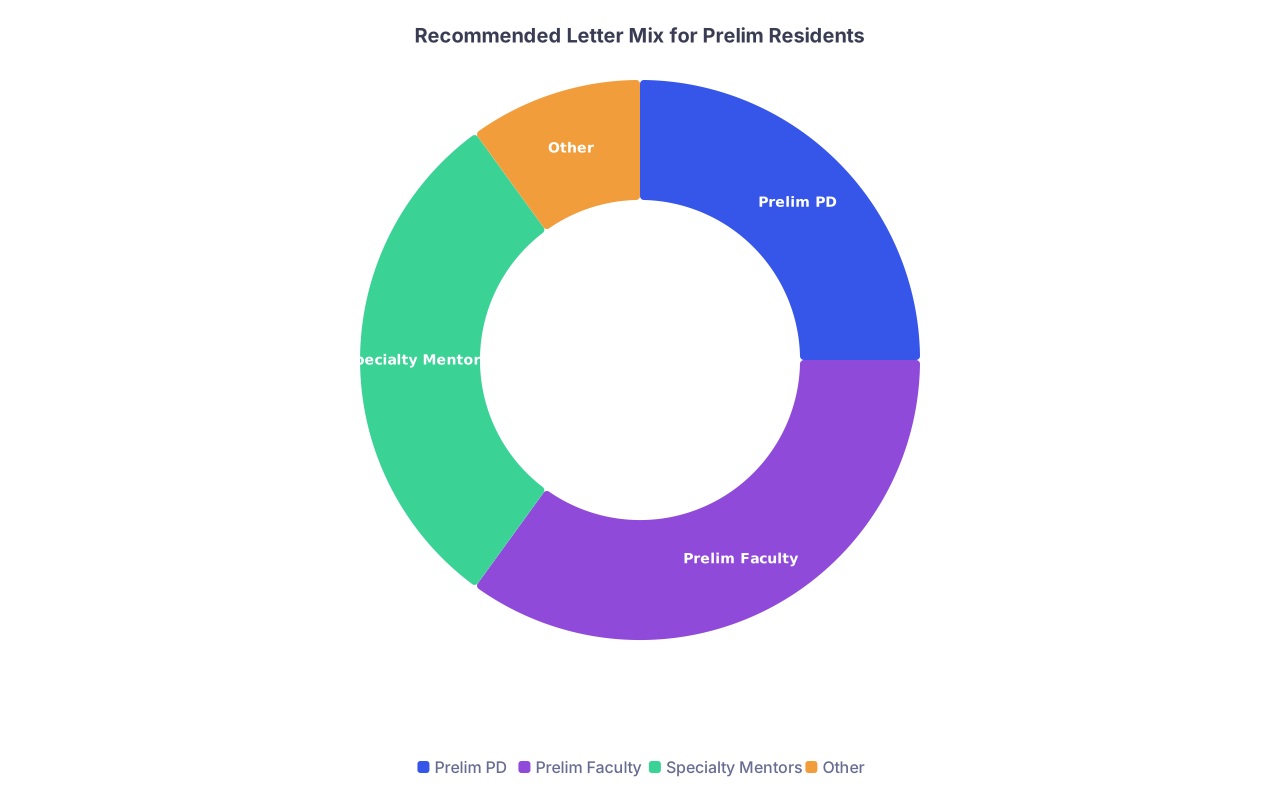
| Category | Value |
|---|---|
| Prelim PD | 25 |
| Prelim Faculty | 35 |
| Specialty Mentors | 30 |
| Other | 10 |
10. The simple daily checklist that actually moves the needle
If all of this feels like a lot, here is the stripped‑down version.
Every week of your prelim year, ask yourself:
- Would my current attending say I am one of the top interns they are working with this block? Why or why not?
- Has my PD heard my name in a positive context in the last 2–3 weeks? From who?
- Did I ask for and act on at least one piece of uncomfortable feedback this month?
- Am I making any part of my PD’s or chiefs’ lives easier?
If the answer is “no” to most of these for more than a month or two, you are not on track for high‑impact letters. Course‑correct now, not in March.

The bottom line
Three things matter if you want to turn a prelim year into real firepower for your next match:
- Be deliberate from day one. Tell your PD your specialty goal, map your rotations to letter writers, and treat the year as a structured campaign, not a holding pattern.
- Perform where it counts and fix what is broken. Be visibly excellent on key services, aggressively seek feedback, and create a clear upward trajectory that PDs can describe with confidence.
- Secure and deploy PD support strategically. Get a truly strong PD letter, invite back‑channel advocacy, and align your narrative so your prelim year reads as proof of reliability and growth—not a consolation prize.
Do those consistently, and your “just a prelim year” becomes the main reason another PD decides to take a chance on you.