The safety net you thought you had for PGY‑2 does not exist. That is not the end of your career. It is the start of a different, more deliberate phase.
You are mid‑prelim year. The advanced spot you were counting on disappeared. Or you did not match. Or your fellowship‑style “handshake deal” fell through once people saw budgets, FTEs, or your evaluations. I have watched residents go through this, and the ones who land on their feet do the same things very quickly and very systematically.
Here is how you fix it.
Step 1: Stop the Panic Spiral and Get a Clean Situation Report
You cannot plan from rumors and half‑information. You need a brutally clear picture of where you stand, in writing and in your own head.
Do this in the next 48 hours:
Write down the exact problem.
Not “my life is over.” Be specific.- “I was prelim IM with an advanced neurology spot; the program lost funding and is not taking me.”
- “I am prelim surgery; I did not match categorical; I have no PGY‑2 contract.”
- “My advanced anesthesiology program placed me on a waitlist; no guarantee of start date.”
Clarify your current employment end date.
- Check your GME contract: exact last working day, benefits end, and any tail coverage.
- Note visa status if applicable (J‑1, H‑1B, etc.). That changes your options.
Pull objective performance data.
- Last 2‑3 block evaluations.
- Any CCC (Clinical Competency Committee) summaries.
- In‑training exam scores if available.
- Procedure logs. You will need these for any mid‑cycle opportunities. And you need to know if performance is limiting you.
Identify any red flags early. Ask yourself honestly:
- Any professionalism citations?
- Any remediation letters?
- Any leaves of absence that will raise questions? If yes, we plan around that. Hiding it will sink you later.
Once you have this, you are not just “screwed.” You are an employed PGY‑1 with a specific problem to solve in 6–9 months.
Step 2: Get Your Home Program Leadership On Board (Quietly but Directly)
Your prelim PD and program coordinator are not optional in this process. They are gatekeepers to letters, phone calls, and sometimes hidden positions.
Who to talk to this week
Program Director (PD)
Ask for a short, private meeting. Script it roughly like this:- “My PGY‑2 plan has fallen through because [one clear sentence]. I would like your help figuring out how to secure a PGY‑2 position. Can you give me candid feedback on whether you would support me as a candidate?”
Then shut up and listen. You need:
- Whether they consider you in “good standing.”
- Whether they would reappoint you if they had a spot.
- Whether they are willing to:
- Write a strong letter.
- Make calls to other PDs.
- Alert you to internal or institutional opportunities.
Chief resident or APD you trust
- Ask them bluntly: “If you were me, what would you do next? Who should I talk to? Where do people from this program land when plans change?”
- Chiefs know informal opportunities and who is on your side.
Program Coordinator
This is often the most practically helpful person:- Ask for:
- Historical examples of residents who switched/scrambled.
- Contact info for institutional GME office.
- Timing for key documents (letters, verification forms, case logs).
- Ask for:
If your PD is hostile or lukewarm, that changes strategy. You lean more on mentors outside the program, previous faculty from medical school, and any rotations where you shined.
Step 3: Decide: Stay in the Same Field or Pivot?
You must make at least a provisional decision about your target. You cannot shotgun every specialty; it looks desperate and unfocused.
Ask yourself 3 hard questions:
Do I still actually want the original specialty?
Example: You were prelim surgery aiming for categorical GS, but you hate the lifestyle and culture. This might be the moment to move—IM, anesthesia, EM, radiology, whatever actually fits you.Is my application realistically competitive for that field right now?
- For ultra‑competitive fields (derm, ortho, ENT, plastics, rad onc), a lost advanced position mid‑prelim often means: you need a serious rethink or a 1–2 year research/transition plan.
- For moderately competitive (anesthesia, EM, radiology, neurology), you may still find PGY‑2 spots or off‑cycle entry if your record is solid.
- For broad entry fields (IM, FM, psych, peds), it is often possible to land categorical PGY‑1 or PGY‑2 with strong clinical performance and hustle.
What are my non‑negotiables?
- Geography for family/visas?
- Need for a guaranteed PGY‑2 versus willingness to repeat PGY‑1 as categorical?
- Burnout level: can you tolerate a research or prelim‑again year?
Once you answer these, commit for now. You can adjust if the market pushes you, but you need a primary direction.
Step 4: Understand Your Realistic Pathways From Mid‑Prelim
Residents in your situation usually have 5 main tracks. None are perfect. Several are survivable.
| Pathway | Duration Impact | Main Use Case |
|---|---|---|
| Find open PGY-2 spot (same field) | 0 extra years | Still want same specialty, strong record |
| Switch to categorical PGY-1 | 0–1 extra year | Want new field, programs willing to credit time |
| Second prelim year | +1 year | Bridge while reapplying or waiting on spots |
| Research/non-ACGME gap year | +1 year | Rebuild CV for competitive specialties |
| Step out of training temporarily | variable | Visa/family/health, planning re-entry later |
Option 1: Find an open PGY‑2 spot in the same field
This is the cleanest solution when it works.
Who this works best for:
- Prelim IM trying to move into categorical IM, neuro, or another IM‑related field.
- Prelim surgery with solid evaluations, looking for categorical or another surgical PGY‑2.
- Prelim transitional year heading into anesthesia, radiology, neurology.
What you actually do:
- Monitor these sources weekly (or more):
- ResidentSwap.org
- FindAResident (if active this cycle)
- Specialty listservs (e.g., Association of Program Directors in Internal Medicine emails).
- Your PD’s informal network.
- Email PDs directly when you see openings:
- Subject line: “PGY‑2 Internal Medicine Applicant – Current Prelim at [Hospital Name]”
- Attach: CV (updated), personal statement (tight, one page), USMLE/COMLEX scores, current evaluations.
- Ask your PD to:
- Send a personal email or call PDs at target programs.
- Provide a formal letter of good standing.
Timing:
- Some spots open mid‑year when residents resign, are let go, or transfer.
- Many PGY‑2 positions are negotiated 4–8 months before July 1.
Step 5: Execute the Application and Outreach Strategy
You are not an MS4 anymore. The game is faster, smaller, and more personal.
Core documents you need ready within 1–2 weeks
Updated CV
- Include prelim rotations, procedures, responsibilities.
- List any teaching, QI projects, or committee work you have already started.
Focused personal statement (1 page)
- What happened: 1–2 sentences max. No drama.
- What you bring: specific strengths demonstrated in prelim year.
- What you want: clear, specific ask (PGY‑2 IM, switch to psych categorical, etc.).
-
- At least 2 strong letters from your prelim year:
- One from PD or APD if possible.
- One from a core attending who supervised you closely (ICU, wards, OR, etc.).
- Consider one letter from medical school if they know you very well and can support your specialty pivot.
- At least 2 strong letters from your prelim year:
Outreach mechanics
You do not wait for ERAS to rescue you. You push.
- Direct email to PDs of programs with known or likely openings.
- Leverage every human connection:
- Med school faculty.
- Sub‑I attendings.
- Fellowship directors you impressed.
- Ask specifically for:
- Off‑cycle PGY‑2 positions.
- Advanced positions that may open if a current resident is struggling or planning to leave.
- Consideration for categorical PGY‑1 with possibility to credit prior year.
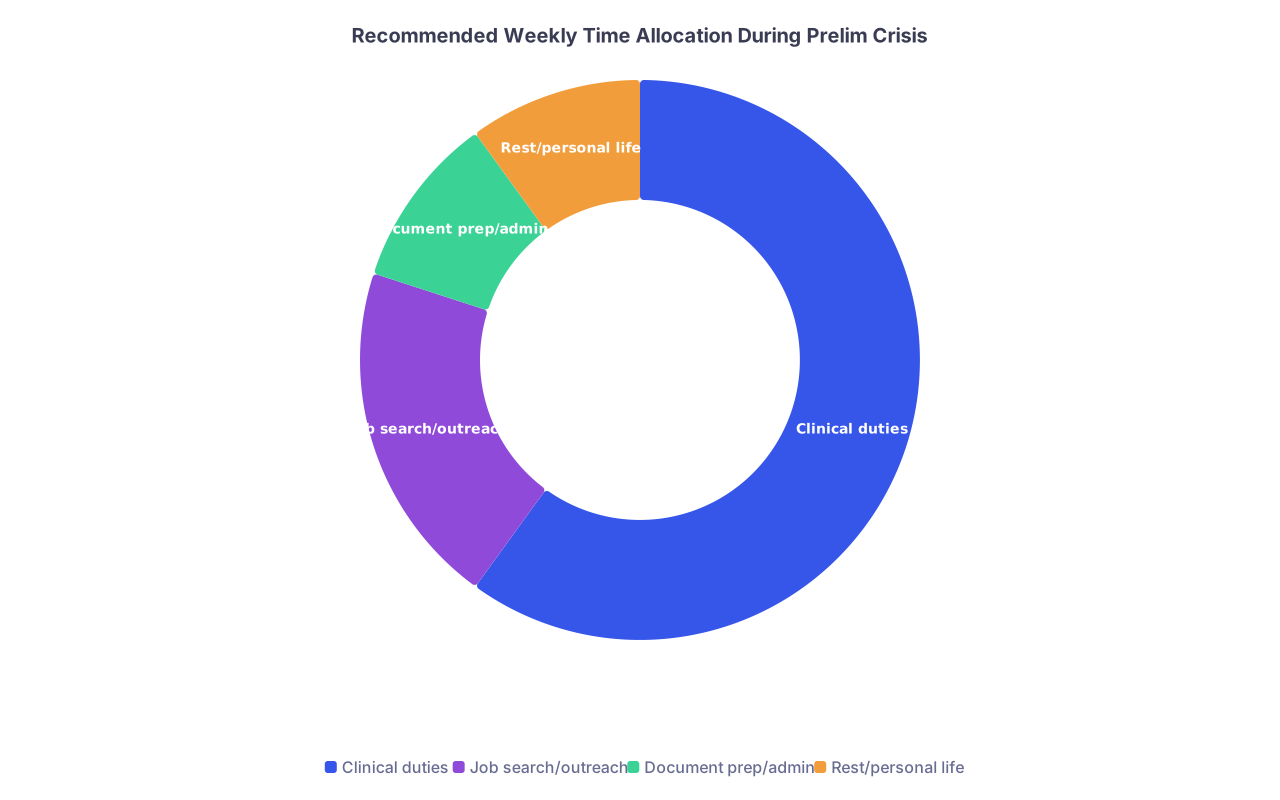
| Category | Value |
|---|---|
| Clinical duties | 60 |
| Job search/outreach | 20 |
| Document prep/admin | 10 |
| Rest/personal life | 10 |
Step 6: Use the SOAP and Off‑Cycle Openings Correctly
If you did not match into an advanced spot or categorical position, SOAP (Supplemental Offer and Acceptance Program) may still be your best immediate lever.
If you are approaching Match / SOAP
- Coordinate with your med school (if within 1 year of graduation) or current program.
- Some NRMP functions still route through your original school.
- Prepare for the SOAP list:
- Decide now: will you accept:
- Categorical positions in another field?
- Another prelim year?
- Geo‑flexibility (are you open to anywhere in the country)?
- Decide now: will you accept:
- Rank your true priorities before SOAP starts.
- Do you want:
- Any categorical spot over any prelim?
- Only certain specialties, even if it means risk of being unmatched again?
- Do you want:
Off‑cycle openings outside of Match
- These are often:
- PGY‑2 positions in IM, psych, neuro, anesthesia, etc.
- Replacements for residents who left or were terminated.
- These do not go through the traditional match timeline:
- PDs may want someone who can start July 1, or even mid‑year.
- Your prelim year completion date must match their need.
Step 7: What If You Have to Do a Second Prelim or a Gap Year?
Sometimes the market or your specialty choice forces this. It is not ideal. It is also not fatal.
Second prelim year
When it makes sense:
- You are committed to a competitive or moderately competitive specialty.
- You could not secure an advanced or categorical spot this cycle.
- Your evaluations are good, and PD is willing to support “prelim again” with improved strategy.
How to make it productive, not repetitive:
- Choose a second prelim with:
- Strong reputation in your target specialty.
- Faculty who are well connected.
- Clear opportunities for research/QI.
- Go in with a deliberate plan to:
- Secure 2–3 powerful letters early.
- Get involved in relevant projects (surgical outcomes, neuro QI, anesthesia patient safety, etc.).
- Fix any prior issues (time management, communication, exam performance).
Research or non‑ACGME clinical year
Used when:
- You are aiming at ultra‑competitive specialties.
- Your scores or CV need bolstering.
- You have interest in academic careers.
What to look for:
- Funded research positions with:
- Real mentorship.
- A track record of residents matching into your specialty.
- Clinical exposure or “moonlighting‑like” opportunities if allowed.
You do not take:
- Random unpaid observerships.
- Informal shadowing roles that do not produce letters, publications, or genuine mentorship.

| Step | Description |
|---|---|
| Step 1 | PGY-2 plan failed |
| Step 2 | Apply to open PGY-2 spots |
| Step 3 | Seek targeted 2nd prelim |
| Step 4 | Research or gap year |
| Step 5 | Choose new specialty |
| Step 6 | Apply as PGY-2 transfer |
| Step 7 | Apply categorical PGY-1 |
| Step 8 | Still want same specialty |
| Step 9 | PGY-2 spots available |
| Step 10 | Willing to do 2nd prelim |
| Step 11 | Programs credit PGY-1 time |
Step 8: Manage Licensing, Visa, and Financial Reality
People ignore this until it explodes in their face. Do not.
Licensing and credentials
- Keep your training license current until your last working day.
- If you are moving states:
- Start the new training license application early (they are slow).
- Request verification of training from current GME as soon as you have a new offer.
Visa considerations
If you are on a J‑1 or H‑1B, get professional advice early.
- J‑1:
- You typically must remain in ACGME‑accredited training continuously.
- Gap years can trigger problems.
- Transfers require ECFMG and sometimes embassy involvement.
- H‑1B:
- Employers file amendments for change in site or role.
- Non‑training gaps can be catastrophic.
Do not rely on PDs to know immigration law. They often do not. Involve:
- Institutional immigration services.
- An actual immigration attorney if there is any uncertainty.
Financial survival
If you end up with a gap (even 1–3 months) between positions:
- Run the math now:
- Loan payments.
- Rent.
- Health insurance.
- Explore:
- Forbearance/deferment options for federal loans.
- Short‑term health coverage (COBRA is expensive but sometimes necessary).
- Moonlighting if licensure and contracts allow, but do not violate visa or GME policies.
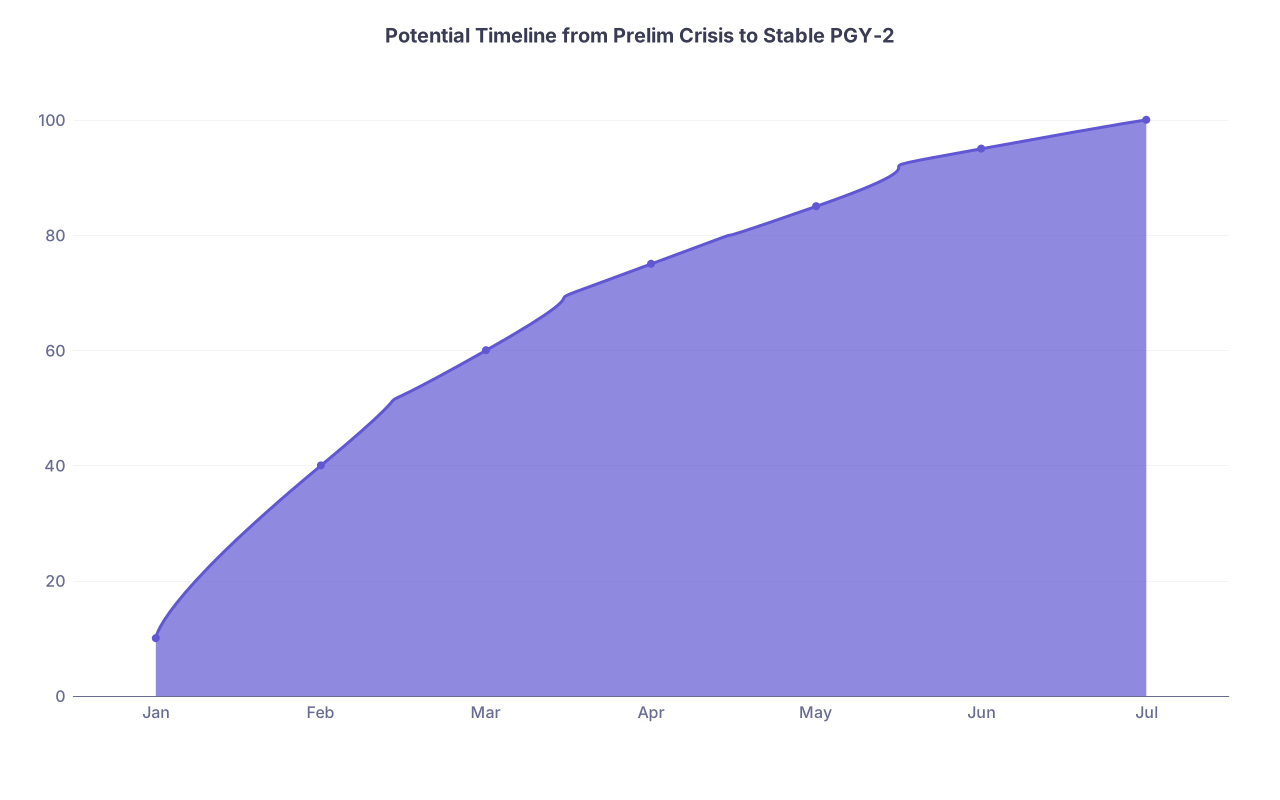
| Category | Value |
|---|---|
| Jan | 10 |
| Feb | 40 |
| Mar | 60 |
| Apr | 75 |
| May | 85 |
| Jun | 95 |
| Jul | 100 |
(Values represent percentage of residents in this situation who typically have a secured next step by that month, based on institutional experience—not exact national data.)
Step 9: On‑the‑Ground Tactics to Strengthen Your Position While You Search
You are still working full‑time. You cannot pause your current job while you fix your future.
Here is how to make your prelim months actively work for you.
Become the “no drama, gets things done” resident.
- Show up early, stay a reasonable amount late, do clean sign‑outs.
- Answer pages, follow up on tasks, minimize dropped balls.
- PDs and attendings will remember the reliability more than the occasional brilliant diagnosis.
-
- Try to get more time in:
- The specialty you want (e.g., neuro, cards, ICU for IM; OR heavy blocks for anesthesia).
- Services with attendings who write strong letters.
- Ask chiefs/coordinator if schedule tweaks are possible.
- Try to get more time in:
Ask faculty directly for support.
- Near the end of a rotation where you performed well, say:
- “I am in a difficult position with my PGY‑2 plans. Would you feel comfortable writing me a strong letter of recommendation if I apply to [specialty/program type]?”
- If yes, follow up with:
- CV.
- Brief summary of cases or projects you worked on together.
- Your career goals in 3–4 bullet points.
- Near the end of a rotation where you performed well, say:
Pick 1–2 quick projects, not 10.
- Examples:
- A case report from an interesting ICU patient.
- A QI project on hand‑off errors, discharge summaries, or OR turnover.
- Focus on something you can realistically finish or at least move to “submitted” by the end of the year.
- Examples:

Step 10: How to Explain the Situation Without Sinking Yourself
Every PD you talk to will want to know some version of: “Why are you available mid‑prelim?” Your answer must be:
- Brief.
- Factual.
- Non‑defensive.
- Consistent.
Good structures for your answer
If the problem was structural (funding, program change):
“I began my prelim year at [Hospital] with the expectation of moving into a PGY‑2 position in [specialty]. Mid‑year, the program lost funding for that position and I was informed I would not have a guaranteed PGY‑2 spot. My evaluations have been strong, and I remain fully committed to [specialty/new specialty], so I am looking for a PGY‑2 position where I can continue training without interruption.”
If you did not match or lost an advanced spot for competitiveness reasons:
“My goal has been [specialty]. I applied to a limited number of advanced programs and did not match. During my prelim year at [Hospital], I have grown significantly in [specific skills]. Based on feedback from my PD and attendings, I am now broadening my search to [specialty or adjacent fields] and am seeking a position where I can contribute at the PGY‑2 level.”
If there were performance issues that are now resolved (be very careful and honest, but concise):
“Early in my prelim year I struggled with [specific, non‑character issue, e.g., time management, documentation]. I worked closely with my program leadership on a remediation plan, and my last [X] block evaluations show marked improvement in those areas. My PD now considers me in good standing and is supportive of my search for a PGY‑2 position.”
Do not:
- Blame everyone else.
- Trash your current PD or colleagues.
- Over‑share your emotional state.

Step 11: Psychological Survival and Keeping Your Options Open
This part is not fluff. The residents who implode psychologically during this phase start missing deadlines, alienating allies, and making desperate choices.
A few hard truths and what to do about them:
Your identity is not “the person whose plan fell apart.”
It is “a PGY‑1 who is still in the game.” Plenty of people never get this far.Have a backup to your backup.
- While you chase your ideal path (PGY‑2 in original specialty), quietly:
- Look at categorical positions in more available fields.
- Consider whether you would accept a switch if that is the door that opens.
- While you chase your ideal path (PGY‑2 in original specialty), quietly:
One trusted sounding board, not a committee.
- Pick 1–2 mentors you actually listen to.
- Stop crowdsourcing life decisions from 30 co‑residents and Reddit.
Set a decision deadline. For example:
- “If I do not have a serious lead on a PGY‑2 in [specialty] by April 15, I will actively pursue categorical [IM/FM/psych/etc.] and commit to that track.”

Final Reality Check: What Actually Matters From Here
You do not need perfection. You need momentum and a plausible, supported story.
Focus your energy on three things:
Secure strong, current endorsements.
PD, attendings, and chiefs who will say: “This resident shows up, works hard, and is safe.” Those voices open more doors than any personal statement.Choose a coherent direction and pursue it aggressively.
Whether that is doubling down on your original specialty or intentionally pivoting to another field, do not present as scattered or desperate. Clear intent looks like maturity.Keep your clinical performance solid while you hunt.
Burnout, anger, or disengagement will show up in evaluations and word‑of‑mouth faster than you think. You are auditioning for your next job every single shift.
Your PGY‑2 plans fell apart. That is a crisis. It is also a common one. Residents recover from this every year and go on to solid, satisfying careers. Handle the next 3–6 months with discipline and clarity, and you will be one of them.