
The biggest mistake people make with prelim years is pretending they are “backup plans.” They are not. If you are pairing an advanced spot with a prelim year, you are essentially matching into two residencies at once—and if you get careless with the planning, you can blow both.
You want a clean path: med school → PGY-1 prelim → PGY-2 advanced, no gaps, no surprises, no last‑minute scrambling. Here is how you actually get that.
Step 1: Get Crystal Clear on What a Preliminary Year Is (And Is Not)
If you do not understand this, every other step is at risk.
A preliminary year is:
- A 1‑year PGY-1 position.
- Usually in Internal Medicine, Surgery, or Transitional Year.
- Designed for people whose “real” residency starts at PGY-2 (advanced specialties: anesthesia, radiology, derm, rads-onc, ophthalmology, PM&R, etc.).
It is not:
- An automatic feeder into that hospital’s advanced program.
- A guaranteed audition for a categorical spot.
- A flexible gap year you can move around.
You match to:
- An advanced program (PGY-2+), and
- A separate prelim (or TY) PGY-1 spot.
Both have to line up: dates, location, contract conditions.
| Type | Length | Starts At | Example Specialties |
|---|---|---|---|
| Preliminary | 1 year (PGY-1) | PGY-1 | IM prelim, Surgery prelim, TY |
| Categorical | Full program | PGY-1 | IM, FM, Pediatrics, General Surg |
| Advanced | PGY-2 onward | PGY-2 | Anesthesia, Radiology, Derm |
If you are applying to an advanced specialty, you must plan your prelim year like a linked mission, not an afterthought.
Step 2: Decide What Kind of Prelim Year Actually Serves Your Advanced Specialty
There are three main flavors:
- Transitional Year (TY) – lighter schedule, broad exposure, often more electives
- Medicine Preliminary – inpatient-heavy, wards, nights, ICU, solid clinical base
- Surgery Preliminary – surgical cases, floor work, call, procedure heavy, high workload
Here is how I tell students to think about it.
Match the prelim to your advanced field’s expectations.
- Anesthesiology, Radiology, Derm, Rads-Onc, PM&R:
- TY or IM prelim is usually ideal.
- You want strong general medicine skills and time to study.
- Ophthalmology:
- Many programs are fine with TY or IM prelim. Some like strong ICU/acute care.
- Neurology (when advanced):
- IM prelim is usually preferred, sometimes required.
- Anesthesiology, Radiology, Derm, Rads-Onc, PM&R:
Check the actual requirement language.
Go to program websites and read their PGY-1 requirement page. Do not guess. You are looking for exact wording like:
- “ACGME-accredited PGY-1 year in Internal Medicine, Surgery, or Transitional Year.”
- “At least 6 months of direct inpatient internal medicine required.”
- “No more than 2 months of emergency medicine and 2 months of electives.”
If you pick a cushy TY with 5 months of dermatology electives and your future anesthesiology program requires 6 months inpatient medicine, you just created a major problem.
Step 3: Build a Target Map: Advanced + Prelim Combinations
You should not be building two separate rank lists in a vacuum. You need a pairing strategy.
Do this before you submit your ERAS.
Make a two-column map.
Left column: advanced programs you are seriously targeting.
Right column: prelim/TY options that “pair well” with each.
Ask:
- Do they have a linked or joint prelim year?
- Do they have a preferred prelim site that their residents commonly use?
- Are there geographically close prelims that make living reasonably easy?
- Look for “integrated” situations.
Some advanced programs:
- Have their “own” prelim year (e.g., “PGY-1 in medicine at the same institution, matched separately but informally preferred”).
- Heavily favor applicants who match into their own prelim.
If your dream anesthesia program strongly prefers you to do prelim IM in their own hospital, you put that pairing at the top of your planning.
- Consider lifestyle + support.
If you think you will magically power through a malignant prelim while trying to prepare for a brutally hard PGY-2 start, you are lying to yourself. For advanced fields with heavy PGY-2 ramp-up (anesthesia, IR, rads, etc.), a survivable PGY-1 matters.
Step 4: Understand NRMP Categories and How the Match Treats These Spots
This is where people get completely lost, usually because nobody explained the codes to them.
Key NRMP position codes:
- C – Categorical (PGY-1 to completion)
- P – Preliminary (one year, PGY-1)
- A – Advanced (starts at PGY-2)
- R – Reserved (for those with prior credit; not relevant for most med students)
You might be applying to both:
- Advanced (A) programs, and
- Preliminary (P) programs.
These are separate tracks on your rank list. The Match will:
- Try to match you to an advanced position.
- Then pair you with a prelim year that works with it, based on your rank list order.
If you do not rank enough prelims or if your pairings are chaotic, you can very realistically end up:
- Matching an advanced spot
- Without a PGY-1 year
That is one of the nastiest outcomes I see—especially in anesthesia and radiology. Avoid it by planning your rank list correctly (we will get there).
Step 5: Checklist Before You Apply – Avoid Compatibility Landmines
Here is the front-end planning checklist you complete before submitting ERAS.
1. Verify start dates.
Almost all advanced programs start PGY-2 on July 1 the following year. Make sure:
- Your prelim year ends June 30 of that same year.
- There is no odd start (like “PGY-2 begins August 1”) without a clear plan for the gap.
2. Confirm accepted prelim types.
For each advanced program on your list, check:
- Do they require an ACGME-accredited prelim year? (Almost always yes.)
- Do they allow TY?
- Do they require medicine prelim?
- Any special notes like “must have at least 4 months of direct patient care in internal medicine”?
3. Check visa and licensing constraints (if IMG or needing visa).
- Some prelim programs sponsor visas, some do not.
- Your prelim and advanced must both be feasible for your visa status.
4. Check call intensity vs your learning needs.
In practice:
- A brutal surgery prelim with 80-hour weeks and constant cross-cover call can crush your Step 3 prep, board prep, and sanity.
- A balanced TY or medicine prelim gives you time to read and not burn out before PGY-2.
If you are going into radiology, for instance, I usually recommend:
- Prefer TY or medicine prelim with decent electives and non-malignant culture.
Step 6: Interview Strategy – Treat Prelim Programs Like Real Jobs
Common mistake: people treat prelim interviews as “lower stakes” and then get burned when they cannot stand their PGY-1 environment.
Fix it.
During prelim/TY interviews, ask hard, specific questions:
- Schedule Reality
- “How many months of wards / ICU / nights on average?”
- “What is the typical weekly hour range for interns on wards?”
- “How many golden weekends can interns realistically expect?”
- Advanced-Track Culture
- “How many of your prelims are in advanced specialties?”
- “Do you coordinate with nearby anesthesia / radiology / derm programs?”
- “Any history of schedule conflicts when interns transition to PGY-2 elsewhere?”
- Education and Flexibility
- “Can rotations be adjusted if my advanced program needs specific experiences?”
- “Any restrictions on vacation months? Can I time vacation before starting my PGY-2?”
If you sense a program that shrugs and says “we do not really care what you do after here,” that is a red flag for an advanced-track prelim.
Step 7: Ranking Strategy – How to Actually Pair Advanced + Prelim on Your ROL
This is where people overcomplicate things, then mess it up. Let’s make it simple.
You will submit:
- One rank order list (ROL) with advanced and categorical programs.
- A separate Supplemental ROL for each advanced program where you want to pair prelims.
Here is the process:
7.1. Build Your Main Rank Order List
On the main ROL, list:
- Categorical programs (if any).
- Advanced programs (PGY-2) in your true preference order.
Example (simplified):
- Anesthesia – Big City Hospital (A)
- Anesthesia – Regional Academic Center (A)
- Anesthesia – State University (A)
No prelim programs on this main list. They go elsewhere.
7.2. Build Supplemental ROLs for Each Advanced Program
For each advanced program you ranked, you create a separate list of prelim/TY programs you would accept if you matched that specific advanced program.
Example for “Anesthesia – Big City Hospital”:
- TY – Big City Community Hospital
- IM Prelim – Big City Hospital
- TY – Nearby Suburban Hospital
- IM Prelim – State University
You repeat this for each advanced program. Yes, it is tedious. Do it anyway.
7.3. Strategy Principles for Supplemental Lists
- Put the prelim that best “pairs” (same city/hospital) first.
- Include enough prelims.
Aim for at least 8–12 reasonable prelim/TY ranks if your specialty is competitive or region is tight. - Do not list programs you genuinely would not attend.
Matching a toxic prelim just because “it was on the list” is a nasty way to start your career.

| Step | Description |
|---|---|
| Step 1 | Rank advanced programs |
| Step 2 | Create main ROL |
| Step 3 | For each advanced program |
| Step 4 | Build supplemental list of prelims |
| Step 5 | Rank prelims by preference and fit |
| Step 6 | Certify all lists in NRMP |
If you skip the supplemental lists or rank only 1–2 prelims, you are gambling on not going unmatched in PGY-1.
Step 8: Geographic and Lifestyle Planning – Live Like a Human, Not a Nomad
You are not just matching jobs. You are matching your life for two back-to-back years that might not be in the same place.
8.1. Best Scenario: Same Institution
Best case:
- Prelim and advanced are at the same hospital system.
- You move once.
- IT, credentialing, EMR training, all straightforward.
You prioritize these combinations high on your rank list when they are competitive and decent quality.
8.2. Next Best: Same City / Metro Area
Still very workable:
- Shared housing market.
- Same significant other job market.
- Short move, maybe not even necessary.
If your advanced is in Downtown Academic Medical Center and there is a strong TY 20–30 minutes away, that is a very reasonable pairing.
8.3. Harder: Different Cities / States
This is very common. Just plan for it:
- Budget for two moves in under 14 months.
- Think through:
- Lease timing
- Significant other careers
- Kids / school if applicable
- Licensure timelines in two different states
I have watched residents scrambling in May of prelim year to pack, move across the country, and start orientation with zero rest. You can survive it, but it is rough.
Step 9: Timing and Paperwork – Avoid Administrative Gaps
You want continuity on paper:
- Med school graduation → prelim contract → advanced contract.
Your checklist:
Licensure / Training License
- Some states have a single training license that covers multi-year residency.
- Others need separate licenses for each state (prelim vs advanced).
Build a timeline: - When do you need to apply for each license?
- What documents are required from your med school and prelim program?
Credentialing
- Each hospital has its own credentialing and onboarding process.
- Do not assume your prelim’s credentialing carries over to advanced.
- Be prepared for:
- Background checks
- Drug screens
- Immunization verification
- NPI numbers
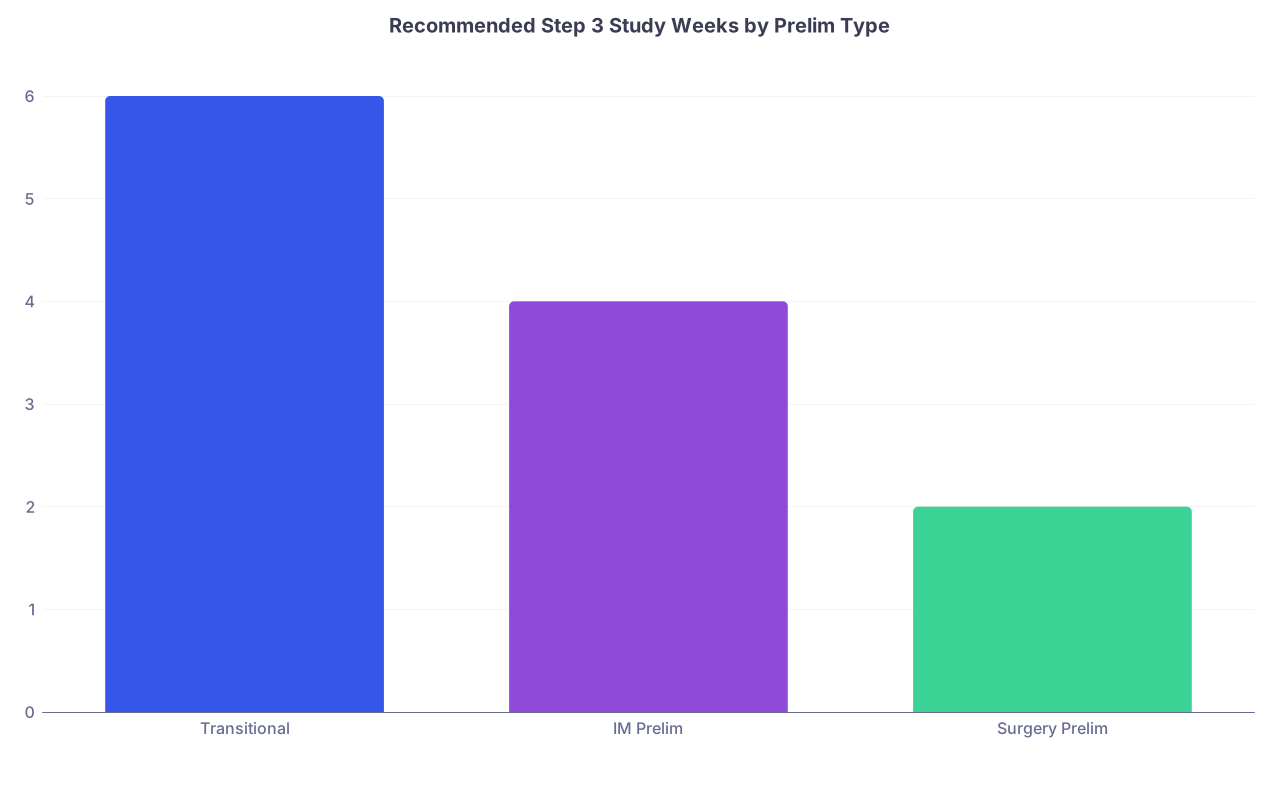
Step 3 Timing
- Many advanced specialties prefer you have Step 3 done by end of PGY-1.
- A lighter TY or balanced prelim IM makes this far more realistic.
- Build:
- 4–6 weeks of predictable time somewhere in PGY-1 to study.
- A test date that is not during ICU or night float.
| Category | Value |
|---|---|
| Transitional | 6 |
| IM Prelim | 4 |
| Surgery Prelim | 2 |
Step 10: Contingency Planning – What If Things Do Not Line Up?
You plan as if everything works. But you also quietly prepare for when it does not.
10.1. Scenario 1: Match Advanced, Do Not Match Prelim
This is where the Supplemental Offer and Acceptance Program (SOAP) becomes critical.
Your move:
- Immediately engage your school’s dean’s office.
- Enter SOAP and target:
- Any ACGME-accredited prelim or TY that fits your advanced program’s requirements.
- Communicate with your advanced program.
- Ask if they have preferred prelims still unfilled.
- Ask if they can support you making specific SOAP choices.
If you still cannot secure a prelim, occasionally advanced programs will help arrange a deferral. Do not bank on that. It is rare and program-dependent.
10.2. Scenario 2: Match Prelim, Do Not Match Advanced
You have options:
- Use prelim year as a strength builder and reapply with stronger letters, US clinical experience, and possibly new research.
- Talk early with your prelim PD about:
- Support for reapplying.
- Possibility of converting to categorical IM/Surg (rare but does happen).
- Do not blindside your prelim PD in January with “by the way, I was reapplying for a different specialty all year.”
10.3. Scenario 3: Terrible Fit at Prelim
You are miserable, but your advanced spot is locked for next year.
Your survival protocol:
- Identify 1–2 attendings who will be allies and write strong letters.
- Protect your evaluations enough not to be labeled a problem resident.
- Carve out:
- At least some time to read in your future specialty.
- A vacation block immediately before PGY-2 start if you can.
This year is not your identity. It is a bridge.
Step 11: Specialty-Specific Planning Nuances
A few high-yield examples I see over and over:
Anesthesiology
- Programs usually:
- Accept TY or IM prelim.
- Prefer solid ICU and inpatient exposure.
- You want:
- Enough acute care to feel comfortable with crashing patients.
- Enough time to prepare for heavy PGY-2 (pharmacology/physiology, etc.).
Best pairing:
- TY or IM prelim with 3–4 months wards, 1–2 months ICU, and some elective time.
Radiology
- Radiology PDs consistently complain about interns who enter PGY-2 clinically rusty.
- A solid medicine prelim often beats an ultra-cushy TY with zero real responsibility.
Best pairing:
- IM prelim with:
- Adequate wards
- Some ICU
- Reasonable call (not malignant)
- Or a strong TY that intentionally builds medicine skills.
Dermatology
- Very competitive.
- Prelim year often doubles as a demonstration of professionalism and work ethic while you pursue derm research or networking.
Best pairing:
- TY with:
- Manageable workload
- Time for derm clinic electives or research
- Or IM prelim with protected weekends/electives.
Do not pick an 80-hour surgical prelim if your main goal is derm research and networking. That is self-sabotage.
Step 12: Personal Checklist – 15 Items to Confirm Before Certifying Your Rank List
Before you hit “certify” on NRMP, sit with this list and be ruthless:
- I understand what type of PGY-1 my advanced programs require.
- Every prelim/TY on my lists meets those requirements.
- I have enough prelim programs ranked on each supplemental list (not 1–2).
- My main ROL correctly lists advanced programs only (plus any categorical backups).
- I have no orphan advanced spots without at least several prelim options.
- I have mapped geographic feasibility for each likely pairing.
- I have a rough financial plan for 1 or 2 moves.
- I know which months during PGY-1 are best suited for Step 3.
- I have checked visa/credentialing constraints for both prelim and advanced.
- I understand my prelim’s schedule culture (wards, nights, ICU).
- I know how often their prelims go into advanced specialties.
- I have asked about vacation timing and whether I can take time off right before PGY-2.
- I have a list of backup strategies if:
- I match advanced but not prelim, and
- I match prelim but not advanced.
- My partner/family understands the two-year plan, not just PGY-2.
- I have had someone experienced (advisor, PD, dean) review my pairing strategy.
If you cannot confidently check these off, pause. Fix the gaps. Then certify.
The Bottom Line
Three points to walk away with:
- A prelim year paired with an advanced spot is not “extra.” You are matching into a two-step system that has to line up cleanly—logistically, educationally, and geographically.
- The NRMP structure (main ROL + supplemental lists) will work for you only if you deliberately map and rank prelim options that your advanced programs actually accept and that you are willing to attend.
- Your prelim year should set you up, not set you back: choose the type, intensity, and location that make you a stronger PGY-2, not just a survivor of PGY-1.