Most prelims waste their best opportunity to escape: they work hard, stay quiet, and graduate forgotten.
You cannot afford that.
If you are in (or heading into) a preliminary year and you want a categorical spot—whether in the same hospital or elsewhere—your real job is not just “do the intern work.” Your real job is: become impossible to ignore for the right people. That means a deliberate, structured approach to networking inside your prelim program.
Let me walk you through how to do that like a professional, not like a desperate applicant spraying emails in February.
Step 1: Get Absolutely Clear on Your Targets
You cannot build an effective network if you are vague about what you want. “I want a categorical spot somewhere” is not a target. That is a wish.
You need three decisions:
- Primary specialty target
- Geographic flexibility
- Strategy for “Plan B”
1. Lock in your primary specialty (at least for this year)
You are a prelim. Common situations:
- Prelim medicine → wants categorical IM, neuro, anesthesia, rads
- Prelim surgery → wants categorical surgery, ortho, urology
- Transitional year → wants basically anything more competitive
Pick one specialty that you will present as your clear goal for this year. You can internally doubt it, fine. Externally, ambiguity kills advocacy. Faculty hate going to bat for someone who “might do IM, or maybe anesthesia, or maybe derm if possible.”
Your script needs to sound like this:
- “I am pursuing a categorical internal medicine position, ideally here or at a similar academic program.”
- “I am aiming for a categorical anesthesia position and using this prelim medicine year to strengthen my clinical base and letters.”
Not:
- “I am keeping my options open and seeing what happens.”
- “Maybe cards later, but I’m also thinking EM or something surgical.”
2. Define your geographic reality
You will get asked:
- “Are you tied to this region?”
- “Would you stay here if something opened?”
- “Are you trying to go back home?”
Answer needs to be clear and consistent. Faculty remember this.
Decide:
- Option A: “I will go anywhere for a categorical spot.”
- Option B: “I prefer this region but will go elsewhere for the right fit.”
- Option C: “I am strongly tied to this city/state.”
Then stop changing the answer every week.
3. Decide your Plan B
If you do not get a categorical in your dream specialty:
- Do you reapply same specialty?
- Pivot to IM/FM/psych?
- Take a research year?
You do not need to broadcast this widely, but you must personally know it. Why? Because it affects whose radar you want to be on:
- If you might pivot to IM, you should be known by the IM PD and at least two core attendings.
- If you might pivot to FM, talk early to the FM folks on any off-site rotation or affiliate.
Step 2: Understand What a Prelim Year Actually Buys You
A prelim year is misunderstood by a lot of residents. It is not just “a gap filler.” It is a powerful one-year audition with three main assets:
- Daily access to attendings who write letters and talk to PDs.
- Proof of performance in an ACGME environment (US grads and IMGs alike).
- A front-row seat to local categorical churn (people leaving, getting dismissed, changing specialties).
Your job is to turn those three assets into:
- 2–4 strong letters from the right people.
- A small group of vocal advocates inside the department.
- Knowledge of categorical openings months before ERAS or SOAP.
If you treat your prelim like “survive and move on,” you get none of that.
Step 3: Build a First-Quarter Networking Blueprint
You need a written plan for the first three months. Not vague intentions. A plan.

| Step | Description |
|---|---|
| Step 1 | Start Prelim Year |
| Step 2 | Map Key People |
| Step 3 | Schedule Intro Meetings |
| Step 4 | Identify 2-3 Core Mentors |
| Step 5 | Targeted Rotation Choices |
| Step 6 | Join Department Activities |
A. Map the key people in your program
Sit down in week 1 and write names. Literally. On paper.
You need to know:
Program leadership
- Program Director (PD)
- Associate/Assistant PDs
- Chief residents
Specialty-specific leaders (depending on your target)
- Division chiefs (cards, GI, pulm, neuro, anesthesia, etc.)
- Clerkship director / site director
- Fellowship directors if relevant
Faculty categories
- People known for writing strong letters
- People who influence the rank list and hiring
- People who run resident research projects
Ask senior residents:
- “Who actually carries weight for fellowship matches?”
- “If someone here wanted to stay for categorical, whose support matters most?”
- “Who writes the strongest letters for people going into [your target specialty]?”
Write it all down. Highlight 5–7 names as your A-list targets.
B. Schedule intro meetings in the first 4–6 weeks
Do not wait until January. That is what everyone else does. By then, faculty are tired and locked into their opinion of you.
For each A-list person, send a direct but respectful email like:
Subject: Prelim resident interested in [specialty] – brief meeting
Dear Dr. X,
My name is [Name], I am a preliminary [medicine/surgery/TY] resident on your service this year. I am planning to pursue a categorical position in [specialty], ideally within an academic setting, and I would value your guidance on how best to use my prelim year to become a strong candidate.
Would you have 15–20 minutes in the next few weeks for a quick meeting? I am happy to come to your office or meet via Zoom at your convenience.
Best regards,
[Name], MD
Prelim [Department] Resident
You are not asking for a job in that email. You are asking for advice. Faculty are more open to that.
C. Go into those meetings prepared
You get one early impression. Do not waste it.
Bring:
- Updated CV (1–2 pages)
- Brief list: your career goals, any research you have done, Step scores
- 2–3 pointed questions
Examples:
- “Given my background, what would you prioritize in this year to be competitive for a categorical [specialty] spot?”
- “Who in this department would you recommend I work closely with?”
- “Are there residents who recently moved from prelim to categorical that I should talk to?”
Then, crucial: write down their advice and act on it. Later, email them:
Thank you again for meeting with me on [date]. I have started doing [X] that you suggested. I will update you in a few months on my progress.
You are teaching them something: that investing in you is not a waste.
Step 4: Use Rotations as Your Primary Networking Weapon
You will not network effectively in hallways and conferences alone. Your strongest tool is how you perform on rotations—and how you leverage that performance afterward.
1. Treat every A-list attending rotation as an audition
For any month where you work with an A-list faculty member, run this protocol:
Before the rotation:
- Read 2–3 landmark articles or guidelines relevant to their field.
- Ask senior residents what this attending values: efficiency? thorough notes? teaching? clean presentations?
During the rotation:
- Show up early. Always.
- Give tight, organized, non-rambling presentations.
- Volunteer for the annoying-but-visible jobs: family meetings, complex discharge summaries, difficult social issues.
- Ask 1–2 intelligent questions per day. Not 10.
End of week 1 script:
“Dr. X, I want to make sure I am meeting your expectations. Is there anything you would like me to focus on improving—either in my presentations, notes, or clinical reasoning?”
They now see you as coachable and serious.
End-of-rotation ask: If the month went well and feedback is positive:
“I am planning to apply for categorical [specialty], and I value your opinion highly. If, after working with me, you feel you could support me, I would be honored to ask for a letter of recommendation later this year. If not, I would still appreciate any advice on what I should work on.”
That last sentence matters. It gives them an out and shows maturity.
2. Engineer your schedule if possible
If your program allows any say in your schedule:
- Front-load rotations with A-list attendings and your target specialty.
- Avoid being invisible on remote off-service months early in the year.
- Try to rotate at the institution you most want to stay at during July–October, not in March when everything is decided.
If you are already stuck with a schedule, then:
- Identify the months where networking potential is highest (wards with PD, consult services with key faculty, ICU with respected attendings).
- Treat those months as “peak performance” months: no extra moonlighting, fewer distractions, sleep optimized.
Step 5: Convert Daily Work into Lasting Advocacy
Most prelims think good work automatically turns into advocacy. It does not. People forget you. They move on.
You need a system to convert “good impression this month” into “person who will email a PD on my behalf in January.”
A. The 3–Touch Rule
For any faculty member you want in your network, you want at least three meaningful touches:
- Clinical work together (rotation, consults, ICU, etc.)
- Follow-up email and/or meeting after rotation
- Concrete ask (letter, advice, introduction) later in the year
Example timeline:
- August: Work with Dr. A on wards → crush it.
- September: Send thank you + update email.
- November: Meet to discuss application strategy + ask for letter.
Sample follow-up email:
Dear Dr. A,
I wanted to thank you again for the opportunity to work with you on the [service] in August. I learned a great deal from your approach to [specific thing they do well].
Since that rotation, I have [joined X project / presented Y case / taken on Z leadership role].
I remain committed to pursuing a categorical position in [specialty], ideally in an academic setting. I would value the chance to meet with you for 15–20 minutes in the next month to get your perspective on how my application profile is shaping up.
Best,
[Name]
You are reactivating their memory of you and updating your “case file” in their mind.
B. Ask for specific types of help
Faculty are more likely to help if the ask is clear.
There are 4 main things you want from your prelim network:
- Strong letters
- Real-time intel on openings
- Introductions to PDs at other programs
- Advocacy for you if an in-house spot opens
You should not ask all of this from one person. Spread it.
Examples:
For letters:
“Given that we worked closely together on [rotation], would you feel comfortable writing a strong, detailed letter supporting my application for a categorical [specialty] position?”
For intel:
“If you hear about any unexpected categorical openings in [specialty] this year, is it alright if I email you to ask whether you think I might be a good fit?”
For introductions:
“I am very interested in [Other Hospital]’s [specialty] program. If you know their PD or faculty and feel comfortable doing so, would you consider sending an email introduction or allowing me to mention your name when I reach out?”
Step 6: Know the Real Timeline for Categorical Opportunities
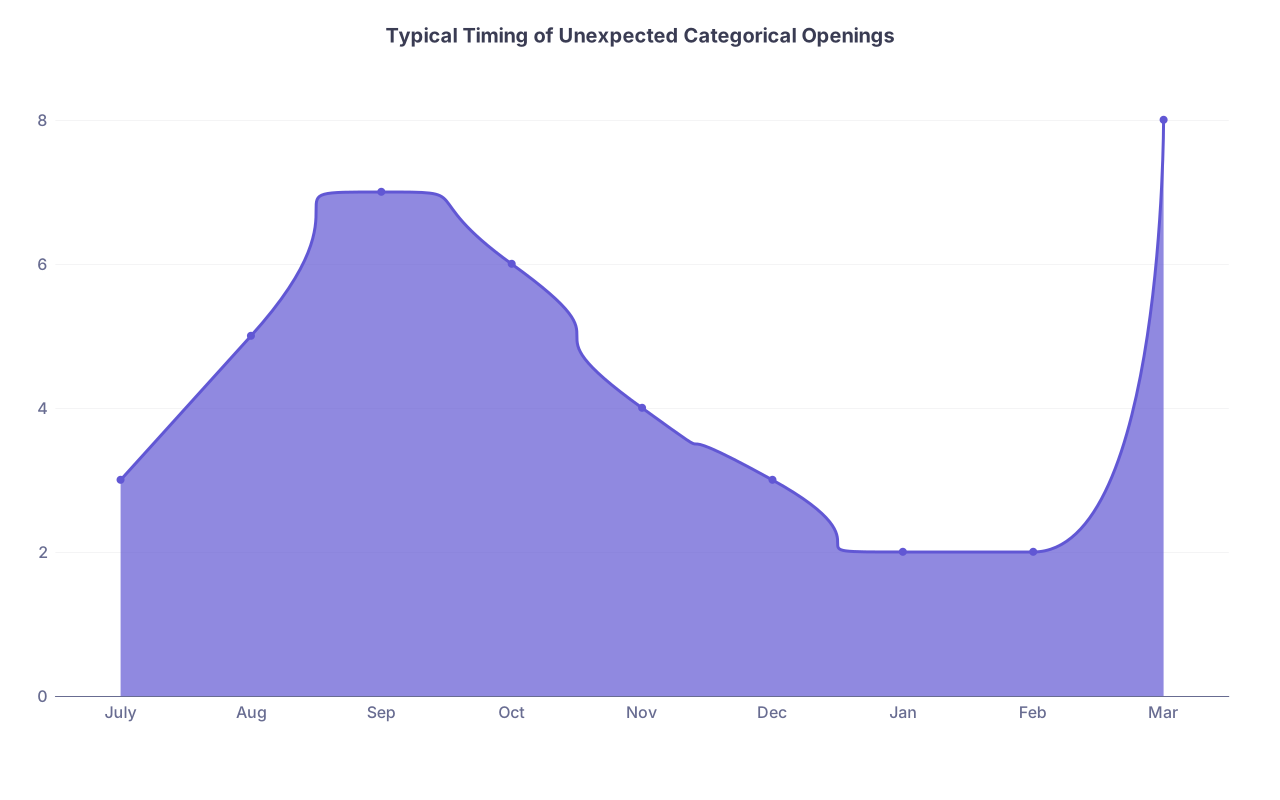
Categorical positions do not just appear in March during SOAP. They leak out across the year.
| Category | Value |
|---|---|
| July | 3 |
| Aug | 5 |
| Sep | 7 |
| Oct | 6 |
| Nov | 4 |
| Dec | 3 |
| Jan | 2 |
| Feb | 2 |
| Mar | 8 |
This is approximate, but the pattern holds:
- Early-year: people quit, fail to show, switch specialties.
- Mid-year: occasional dismissals or sudden leaves.
- SOAP: the chaotic, formalized version of all that churn.
If you build your network early, you are in position when:
- An upper-level leaves a categorical program.
- A PD needs someone reliable to plug a gap.
- Another region hears of you through a faculty connection.
Critical pattern: PDs fill quietly before they fill publicly
What tends to happen:
- PD hears someone is leaving.
- PD asks local faculty: “Do we know any prelims, TYs, or residents who would fit?”
- If no one obvious, then they consider posting broadly or waiting for SOAP.
Your network’s job is to make sure your name surfaces at step 2.
That happens only if:
- You have told people your clear goal.
- You have shown you can function as a solid, not-problematic resident.
- You have at least one vocal advocate who will say, “You should look at [your name].”
Step 7: Build Resident-Level and Peer-Level Support
Faculty are not your only network. Residents can make or break your chances quietly.
A. Be the intern upper levels want again
Upper-levels talk. A lot.
You want:
- “If they need someone solid, this prelim is safe to hire.” Not:
- “They are nice but disorganized.”
- “Smart but slow. Not sure they can handle a full load.”
Concrete behaviors:
- Pre-round early and be ready at sign-out.
- Close the loop on tasks. If you say you will call, you call.
- Communicate bad news early: “I am behind on X; here is my plan to catch up.”
Then, once someone consistently likes working with you, you can say:
“I am trying hard to earn a categorical spot somewhere. If you hear of any openings or PDs looking for a reliable prelim, would you mind letting me know? I really value your judgment.”
Now they are actively scanning on your behalf.
B. Use your prelim class wisely
Do not make the classic error: turning your prelim cohort into a gossip circle. Use them as scouts.
Create a simple shared doc or group chat:
- Track: rumors of openings, PDs changing, new positions at affiliates.
- Share intel: “Spoke with Dr. X in anesthesia—sounds like they might have a spot.”
One of you gets a lead? Ask if you both can be considered. This is not zero-sum every time.
Step 8: Manage the PD Relationship Strategically
Your prelim program director is not your enemy. But they are also not automatically your champion.
Your goal is to:
- Be known
- Be trusted
- Be seen as low-drama, high-upside
A. Early PD meeting (ideally by September)
Request a short meeting once you have a month or two under your belt.
Script:
“Dr. [PD], I wanted to check in early in the year to share my goals and hear your advice. I am a preliminary [medicine/surgery] resident and I am committed to pursuing a categorical position in [specialty]. I would value your perspective on how I am doing so far and what I should focus on this year to maximize my chances.”
Bring:
- CV
- Brief summary of your target specialty and reasons
- 2–3 specific questions
Ask directly:
- “Do you see any weaknesses in my application or performance that I should urgently address?”
- “If a categorical spot here opened, what kind of resident are you usually willing to consider?”
Do not pressure them with:
- “Can you promise to help me stay here?”
- “Are there any spots opening?” (too early, too aggressive)
B. Keep them updated, not overwhelmed
Three PD touchpoints across the year usually works:
- Early meeting (July–September)
- Mid-year update (November–January, as ERAS or SOAP planning begins)
- Pre-SOAP or when a real opportunity appears
In your mid-year email:
- Briefly summarize your performance, any honors, feedback, research.
- Restate your goal.
- Ask: “As I prepare for [ERAS/SOAP/second application cycle], is there anything you recommend I do differently?”
Now, when another PD emails, “How is this prelim?” your PD has fresh, specific info.
Step 9: Documentation: Turn Your Year into Evidence
Networking is easier when you have receipts.
Throughout the prelim year, keep a simple running log:
- Rotations and attendings
- Positive feedback quotes or emails
- Projects, QI, case reports, presentations
- Approximate dates you met or emailed key people
| Month | Rotation/Service | Key Faculty | Action Taken | Next Step |
|---|---|---|---|---|
| July | Wards A | Dr. A (PD) | Intro meeting | Follow up in Oct |
| Aug | ICU | Dr. B | Strong eval | Ask for letter Nov |
| Sep | Cards Consult | Dr. C | Project started | Abstract Jan |
| Oct | Nights | Dr. D (APD) | Good feedback | Email update Dec |
This log does three things:
- Helps you remember who to circle back to.
- Makes letter requests easier: you remind them of specifics.
- Gives you confidence—you see your progress, not just the chaos.
Step 10: When the Door Cracks Open—How to Step Through
Let us say your network does what it is supposed to do. Someone tells you:
- “PD at X has an unexpected categorical PGY-2 opening.”
- Or, “Our department may add one more categorical spot next year.”
Your response must be immediate and disciplined.
A. Confirm your PD and key faculty are on board
Before you send applications all over, quickly check with:
- Your prelim PD
- At least one strong letter writer
Script:
“I heard about a potential categorical opening in [Program]. I am very interested. Would you feel comfortable supporting me if they reach out for an opinion?”
If they hesitate, you have a bigger problem that networking alone cannot fix: performance or professionalism concerns. Address that first.
B. Send a clean, targeted outreach
For a specific opening, do not send a generic “Dear Sir/Madam” email.
Example:
Subject: Prelim [specialty/medicine/surgery] resident – interest in categorical [Specialty] opening
Dear Dr. [Name],
I am currently a preliminary [medicine/surgery] resident at [Your Hospital], planning to pursue a categorical position in [specialty]. I heard from [Referring Faculty, if permitted] that there may be an upcoming opening in your program.
I would be very interested in being considered.
Briefly: I graduated from [School] in [Year], USMLE Step 1 [score or Pass], Step 2 [score], and have strong clinical evaluations in my internship year, particularly on [relevant rotations]. I have attached my CV and ERAS application (if available) for your review.
Dr. [Local PD/Faculty] has kindly agreed to be contacted regarding my performance this year.
If you are accepting applications or would be open to a brief conversation, I would be grateful for the opportunity.
Sincerely,
[Name], MD
Prelim [Department] Resident, [Hospital]
[Contact info]
Your network’s job here is:
- The referring faculty forwards your email and says, “This is a strong prelim; worth a look.”
- Your PD confirms that yes, you are solid.
That combination is powerful.
Step 11: Avoid the Networking Traps That Sink Prelims
Let me be blunt. There are common behaviors that ruin everything you just read.
Being needy instead of professional.
Constantly asking “Any spots yet?” makes you background noise. Ask smart questions. Space out your touches.Trash-talking your current program.
Even if your prelim program is chaotic, do not complain about it in external networking. It makes you look disloyal and risky.Blurring lines into manipulation.
Flattery, fake interest in research, or pretending to love a specialty you clearly do not plan on pursuing—faculty see through it. They talk.Hiding performance concerns.
If you have a red flag (bad eval, professionalism issue), your first networking task is to clean that up. Meet with PD, ask how to fix your reputation, then over-deliver.Waiting for SOAP like it is a rescue boat.
SOAP is chaos. You want to be someone who already has faculty emailing PDs on your behalf before SOAP even starts.
Step 12: If You Are Starting Late, Here Is the Damage Control Plan
Some of you are reading this in December or January. Half the year gone. Alright. You are behind, not dead.
Here is the compressed protocol:
- Identify 3–4 faculty who already know you (even a little) and like you.
- Schedule brief meetings with each over the next 2–3 weeks:
- Be honest: “I am a prelim resident applying for categorical [specialty]. I realize I should have reached out earlier, but I would value your honest feedback and any guidance.”
- Pick the 1–2 who respond most strongly.
- Ask them:
- “If opportunities arise, would you feel comfortable supporting me?”
- “Do you know any PDs who might be open to considering a prelim for a categorical spot this year or next?”
- Meet with your PD now, if you have not.
- Use the remaining months to:
- Crush any rotations with those key faculty.
- Get at least two strong letters.
- Document all achievements and feedback.
You are doing in 3–4 months what should have taken 8–10. It is possible if you stay focused.
The Bottom Line
A prelim year can be a dead-end job or a launchpad. The difference is not your Step score. It is how deliberately you build and use your network.
Here is the reality:
- Programs always need known, safe, hard-working people more than they need mystery applicants with shiny scores.
- Your prelim year gives you full-year exposure to exactly those decision-makers.
- If you squander that, you will be competing cold against people with better paper stats and better connections.
Do not do that.
Today, not tomorrow, do this:
Open a blank page and write a prelim networking map. List:
- Your target specialty (one line, no hedging).
- 5–7 key faculty and leaders you need to know by name.
- 3 residents (upper-levels) whose opinion of you must be “strong yes.”
- The date you will email each for an intro or check-in.
Then send one email right now to the most important person on that list. Fifteen minutes. One message. That is how you start turning a precarious prelim year into categorical doors that actually open.