
The way most residents handle a specialty pivot during a preliminary year is sloppy, short-sighted, and burns bridges they will regret losing. You are not going to do it that way.
You can use your preliminary year to change specialties and walk away with strong letters, mentors, and a reputation that follows you in a good way. But only if you treat this like a structured project, not a panic reaction.
Let me show you the playbook.
1. Get Clear On What a Preliminary Year Really Is
If you are going to pivot from it, you need to understand what you are standing on.
A preliminary year is:
- A 1‑year internship (usually PGY‑1) in internal medicine, surgery, or transitional year
- Often required for advanced specialties (derm, radiology, anesthesia, PM&R, ophtho, neuro, rad onc)
- Sometimes a holding pattern for applicants who did not match into their target categorical specialty
- A fully licensed year of ACGME training—not a throwaway year
The key fact:
Your preliminary program will control your letters, reputation, and schedule for the next application cycle. They can make your pivot either smooth or miserable.
Typical structures:
| Type | Usual Specialty Base | Structure Focus |
|---|---|---|
| Prelim Medicine | Internal Medicine | Wards, ICU, electives |
| Prelim Surgery | General Surgery | OR, wards, trauma |
| Transitional Year | Mixed | Rotations across fields |
| TY w/ advanced spot | Mixed | Tied to advanced program |
If you already have a reserved advanced spot (e.g., matched TY + Radiology):
- Pivoting will be politically and logistically harder
- You are reneging on a contract with your future advanced program
- You need a very strong, well-justified reason and impeccable diplomacy
If you do not have an advanced spot and are on a stand-alone prelim:
- You are in a better position to pivot cleanly
- But your prelim program still controls your narrative for the next application cycle
2. First 4–6 Weeks: Quiet Assessment and Damage Control
The worst thing you can do in July is announce, “I think I picked the wrong specialty.” People barely know your name. You have no credibility. And word will spread fast.
Here is what you do instead.
Step 1: Stabilize your performance
Before you talk about changing specialties, you must prove you can function.
For your first 4–6 weeks:
- Show up early, leave when the work is actually done
- Be clinically safe and ask for help early
- Respond fast to pages and texts
- Double-check orders, especially high-risk meds and consults
- Document clearly and on time
You are building one thing: trust. Without that, no one will go to bat for you later.
Step 2: Start a private reality check
In parallel, you quietly assess:
- Do I hate the whole idea of this specialty, or only this rotation / hospital / attending?
- What parts of the job energize me, even on bad days?
- What parts drain me so badly I dread coming in?
- How much of my dissatisfaction is burnout vs poor fit?
Write this down. Not in your hospital computer. In a private notebook or personal file.
If after a month it is obvious this is not survivable as a career, you are not overreacting. It is data.
3. Decide Early: Pivot or Double Down
You cannot sit on the fence all year. Application timelines will not wait for your feelings to settle.
Here is a practical timeline for a prelim year pivot.
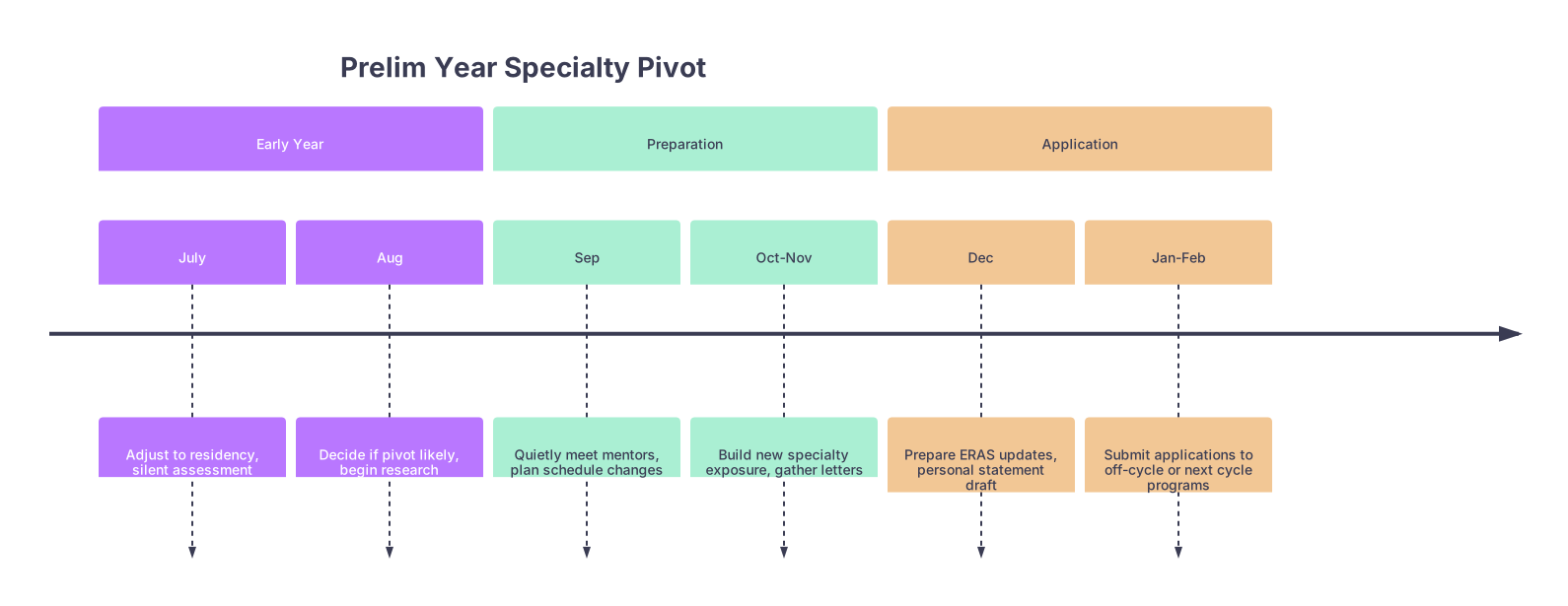
| Period | Event |
|---|---|
| Early Year - July | Adjust to residency, silent assessment |
| Early Year - Aug | Decide if pivot likely, begin research |
| Preparation - Sep | Quietly meet mentors, plan schedule changes |
| Preparation - Oct-Nov | Build new specialty exposure, gather letters |
| Application - Dec | Prepare ERAS updates, personal statement draft |
| Application - Jan-Feb | Submit applications to off-cycle or next cycle programs |
If by end of August you:
- Still feel a strong pull away from your matched specialty
- Can name at least one realistic target specialty that fits better
- Are willing to do the paperwork, networking, and extra effort
…then you pivot. But you do it methodically.
4. Choose Your New Target Specialty Like an Adult, Not a Fantasy
This is where many residents blow it. They pivot from a demanding field to a “lifestyle” field with no realistic shot and no concrete plan. That is not a pivot. That is denial.
You need three things to choose your target:
- Objective viability
- Subjective fit
- Timeline reality
4.1 Objective viability
Pull your actual numbers:
- USMLE/COMLEX scores
- Medical school class rank / AOA / honors
- Research output
- MS4 rotations, sub‑Is, prior interest
Now compare them to real data. Not Reddit.
| Specialty | Typical Step 2 Range (Matched) | Research/Signals |
|---|---|---|
| Dermatology | 255+ | Heavy research, strong ties |
| Orthopedics | 250+ | Home program huge plus |
| Anesthesiology | 235–245 | Some flexibility |
| IM (academic) | 230–245 | Research helpful |
| FM | 220–235 | Broadly accessible |
If your Step 2 is 226 and no research, derm is fantasy. Anesthesia, PM&R, psych, FM, some IM programs might be realistic.
You can still try for a reach, but you must have safe targets.
4.2 Subjective fit
Ask yourself:
- Do I want more procedures or more thinking?
- Inpatient chaos or outpatient continuity?
- Long training with high pay, or shorter training with quicker stability?
- How much do I care about lifestyle really, not just in theory?
You already have new information from residency. For example:
- If you love ICU nights, maybe anesthesia or critical care–leaning IM
- If you enjoy working with neuro patients on the floor, maybe neurology or PM&R
- If you like clinic days more than call, think outpatient-heavy fields
4.3 Timeline reality
Some pivots are best done as:
- In-cycle reapplication (apply in September for the next July)
- Off-cycle transfers (take open spots mid-year)
- Post‑prelim gap followed by re-applying
If you are starting your prelim in July and decide by August, you are likely targeting next year’s PGY‑1 or PGY‑2 spots. Occasionally, you can land a PGY‑2 categorical transfer if you are in the same base specialty (e.g., prelim IM to categorical IM), but that is a different conversation.
5. Tell Your Program Without Blowing Yourself Up
You need your program on your side. Or at least not against you.
Timing and framing matter.
Step 1: Identify one trusted person
Not the most senior, not the most intimidating. The person who has already shown they:
- Care about resident development
- Are relatively sane
- Give honest feedback
Could be:
- An APD who does evaluations
- A chief resident with real influence
- A faculty mentor from early rotations
Step 2: Have a structured conversation
You do not say:
“I hate surgery and want to do psych instead. What do you think?”
You say something closer to this:
“Dr. Smith, thank you for meeting with me. I want to be transparent early so I can do this the right way.
Over the last few months, I have realized that my long‑term fit is likely in [new specialty] rather than [current specialty]. This is not about this program—everyone has been supportive and I am fully committed to doing excellent work here this year.
I want to ask your advice on how to explore [new specialty] responsibly while still being a strong prelim here, and to understand what is realistic from the program’s perspective in terms of letters and scheduling.”
What you are signaling:
- Respect for their program
- Commitment to doing good work this year
- Thoughtful decision, not impulsive whining
- Willingness to play by the rules
Then stop talking. Let them react.
Some will be surprisingly helpful. Some will be neutral. A few will be hostile. Your job is to stay calm and keep framing this as a career alignment issue, not a criticism of them.
Step 3: Ask for specific help
If the conversation goes “okay” or better, ask concrete questions:
- “Are there any elective blocks that could be rearranged so I can rotate in [new specialty]?”
- “What would you need to see from me to feel comfortable writing a strong letter?”
- “Do you know anyone in [new specialty] here or at our affiliate sites I should talk to?”
If it goes badly and they shut you down:
- Stay professional
- Do not argue
- Quietly look for other faculty and outside rotations to build your case
You only need a few advocates. Not the whole department.
6. Use Your Schedule Strategically
Your preliminary year schedule is a currency. You must spend it carefully.
If you are in a Transitional Year
You have the most flexibility. Use it.
- Front‑load heavy mandatory rotations (wards, ICU, ER)
- Reserve later months for your target specialty electives
- Aim for at least 1–2 rotations in your new field, plus related subspecialties
Example: Pivoting to anesthesiology?
- Try to get: anesthesia, ICU, maybe pain or perioperative clinic
If you are in a Prelim Medicine or Surgery Year
You have more constraints, but there is usually some room:
Ask early about elective / ambulatory blocks
Volunteer for rotations that align with your new target:
- IM prelim → neurology, cardiology, outpatient clinic, ICU
- Surgery prelim → anesthesia, surgical ICU, interventional radiology, EM
If internal electives are blocked, explore:
- Away electives at affiliated sites
- Observerships in the evenings or on golden weekends (if permitted)
- Research projects with the new specialty, even remotely
What you are trying to get from these rotations:
- One very strong letter writer in the new specialty
- Concrete stories and cases for your personal statement
- Evidence that you understand the work and still want it
7. Letters, Reputation, and Not Burning Bridges
This is where people underestimate how small medicine is.
You might leave your preliminary specialty, but you will not leave the network. Your attendings will know attendings in your new field. Word travels.
Your goals:
- Finish your prelim year as “one of our best interns, even if they went elsewhere.”
- Walk away with at least 2 strong letters: one from prelim program, one from target specialty.
- Avoid any narrative of “difficult, unprofessional, or entitled.”
7.1 How to earn strong letters while pivoting
On your current specialty rotations:
- Treat each one as if you are staying long term
- Be the person who makes the team’s day a little easier—not the constant complainer
- When you know a rotation will end, ask directly:
“Dr. Lee, I have really appreciated working with you this month. I am applying to [new specialty] this year, and although it is a different field, a letter from you about my work ethic and clinical performance would be extremely valuable. Would you feel comfortable writing a strong letter for me?”
If they hesitate, thank them and move on. You want strong, not lukewarm.
On your new specialty rotations:
- Tell them up front that you are serious about switching
- Ask for feedback early: “What would I need to demonstrate on this rotation to be a competitive applicant in your opinion?”
- Then actually do those things
7.2 Things that will burn bridges
Avoid these like a central line infection:
- Trash-talking your current specialty or program to anyone (especially students)
- Calling your prelim year “a waste” in any written application or interview
- Being visibly disengaged on rotations once people know you are pivoting
- Going over key faculty’s heads without at least trying to involve them
- Making your program chase you about duty hours, notes, or professionalism
You can be honest about the mismatch without being disrespectful. Something like:
“I have gained a lot from this year in [specialty], especially in managing acute illness and complex inpatients. Long term, I realized my strengths and interests fit better with [new specialty], so I am grateful I recognized that early and can make that transition thoughtfully.”
8. Application Mechanics: How to Re-Enter the Match Without Chaos
You are now juggling:
- Full‑time resident workload
- Specialty exploration
- ERAS (or other) applications
- Letters, personal statement, and logistics
Here is how to make it less painful.
8.1 Decide your target entry point
You have a few options:
- Apply for PGY‑1 categorical in the new specialty (start over next July)
- Apply for advanced PGY‑2 spots with your prelim counting as PGY‑1
- Look for off-cycle PGY‑2 openings posted on NRMP, program websites, or listservs
You need to ask programs explicitly whether your preliminary year will count toward time in training for that specialty.
8.2 Build a coherent story
Your personal statement and interviews must answer:
- Why you entered your original field.
- What you learned concretely during your prelim year.
- Why you are pivoting now.
- Why the new specialty is a better fit based on evidence, not vibes.
You cannot say, “I realized I wanted a better lifestyle.” Even if it is true. You frame it as:
- Better alignment with your strengths
- Stronger long-term match with the type of patients and problems you enjoy
- Clear understanding of the new field’s challenges
Tie your prelim experience into your new specialty:
- IM prelim → anesthesia: talk about comfort with acutely ill patients, ICU experience, airway exposure if any
- Surgery prelim → radiology: discuss understanding anatomy, operative planning, imaging in decision-making
- TY → anything: highlight breadth, adaptability, and systems knowledge
8.3 Coordinate letters correctly
Typical good mix:
- 1–2 letters from attendings in your new specialty
- 1 letter from your prelim program director (or associate PD)
- Optional: one additional letter from a strong advocate in your current specialty
Check each program’s requirements. Some will insist on a PD letter. Do not dodge it. That looks worse.
8.4 Manage logistics without imploding on service
Concrete tactics:
- Block out 2–3 evenings per week in your calendar as “application time” for 2–3 months
- Use lighter rotations (clinic, elective, consults) to push major application tasks
- Draft personal statements and CV updates early (September–October) before interview season chaos
- Keep track of everything in a simple spreadsheet: programs, deadlines, letter status, communication
You are running two jobs: intern and applicant. Treat it that way.
9. Protect Your Mental Health While You Pivot
This process is stressful and isolating. Most residents pretend they are fine until they are not.
Here are pragmatic ways to not implode:
- Find one or two peers you trust who know about your pivot. Not ten. Two.
- Set a strict rule: zero doomscrolling on anonymous forums after 10 p.m.
- Use your institution’s counseling or resident wellness services at least once to get plugged in. You do not need to be “falling apart” to justify it.
- Have non-medical structure each week: gym, walks, a recurring call with a friend, religious services, whatever anchors you.
You are making high-stakes decisions under fatigue. That is dangerous. You need guardrails.
10. If You Hit a Wall: What to Do When Programs Say No
Sometimes you do everything right and still:
- Do not match into the new specialty
- Only get offers in community programs you are unsure about
- Face pressure to stay in your original field
This is where you make an adult decision, not a panicked one.
Options to consider:
- Take a categorical spot in your original field and try to shape your career within it (fellowship, niche, hybrid roles).
- Accept a less-than-ideal program in your new specialty with a plan to work hard, build a reputation, and possibly transfer later.
- Do a gap year (research, chief year, hospitalist, or non-training role) and reapply stronger.
There is no universal “right” answer here. But three rules apply:
- Do not burn your current bridge unless you have a signed new one.
- Do not assume “I can always reapply later” without a realistic plan to improve your application.
- Do not let pride make the decision. Prestige does not treat your patients or pay your loans.
If you get stuck, talk to:
- A trusted mentor outside your institution
- A PD in your target specialty who is willing to be blunt
- Your medical school dean’s office (they have seen every version of this before)
11. Quick Visual: How Your Time Should Shift During the Pivot
You cannot add more hours to the day, but you can rebalance.
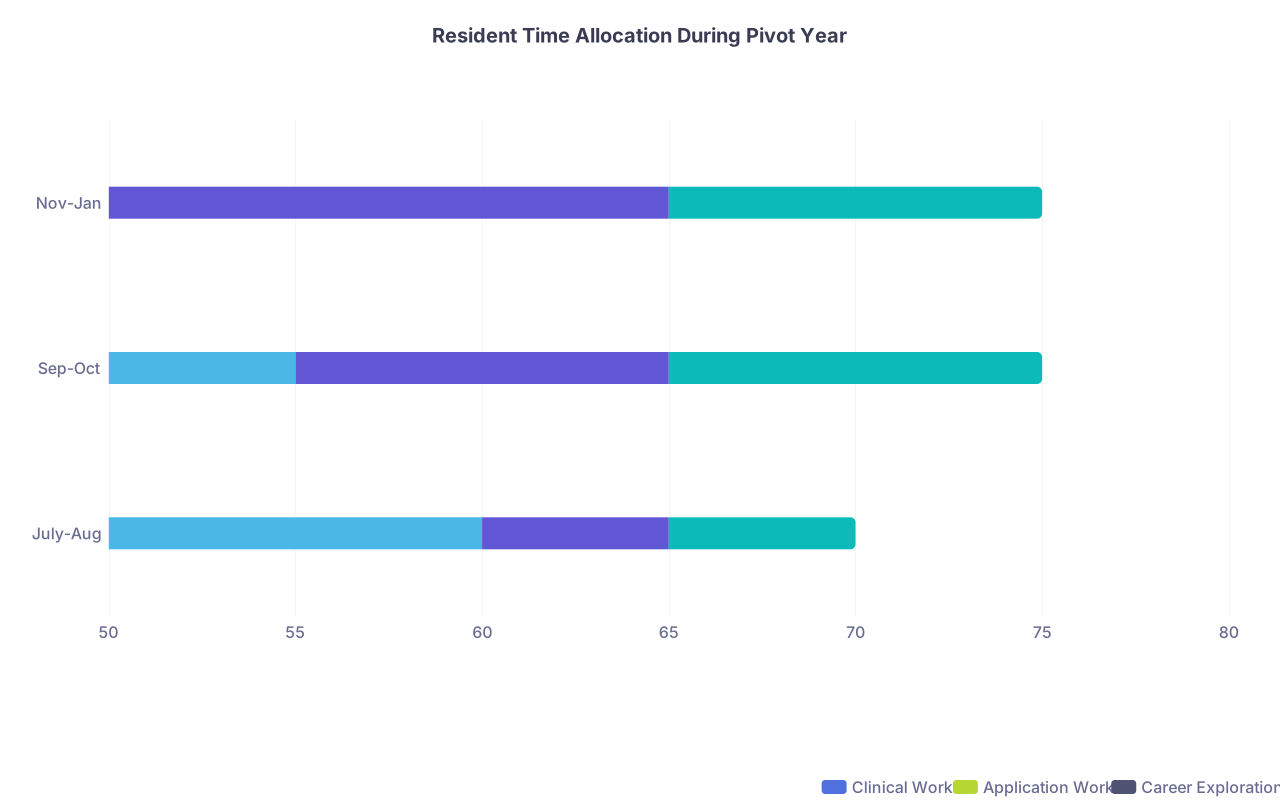
| Category | Clinical Work | Application Work | Career Exploration |
|---|---|---|---|
| July-Aug | 60 | 5 | 5 |
| Sep-Oct | 55 | 10 | 10 |
| Nov-Jan | 50 | 15 | 10 |
You are not working fewer hours overall. You are shifting your limited discretionary time from “mindless recovery scrolling” into targeted career work. That is the difference between drifting and pivoting.
12. Concrete Example Scenarios
Two quick sketches from situations I have seen play out.
Scenario 1: Prelim Surgery → Anesthesia
- Step 2: 239, no red flags
- Realizes by August that OR is great, clinic is not, but hates 80+ hour weeks and constant pages
- Talks to PD in September, frames pivot professionally
- Gets anesthesia elective in November, ICU in January
- Earns strong letters from ICU attending and anesthesia rotation director
- Applies to a mix of mid-tier university and strong community anesthesia programs
- PD writes supportive letter focusing on work ethic and performance
- Matches into anesthesia PGY‑1 the next July, prelim surgery year counts as PGY‑1 for some programs but ends up starting over in a categorical PGY‑1 for better training environment
Outcome: No burned bridges. Still invited to old program’s events. Has attendings from surgery who refer complex cases to him later as an attending anesthesiologist.
Scenario 2: TY → FM after missing derm
- Initially did TY as a holding year for dermatology research
- Mid-year realizes what they like most: continuity clinic, counseling, procedures that are simpler
- Quietly pivots attention to FM
- Takes outpatient FM elective and sports med rotation
- Builds a narrative around liking broad care and community impact
- Applies broadly to FM with one derm letter, two FM letters, and TY PD letter
- Lands strong community FM program with sports med fellowship
Outcome: No one cares they “missed derm.” They built a coherent story and showed up fully for each phase.
13. Use the Prelim Year as Leverage, Not a Liability
If you do this right, your preliminary year becomes a flex in applications, not a stain:
- You have real-world proof of resilience and adaptability.
- You have seen medicine from another angle—genuinely useful in almost every field.
- You show maturity: recognizing a mismatch early and fixing it without drama.
You are not “stuck,” and you are not “behind.” You are just in a more complex part of the game that demands strategy instead of autopilot.

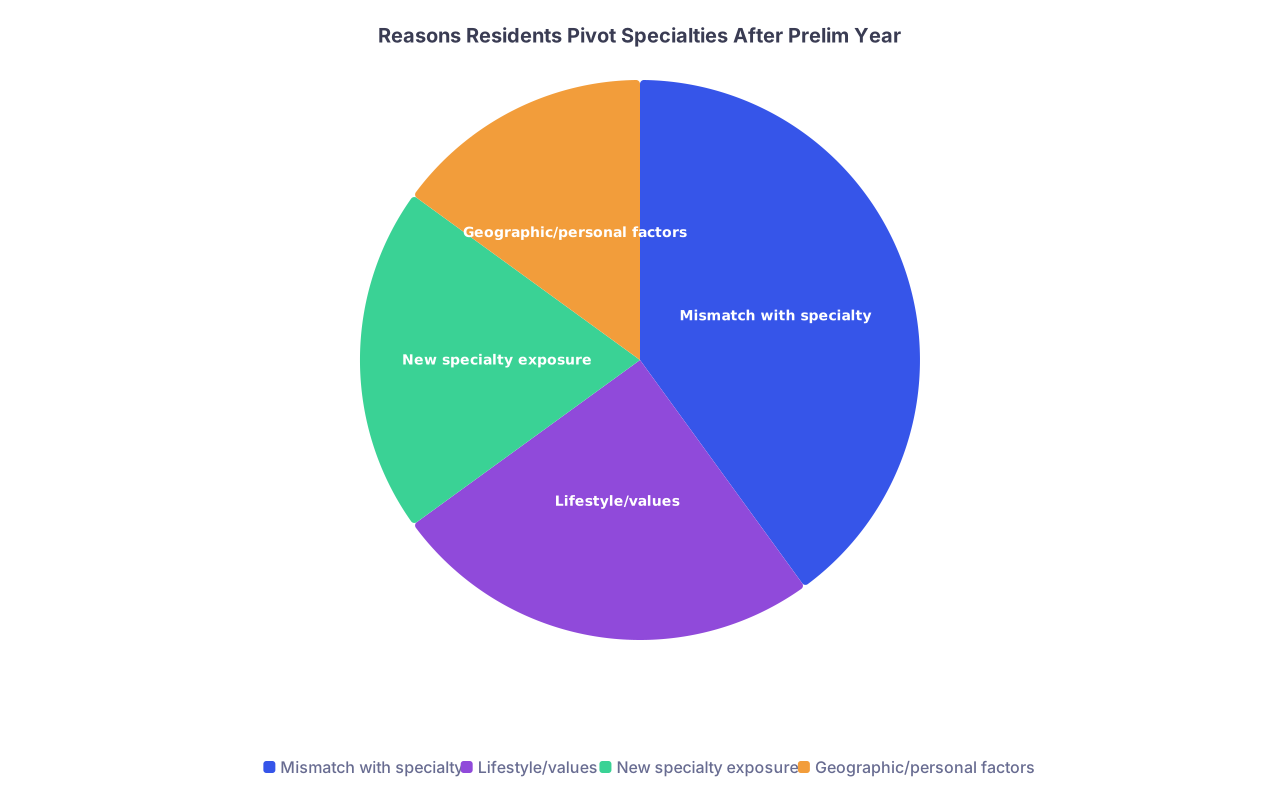
| Category | Value |
|---|---|
| Mismatch with specialty | 40 |
| Lifestyle/values | 25 |
| New specialty exposure | 20 |
| Geographic/personal factors | 15 |
Bottom Line: Three Things to Remember
- Perform first, pivot second. Your reputation this year is the foundation of any successful specialty change.
- Be strategic and transparent, not impulsive. Choose a realistic target, involve the right people early, and build rotations and letters that support your story.
- Leave every bridge standing. You may leave your preliminary specialty, but those attendings and co-residents will remain part of your professional world for decades. Treat them that way.