
The biggest mistake prelim interns make is treating the year like a 12‑month holding pattern. It is not. A preliminary internal medicine year can be the single most powerful lever you have to engineer a successful re‑match—if you treat it like a deliberate, high‑stakes audition instead of a consolation prize.
You lost the first match. Fine. Now you have one year to fix the file, prove your value on the wards, and get yourself back in the game with a much stronger application. Here is exactly how to do it.
1. Understand What a Preliminary Internal Medicine Year Really Is
A preliminary internal medicine (IM) year is not just “PGY‑1 before something else.” It is:
- A fully accredited ACGME internship in internal medicine
- One year (sometimes two) of broad clinical training without guarantee of continuation in the same program
- Typically used by people headed into:
- Neurology
- Anesthesiology
- Radiology
- PM&R
- Dermatology
- Ophthalmology
- Radiation oncology
- Sometimes surgery specialties (if they did not secure a categorical spot)
For a re‑match, a prelim IM year gives you three high‑value assets:
- Fresh, U.S. clinical performance in an ACGME setting
- Letters from real attendings who see you manage patients, not just shadow
- A narrative: you took a hit, did real work, improved, and are now better prepared
Here is the harsh reality: many unmatched applicants spend a year doing research or observerships and change very little about their core weaknesses. You will be in the trenches—admitting, cross‑covering, leading codes. If you are smart, you convert that grind into undeniable evidence that you belong in residency…this time in the right specialty.
2. Diagnose Why You Missed the First Match (Bluntly)
If you do not have a precise, written diagnosis of why you failed to match or matched only prelim, you are already behind. Guessing is useless. You need a clean autopsy of your application.
Sit down—in one uninterrupted hour—and list out the likely reasons under four buckets:
- Academic: USMLE/COMLEX scores, fails, gaps, coursework, remediation
- Clinical: Weak evaluations, lack of U.S. clinical experience, no continuity experience
- Professionalism / Communication: Red flags, vague dean’s letter language (“requires supervision,” “benefits from feedback,” etc.), poor interviews
- Strategy / Logistics: Late ERAS, poor school list, weak personal statement, scattered letters, over‑reliance on “reach” programs
Then pressure test that list with someone who will not sugarcoat it:
- A trusted program director (PD) or associate PD at your prelim institution
- Your medical school dean or advisor
- A senior resident who does rank lists and knows how committees think
Do not ask, “What do you think?” Ask:
- “Would you have ranked my file to match in your program? If not, why exactly?”
- “If you could change three things about my last application to get a different result, what would they be?”
- “Where does my file fall compared to your average matched intern—scores, letters, experiences?”
Write the answers down. Ugly truths included.
That list becomes your Prelim‑Year Re‑Match Problem List. Everything you do this year must attack items on that list.
3. Set a Re‑Match Strategy Before July 15
You cannot wing a re‑match using “I’ll just work hard and see.” That is how you get to January with no letters and a vague plan.
By mid‑July, you need:
A. Target Specialty and Backup Plan
Commit. Not “maybe derm, maybe anesthesia, maybe IM.” That reads as confused and unserious.
Your decision framework:
- If your dream specialty is ultra‑competitive (derm, ortho, plastics), ask:
- Do I have at least one major differentiator? (high Step 2, strong research, connection)
- Or am I better served pivoting to a realistic specialty now?
Sometimes the smartest move is: aim for medicine, anesthesia, neuro, psych—something attainable—then subspecialize later.
Write it out:
- Primary target: e.g., Anesthesiology
- Backup specialty: e.g., Internal Medicine (categorical)
- Non‑negotiables: geography, visa, specific training needs
B. Re‑Match Scorecard
Put your weaknesses against clear, measurable prelim‑year goals:
| Problem | Target Change by ERAS |
|---|---|
| Low Step 1, avg Step 2 | Honors on 4+ inpatient rotations |
| Weak letters | 3 new, specialty-aligned LoRs |
| No research | 1 submitted abstract or paper |
| Poor interview skills | 3+ mock interviews completed |
This is your dashboard. If your actions this month do not move any of those metrics, you are wasting time.
4. Use the Wards as a 12‑Month Audition
Your prelim internship is your live audition for PDs. They are not looking for perfection. They are looking for:
- Reliability
- Work ethic
- Clinical growth
- Team behavior
- Zero professionalism drama
Here is how you deliberately build that reputation.
A. Behave Like a Categorical Resident
Even though you are prelim, act as if you will be there for three years:
- Show up 10–15 minutes early, consistently
- Know your patients cold at sign‑out
- Volunteer (selectively) for the extra admission, the sick patient, the family meeting
- Never be the person nursing has to chase
If you carry yourself like an “extra,” attendings mentally write you off as temporary. You need them thinking, “We should keep this person.”
B. Nail the Unsexy Work
People remember three things about interns:
- Did you get the work done?
- Did you own your mistakes?
- Were you decent to be around at 2 a.m.?
Be systematic:
- Create a reliable task tracking method on every shift (checklist, OneNote, index card—whatever you will actually use)
- Call back consults and families promptly. Document clearly.
- When you screw up (and you will), tell your senior early, propose a fix, and follow through
I have watched prelims go from “random extra body” to “we have to find a spot for this person” purely because they were relentlessly dependable and low‑drama.
C. Target Evaluations and Comments, Not Just “Meets Expectations”
You want evaluations that say:
- “Functions at or above level”
- “Would rehire”
- “Top intern on the team”
- “We would be happy to have them in our residency”
To get that, you must ask:
- Week 1 of every rotation: “Dr. X, I want to make the most of this month. What are 2–3 specific things you look for in a strong intern?”
- Mid‑rotation (not day 28): “Are there one or two things I can adjust to be more effective on the team?”
Then actually do what they say. You are not fishing for compliments; you are manufacturing strong end‑of‑rotation comments.
5. Engineer Powerful Letters of Recommendation
Weak letters kill re‑matches. Generic “hard worker, pleasant to be around” letters help nobody.
You need 3–4 high‑impact letters:
- 1–2 from your prelim IM program (inpatient attendings, chief, or PD)
- 1–2 from faculty in your target specialty (if you are switching, you must show commitment to the new field)
A. Choose Letter Writers Intentionally
Strong letter writers:
- Have actually supervised you closely (not just saw you on rounds twice)
- Are known in the field or have titles (PD, APD, division chief, fellowship director)
- Can compare you to peers (“top 10% of interns I have worked with in 10 years”)
Plan your rotation schedule (where possible) to work with these people early enough that letters are ready for ERAS.
B. How to Ask for a Strong Letter
Do this face‑to‑face or over Zoom, never just by email:
“Dr. Smith, I am applying to re‑match into anesthesiology this cycle. I have valued working with you this month. Would you feel comfortable writing me a strong letter of recommendation that comments on my clinical performance and growth during this rotation?”
Watch their reaction. If they hesitate or soften (“I can write you a letter…”), move on. You need enthusiastic writers.
Provide them:
- Your updated CV
- A brief paragraph reminding them of specific patient encounters or projects you worked on
- Your personal statement draft or short specialty interest summary
Give them a real deadline (e.g., “By September 1”) and politely follow up once if needed.
6. Fix the Paper Application: Scores, CV, and Personal Statement
The clinical year is only half the story. Programs still screen on paper first.
A. Exams and Certifications
If any of this applies to you, address it head‑on:
Low Step 1 / Step 2: You cannot change the number, but you can:
- Crush Step 3 (if timing and licensing rules allow during prelim year)
- Show a clear upward trend in in‑service or other standardized testing
Failed attempts: You must have a concise explanation ready:
- Short, direct, without excuses
- Paired with concrete evidence of improvement (Step 2/3, strong evaluations)
Do not take Step 3 casually. If you cannot realistically score well while working, coordinate with your PD to use an elective or lighter block for focused prep.
B. Research and Scholarly Work (Without Wasting Nights)
If your specialty cares about research (derm, rad onc, academic IM, etc.), you cannot ignore this. But you also cannot work 80 hours and pretend you will write three first‑author papers from scratch.
You aim for feasible wins:
- Case reports from interesting admissions
- Quality improvement projects you are already doing (sepsis bundle compliance, discharge delays)
- Retrospective chart reviews where data collection can be spread over months
Find a mentor in July or August:
- Email 2–3 faculty: “I am a prelim IM intern interested in [specialty]. I am looking for a small project I can contribute to this year that is realistic with my schedule. Is there anything ongoing I can help with?”
Your realistic goal by ERAS:
- 1 submitted abstract or manuscript
- Or 1 national/local poster with your name on it
Not impressive by itself, but it signals momentum and commitment.
C. Rewrite Your Personal Statement Like a Grown‑up
Your previous personal statement probably read like every other student: “I have always wanted to help people… a patient inspired me… I love both science and humanity.”
You are not a student anymore. You have battle scars. Use them.
Your revised statement should:
Own the set‑back briefly (if appropriate):
- “I did not match into a categorical position on my first attempt. During my preliminary internal medicine year, I have had the opportunity to…”
- Do not wallow. Two sentences, then pivot to growth.
Highlight specific growth from the prelim year:
- You managed septic shock in the middle of the night
- You conducted difficult family goals‑of‑care conversations
- You learned to prioritize, triage, and lead
Tie those experiences directly to your target specialty:
- For anesthesia: calm under pressure, physiology focus, team‑based care
- For IM categorical: longitudinal thinking, complexity management
- For neuro: detail orientation, comfort with uncertainty
If you cannot see a reader nodding along thinking, “This person has actually done the job,” you need to rewrite.
7. Work with Your Prelim Program Leadership Strategically
Your prelim PD and chiefs can be your biggest allies—or obstacles—depending on how you handle them.
A. Be Transparent Early (But Not Chaotic)
By August or early September, schedule a meeting with your PD:
- “I want to be upfront about my career plans so I can get your guidance. I am planning to apply to re‑match into [specialty] this cycle. I am fully committed to giving 100% to this program this year, and I also want to make sure I set myself up well for the next step. Can I get your advice on how to approach this and whether you would be willing to support my applications?”
You want their buy‑in, not their surprise when they get a call in January asking about you.
B. Ask for Concrete Help
Specifically:
- “Could you comment in your letter on my performance compared to your categorical residents?”
- “If you hear of open PGY‑2 or categorical PGY‑1 positions, would you be willing to let me know?”
- “Are there faculty in [target specialty] you recommend I work with or contact?”
Some prelim IM programs have strong connections with anesthesia, neuro, etc. Use those networks.
8. Time Your Re‑Match Effort: Month‑by‑Month Roadmap
Here is a realistic structure for your year.
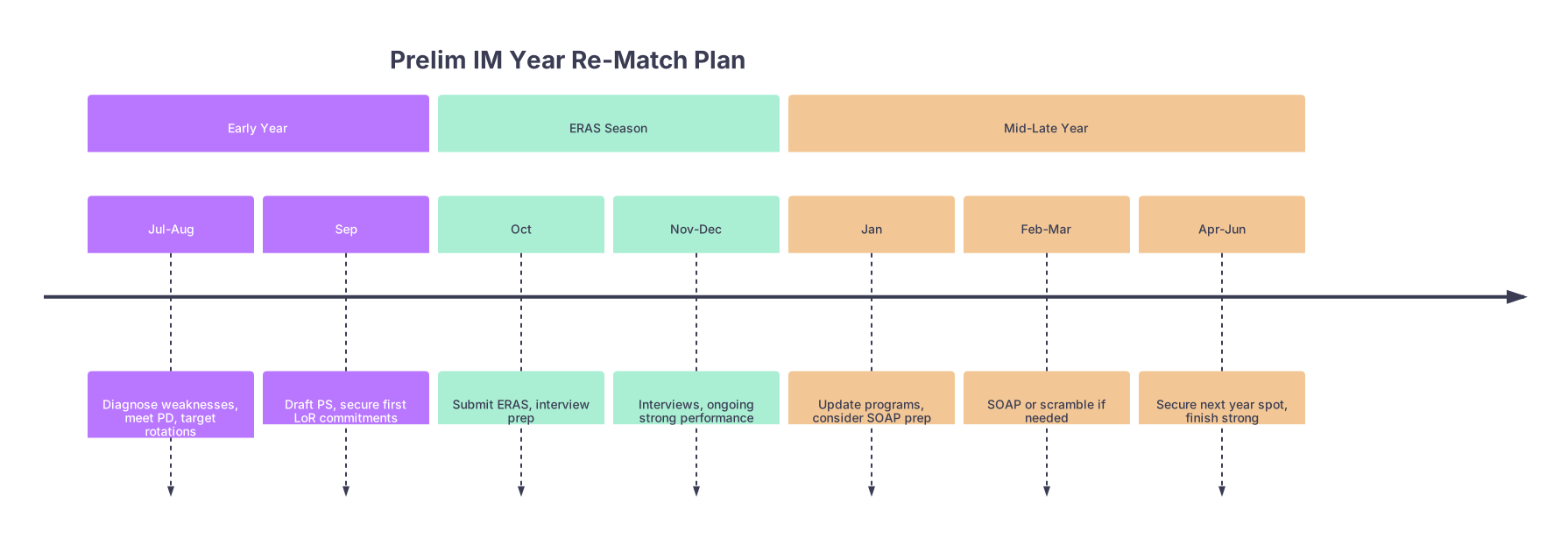
| Period | Event |
|---|---|
| Early Year - Jul-Aug | Diagnose weaknesses, meet PD, target rotations |
| Early Year - Sep | Draft PS, secure first LoR commitments |
| ERAS Season - Oct | Submit ERAS, interview prep |
| ERAS Season - Nov-Dec | Interviews, ongoing strong performance |
| Mid-Late Year - Jan | Update programs, consider SOAP prep |
| Mid-Late Year - Feb-Mar | SOAP or scramble if needed |
| Mid-Late Year - Apr-Jun | Secure next year spot, finish strong |
July–August
- Clarify target specialty and backup
- Meet with PD and maybe associate PD
- Identify 3–4 attendings as potential letter writers
- Start 1 small research/QI project if relevant
September
- Draft and revise personal statement
- Prepare CV with prelim activities included
- Ask first 1–2 attendings for strong letters
- Begin light interview prep (common questions, your story)
October–December
- ERAS submission (ideally early in the season)
- Interviews: schedule practice sessions with faculty or advisors
- Continue performing solidly on rotations; this is not the time to burn out or blow up
January–March
- If matched: good. Maintain performance; do not coast.
- If not matched or uncertain:
- Prepare for SOAP aggressively with your school and PD
- Update programs with any new achievements (posters, strong mid‑year evals)
April–June
- Lock in any last‑minute positions (late openings happen)
- Close out QI/research for your CV
- Finish strong—programs will still call your PD and ask how you ended the year
9. Control the Narrative in Interviews
If you re‑match, you will get one question in multiple flavors:
- “Why did you not match the first time?”
- “Why are you coming from a preliminary position?”
- “What changed between then and now?”
You cannot dance around it. You need a 30‑second, clean answer.
Use this structure:
Brief fact
- “I applied broadly in the last cycle but did not secure a categorical position in [specialty].”
Non‑defensive reason
- “My application at that time had [low Step 1, limited U.S. clinical, no strong specialty letters].”
Evidence of change
- “During my preliminary internal medicine year, I have taken care of high‑acuity patients, earned strong evaluations, and worked closely with faculty who can now speak to my clinical ability and reliability.”
Forward focus
- “I am better prepared clinically and more certain that [specialty] is the right field for me, and I am excited to bring that experience into a categorical position.”
Practice this out loud until it sounds like you, not a script.
10. Avoid the Classic Prelim Year Re‑Match Traps
I have watched prelims sabotage their re‑match in predictable ways. Learn from them.
Trap 1: Emotional Collapse
You are tired. The year is hard. You still feel raw about not matching. That is understandable. It is also irrelevant to the PD reading your file.
Solution:
- Get support early: counseling, peer support, one trusted friend or mentor
- Protect your sleep when off; do not self‑medicate with alcohol or distractions every post‑call
- Remember the goal: one year of focused discomfort to change your trajectory
Trap 2: Overcommitting to Research / Side Projects
You sign up for three projects with three different attendings. You complete none. Now you look flaky and exhausted.
Solution:
- One main project. Maybe a second tiny one if it literally drops in your lap.
- Say “no” more than you say “yes” unless it directly supports your re‑match plan.
Trap 3: Being the Prelim Who Complains
If you say things like “We are just prelims” or “Why would I care, I am not staying,” staff hear it. PDs hear it. Your file gets marked accordingly.
Solution:
- Never say that out loud. Not once.
- In your head, treat each rotation like a month‑long interview.
Trap 4: Waiting Too Long to Plan
You blink and it is December. No letters ready. Personal statement half‑written. No PD meeting.
Solution:
- Take one evening this week. Build your written problem list and scorecard.
- Schedule PD and mentor meetings now, not “later.”
11. How to Think About Specialty Choice After a Prelim Year
Some of you will have to face a hard decision: stick with an ultra‑competitive specialty that already rejected you—or pivot.
Here is the blunt filter:
- If you have multiple serious weaknesses (low scores, IMG, visa need, no research) and your dream field is derm, plastics, ortho, ENT, or neurosurgery, the probability of success on a second try is low.
- A prelim IM year rarely changes those odds enough.
On the other hand:
- Many applicants successfully pivot into anesthesia, IM, neuro, psych, EM, PM&R, or even radiology with a strong prelim year and targeted effort.
You must decide whether you want your identity tied to a specific specialty at all costs or whether you want a sustainable, fulfilling medical career that actually happens.
That decision is personal, but pretending you can “manifest” an improbable path is self‑sabotage. Use mentors who will be honest with you, not just encouraging.
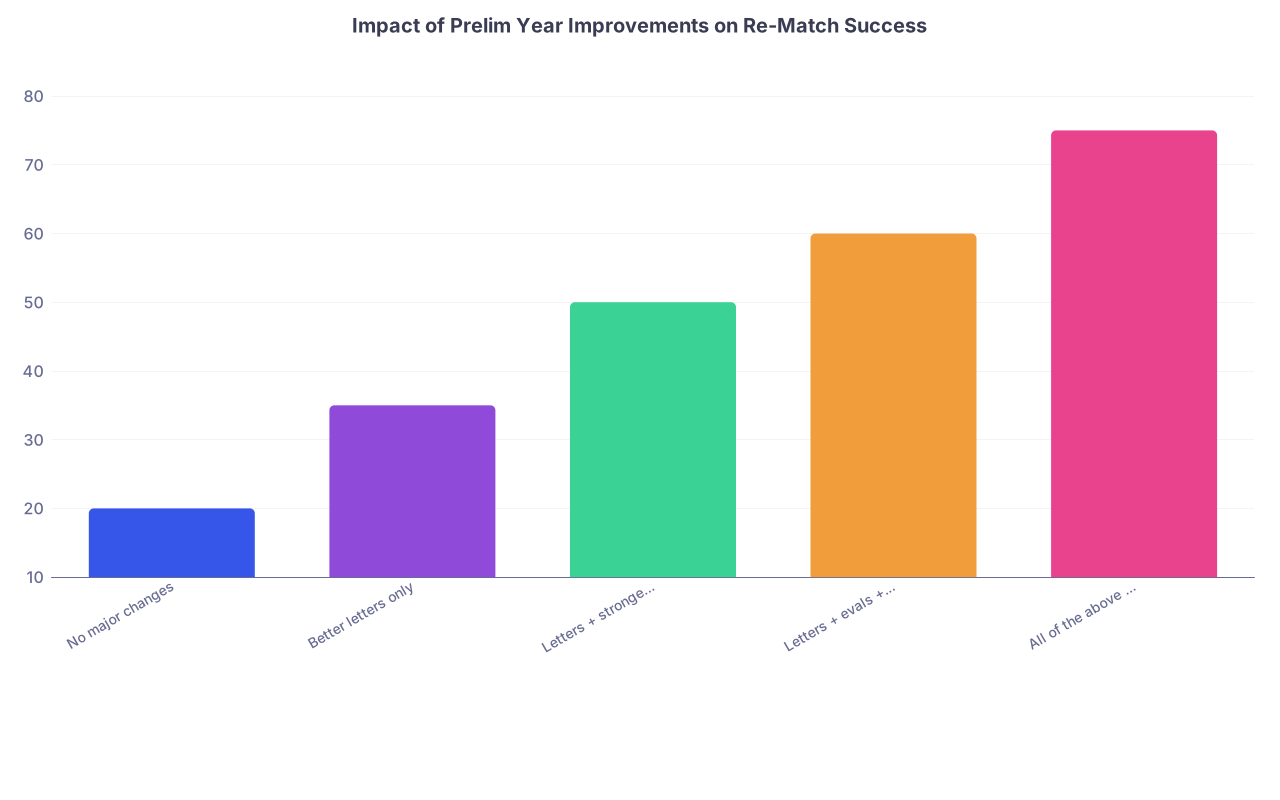
| Category | Value |
|---|---|
| No major changes | 20 |
| Better letters only | 35 |
| Letters + stronger evals | 50 |
| Letters + evals + research | 60 |
| All of the above + clear narrative | 75 |
You have one year to flip your story. Do not waste it treating this prelim internal medicine year as purgatory. Treat it as a focused, high‑yield training block where every month has a job to do for your future.
Today—before your next shift—do one concrete thing: open a blank document and write your Prelim‑Year Re‑Match Problem List. List the 3–5 reasons your last application failed. Then, next to each, write one prelim‑year action that will attack it. That is your playbook. Use it.