
Most applicants choose their preliminary year wrong because they underestimate one thing: the call schedule.
You can survive almost any kind of work if you know the pattern and the pain is predictable. What breaks interns is chaotic, unsafe, or poorly designed call. Let me break down how the common prelim year structures really work in practice—especially for ICU time and overnight coverage—so you can stop guessing based on glossy brochures and start reading between the lines.
1. The Big Picture: What “Preliminary Year Design” Actually Means
You are not comparing “internal medicine vs surgery vs transitional year” in the abstract. You are comparing three concrete things:
- How many weeks you spend:
- On wards vs ICU vs electives vs ambulatory.
- How many nights you spend:
- In-house vs home call vs night float.
- How much control you have:
- To adjust rotations, protect interview time, and avoid being destroyed before your advanced residency.
Most programs will not hand you those numbers cleanly. You have to extract them from:
- Sample schedules on the website.
- How residents answer: “Can you walk me through your average month?”
- How many ICU months they slide into vague phrases like “critical care exposure”.
Let us anchor this with a simple comparison framework.
| Prelim Type | Wards (wks) | ICU (wks) | Electives (wks) | Nights Style |
|---|---|---|---|---|
| Traditional IM Prelim | 20–28 | 4–8 | 4–8 | Mix; often NF + calls |
| Transitional Year (TY) | 12–16 | 0–4 | 12–20 | Light NF, limited calls |
| Surgery Prelim | 28–36 | 4–8 (SICU) | 0–4 | Heavy in-house call |
Those are ranges I keep seeing across major university and community programs. The outliers exist (the unicorn chill prelim, the malignant surgery year), but this is the reality for most applicants.
2. The Core Models: How Call and ICU Are Structured
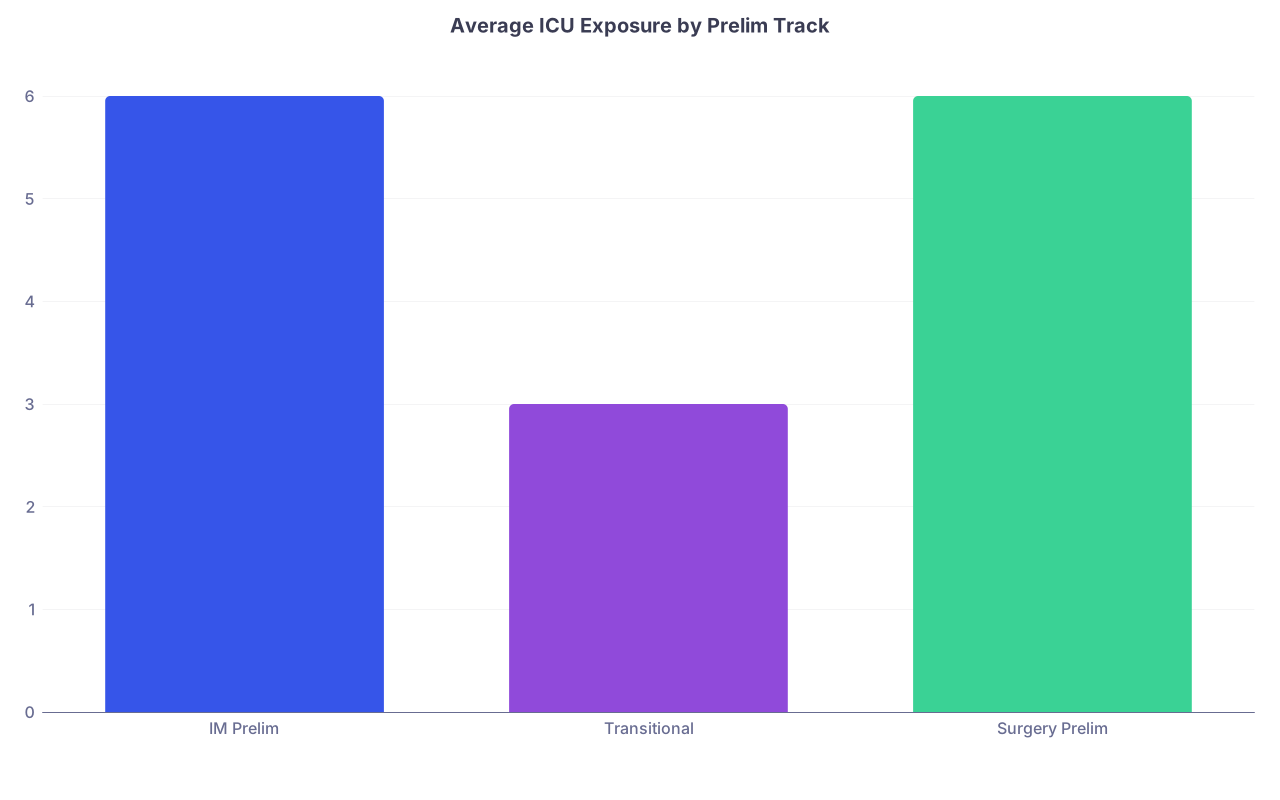
| Category | Value |
|---|---|
| IM Prelim | 6 |
| Transitional | 3 |
| Surgery Prelim | 6 |
A. Traditional Internal Medicine Preliminary Year
This is the workhorse option, especially for future radiology, anesthesia, neurology, PM&R, and derm residents when a TY is not available or competitive enough.
Typical design (for a categorical-style IM prelim):
- 4–6 blocks general medicine wards (≈16–24 weeks)
- 1–2 blocks MICU (4–8 weeks)
- 1 block CCU/cardiology (2–4 weeks)
- 2–4 blocks electives/consults (8–16 weeks)
- Maybe 1–2 blocks ambulatory clinic
Now the part that actually affects your life: call patterns.
Common call setups:
Night float (NF) system
- 1–2 weeks of NF every few months.
- Schedule like 6–7 nights on / 1–2 off, often 8p–8a or 7p–7a.
- You are cross-covering multiple wards teams, sometimes stepdown or telemetry.
Traditional q4–q5 call (older-school, but still alive in some community and VA-heavy programs)
- Long-call frequency: every 4th or 5th night until late evening or overnight.
- Still constrained by ACGME 16-hour cap for interns, so it may be:
- 7a–11p “long call” + night float backup.
- Feels brutal because the pattern is less predictable and you are always “almost post-call” or “almost on-call”.
Hybrid model
- Wards use long days (e.g., 7a–9p rotations) plus a dedicated NF team.
- ICU almost always in-house 12–13 hour shifts (days and nights).
ICU specifics for IM prelims:
- MICU blocks are usually front-loaded in PGY-1 for IM categorials, and prelims ride along that schedule.
- Expect:
- 6–7 day stretches.
- 12–13 hour shifts.
- A real mix of codes, vents, pressors, and end-of-life conversations.
- Nights:
- Either full week of MICU nights.
- Or split days/nights in one block (first two weeks days, second two weeks nights).
Some programs quietly make prelims do more nights in ICU than categorial interns “to help cover.” Listen for this during interviews.
Red flags in IM prelim call design:
- “We alternate a week of days and a week of nights on wards” for extended periods → that destroys sleep and interview flexibility.
- Prelims “primarily cover nights” because “categoricals need continuity clinic” → you will be the nocturnal workhorse.
- ICU described as “great exposure” but residents visibly wince when describing the schedule.
B. Transitional Year (TY): The Myth vs Reality
Transitional years are sold as the “cush” option. Some are. Many are not. The difference is in how they distribute wards/ICU vs electives and how they handle nights.
Typical structure for a well-balanced TY:
- 3–4 blocks wards (12–16 weeks)
- 0–1 block ICU (0–4 weeks)
- 1–2 blocks ER
- 4–6+ blocks electives (16–24 weeks), often very flexible
Common call designs:
Light NF with capped ward exposure
- Wards months often have:
- 1–2 weeks of days, then 1 week NF, then 1 week elective or ambulatory.
- ICU month:
- 12-hour shifts, but often boxed into a single, painful but finite 4-week block.
- Wards months often have:
“Elective-heavy but still real work” model
- Wards similar to categorical IM but fewer total blocks.
- Nights spread throughout the year, but overall fewer than IM prelim.
- Electrolyte consult elective that mysteriously ends at 3 pm every day. You know the ones.
The fake cush: high call density despite many “electives”
- Electives that are really service:
- Night float elective.
- ER “elective” with 8–10 night shifts in two weeks.
- ICU labeled as “subspecialty elective” but functionally a full ICU service.
- Electives that are really service:
ICU exposure in TYs:
- Some TYs proudly advertise “no ICU required.” Great if you are IR or diagnostic radiology and want to survive the year intact.
- Others have 2–4 weeks of ICU “to keep you sharp.”
- A few (often at large academic centers) treat TYs almost exactly like IM prelims regarding ICU, because they want everyone to be “well-rounded” (translation: they need warm bodies).
Where TYs win very clearly:
- Flexibility for interviews.
- Fewer night shifts overall.
- Far more calendar control if the program director is on board with your advanced specialty.
I’ve seen anesthesia-bound TY residents who stacked their heavy rotations early, then had December–January full of electives and clinic with zero night call, letting them interview without blowing up the schedule.
C. Surgery Preliminary Year: Maximum Call, Maximum ICU
If you choose a surgery prelim year, you are signing up for volume and intensity.
Basic surgery prelim structure:
- 7–9 blocks general surgery (28–36 weeks)
- 1–2 blocks SICU (4–8 weeks)
- 1–2 blocks subspecialty (trauma, vascular, etc.)
- Maybe 0–2 weeks of true “elective” or research time if you are lucky
Call patterns:
- In-house q3–q4 at many programs on busy rotations.
- Long stretches of 24–28 hour calls (still within ACGME 80-hour rule but skewed to in-house call).
- Trauma call and SICU nights with constant admissions, consults, and OR add-ons.
ICU specifics:
- SICU and trauma ICU shifts can be some of the hardest in the hospital:
- High-acuity post-op patients.
- Fresh trauma activations.
- Airway and line-heavy nights.
- Some prelims basically live in the ICU:
- Surgery categorials rotate out to clinic or research.
- Prelims stay in the trenches to keep the service running.
This track makes sense if:
- You are trying to rematch into categorical surgery.
- You want maximal procedure and critical care exposure and can tolerate the hit to quality of life and interview flexibility.
For everyone else, it is overkill and often self-sabotage.
3. How Call Really Feels Month-to-Month
Let us calculate what the year might actually look like based on design. Nobody does this on paper. You should.
Assume three archetype prelim years, all compliant with 80-hour rules:
- IM Prelim at a big academic center.
- TY at a community-affiliated hospital.
- Surgery prelim at a trauma-heavy tertiary center.
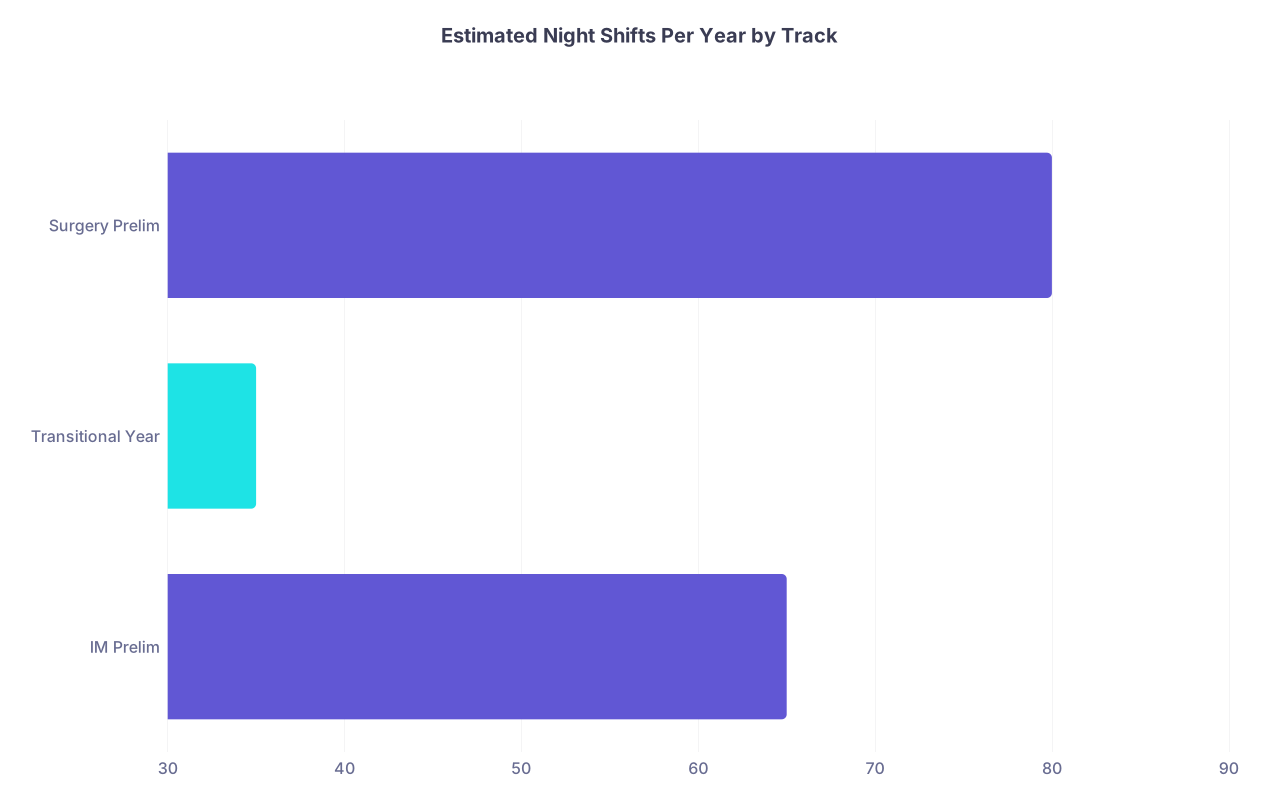
| Category | Value |
|---|---|
| IM Prelim | 65 |
| Transitional Year | 35 |
| Surgery Prelim | 80 |
These are realistic approximations.
A. Internal Medicine Prelim – Nights and ICU Time
Let us say:
- 5 ward blocks:
- Each block: 1 week NF (6–7 nights) + 1–2 long-call evenings.
- Roughly ≈ 7 nights × 5 = 35 nights.
- 1 MICU block:
- 7 nights per week × 2 weeks = 14 nights.
- 1 CCU block:
- Maybe 4–7 nights depending on structure.
- Misc. NF on electives or ER:
- Another 10–15 nights over the year.
You are looking at 55–70 nights total, with 4–8 weeks of true ICU-level intensity.
Functional impact:
- That ICU month will be physically brutal but educationally valuable.
- Wards months with NF can destroy any sense of normal circadian rhythm.
- Interview season (Nov–Jan) can be tough if NF or ICU blocks land there.
B. Transitional Year – Nights and ICU Time
Example:
- 3 ward blocks:
- Each with 1 NF week = 18–21 nights / year.
- 1 ICU block:
- Let’s say 10–12 nights depending on rotation design.
- 1 ER block:
- Usually a few evening or night shifts, total maybe 5–8 nights.
Total: 35–40 nights, ICU 0–4 weeks.
Subjectively:
- Noticeably lighter than a full IM prelim.
- More weeks where you are home for dinner most nights.
- Blocks of daytime elective give your brain and body a break.
C. Surgery Prelim – Nights and ICU Time
One realistic structure:
- 8 general surgery blocks:
- q3–q4 24-hour call.
- Roughly 7–8 calls per month × 8 months:
- ≈ 56–64 in-house 24-hour calls.
- 2 ICU/trauma blocks:
- Mix of 12–24 hour in-house nights; add 14–18 more nights.
Total: 70–80+ nights, with a large proportion as 24-hour calls.
This is a different universe in terms of fatigue. People do it. They survive. But they are not scheduling 15 interviews in January without pain.
4. How ICU Time Shapes Your Skills (and Sanity)

ICU is high-yield for learning. It is also where burnout and moral distress spike. The right amount depends on your future specialty.
A. If You Are Going Into Anesthesia, EM, Critical Care, or Pulm
You actually benefit from:
- 4–8 weeks of MICU/SICU.
- Frequent codes and airway exposure.
- Managing pressors, vents, and shock states.
An IM prelim or surgery prelim (vs a very cush TY) may make you a sharper early CA-1 or EM-2. I have seen anesthesia programs openly prefer interns who have done:
- At least one hardcore MICU month.
- One wards month with heavy cross-cover overnight.
For these specialties, completely avoiding ICU may be comfortable now but will hurt your learning curve later.
B. If You Are Going Into Radiology, Derm, Pathology, or Maybe Ophtho
You need to be functional and alive for interview season and step into PGY-2 without hating medicine.
For many of you:
- 0–2 weeks of ICU is more than enough.
- One solid wards month to understand inpatient medicine is fine.
- The marginal benefit of a 3rd ICU month is basically zero, and the marginal harm (sleep debt, burnout, interview inflexibility) is nontrivial.
Here a well-designed TY usually beats an IM prelim.
C. If You Are Reapplying Surgery or IM
Then the equation flips.
You need:
- Maximum face time with attendings.
- Evidence that you can handle high-acuity call.
- Strong ICU evaluations that say “already functioning at PGY-2 level.”
A heavy ICU / heavy call IM prelim or surgery prelim (not TY) can make or break your reapplication.
5. Spotting Good vs Bad Call Designs From Brochures and Interviews

Programs will rarely say, “We crush our prelims with call.” You need to decode.
A. Read Between the Lines on Their Website
If you see:
“Our preliminary interns share the same schedule as categoricals”
Translation: Expect full wards, full ICU, full night float, minimal elective control.“Preliminary schedule is slightly heavier than categorical to maximize exposure”
Translation: They use prelims to cover extra nights and unfilled shifts.“ICU is a core component with multiple rotations”
Translation: At least 2 ICU blocks, likely with nights.
Now compare that to:
- “Transitional year designed to support advanced specialties with abundant electives and limited ICU”
That usually means 0–1 ICU block and more humane call.
B. Questions You Should Actually Ask Residents
Do not ask, “Is the schedule reasonable?” Everyone will say yes. Instead:
- “How many full weeks of nights did you do this year?”
- “How many ICU blocks did you have, and were you on nights there?”
- “If I look at your schedule from November to February, what did it look like last year?”
- “What changes have been made to the call schedule in the last 2–3 years, and why?”
- “Do prelims ever feel like they do more nights or worse rotations than categoricals?”
You will know within 30 seconds if the call design is punishing.
6. Matching Strategy: Aligning Design With Your Actual Goals

| Step | Description |
|---|---|
| Step 1 | Your Advanced Specialty |
| Step 2 | Consider IM or Surgery Prelim |
| Step 3 | Prefer Transitional Year |
| Step 4 | Choose heaviest exposure program |
| Step 5 | Balanced IM prelim with 1 ICU block |
| Step 6 | TY with limited ICU and NF |
| Step 7 | TY or light IM prelim |
| Step 8 | Needs strong ICU/wards? |
| Step 9 | Reapplying for same field? |
| Step 10 | Need interviews flexibility? |
Let me be specific.
A. Future Radiology / Derm / Path / Neurology / PM&R
Priority stack:
- Protected time and flexibility for interviews.
- Enough inpatient exposure to be safe, not world-class at codes.
- Not starting PGY-2 burned out.
Recommended design:
- Transitional year with:
- 3–4 wards blocks.
- 0–1 ICU block.
- No more than ~40 nights in the year.
- If TYs are too competitive:
- Choose the lightest IM prelim:
- 1 ICU block.
- 4–5 wards blocks.
- Solid elective time late in the year.
- Choose the lightest IM prelim:
B. Future Anesthesia / EM / Pulm / Critical Care
Priority stack:
- Solid ICU and acute care exposure.
- Reasonable but not insane call.
- PDs who know how to train acute-care residents.
Recommended:
- IM prelim with:
- 1–2 MICU blocks.
- 1 CCU.
- Mix of wards and ER.
- Transitional year only if:
- It has at least 1 strong ICU month.
- ER rotation is real and not purely observation.
C. Planning to Reapply (Surgery or IM)
You need receipts.
- Surgery reapplicant:
- Surgery prelim at a program with:
- Strong SICU/trauma exposure.
- Letters from well-known attendings.
- Heavy call that proves you can take the hit.
- Surgery prelim at a program with:
- IM reapplicant:
- IM prelim with:
- ≥2 ICU/CCU months.
- Evaluations highlighting leadership on call-heavy rotations.
- IM prelim with:
This is where the punishing call/ICU design is not just tolerable—it is actually strategically useful. Once. Do not volunteer for this twice.
7. Reading Past the Marketing: A Quick Comparative Snapshot
| Feature | IM Prelim | Transitional Year | Surgery Prelim |
|---|---|---|---|
| Total ICU Weeks | 4–8 | 0–4 | 4–8 (often SICU/Trauma) |
| Estimated Night Shifts | 55–70 | 30–40 | 70–80+ |
| Elective Flexibility | Low–Moderate | High | Very Low |
| Interview Season Friendly | Moderate | High | Low |
| Burnout Risk | Moderate–High | Low–Moderate | High |
Use this as a mental template when programs start bragging about “comprehensive training.” Comprehensive often means more nights for you.
8. Common Traps and How to Avoid Them

I see the same mistakes every year.
Choosing based on reputation alone
“Big-name IM prelim at University X must be good.”
Then you find out the prelims do extra NF because categoricals are protected for clinic and research time.Underestimating interview season
You match a heavy-call IM prelim and realize in December you are post-call on days you should be flying for interviews. Programs will often “work with you,” but the cost is swapped shifts and burned weekends.Overvaluing ICU without a plan
Extra ICU does not automatically translate to better training if:- You are exhausted the entire time.
- No one actually teaches, they just use you as a note-factory.
Believing “we treat prelims and categoricals the same” is always good
That phrase can mean:- You get the same continuity clinic demands.
- Same number of wards and ICU blocks.
- But fewer electives and less scheduling power because you are gone after a year.
What you want instead: programs that explicitly recognize prelim and TY residents have different needs and tailor schedules accordingly.
FAQ (Exactly 6 Questions)
1. Is a transitional year always better than an internal medicine preliminary year?
No. Transitional years are often better for lifestyle and interviews, but not automatically better for training. If you are going into anesthesia, EM, or critical care, a solid IM prelim with real ICU time can set you up better clinically. A weak TY with almost no acute care can leave you underprepared.
2. How many ICU months should I aim for in a prelim year if I am not going into a critical care specialty?
For radiology, derm, path, PM&R, and most neurology applicants, 0–1 ICU month is plenty. You need basic familiarity with vents, pressors, and codes, not a fellowship-level skill set. Anything beyond 2 ICU months is usually unnecessary and just adds fatigue and schedule rigidity.
3. Does doing more call or ICU help my application to competitive advanced specialties?
Only if you can convert that work into strong letters and concrete stories of responsibility. Programs rarely give you “extra credit” just for suffering. A focused, well-evaluated ICU month is far more valuable than three poorly supervised ones that leave you burned out and interviewing badly.
4. Are surgery preliminary years ever a good idea if I am not reapplying to surgery?
Almost never. The call is heavy, ICU time is intense, and electives are minimal. Unless you have a very specific reason (e.g., you want maximal procedures before IR or EM and cannot get that elsewhere), an IM prelim or TY will serve you better and preserve your mental health.
5. How can I tell during interviews if prelims are being used as coverage workhorses?
Ask whether prelims have:
- More nights or ICU than categoricals.
- Less elective time.
- Duties like “extra cross-cover” or “float” that sound vague.
If residents joke about prelims “earning their keep,” that is not a joke. That is your life for 12 months.
6. What is the single most important scheduling question to ask current residents?
“Can you show me, or at least describe in detail, a typical prelim schedule for November through February this year?”
If that period is heavy with ICU, night float, or ward blocks, your interview season will be a fight. If they intentionally stack electives and lighter rotations there, that program understands what you actually need as a prelim.
Key takeaways:
First, you are comparing call design and ICU load more than program names—count nights and ICU weeks, not just logos. Second, align the prelim structure with your actual specialty needs and interview plans; do not let “comprehensive training” become code for miserable scheduling. Third, interrogate schedules ruthlessly during interviews—how they treat prelims in call and ICU is how they value you, and that will shape your entire PGY-1.