
The idea that “a prelim year is a prelim year” is wrong.
For neurology, diagnostic radiology, and anesthesiology, the preliminary (or transitional) year is not interchangeable background noise. The workload, skills that actually matter, and how PDs read your choices are different in each field. If you treat them as the same, you will make dumb choices that you feel for years.
Let me break this down specifically.
1. Quick definitions: prelim vs transitional vs advanced spots
You cannot compare “prelim needs” until you are clear on what the year even is.
- Advanced residency: Neurology, diagnostic radiology, and anesthesiology are usually “advanced” programs starting at PGY‑2. They expect you to have completed 1 year of prior training (PGY‑1) in something acceptable (IM, surgery, TY, etc.).
- Preliminary (prelim) year: One year of training in a categorical specialty, but without continuation. Most commonly:
- Prelim internal medicine (IM)
- Prelim general surgery
- Transitional year (TY): Rotating internship with more electives, generally lighter and more flexible, heavily dependent on the specific program.
For your purposes, those three specialties usually stitch together like this:
| Specialty | Typical PGY-1 Choice | Program Structure | Notes |
|---|---|---|---|
| Neurology | Prelim IM or TY | Advanced (PGY-2+) | Some categorical neuro exist |
| Diagnostic Rads | TY or Prelim IM | Advanced (PGY-2+) | Many prefer cushier PGY-1 |
| Anesthesiology | TY or Prelim IM | Advanced or Cat | Some categorical anesthesia |
The nuance: A “technically acceptable” PGY‑1 year is not the same as an optimal one. The ACGME language is broad; program directors’ expectations are not.
2. What ACGME and boards actually require for PGY‑1
Everyone quotes “ACGME requirements” without having read them. Here is the distilled version relevant to you.
Neurology
Neurology is the most prescriptive of the three.
The ACGME neurology program requirements explicitly spell out what you should have done in your PGY‑1 year:
- At least 6 months of internal medicine (general inpatient or sub-specialty IM) or equivalent.
- The remaining months can be:
- Emergency medicine
- Pediatrics (sometimes, depending on program)
- Family medicine
- Neurology
- Psychiatry
- Other appropriate clinical rotations
Most neurology PDs heavily prefer a prelim internal medicine year. Transitional year is often accepted, but they will look closely at:
- How much actual ward/internal medicine you did.
- Whether your TY is known to provide solid inpatient exposure.
If you show up to neurology PGY‑2 with 1 month of IM and 7 months of electives in dermatology and ophthalmology, you will be behind. Neurology is built on adult medicine.
Diagnostic Radiology
Radiology’s requirements are broader.
What they want (ACGME language summarized):
- 1 clinical year in an ACGME-accredited program:
- Internal medicine, general surgery, transitional year, pediatrics, OB/GYN, or even a mix.
- Needs to be mostly direct patient care (not just research or lab).
Radiology PDs care much less about which specific rotations you did, as long as:
- You actually worked in a real hospital job.
- You can function clinically enough to:
- Place basic orders
- Understand acute care workflows
- Communicate with services intelligently when they call you at 2 AM about a STAT scan
TY and prelim IM are both fine. Your PGY‑1 will mostly be judged by:
- Did you survive without disaster?
- Any red flags (unprofessionalism, huge performance issues)?
- A sense that you understand clinical context.
They are not obsessed with whether you did 5 vs 7 months of pure IM.
Anesthesiology
Anesthesia is in between neurology and rads.
Requirements (again, summarized):
- 1 clinical base year with:
- Direct responsibility for patient care in:
- Internal medicine
- Pediatrics
- Surgery (up to a few months)
- OB/GYN
- Emergency medicine
- Critical care
- Direct responsibility for patient care in:
- Many anesthesia programs specify:
- At least 6 months of direct patient care.
- Up to 1 month anesthesia, 1 month pain, 2 months ICU during PGY‑1 may count toward core content.
Practically:
- Prelim IM, TY, or prelim surgery can all “work.”
- Most PDs like:
- IM-heavy base year OR
- Mixed TY with genuine ICU/ED exposure.
Anesthesiology is procedural and physiology-heavy. They need you to show up with some grip on sick patients and acute care.
3. The core differences: what each specialty actually wants out of your PGY‑1
Strip away the regulatory language. Look at actual needs.
What neurology needs from your prelim year
Neurology is adult hospital medicine with a neuro filter. The first year of neurology residency (PGY‑2) often includes:
- Stroke service (high-tempo, IM-ish)
- Neuro ICU exposure
- General consults on every floor: septic encephalopathy, hyponatremia causing seizures, hepatic encephalopathy, etc.
- Management of chronic neurological conditions with complicated comorbidities
So from PGY‑1, neurology needs you to:
Run a medicine list without falling apart
You should be comfortable with:- Daily notes and dispo planning
- Cross-cover issues: fevers, chest pain, AKI, hypertension, delirium
- Basic management of DM, CHF, COPD, infections, anticoagulation
Understand hospital flow
- How admissions actually happen
- How to escalate care
- How to use order sets, call consultants, and not sound lost
Think in systems, not just symptoms
Neuro is constantly filtering “is this primary neuro vs systemic?”:- Hyponatremia vs primary seizure disorder
- Metabolic encephalopathy vs non-convulsive status
- Drug toxicity vs new demyelinating disease
That skill comes straight out of a real IM-style PGY‑1.
This is why many neurology PDs quietly rank candidates with strong IM prelims above those who did a cushy TY with minimal floor time.
What radiology needs from your prelim year
Radiology will not care how many total patients you rounded on. They care about something different: clinical literacy and social functioning in a hospital.
From PGY‑1, radiology needs you to:
Understand what is actually being asked on imaging orders
When someone orders a CT abdomen “r/o SBO”:- You should know how SBO presents.
- You should understand why they chose CT rather than ultrasound.
- You should have seen enough real cases that you can interpret urgency and context.
Communicate with clinicians without sounding like a robot
Rads residents spend a huge amount of time dictating and calling:- Critical results to ED, ICU, and floors
- Clarifying indications with ordering physicians That communication is much easier if you have actually lived on the other side of the phone as a PGY‑1.
Have basic acute care instincts
- When you see “new severe headache + focal deficit” you should instinctively know this is a code stroke problem, not a routine outpatient scan.
- When you see a tension pneumothorax on CXR, you should not just blandly dictate; you should feel urgency.
You do not need 12 months of inpatient medicine to get this. A balanced TY or lighter IM prelim can absolutely accomplish it.
Which is why radiology residents, in large numbers, aim for good transitional years with:
- Enough ward time to be credible
- Enough elective time to study, research, and live
What anesthesiology needs from your prelim year
Anesthesia is where bad PGY‑1 choices come back to bite.
You show up on day 1 having to think like this:
- Hypotension under anesthesia – is it volume, vasodilation, pump failure, arrhythmia, obstruction?
- Post-op hypoxia – atelectasis, opioid-induced hypoventilation, PE, pneumothorax, CHF?
- Septic patient going to the OR – what lines, what hemodynamic endpoints, what induction plan?
From PGY‑1, anesthesia needs you to:
Be comfortable with sick patients and vital-sign changes
ICU, ED, or heavy inpatient medicine (or surgery) months matter. You should:- Have run codes or at least been present for many.
- Managed sepsis, GI bleeds, CHF exacerbations.
- Seen vasopressors used outside of a quiz question.
Have some procedural familiarity
Not mandatory, but helpful:- Lines, ABGs, maybe basic bedside ultrasound exposure.
- Placing IVs, running drips, managing oxygen devices.
Know perioperative medicine basics
You will be asked:- “Can this patient safely go to the OR?”
- “What to do with this anticoagulated patient needing emergent surgery?”
A PGY‑1 with EM/ICU/surgery/IM mix prepares you much better than a glorified outpatient TY.
So anesthesiology often values:
- TY with real ED/ICU time, or
- A solid prelim IM that is not all clinic.
4. Prelim IM vs TY vs Prelim Surgery for each specialty
Here is where people actually get burned—choosing the wrong style of year for their target field.
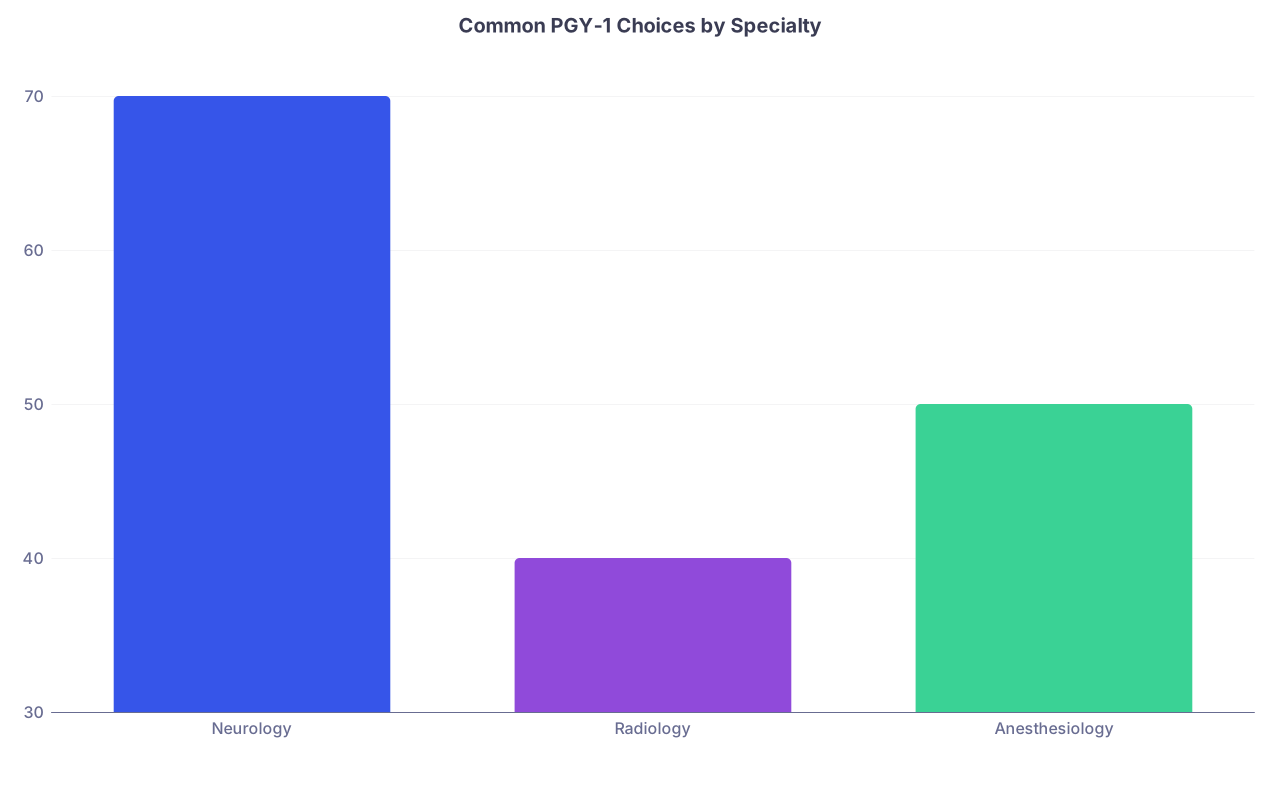
| Category | Value |
|---|---|
| Neurology | 70 |
| Radiology | 40 |
| Anesthesiology | 50 |
(Values here conceptual: rough proportion who end up choosing prelim IM; reality varies by institution and year.)
Neurology: what works and what does not
Best choices, in order of how PDs usually think:
Prelim Internal Medicine at a solid academic or strong community program
Pros:- Aligns perfectly with neurology’s expectations.
- Lots of exposure to the same patient population your neuro program sees.
- IM attendings write convincing letters about your inpatient capabilities.
Cons:
- Can be brutal: call, night float, high census.
- Less elective time to explore neuro or research.
Transitional Year with significant IM and ED time
Pros:- More balanced; some electives (neuro, radiology, research).
- Lifestyle often better.
Cons:
- Risk: some TYs are so cushy that you end up under-trained for neurology.
- You need to document at least ~6 months of IM-like work.
Prelim Surgery
Usually a poor idea for neurology unless:- You had no other option, or
- It is explicitly accepted by your future neuro program and includes dedicated ICU/medicine-style exposure.
Neurology PD thinking is straightforward: “Is this person essentially an IM intern with a neuro interest?” If yes, good. If no, they worry.
Radiology: what works and what is overkill
Best choices for radiology, realistically:
Strong Transitional Year
The classic radiology move for a reason. Features of a good TY for radiology:- Enough inpatient months (IM, ED, maybe some ICU).
- Several months of elective time to:
- Study physiology/anatomy.
- Do radiology electives.
- Have a life before a demanding 4 years.
Radiology PDs often think: “You got actual clinical exposure and you are not burned out. Great.”
Prelim Internal Medicine
Good, but sometimes unnecessary heavy lifting. Pros:- You will be clinically competent and comfortable in hospital chaos.
- If you end up switching specialties to IM, cards, GI, etc., you are set.
Cons:
- Less time to explore radiology.
- More burnout risk before starting a mentally intense specialty.
Prelim Surgery
Occasionally done, but not ideal unless:- You had limited options.
- You are at a program where the surgery prelim is not malignant and gives some ICU/trauma that might interest you.
Radiology does not reward extra pain. They just want you clinically literate and able to collaborate without being lost.
Anesthesiology: where variation actually matters
For anesthesia, PGY‑1 style clearly changes your readiness.
Ranking of choices, assuming typical programs:
Balanced Transitional Year with real acute care
Ideal if:- 3–4 months IM/floor
- 1–2 months ICU
- 1–2 months EM
- Some elective time (including maybe anesthesia or cardiology)
This produces an intern who has:
- Seen shock, respiratory failure, peri-arrest states.
- Dealt with rapid responses and cross-cover.
- Still had some time to breathe.
Prelim Internal Medicine with decent ICU exposure
Strong choice, especially if:- Your prelim IM includes at least 1–2 months ICU.
- You are actually seeing sick, complex patients.
You will start anesthesia well-prepared to understand:
- Pressors, volume status, comorbidity optimization.
Prelim Surgery
Can be very good or very bad:- Good: If it includes trauma/ICU, OR exposure, real acute care.
- Bad: If it is malignant, destroys you, and does not actually teach physiology because you were just scut support.
I have seen anesthesia interns who did prelim surgery show up extremely comfortable in the OR environment—but weak on medical reasoning outside the surgical bubble.
Bottom line: anesthesia benefits from anything that genuinely strengthens your acute care and physiology brain, not just “brutal hours.”
5. How program directors interpret your prelim choice
Now to the part people do not talk about out loud.
Program directors use your prelim choice as a signal. A few common interpretations:

For Neurology PDs
What they think when they see:
Prelim IM at reputable academic center
“Serious about neurology, understands adult medicine. Day 1 they can handle a list on stroke service.”Transitional year at a very cushy community program with minimal IM
“I need to carefully check if they actually did enough medicine. Will they drown on the stroke ward?”Prelim surgery
“Why? Did they pivot late? Are they going to understand complex medical management? I must see strong letters and explanations.”
Neurology is moving closer and closer to IM in expectations. PDs won’t say it this bluntly on websites, but they prefer medicine-flavored interns.
For Radiology PDs
Their internal monologue is different:
Transitional year with solid reputation
“Good. They will arrive rested, with some clinical sense. No concern.”Prelim IM
“Fine, maybe more pain than they needed, but solid. Let me check they did not fail out or get destroyed.”Very heavy surgery prelim
“Curious choice for radiology. Maybe late switch or limited options. As long as performance and professionalism are good, not a problem.”
Radiology PDs usually do not reward masochism. They do not give extra credit for 18 months of trauma night float.
For Anesthesiology PDs
They pay closer attention to content.
TY with ICU and EM
“Great. This person has seen shock, airways, and crashing patients. That translates.”Prelim IM with ICU
“Strong acute care foundation. Good candidate.”TY with mostly outpatient, no ICU/ED
“Red flag. Under-exposed to critical illness. We will be backfilling a lot of basic resus knowledge in CA‑1 year.”Prelim surgery, high-volume OR + trauma/ICU
“Potentially ideal. Comfortable in OR, comfortable with acute surgical physiology. As long as they were not chewed up.”
So anesthesia looks at what you did, not just the label “TY” or “prelim.”
6. Practical selection strategy: how you should actually choose
Let us move from theory to actual decisions you will make when ranking.
Step 1: Be honest about your specialty’s demands
Ask yourself, realistically:
For neurology:
“Do I want to show up as the intern who cannot manage a basic CHF exacerbation?”
If not, prioritize prelim IM or medicine-heavy TY.For radiology:
“Do I need 12 months of punishing wards to understand what a CT PE is for?”
Probably not. A good TY with some wards is enough.For anesthesia:
“Will I be safe starting in the OR if I have never managed a crashing ICU patient?”
You want ICU/ED-heavy exposure somewhere: TY or prelim IM/surgery with ICU.
Step 2: Map your tolerance for intern-year suffering
This matters more than people admit.
- If you are neuro-bound and can handle a hard year:
- A rigorous IM prelim is genuinely useful.
- If you are radiology-bound and strongly value study time, wellness, or research:
- Target high-quality, balanced TYs. Over-grinding in PGY‑1 does not make you a better radiologist.
- If you are anesthesia-bound:
- You want a “moderately hard” year with serious acute care, not a nihilistic grind that leaves you burned out.

| Step | Description |
|---|---|
| Step 1 | Choose Specialty |
| Step 2 | Prefer strong IM prelim |
| Step 3 | Prefer balanced TY |
| Step 4 | TY with ICU/ED |
| Step 5 | IM prelim with ICU |
| Step 6 | Neurology |
| Step 7 | Radiology |
| Step 8 | Anesthesiology |
| Step 9 | Need acute care exposure |
Step 3: Look past the label
Do not obsess over “TY vs prelim” as words. Ask:
For each program you are ranking:
- How many months of:
- Inpatient IM?
- ICU?
- ED?
- Surgery/trauma?
- How malignant is the culture? (Ask upperclassmen. Someone from your school knows.)
- What do the PGY‑2s in your target field say about how prepared they felt?
A transitional year where:
- 4 months IM
- 2 months ICU
- 1 month ED
- 1 month neurology
- 4 months electives
is dramatically better for anesthesia than some cushy TY with 1 month of ward work and 7 months of outpatient dermatology.
Step 4: Coordinate with your advanced program if possible
If you have a linked advanced + prelim (rare but ideal):
- Often designed to match well:
- Neuro programs sometimes partner with IM prelims that are medicine-heavy.
- Rads programs often pair with local TYs known to be good but not malignant.
- Anesthesia programs sometimes have explicit “clinical base year” tracks.
If your advanced program has preference lists or historical patterns:
- Ask current residents where they did PGY‑1 and which ones prepared them well.
- Pay attention if a PD raises an eyebrow at certain PGY‑1 structures (“We prefer you have at least 6 months IM or ICU exposure”).
7. Common mistakes by specialty (and how to avoid them)
Neurology applicants
Frequent bad move:
- Chasing a cushy TY with minimal IM just for lifestyle, then arriving to stroke service undercooked.
Fix:
- If you pick a TY, make sure it is functionally a medicine year:
- 5–6 months wards / ED
- Not all outpatient.
Another bad move:
- Assuming prelim surgery is “basically the same” as medicine because “surgery patients are sick too.”
- The problem is not the sickness; it is the focus. Surgery teaches post-op issues more than complex systemic neuromedical thinking.
Radiology applicants
Frequent bad move:
- Doing an ultra-malignant prelim IM because “it will make me stronger” and then starting radiology completely fried and resentful.
Fix:
- Choose balanced over “hardcore” if you have the option, as long as you get:
- Some wards
- Some ED/ICU exposure
- Use your electives to:
- Do rads rotations
- Learn anatomy and cross-sectional imaging
- Start reading classic radiology texts.
Anesthesiology applicants
Frequent bad move:
- Picking an easy outpatient-heavy TY because “I just need to get through PGY‑1,” then struggling with sick patients during CA‑1.
Fix:
- Ensure your PGY‑1 year includes:
- Real ICU/ED
- High-acuity IM or surgery
- Avoid the mindset that your base year does not matter. It shows. ICU nurses and surgeons can tell which CA‑1s have never seen a crashing patient before.
8. How this affects your ERAS strategy and ranking
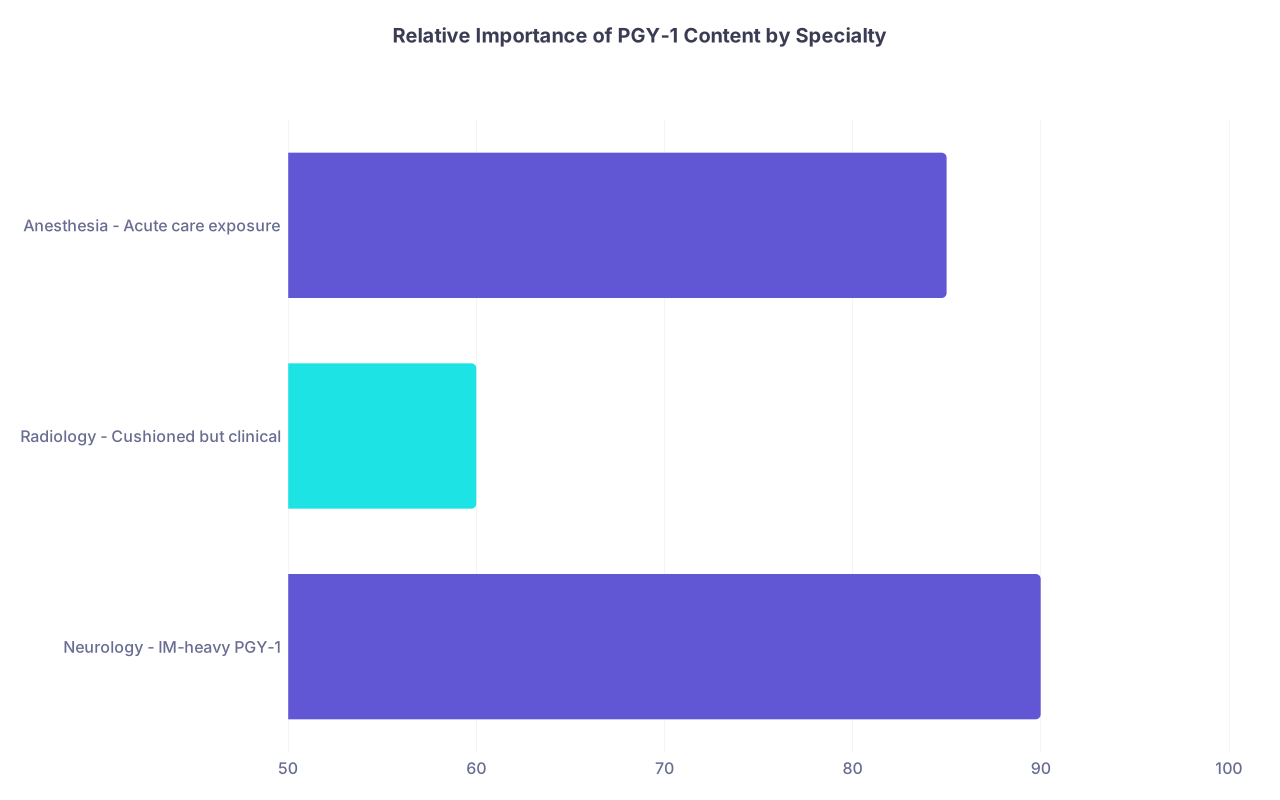
| Category | Value |
|---|---|
| Neurology - IM-heavy PGY-1 | 90 |
| Radiology - Cushioned but clinical | 60 |
| Anesthesia - Acute care exposure | 85 |
These are not “official percentages,” but they capture reality:
- Neurology: PGY‑1 IM content is almost non-negotiable.
- Radiology: PGY‑1 is more about sanity + baseline clinical literacy.
- Anesthesia: PGY‑1 acute care exposure matters a lot.
In practical ERAS terms:
- Apply broadly to prelim and TY programs that match your target specialty’s needs.
- On interview day, ask explicitly:
- “For residents going into [neuro/rads/anesthesia], how do you structure their intern year?”
- “How much ICU/ED/ward time do your interns get?”
- “How do grads feel starting their PGY‑2 year in those specialties?”
When constructing your rank list:
- Rank advanced programs first based on fit.
- For prelim/TY lists:
- Neurology: move medicine-heavy programs up.
- Radiology: move high-reputation, humane TYs and reasonable IM prelims up.
- Anesthesia: move programs with serious ICU/ED and reasonable culture up.
9. Final reality check: what actually matters long-term
No, your choice of prelim year will not fully define your career. But it does three things that matter:
Shapes how brutal or survivable your intern year feels.
Overly malignant or misaligned PGY‑1 can:- Fry your mental health.
- Make you less enthusiastic about your chosen specialty.
Determines how confident you feel starting PGY‑2.
- Neurology: Are you comfortable managing comorbidities while thinking neuro?
- Radiology: Do you understand what your referrers are actually dealing with?
- Anesthesia: Are you safe and decisive with unstable patients?
Signals to future colleagues how seriously you took preparation.
They will absolutely notice whether your PGY‑1 prepared you or if they are constantly backfilling basics.
Key takeaways
Neurology needs an IM-flavored PGY‑1. Aim for a prelim internal medicine year or a medicine-heavy TY. Think like an internist who loves brains.
Radiology benefits most from a balanced, humane year. A good transitional year with enough clinical exposure and room to breathe is usually better than a punishing IM prelim.
Anesthesiology depends on acute care exposure. Whatever you choose—TY, prelim IM, or prelim surgery—make sure it includes real ICU/ED time and sick patients, not just outpatient filler.