
Most people waste their prelim year for radiology. You do not have to.
You are not “killing time” before R1. A badly chosen or badly structured preliminary year will slow your radiology ramp‑up, hurt your fellowship prospects indirectly, and make your life needlessly miserable. A well‑tailored prelim year does the opposite: it turns you into the intern that radiology program directors actually want.
Let me walk you through this in a very specific, nuts‑and‑bolts way.
What A Preliminary Year Actually Is (For Radiology, Not In Theory)
Forget the generic definition. For someone aiming at diagnostic or interventional radiology, a “preliminary year” boils down to:
- A non‑categorical PGY‑1 year
- Usually in internal medicine, transitional year (TY), or less commonly surgery
- Required before you start your advanced DR or IR residency
But the key point most applicants miss: the same PGY‑1 “label” can feel completely different depending on:
- Call structure and workload
- ICU exposure
- Floor vs clinic time
- How malignant or humane the culture is
- Whether anyone there cares that you are going into radiology
You are not choosing “TY vs prelim medicine” in the abstract. You are choosing a very specific hospital reality you will live in for 80+ hours per week.
The Three Main Flavors You Care About
Here is the honest, radiology‑focused breakdown.
| PGY-1 Type | Typical Workload | Radiology-Relevant Exposure |
|---|---|---|
| Transitional Year | Light–Moderate | Flexible electives, variable intensity |
| Prelim Medicine | Moderate–Heavy | Strong acute care, floor and ICU |
| Prelim Surgery | Heavy–Brutal | Procedural focus, low imaging depth |
Transitional Year (TY)
Hybrid year. Mix of medicine, electives, sometimes ED, sometimes ICU.
Radiology upside: maximal flexibility, often more elective time for rads, research, or reading.
Downside: quality is wildly variable. A “lifestyle TY” can leave you underprepared clinically.
Preliminary Internal Medicine
Heavy wards, real ICU, solid acute care foundation.
Radiology upside: you actually learn medicine. You understand why that CT PE was ordered at 2 a.m. You get comfortable managing sick patients during contrast reactions or IR complications later.
Downside: fatigue. Some medicine prelims will chew you up if the program treats prelims as disposable labor.
Preliminary Surgery
Ortho, general surgery, maybe a trauma ICU.
Radiology upside: decent if you are IR‑bound and especially if you love procedural and peri‑op care.
Downside: terrible for most DR‑bound people. Minimal direct imaging interpretation, extreme hours, and a culture that often does not care you are going to rads.
My opinion:
- DR‑bound → usually best served by a strong but not malignant prelim medicine or a well‑run, legit academic TY.
- IR‑bound → either prelim medicine with strong ICU/ED or a sane prelim surgery if you specifically want the surgical critical care mindset.
What “Tailoring” A Prelim Year Actually Means
Tailoring is not just “getting an easy year.” That is the lazy version.
You are optimizing four things:
- Clinical foundation relevant to radiology
- Radiology‑adjacent exposure and relationships
- Burnout risk and lifestyle
- How this year supports your long‑term CV and learning
1. Clinical Foundation: What You Need Before Day 1 Of Rads
Radiologists who were mediocre interns are obvious. They do not understand what is actually happening upstairs.
You want a prelim year that makes you:
- Comfortable managing an acutely decompensating patient
- Fluent in basic labs, hemodynamics, and imaging indications
- Reasonable at prioritizing sick vs not sick
Key rotations that matter more than students realize:
- General medicine wards with real responsibility
- Medical ICU (at least 1 month, 2 is better)
- Night float or night wards (learning to function when things deteriorate quickly)
- Emergency department (indications and triage, constant imaging ordering)
Rotations that are less crucial for radiology preparation (not useless, just lower yield for your future job):
- Long outpatient clinic blocks
- Low‑acuity elective subspecialty clinics
- Obscure consult services where you barely touch the patient
During interviews, ask very targeted questions:
- “How many months of ICU do prelims do?”
- “How much of the year is floor versus clinic?”
- “Do prelims take true admitting call or just cross‑cover?”
If the answer is: 0 ICU, 5 months clinic, prelims mostly do scut and never run their own patients, that might be “easy” but it is not preparing you for radiology as much as you think. Especially not for IR.
2. Radiology-Adjacent Exposure: Where You Quietly Build Your Future
This is the part almost nobody thinks about until it is too late.
Specific levers you can pull:
Elective time in radiology:
Not just shadowing. You want structured exposure, maybe even time to do a small research project or participate in resident conferences.IR rotations (if you are IR‑interested):
Being the intern on IR service where you pre‑op, post‑op, and see complications is a huge advantage later.Services that live and breathe imaging:
- Pulmonary/critical care (tons of CTs, CXRs, procedural imaging for thoracentesis, bronch, etc.)
- Neurology/stroke (constant CT/CTA/MRI; you start thinking in imaging algorithms)
- Oncology (staging, response assessment, PET/CT)
- Trauma (if your hospital has it)
You want these not because you will be interpreting scans yet, but because you are building mental links:
“Short of breath + cancer + sudden pleuritic pain → consider PE → CT PE protocol. When do we actually push for it at 3 a.m. versus not?”
That background is gold when you are the radiology resident getting grilled by IR about whether this guy really needs a CT venogram now.
Ask programs:
- “Can prelims take a radiology or IR elective? How long?”
- “Do prelims participate in noon radiology conferences if on radiology elective?”
- “Has anyone ever done radiology research during the prelim year?”
If you hear, “Prelims mostly just fill coverage gaps, electives are rare,” adjust your expectations.
Choosing The Right Prelim Program When You Already Matched Rads
You will meet two archetypes on the trail:
- The “I just want chill lifestyle” intern
- The “I want maximal clinical training” intern
Both extremes are flawed. You want “demanding but controlled.”
Target Program Features For Radiology-Bound Interns
Here is what tends to work best:
- 1–2 months ICU, not 4–5
- 4–6 months wards (including night float)
- 1–2 ED months
- 2–3 months of electives, with at least 1 in radiology/IR
- Reasonable cap on patients (e.g., 8–10 per intern on wards, not 16)
- Prelims treated similar to categoricals, not second‑class citizens
Compare some realistic composites:
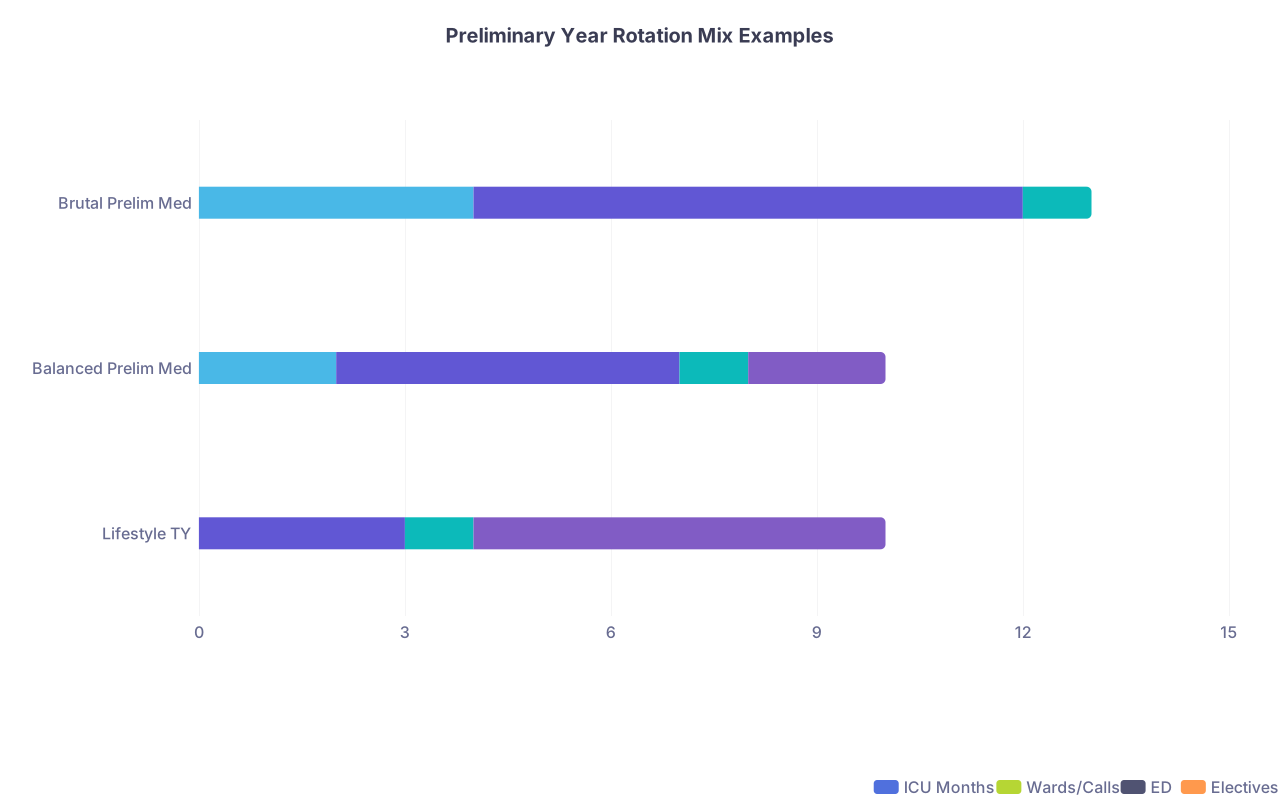
| Category | ICU Months | Wards/Calls | ED | Electives |
|---|---|---|---|---|
| Lifestyle TY | 0 | 3 | 1 | 6 |
| Balanced Prelim Med | 2 | 5 | 1 | 2 |
| Brutal Prelim Med | 4 | 8 | 1 | 0 |
- The “Lifestyle TY” looks nice but can leave you clinically flimsy if it is all derm clinic and ophthalmology electives.
- The “Balanced Prelim Med” is the sweet spot for most radiology‑bound interns.
- The “Brutal Prelim Med” will make you tough but exhausted and probably bitter.
Geography And Alignment With Your Advanced Program
If your prelim and advanced radiology programs are in the same institution or city, you gain:
- Continuity with the EMR and hospital culture
- Early relationships with radiology faculty and residents
- Less chaos with moving, housing, and licensing
But do not force a toxic prelim year just to be at the same place as your DR program. A malignant PGY‑1 will hurt more than it helps.
Ask yourself:
- Will this prelim program respect me as a radiology‑bound trainee or see me as one‑year cheap labor?
- Are there rads‑interested interns here who speak well of the year?
When you talk to current prelims, listen for specific phrases. “They protect our electives,” “the ICU is tough but fair,” “they actually care about teaching” versus “we are just here to plug holes” and “no one cares what you are going into.”
How To Structure Your Year Once You Start: Month‑By‑Month Strategy
You matched. You ranked a prelim. Now you are stuck with what you got. Tailoring becomes about how you move through it, not what shows on paper.
Front-Loading vs Back-Loading The Pain
If you can rank‑order or request rotations, here is how I usually advise rads‑bound interns:
- Early (July–October):
- General medicine wards
- One ICU month
- One ED or night float block
You learn the basics fast and solidify your clinical identity while you still have energy and no boards or in‑training exams on your back.
- Middle (November–February):
- Remaining ICU or heavy rotations
- Mix with one “lighter” consult or subspecialty month
By winter, you are functioning. You can handle heavier rotations more efficiently.
- Late (March–June):
- Radiology/IR electives
- Electives in high‑imaging specialties (pulm, neuro, onc)
- Avoid starting a brutal new service in June when everyone else has checked out
You want the final quarter of the year to begin pivoting mentally into radiology.
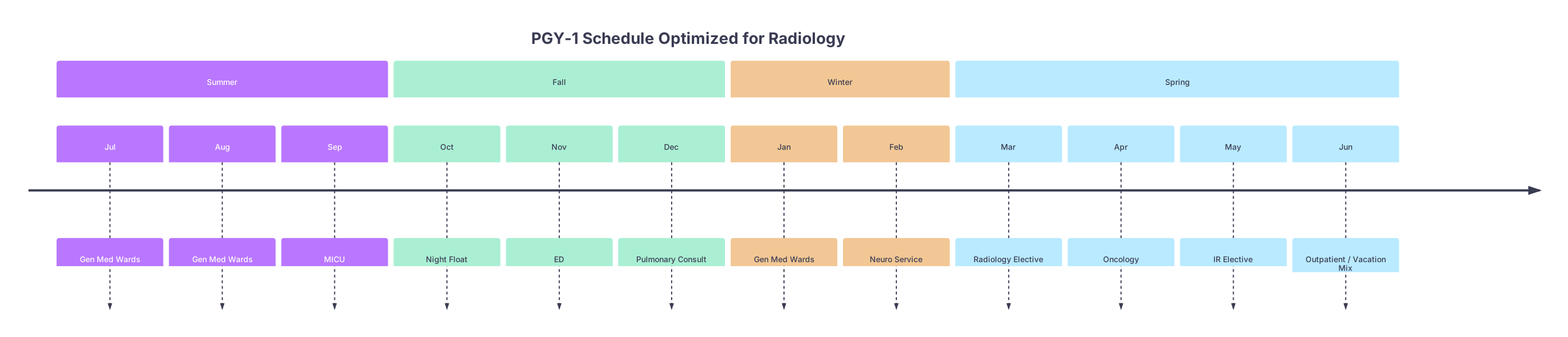
Here is what a nicely structured prelim medicine year might look like:
| Period | Event |
|---|---|
| Summer - Jul | Gen Med Wards |
| Summer - Aug | Gen Med Wards |
| Summer - Sep | MICU |
| Fall - Oct | Night Float |
| Fall - Nov | ED |
| Fall - Dec | Pulmonary Consult |
| Winter - Jan | Gen Med Wards |
| Winter - Feb | Neuro Service |
| Spring - Mar | Radiology Elective |
| Spring - Apr | Oncology |
| Spring - May | IR Elective |
| Spring - Jun | Outpatient / Vacation Mix |
Is every program that flexible? Obviously not. But even at rigid places you can often negotiate:
- Which month you do ICU
- Whether you get rads vs some random low‑yield elective
- Whether IR is an option
Residents who ask early and politely, and follow up, get better schedules. The passive ones get whatever is left.
On Your Radiology Elective: Do Not Waste It
Most interns use their radiology elective as a vacation with a chair and some snacks. Big mistake.
Use that block to:
- Sit in the reading room for the high‑intensity services: ER, chest, neuro
- Ask for a micro‑project: case presentation, brief write‑up for a case report, image‑rich teaching file
- Show up to resident conferences, even if you do not understand all of it yet
- Ask senior residents what they wish they had learned as interns
You are not just “shadowing;” you are signaling future performance and building mentors who will remember you when fellowship letters are needed.
Skills You Must Deliberately Build During Prelim Year (With Radiology In Mind)
You are not going to be reading scans. That is not the goal. The goal is to show up to R1 with a different brain than the pure radiology‑bubble trainee.
1. Clinical Question Framing
Every consult, every admission, force yourself to articulate:
- What is the actual question I need answered?
- What imaging, if any, would best answer that question?
- What will we do with the result?
Example:
Bad: “Rule out everything CT abdomen pelvis” for “abdominal pain.”
Good: 62‑year‑old with known diverticulosis, fever, left lower quadrant pain, leukocytosis, concern for diverticulitis vs perforation → CT abdomen/pelvis with IV contrast.
You are training yourself to think like a rational ordering provider. That directly informs how you will later critique orders as a radiologist.
2. Systems‑Level Awareness
When you are buried on wards, pay attention to:
- Turnaround times for key studies (CT PE, MRI spine, stroke imaging)
- Bottlenecks: transport, contrast availability, after‑hours staffing
- Communication failures between teams and radiology
You will later be the doctor on the other side of that phone. The intern who remembers these system realities will design better workflows when they are chief, or when they are the attending trying to fix a broken contrast reaction protocol.
3. Procedural and Resuscitation Comfort (Especially For IR‑Leaning Residents)
Code blue. Intubation. Central lines. Chest tubes.
You will not be doing most of these as a DR attending, but as IR or as a senior radiology resident covering nights, you will be involved in:
- Contrast reactions
- Post‑biopsy hemorrhage
- PE during procedure
- Hemodynamic collapse in IR suite
You want to leave prelim year with:
- AT LEAST one ACLS course internalized, not just “passed”
- Comfort doing ACLS in real codes (run at least a few)
- A few central lines and arterial lines under supervision if your program allows
Again, you are not becoming an intensivist. You are avoiding being the radiologist who panics the first time a patient crumps in the angio suite.
Red Flags In Prelim Programs If You’re Radiology-Bound
Let me be blunt. If you see these, reconsider.
- Prelims explicitly treated as expendable. “Our categoricals get priority for everything; prelims are just coverage.”
- No guaranteed elective time, or electives routinely stolen for “service needs.”
- No ICU exposure at all in a medicine‑based year. That is not a good trade‑off; it means you will be uncomfortable with very sick patients later.
- Zero structural contact with radiology: no elective, no lectures, no research, no interest.
- Culture bragging about suffering: “If you leave before 7 p.m., you are weak.” “We do not care you are going into rads; we will make you a real doctor first.” That last phrase sounds noble and is often just code for abusive.
A hard year that still respects you can be fine. A year that sees you as disposable will erode your enthusiasm for medicine and radiology both.
How This Prelim Year Plays Into Long-Term Radiology Goals
You might think: “Radiology match is done. Who cares what happens in PGY‑1 as long as I do not get fired?” That is naïve.
Here is how prelim year silently shapes your radiology career:
1. Letters And Reputation
You may later need:
- A medicine attending letter for an early fellowship application
- Someone to vouch for your clinical acumen
- A reference when you go for academic jobs that want a cross‑departmental view
If your ICU or wards attending thinks you are sharp, reliable, and clinically grounded, your stock goes up. Especially in fields like IR or cardiothoracic imaging, where they care that you “get” the clinical side.
2. Research And Niche Development
That radiology elective project? That can turn into:
- A case series
- A poster or abstract at RSNA or SIR
- The kernel of a subspecialty interest (e.g., lung transplant imaging, transplant IR, stroke imaging)
You do not need 10 papers as an intern. But a small, focused piece of work with one radiology mentor can set your trajectory.
3. How Fast You Climb The Rads Learning Curve
Radiology is a different language. Interns with a solid prelim year:
- Understand why studies are ordered
- Know what is emergent versus outpatient nice‑to‑have
- Ask better questions when they read (because they understand the clinical story)
These residents accelerate. The ones who drift through a “vacation” prelim year often spend R1 learning basic medicine and imaging indications that should already be second nature.
A Quick Reality Check: Burnout And Boundaries
Let me inject some realism. You are not a machine. A “perfectly optimized” prelim year that leaves you depressed and hollow is a failure.
Non‑negotiables:
- At least some protected vacation that is truly vacation, not “prelims cover everything while categoricals take real time off.”
- A program where you can actually go to the dentist or a doctor without begging.
- PD and chiefs who do not dismiss every concern as “the new generation is soft.”
Your job is not to martyr yourself. You want to arrive at radiology residency:
- Tired but intact
- Respectful of medicine but not traumatized by it
- Still curious
If you find yourself halfway through the year absolutely drowning, talk to someone early:
- Chief resident you trust
- Program director
- A senior radiology resident you know from your elective
The worst thing you can do is white‑knuckle the entire year and show up day 1 of R1 already burned out. You will not hide it. Radiology is intense in its own way.
FAQs
1. Is a “chill” Transitional Year bad if I want a competitive radiology fellowship later?
Not automatically. A well‑designed TY with:
- Some ICU or ED exposure
- A few solid inpatient blocks
- Genuine radiology or IR elective time
can be perfectly adequate and may protect your mental health. The problem is the ultra‑soft, clinic‑heavy TY where you never really manage sick patients or develop call endurance. If you pick a lighter TY, you should be honest with yourself and deliberately seek more acute care exposure during electives.
2. For IR, should I choose prelim medicine or prelim surgery?
If you are serious about IR, both can work, but I usually recommend:
- Prelim medicine with strong ICU and ED for most people, because it builds a broad base in multi‑organ failure, sepsis, cardiopulmonary management, and complex medical decision‑making.
- Prelim surgery is reasonable if it is not malignant and has robust surgical ICU and trauma exposure and you specifically want that environment. But repeated 100‑hour weeks with minimal imaging interaction are not magically “better” just because they are harder.
3. How much does my prelim program name or prestige matter for radiology?
Much less than you think. Your advanced radiology program carries far more weight for fellowships and jobs. What matters in prelim year is:
- You do not get fired.
- You develop real clinical competence.
- You build at least one or two strong relationships for future letters.
No one cares that your prelim was a mid‑tier community hospital if you show up to radiology sharp, stable, and clinically savvy.
4. Can I do radiology research during my prelim year without burning out?
Yes, but you must be strategic. The right way:
- Identify one radiology attending or fellow willing to supervise a small, contained project (case report, short retrospective review)
- Use an actual elective block or lighter rotation, not ICU nights, to do the work
- Set realistic scope: something that can be finished within 2–3 months of part‑time effort
The wrong way is to promise a big multi‑year project during a brutal wards stretch and then fail both clinically and academically.
5. What if my prelim schedule is already fixed and has no radiology elective?
You can still tailor it. Do the following:
- Pick high‑imaging rotations (pulm, neuro, onc, trauma) as any remaining electives.
- On those services, actively engage with radiology: sit briefly in the reading room when your patients are scanned, call for results yourself, attend imaging‑based conferences.
- During nights or down time, read short, practical radiology primers (e.g., basics of chest radiology, emergency neuroimaging).
- Reach out to your future radiology program early, ask if you can attend their noon conference occasionally when you have a day off.
You are using the same fixed schedule but extracting more radiology‑relevant value from it.
Key points:
A well‑tailored preliminary year for radiology is not about “easy vs hard.” It is about a balanced clinical foundation plus deliberate radiology‑adjacent exposure while preserving enough sanity to arrive at R1 ready to learn. If you choose or shape your prelim with that lens, you will look and feel very different from the intern who just tried to survive.