Most prelim interns waste their electives. Then wonder why their fellowship application feels generic.
You can do better than “whatever is available on Amion.” A well‑designed prelim year can function like a 12‑month audition tape for your future fellowship—if you stop thinking like “temporary help” and start thinking like a future subspecialist.
Let me break this down specifically.
What a Preliminary Year Actually Is (And Is Not)
A preliminary year is not “one year of IM before anesthesia” or “surgery bootcamp before radiology.” That is the brochure version. Functionally, it is:
- A one‑year, mostly service‑heavy contract where you are cheap labor.
- A place where almost no one is designing your schedule around your long‑term goals.
- A year that fellowship directors will still scrutinize very closely.
You will see three broad prelim models:
- Medicine prelim – Common for: neurology, anesthesia, radiology, derm, PM&R, radiation oncology, EM (some), ophthalmology.
- Surgery prelim – Common for: radiology, anesthesia (some), urology, ortho (rarely), neurosurgery (backup), categorical gen surg hopefuls.
- Transitional year (TY) – The unicorn: more elective time, lighter call, but variable quality.
The mistake I see every year: interns treat this as a gap year they just need to survive. Then they end up with:
- Random electives nobody can interpret.
- Weak or generic letters.
- No coherent narrative that explains why they belong in their chosen fellowship.
Your goal is different: weaponize this year so that when fellowship PDs read your file, the prelim year clearly points in one direction.
The Only Three Things Your Prelim Year Has to Do for Fellowship
Strip away the noise. For future fellowship training, your prelim year must:
Not raise any red flags.
No professionalism issues, no “struggles with time management” language in your MSPE or residency letter, no failed rotations. Clean file.Demonstrate readiness for advanced training.
This is code for: solid clinical skills, can handle call, knows when to ask for help, works well with teams.Support your subspecialty story.
Through targeted electives, letters, and small but deliberate scholarly activity that signal: this person has been pointed toward [your field] for a while, not last month.
Everything else—wellness, location, social life—matters to your sanity, but not to a fellowship selection committee. When you plan electives, keep these three pillars in front of you.
How Fellowship PDs Actually Read Your Prelim Year
Let’s make it concrete. When a cardiology PD, or neuro PD, or IR PD scans your file, here is what they subconsciously check:
- Were they in a serious clinical environment or a cruise‑control TY where no one knows how they function under pressure?
- Did they do at least a few rotations relevant to my field?
- Are there letters from people I know or respect in my specialty or a related one?
- Any sign they were avoiding hard work? A year stacked with “Research Elective,” “Administrative,” “Vacation,” “Outpatient” with no acute care?
- Does the timing of their interest line up? Or did they “discover” cardiology three months before applying?
If you build your year haphazardly, you leave these questions to chance. You can design your electives so that every answer leans in your favor.
First Decision: What Type of Prelim and What That Implies
If you are still choosing or ranking programs, recognize the structural differences.
| Prelim Type | Typical Elective Time | Control Over Choices | Service Intensity |
|---|---|---|---|
| Medicine | 2–4 months | Moderate | High |
| Surgery | 0–2 months | Low | Very High |
| Transitional | 3–6 months | High | Variable |
Medicine prelim:
Most compatible with IM‑based fellowships (cards, GI, heme/onc, pulm/crit, nephro, ID, rheum, endo, geri, palliative) and with anesthesia, neuro, PM&R. You usually get 2–4 months elective. That is where you make moves.
Surgery prelim:
Designed as service coverage. One to two “electives” that are still essentially off‑service labor like SICU, trauma, vascular. Best leveraged for surgical or procedurally focused fields (IR, some radiology, anesthesia, urology) to show you can function in the OR and ICU. Harder for cognitively heavy fellowships but not impossible.
Transitional year:
If you match here, you have the most room to engineer a subspecialty‑oriented schedule, but the biggest danger of under‑challenging yourself. A TY with zero acute care or ICU is a red flag for some fellowships.
So: you already know your advanced specialty (or you should if you’re reading this). Now structure the prelim year to make that future self look inevitable.
Core Strategy: Balance “Legit” with “Targeted”
PDs can smell a schedule designed purely for comfort. They can also spot a schedule that is all grind and zero direction.
You want three things in your elective design:
- At least one or two high‑acuity rotations that prove you can handle sick patients.
- Direct exposure to your future specialty or its feeder rotations.
- Space for at least one letter‑generating, relationship‑rich month.
Let’s hit specific specialties because the details matter.
If You Are Heading Into Cardiology (Cards Fellowship Later)
You are doing: IM categorical after prelim (or you are already in IM with a heavy prelim‑style PGY‑1).
Key rotations to prioritize:
Cardiology consults (not just CCU):
Shows you can think through chest pain, syncope, arrhythmias on the floors and ED. Excellent for letters. You see a broad referral base.CCU / Cardiac ICU (if allowed as intern):
One of the strongest signals that you are serious. But only if you function well under pressure. If you are still figuring out how to write notes, maybe schedule this later in the year.MICU:
Fellows and PDs know this is where real internal medicine happens. A strong MICU evaluation is gold.ED (adult):
Shows you have evaluated undifferentiated chest pain, shortness of breath, arrhythmias. Helpful but less critical than CCU/MICU.
Rotations that add little at the application level:
- Obscure outpatient electives unrelated to cardiovascular disease.
- Research “elective” where you mostly sit and read and generate nothing.
Concrete sample schedule fragment for a medicine prelim intern interested in cards:
- Sept: CCU (accredited, with robust teaching).
- Nov: Cardiology consults (build relationships for letters).
- Jan: MICU.
- Feb: Research / QI elective in cardiology with a clear deliverable (case report, abstract, QI poster).
During your cards‑adjacent months, you are not just “doing the rotation.” You are:
- Identifying one or two attendings/fellows who are serious educators.
- Asking to help with data collection, a case write‑up, or registry project.
- Getting feedback explicitly and early (“I am aiming for cardiology and would appreciate your feedback on how I can grow.”).
If You Are Heading Into Neurology (Prelim IM or TY then Neuro)
Neurology PDs look hard at your medicine base. They want residents who are not lost with pneumonia and heart failure before talking about demyelinating disease.
Priority rotations:
General medicine wards where you see bread‑and‑butter internal medicine.
Sounds obvious, but I have watched future neurologists hide in consult electives and struggle later with basic co‑management.Neurology consult service (if available):
Ideal. You learn how neuro interfaces with medicine: stroke alerts, seizure evaluations, delirium. Crucial for letters.Stroke service or Neuro ICU (if allowed):
High‑yield for future vascular neurology or critical care neuro. Even one month puts you ahead.MICU:
Neuro PDs love to see comfort with vents, pressors, and delirium. Neuro ICU is mostly built on MICU fundamentals.ED with stroke calls:
Good, but only if you get meaningful neuro exposure.
Things that are nice but not essential:
- Outpatient neurology clinic month as an intern — helpful for comfort, but consult/stroke service is weighted more.
For a medicine prelim before neuro:
- Try to stack neuro exposure late fall or winter so letters are recent when you apply to neurology that cycle.
- Protect at least one “lighter” rotation around interview season if your neuro program is a separate match year.
If You Are Heading Into Anesthesiology
Some anesthesia PDs openly say: “I want to see that your prelim year was not a vacation.”
You want:
ICU exposure – MICU, SICU, or CTICU.
This is arguably the single most valuable elective for future anesthesiologists: vent management, hemodynamics, sedation, vasopressors.Acute pain / perioperative medicine (if your prelim program has this):
Great but not mandatory. Often more available in anesthesia departments than in prelim structures.ED – Airway exposure, preoperative assessment, resuscitation logic.
If you are in a surgery prelim:
- SICU or Trauma ICU is your friend.
Build relationships with anesthesiologists covering these units. They will remember the prelim who handled hypotension calmly at 3 a.m.
If you are in a TY:
- Do not fill your year with dermatology clinic and “research.”
A TY heavy in ICU + ED + a dedicated anesthesiology month is vastly more persuasive.
If You Are Heading Into Radiology (Including IR)
Radiology PDs know you will learn imaging on the job. They care more about whether you can recognize sick patients and communicate.
High‑yield rotations:
ICU (MICU or SICU):
Pathophysiology, procedure exposure (lines, thoracenteses), real‑time decision‑making. Also: you will later understand why that chest CT was ordered at 3 a.m.ED:
Where imaging drives acute care. Great for understanding when a CT head actually changes management.Radiology elective:
But not as a vacation. Shadow reading sessions, help with basic QI (e.g., critical results communication), maybe a case series.
For IR specifically:
- Any vascular surgery, hepatology, oncology, or nephrology/dialysis access exposure can be spun as relevant.
- Try to get at least 1 month where you are physically present around IR attendings/fellows. Learn names, faces, and their expectations. Letters from IR are very potent.
If You Are Heading Into Derm, PM&R, Ophthalmology, Radiation Oncology
These specialties often require or highly value a prelim medicine or TY.
General principles:
You must still prove you can handle acutely ill adults.
MICU or at least a month with significant inpatient medicine is almost mandatory for credibility.Then: one or two months that directly touch your future field.
Derm:
- Inpatient consult derm (if your institution has it) is outstanding.
- Rheum or heme/onc with cutaneous manifestations can be spun as supporting training.
PM&R:
- Inpatient rehab, neurology consults, ortho, pain, spine surgery, or sports medicine clinics.
- One ICU or trauma month to show comfort with medically complex patients with disabilities.
Ophthalmology:
- ED with eye complaints, neurology consults (neuro‑oph), rheum (uveitis), maybe a dedicated ophtho month if allowed.
Rad Onc:
- Heme/onc wards, inpatient oncology consults, palliative care, pain management.
- A rad onc elective is helpful but not strictly required if you have a strong record of oncology exposure.
Again: your elective months must tell a story. “This intern lived near the diseases we treat.”
What About Research and QI During a Prelim Year?
Harsh truth: you are unlikely to produce a high‑impact publication from scratch in a single prelim year while learning how to admit patients and manage cross‑cover.
So do not promise that.
What you can do:
Case reports and small series – identify interesting patients on your subspecialty‑relevant rotations and ask an attending if they are publication‑worthy. You can often get at least one case write‑up out in 6–9 months.
Join an ongoing project – many divisions have a registry or chart‑review project that needs another pair of hands. Your contribution can be realistic: data abstraction, literature review, basic statistics help.
Quality improvement – short projects with defined endpoints are perfect for a 1‑year stop: reduce time to antibiotics in neutropenic fever, improve anticoagulation documentation before procedures, etc.
The elective strategy piece:
- If you want research, block one month as “research/QI” and protect it.
- Go in with a project and IRB status already lined up from the first quarter of the year. If you schedule “research elective” and start hunting for ideas on day 1, the month will evaporate.
Politics and Letters: Use Electives as Auditions
Electives are not just content; they are where you earn your letters and your advocates. This is the part most interns bungle.
Some specifics:
Identify your letter writers before the rotation starts.
If you are doing a cardiology consult month, walk in on day 1 knowing you will aim for a letter from Dr. X or Dr. Y.Signal your intentions early but not desperately.
“I am planning on pursuing cardiology fellowship after my IM training and would really appreciate feedback on how I am doing and what I should be focusing on.”Show up like a future fellow, not a short‑timer.
Do the unsexy work: follow up on tests, call families, read primary literature on your patients. Attend conference. Ask actually thoughtful questions.Ask for letters during or immediately after the rotation, not 8 months later.
Fellowship PDs know the difference between a fresh, specific letter and a vague one written from distant memory.
If your future fellowship is at a different institution:
- Strong letters from recognizable names in the field carry far. If your hospital has national figures in your target specialty, fight to rotate with them even if it costs you some comfort (longer commute, busier service).
Timing: When to Schedule What Across the Year
This is where you move from theory to an actual Gantt chart in your head. Think about three phases of intern year.
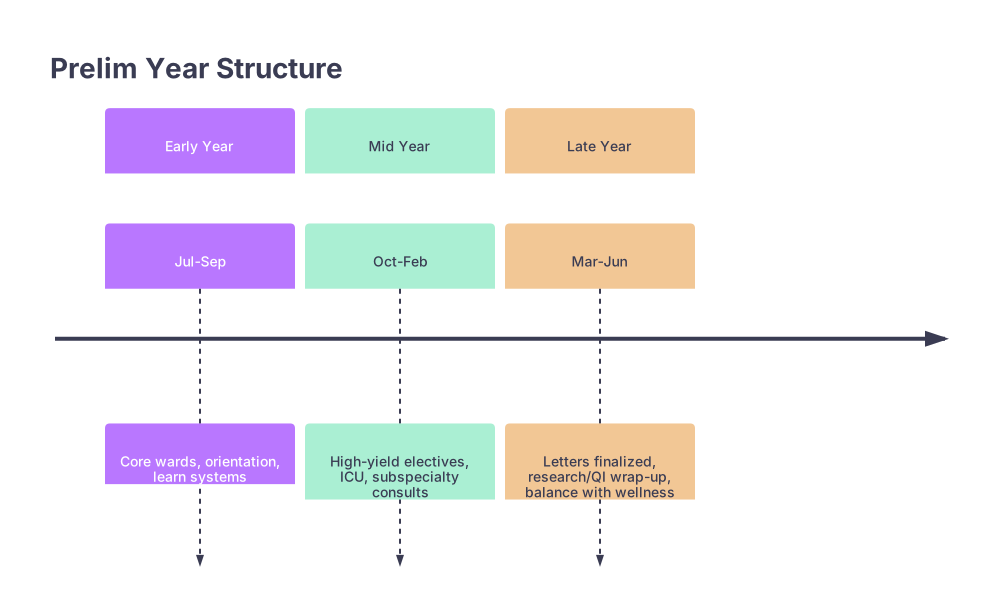
| Period | Event |
|---|---|
| Early Year - Jul-Sep | Core wards, orientation, learn systems |
| Mid Year - Oct-Feb | High-yield electives, ICU, subspecialty consults |
| Late Year - Mar-Jun | Letters finalized, research/QI wrap-up, balance with wellness |
Early (July–September):
- You are still learning how to admit and discharge, write notes, call consults.
- Ideally: fewer electives here unless your program forces them.
- If you must take electives: choose something with clear teaching and not too high acuity (e.g., general consult service, outpatient subspecialty clinic) rather than MICU on day 1.
Mid (October–February):
- This is primetime for fellowship‑relevant electives.
- You are competent with basic inpatient tasks and can actually impress people instead of just drowning.
- Stack:
- ICU (one month here).
- Major subspecialty consult rotation in your field.
- Optional second adjacent subspecialty rotation (e.g., cardiology + MICU, neuro + stroke, heme/onc + palliative).
Late (March–June):
- Use for:
- Research/QI wrap‑up.
- A “victory lap” elective in your specialty to strengthen a borderline letter or build a second one.
- Some sanity‑preserving rotations before you transition to PGY‑2 or to your advanced program.
Do not schedule all your hardest rotations back‑to‑back in January–March and then wonder why you are burned out and making mistakes. You are still human.
Specialty‑Specific Sample Elective Bundles
Let me give you a few sample “bundles” so you can see the pattern.
Future Cardiology – Medicine Prelim
- 1 month MICU (winter).
- 1 month CCU or combined cardiac ICU (winter or spring).
- 1 month Cardiology consults (fall or winter).
- 1 month research/QI in Cardiology (spring).
You emerge saying: “I have managed acutely decompensated heart failure, ACS, arrhythmias in ICU and consult settings, and I contributed to a QI project on door‑to‑needle times.”
Future Neurology – Medicine Prelim or TY
- 1 month Neurology consults (fall).
- 1 month Stroke service or Neuro ICU (winter).
- 1 month MICU (winter).
- Optional 1 month Rehab or PM&R (spring) if you lean toward neuro‑rehab.
Your letters come from neuro attendings who watched you run stroke codes and from ICU faculty who know your clinical grit.
Future Radiology (Diagnostic with IR interest) – TY
- 1 month MICU.
- 1 month ED.
- 1 month Radiology elective with IR exposure.
- 1 month oncology or vascular surgery.
You can say credibly: “I saw how imaging decisions impact acute care in the ED and ICU, and I worked closely with IR on procedural planning and follow‑up.”
Common Mistakes That Kill the Value of Your Prelim Electives
I have watched this play out every year. Avoid the following:
Elective hoarding without strategy.
Four months of vague “Outpatient” or “Clinic” with no clear specialty focus just looks like you were dodging work.No ICU exposure at all.
For almost any fellowship other than the most outpatient‑heavy (pure outpatient rheum, perhaps derm), zero ICU is a red flag.Choosing “easy” services with toxic or disengaged faculty.
An easier call schedule is not worth a bad reputation or weak letters.Waiting until May to think about letters or projects.
By then, your best attendings have rotated off, or the IRB clock has just started.Ignoring the advanced program’s expectations.
Some advanced residencies (e.g., certain neurology or anesthesia programs) have explicit or implicit preferences: they expect MICU, or they expect a certain number of inpatient months. Confirm with them and align your prelim electives accordingly.
How to Actually Get the Electives You Want
You are not scheduling in a vacuum. There is a chief resident or coordinator gatekeeping everything.
Tactics that work:
Ask early.
As soon as schedules open, email or meet with the chief/coordinator and say plainly: “I am planning on [future specialty]. I need at least [X, Y, Z] electives if possible.” Early planners get the good blocks.Be flexible with months, not content.
You might not get Cardiology in November, but you can usually get it somewhere if you are clear that it is a priority.Trade smartly.
Prelims often swap rotations informally. If you see someone trying to dump a MICU month that you want, volunteer to trade a less critical elective.Document agreements.
After a verbal promise, send a brief email: “Thanks for agreeing to schedule me on MICU in January; I really appreciate your help aligning this with my future fellowship goals.” Protects you when schedules get “revised.”
A Word on Transitional Years: The Double‑Edged Sword
TYs can be phenomenal or disastrous for fellowship, depending on how you build them.
Bad TY profile:
- 0 ICU.
- 0 ED.
- All electives in dermatology clinic, ophthalmology clinic, and “wellness.”
- Fellowship PD reads it and wonders if you have ever managed a crashing patient.
Good TY profile (for, say, anesthesia or radiology):
- 1–2 months ICU.
- 1 month ED.
- 1 month hospitalist‑style wards.
- 1–2 months specialty‑adjacent electives (e.g., pain, radiology, cardiology, neurology).
- 1 month research or QI with a tangible output.
You can still sleep more than a surgery prelim while showing that you understand acuity and responsibility. That is the sweet spot.
Final Check: Does Your Prelim Year Tell a Coherent Story?
Stand back and look at your draft schedule like a fellowship PD.
- Would someone reasonably guess your intended field from your electives?
- Do you have at least one month that screams “this person can handle very sick patients”?
- Do you have at least one or two clear opportunities for strong letters from relevant attendings?
- Is there a realistic window for a small but concrete scholarly or QI product?
If the answer to all four is yes, you are ahead of most of your peers.
If not, revise. Before the year starts if possible. Mid‑year if you must.
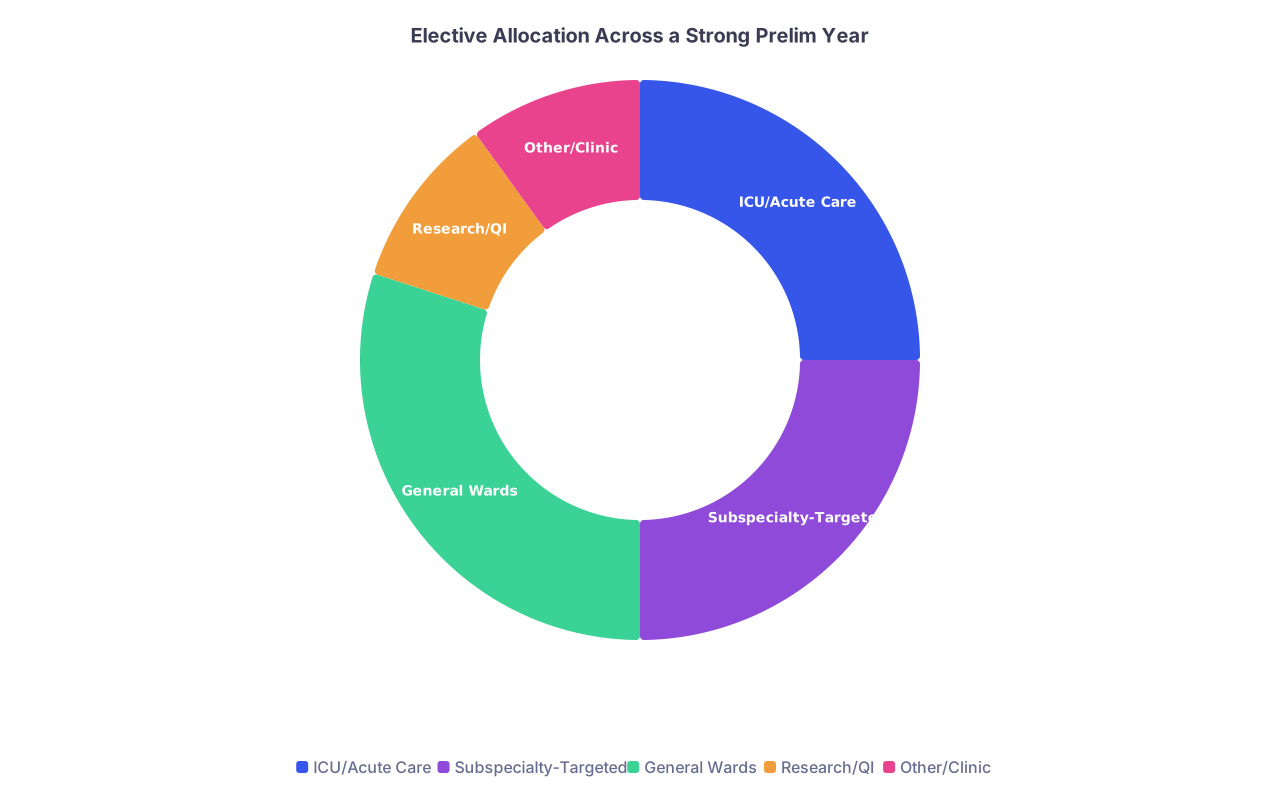
| Category | Value |
|---|---|
| ICU/Acute Care | 25 |
| Subspecialty-Targeted | 25 |
| General Wards | 30 |
| Research/QI | 10 |
| Other/Clinic | 10 |
The Bottom Line
Three points and you are done:
- A prelim year is not filler; fellowship directors scrutinize it for red flags, clinical readiness, and whether your electives align with your stated interests.
- The highest‑yield schedule balances at least one ICU/acute‑care month, one or two directly relevant subspecialty electives, and at least one relationship‑rich month that can generate a strong letter.
- If your schedule does not obviously tell the story of a future [your specialty] physician—fix it now, before the chief resident’s spreadsheet hardens into fact.