
The way you structure your preliminary year will either accelerate your path to cardiology or quietly sabotage it. Same for GI. Most interns drift through a generic “medicine prelim” and then wonder why they feel behind their categorical IM colleagues when fellowship applications hit. That is avoidable.
Let me break this down specifically: a prelim year for an aspiring cardiologist should not look the same as a prelim year for someone aiming at gastroenterology. The ACGME requirements might be identical. The strategy is not.
We are going to talk about prelim years in the context that matters: matching into cardiology vs gastroenterology. You are not just surviving intern year. You are setting up the file that PDs and fellowship committees will dissect 2–3 years from now.
First: What a Preliminary Year Actually Is (And What It Is Not)
People overcomplicate this. A “prelim year” in this context is almost always:
- A 1‑year internal medicine internship
- Sometimes a transitional year (TY), far less often surgical prelim, for these specialties
You complete 12 months of ACGME-accredited postgraduate training. That year can count toward:
- Neurology, anesthesia, radiology, etc.
- Or you use it as a stand‑alone year before reapplying
- Or you start as “prelim IM” then match categorical IM via the “off‑cycle” or PGY‑2 match
For future cardiologists and gastroenterologists, the reality is simple:
- If your end goal is cardiology or GI in the U.S., you almost always need 3 full years of categorical Internal Medicine first.
- A single prelim year does not qualify you to apply for cardiology or GI fellowship.
- The prelim year is either:
- Your first IM year before sliding into a categorical spot, or
- A holding pattern while you re‑enter the match more competitively.
So why should you care so much how you structure it?
Because the evaluations, letters, early scholarly work, and clinical exposure from that year heavily influence:
- Whether an IM program will take you into a categorical spot
- How competitive you look when you finally hit the fellowship application window in PGY‑3
Your attitude should not be: “It’s just a year; I’ll figure things out later.”
Your attitude should be: “This is the foundation for my cardiology or GI file. I cannot waste it.”
Core Differences: Cardiology vs GI Trajectory
Cardiology and GI share the same IM prerequisite but reward different “signals.”
Cardiology fellowship readers obsess over:
- Cardiac ICU exposure
- Step/board scores (including strong IM in‑training exam)
- EKG/echo literacy
- Procedural interest (lines, temporary pacing, etc. in some centers)
- Research in heart failure, interventional, EP, imaging
- Quantitative mindset, advanced imaging comfort
Gastroenterology fellowship readers care more about:
- Strong inpatient GI exposure (especially GI bleeds, liver disease, IBD)
- Endoscopy interest and procedural temperament
- Hepatology and transplant exposure at some centers
- Continuity of care (IBD, cirrhosis, chronic pancreatitis)
- Research or QI in GI, hepatology, or nutrition
On paper, both are competitive. In practice, cardiology is slightly more tolerant of hard-core “academic grind + ICU heavy” profiles, while GI often tilts toward procedural, well‑rounded internists with clear subspecialty interest and strong letters from GI division chiefs.
Meaning: what you emphasize during your prelim year should differ.
Let me show this in a quick comparison.
| Aspect | Aspiring Cardiologist | Aspiring Gastroenterologist |
|---|---|---|
| Key Clinical Rotations | Cardiac ICU, CCU, cardiac stepdown | Liver service, GI consult, MICU |
| Ancillary Exposure | EKG, echo, cath lab observation | Endoscopy suite, hepatology clinic |
| Ideal Procedures | Central lines, arterial lines | Paracentesis, PEG-related care |
| Research Focus | HF, interventional, EP, imaging | IBD, liver disease, endoscopy/QI |
| Letters to Target | Cardiology faculty, ICU attendings | GI attendings, liver/transplant |
Big Picture: What a High‑Yield Prelim Year Must Contain
Regardless of cardiology vs GI, a prelim year that helps you long‑term needs four pillars:
- Strong inpatient medicine performance
- You must be known as the intern who gets things done, knows the patient, and never disappears.
- Evidence of subspecialty interest
- Cards: your notes, management plans, and questions scream “cardiology brain.”
- GI: same idea, but around GI/liver problems.
- Early academic or QI output
- Case reports, small QI projects, or at least a pipeline starting in PGY‑1.
- Letters of recommendation
- At least one from a general IM figure, and at least one from your target subspecialty.
Everything else—call schedule, scut work, who covers nights—is secondary to those four pillars.
Now let’s get concrete: how you actually structure 12 months if you are aiming for cardiology vs gastroenterology.
Structuring a Prelim Year for Aspiring Cardiologists
If you want to end up in cardiology, your prelim year should feel biased toward ACS, heart failure, arrhythmias, and hemodynamics whenever you can get it.
1. Choose the Right Type of Prelim Spot
Given a choice:
- Prelim IM at a medicine-heavy, academic center with a real cardiac presence > fancy transitional year with almost no ICU exposure.
I have seen people choose a cushy TY to “protect wellness” and then struggle to stand out when applying for IM categorical and later cardiology.
Signals that a prelim year is cardiology‑friendly:
- Robust cardiology division: HF service, EP, interventional, advanced imaging
- Separate CCU rotation (not just “MICU plus some cards patients”)
- Night float systems that actually let interns step into acute cardiac care
Red flags:
- No CCU or cardiac stepdown exposure for interns
- Community hospital with minimal in-house cardiology, all sent out to tertiary center
- Only one or two cardiologists, mostly doing outpatient consults
If you already matched advanced specialty requiring only a prelim year (e.g., radiology) but still dream of pivoting to cardiology later, your best move remains: pick the prelim IM with the strongest medicine + cardiology exposure you can. Your future self will thank you.
2. Target Rotations: What You Should Fight For
Here is how I would prioritize rotation structure for a cardiology‑bound prelim, within the usual 12‑month template.
Non-negotiable:
- At least 1 month MICU
- At least 1 month CCU/cardiac ICU (if available)
- 2–3 months of general medicine wards (daytime) at the main academic site
Highly desirable:
- 1 cardiology consult month
- 1 night float month in a setting with heavy cardiac admissions
- 1 outpatient month with dedicated cardiology clinic time
Things you can live with but should not overdo:
- Floors at small community affiliates with low cardiology complexity
- Non‑IM electives that have little bearing on hemodynamics or systemic pathophysiology
If your program lets you have input on scheduling, you want your strongest attendings and best letters clustered in:
- Q2–Q4 of the year (remember: when you apply for categorical IM or get early fellowship mentors, those are the evals they will read)
“Front‑loading” the hardest rotations in July–September is fine if you can handle it, but you want your later blocks to be where you shine after you stop drowning.
3. Day‑to‑Day Behaviors That Signal “Cardiology Person”
Fellowship committees read between the lines of your letters and evals.
On wards, MICU, and CCU:
- Be the intern who actually reads the telemetry strips and EKGs, not just writes “NSR” in the note because someone told you that.
- Volunteer to present on topics like:
- Management of HFrEF in the ICU
- Anticoagulation in AF with GI bleed (yes, cross‑over with GI)
- Approach to wide‑complex tachycardia
- During CCU, ask to:
- Observe caths, TEE, cardioversions
- Help with bedside echo to assess volume status (even just watching closely as fellows scan)
Your notes should show:
- Clear, cardiac‑focused problem lists: HF, ACS, arrhythmias, valvular disease
- Rational med titration: beta‑blocker logic, ACEi/ARB/ARNI, SGLT2i when appropriate
- Evidence that you think about guideline‑directed therapy, not just “continue home meds”
Your attendings remember interns who show up at 5:45 am to check trending troponins and overnight rhythms without being told. That gets into your letters.
4. Academic Output: What Is Realistic in a Single Year
You are not going to publish a NEJM heart failure trial in a prelim year. Aim for realistic targets:
- 1–2 case reports (e.g., unusual ACS presentation, cardiogenic shock, complex device infection)
- A small QI project:
- Reducing door‑to‑ECG times
- Improving adherence to heart failure discharge education or post‑discharge follow‑up
- Poster at local ACC chapter or hospital research day
Start early:
- By October–November, identify:
- One cardiology mentor
- One project you can realistically move to poster/abstract by June
Do not wait until April to “get involved in research.” At that point, you are just asking faculty to put your name on something. They can smell it.
5. Letters of Recommendation: Who and When
For cardiology trajectory, during prelim year you need:
- One strong general IM letter: someone on wards or MICU who can say you are a safe, reliable intern.
- One early cardiologist letter: ideally from CCU, cards consults, or from a mentor who supervised your project.
Even if you will not apply for cardiology fellowship for a few years, it is perfectly acceptable to:
- Ask for a letter at end of CCU month
- Have them write a detailed letter now, then update later when you are IM PGY‑2/3
Your ask should sound like:
“I am very interested in cardiology and would like to build a strong trajectory from intern year onward. Could you write a detailed letter describing my performance on CCU, especially around clinical reasoning and work ethic?”
That tells them this is not a generic residency LOR request.
6. What to Avoid in a Cardiology‑Bound Prelim Year
Bluntly:
- Avoid constructing a schedule full of “easy” outpatient months, dermatology electives, or random non‑IM fields just for lifestyle.
- Avoid being the intern who refuses night float or MICU because “it is not my interest.” Those rotations are where you prove you can handle acute physiology.
- Avoid disappearing from didactics. Cards and GI faculty watch which interns show up, ask questions, and stay awake.
A single bad eval on a key rotation can be explained. A pattern of “average” on every hard month is much harder to overcome when you try to pivot to categorical IM at a strong institution, then later cardiology.
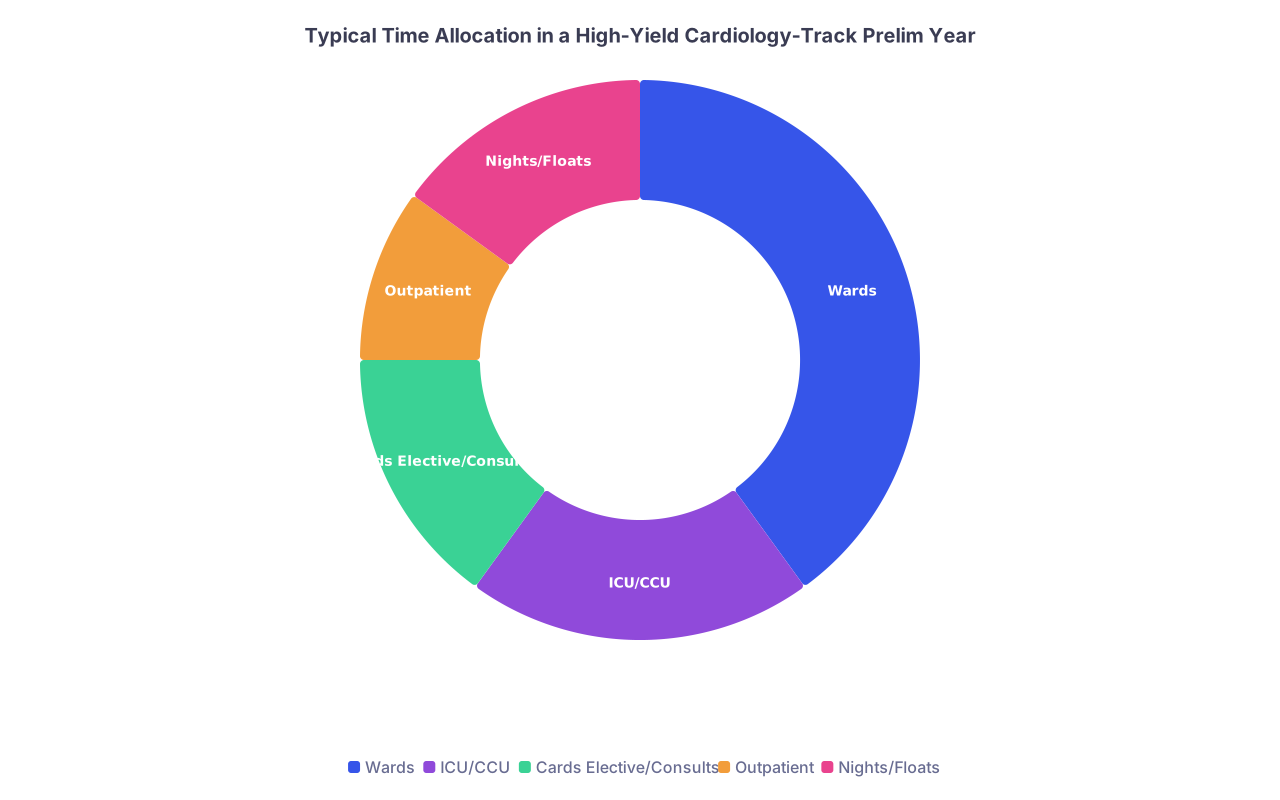
| Category | Value |
|---|---|
| Wards | 40 |
| ICU/CCU | 20 |
| Cards Elective/Consults | 15 |
| Outpatient | 10 |
| Nights/Floats | 15 |
Structuring a Prelim Year for Aspiring Gastroenterologists
Now shift lenses. The future GI fellow does not need to live in the CCU, but they do need to look like someone who can own complex GI and liver patients and clearly likes procedural, longitudinal care.
1. Select the Right Environment
Signs that a prelim IM spot is GI‑friendly:
- Active GI division with:
- At least a few advanced endoscopists
- Dedicated hepatology service or strong liver transplant connections
- High volume of:
- GI bleeds
- Decompensated cirrhosis
- IBD
- A system where interns:
- Rotate on GI consults or liver service
- Have exposure to endoscopy suite
Red flags:
- Tiny hospital where GI is mostly outpatient scopes, minimal inpatient consults
- No dedicated GI or hepatology elective for interns
- All cirrhotics shipped to a different system
2. Priority Rotations for GI‑Bound Prelims
Non‑negotiable:
- 2–3 months inpatient medicine floors with heavy GI/liver pathology
- 1 month MICU (GI bleeds, varices, shock, sepsis from abdominal sources)
- 1 dedicated GI consult month if possible
Highly desirable:
- 1 hepatology service month or liver transplant service, if your hospital has it
- 1 elective that touches nutrition, oncology (GI malignancies), or inflammatory diseases
- 1 outpatient rotation with GI clinic days
Outpatient medicine is not wasted for GI. Continuity with patients who have chronic abdominal pain, GERD, or early liver disease helps you build the skill set of long‑term management, not just acute bleeds.
3. Behaviors That Signal “GI Person”
On the wards and MICU:
- Be meticulous with:
- MELD and Child‑Pugh scores on cirrhotics
- Ascites evaluation: SBP workup, when to perform paracentesis, albumin dosing
- Differential for GI bleeds: upper vs lower, variceal vs non‑variceal
- Volunteer to present:
- Variceal bleed management
- Approach to abnormal LFTs
- Evidence on PPIs in UGIB or prophylaxis in cirrhotics
In GI consults or electives:
- Show up to the endoscopy suite early, watch:
- EGDs, colonoscopies, ERCPs, EUS
- How attendings consent, manage sedation, handle complications
- Ask for hands‑on opportunities that are realistic for intern level:
- Writing detailed consult notes
- Calling primary teams with clear recommendations and reasoning
- Helping organize follow‑up colonoscopy schedules or liver clinic appointments
Your notes should show:
- Structured assessment of GI complaints: clear HPI around stool, bleeding, weight loss, timing with meals, meds
- Real thinking about:
- Risk stratification for bleeds
- Encephalopathy grades
- Nutrition, NPO status, and when to restart diet
GI attendings remember interns who know exactly which patients need urgent EGD versus those who can be scoped tomorrow. That nuance shows up in letters.
4. Realistic Academic Output for GI
In a single year, again, your goal is not to become the next lead author on biologics for ulcerative colitis. Your goals:
- A few case reports:
- Unusual etiology of GI bleed
- Rare hepatology cases (e.g., spontaneous bacterial empyema, portal vein thrombosis with unusual presentation)
- Small QI projects:
- Improving documentation of cirrhosis care bundles (beta‑blocker for varices, lactulose for encephalopathy, vaccination rates)
- Reducing time to paracentesis in hospitalized cirrhotics
- Posters at ACG, AASLD, or institutional research days, if opportunities align
Start by October:
- Identify GI or hepatology mentor
- Ask specifically, “Do you have ongoing case series or QI I can contribute to this year?”
GI faculty are often more clinically slammed than cardiology. This means:
- They may have multiple half‑finished projects
- They will give you responsibility only if you prove you can deliver under supervision
5. Letters of Recommendation for GI Trajectory
From a prelim year, you want:
- One rock‑solid IM letter (inpatient attending, maybe MICU or wards)
- One letter from a GI or hepatology attending who:
- Has seen you on consults, inpatient service, or outpatient clinics
- Can comment on procedural interest, clinical reasoning, and reliability
You do not need the “world‑famous IBD researcher” to write this in PGY‑1. You need someone who actually worked with you closely.
Again, ask early. At the end of your GI month:
“I am planning to pursue GI long term and would like to build that path starting now. Would you be comfortable writing a detailed letter commenting on my performance on the GI consult month?”
They may say they want to see you again later in residency. That is fine. You have planted the seed.
6. What to Avoid in a GI‑Bound Prelim Year
Common mistakes:
- Over‑loading ICU rotations at the expense of any GI exposure. You are not applying to critical care.
- Spending elective time on subspecialties far from GI (e.g., pure rheum, endocrine, derm) unless there is a clear rationale.
- Getting a reputation as the intern who “does not like scut” and avoids procedures like paracentesis, NG tubes, or rectal exams. Sorry, but GI is a hands‑on field.
One subtle but real point: some GI PDs react poorly to applicants who spent a year in a very cushy transitional year with minimal sick patients. If your prelim environment is light, counter‑balance it later with heavier rotations during categorical IM.
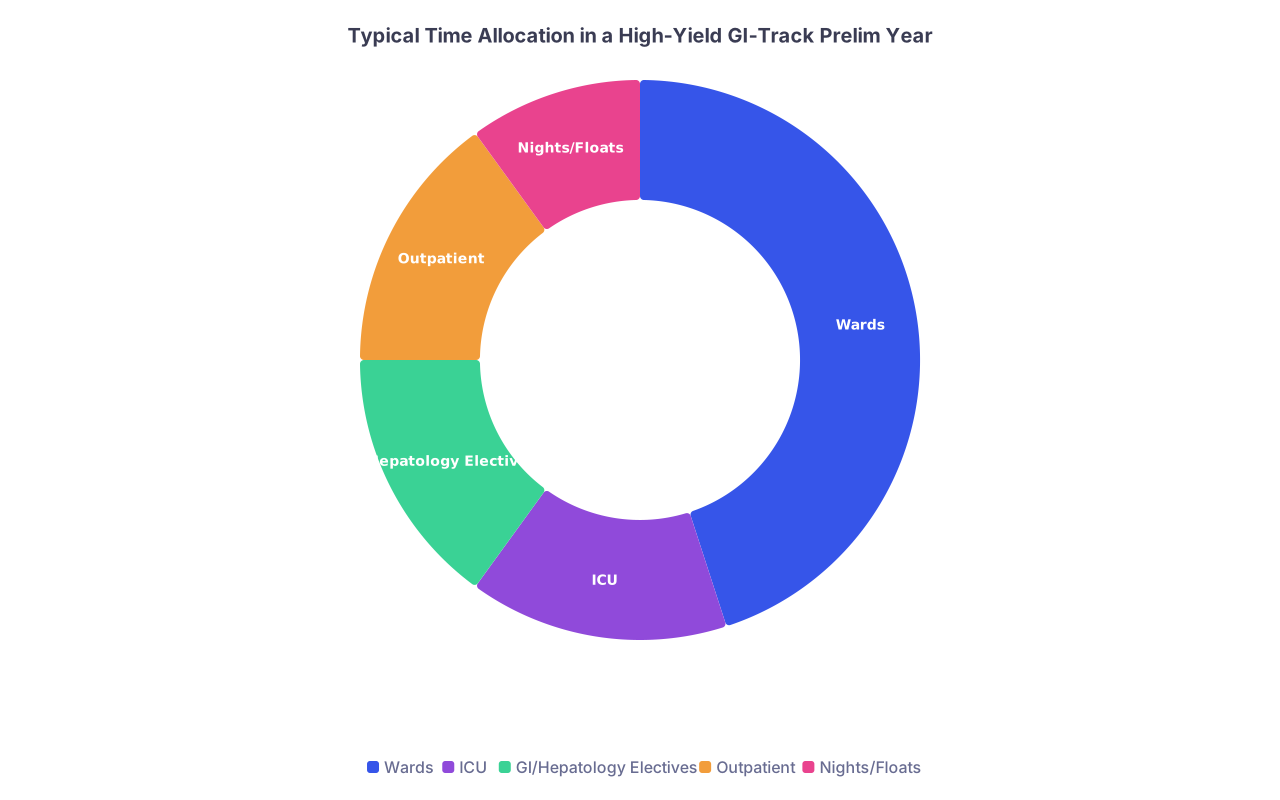
| Category | Value |
|---|---|
| Wards | 45 |
| ICU | 15 |
| GI/Hepatology Electives | 15 |
| Outpatient | 15 |
| Nights/Floats | 10 |
Cards vs GI: How Your Prelim Choices Diverge
Let me put the differences in strategy side‑by‑side and be blunt about them.
| Domain | Cardiology-Bound Prelim | GI-Bound Prelim |
|---|---|---|
| ICU Emphasis | High – MICU + CCU ideal | Moderate – MICU yes, CCU optional |
| Key Service | CCU, cardiology consults | GI consults, liver service |
| Signature Skills | Hemodynamics, arrhythmia management | GI bleed algorithms, cirrhosis management |
| Outpatient Value | Cards clinic secondary | GI/hepatology clinic more central |
| Procedures | Central lines, arterial lines, cardioversion obs | Paracentesis, diagnostic taps, scope exposure |
| Research | HF, EP, interventional, outcomes | IBD, liver, endoscopy/QI |
Final Reality Check: What This Year Can and Cannot Do For You
A well‑structured prelim year will:
- Prove you can function as a competent internist under pressure.
- Put you on the radar of cardiology or GI faculty early.
- Generate at least the first pieces of your academic and recommendation portfolio.
- Make you a more appealing candidate for categorical IM spots at stronger institutions.
It will not:
- Single‑handedly guarantee a cardiology or GI fellowship.
- Compensate for chronically weak test scores if you do not improve performance on in‑training exams.
- Replace the 2–3 years of cumulative track record you will build during categorical IM.
So use the prelim year for what it truly is: a high‑stakes foundation year. If you are aiming at cardiology, bias your time toward high‑acuity cardiac exposure, hemodynamics, and early cardiac mentorship. If you are aiming at GI, steer toward complex GI/liver services, procedural exposure, and hepatology mentorship.
Do this well, and you start PGY‑2 not as “just another medicine resident,” but as the resident everyone already quietly labels in conference: “That is the one who will go into cards.” Or, “That is the GI person.”
Your next move, once the prelim year is under control, is to think two steps ahead: which categorical IM programs, and which internal rotations in PGY‑2/3, best convert that early identity into a fellowship match. But that is the next phase of the game, and it deserves its own deep dive.