
Most applicants misunderstand prelim requirements for radiology, anesthesia, and neurology—and some find out too late, when a board tells them their intern year does not count.
Let me be blunt: the American Board of Radiology (ABR), the American Board of Anesthesiology (ABA), and the American Board of Psychiatry and Neurology (ABPN) all care deeply about how your PGY‑1 year is structured. But they express that in vague language, program coordinators often hand-wave it, and you are the one who gets burned years later if it is wrong.
You are asking about a classic blind spot in the residency match process: which preliminary years are acceptable for these three boards, and what “acceptable” actually means in concrete terms—rotation by rotation, ACGME category by ACGME category.
Let me break this down specifically.
Big Picture: How ABR, ABA, and ABPN Think About the Prelim Year
Each board has the same basic concern: before you are trained in a cognitively narrow specialty (radiology, anesthesia, or neurology), you must spend one year taking care of acutely ill adults as a real physician.
They are allergic to:
- “Fluffy” prelim years packed with electives and clinic.
- Years where you essentially avoid inpatient adult medicine.
- Programs that do not meet ACGME rules or are not accredited in the correct category.
They tend to like:
- Solid ACGME-accredited categorical or preliminary years with heavy inpatient medicine exposure.
- Transitional years that genuinely behave like a medicine-heavy intern year.
- Documented curricula with clear adult inpatient experience.
But their detailed requirements are not identical, and the nuances matter.
We will go specialty by specialty: ABR (radiology), ABA (anesthesiology), ABPN (neurology/child neurology). Then we will deal with the core question: what actually makes a prelim year “acceptable” vs “risky.”
Core Definitions: Prelim, Transitional, Categorical – What Boards Actually Care About
You cannot understand the board nuances until you understand how ACGME labels programs versus how applicants casually talk about them.
Quick translation:
Preliminary year (Prelim IM or Prelim Surgery)
One year of training in a discipline (often internal medicine or surgery), usually PGY‑1 only, not leading to board eligibility in that field.
Examples: “Preliminary Internal Medicine,” “Preliminary Surgery,” “Prelim at a big academic center.”Transitional year (TY)
A one-year, broad-based ACGME-accredited program with a mix of inpatient, outpatient, emergency, and elective rotations. Almost always used before advanced specialties: radiology, anesthesia, derm, ophtho, radiation oncology, PM&R, etc.Categorical program
Full pathway in one specialty (e.g., categorical neurology 4 years, categorical anesthesia 4 years, categorical radiology 5 years). Some of these include the intern year, some do not.
Now the subtle but critical thing:
ABR, ABA, and ABPN do not actually care whether the program is called “transitional,” “preliminary,” or “categorical” on ERAS. They care about:
- ACGME accreditation type and duration.
- The content of the year—how many months inpatient adult medicine, what kind of patients, what rotations.
So yes, a transitional year can be totally fine—or totally unacceptable—depending on its structure.
ABR (Radiology): Requirements and Common Pitfalls
The ABR handles diagnostic radiology and interventional radiology (integrated and independent pathways). Radiology is often the most forgiving in label (they accept prelim IM, prelim surgery, or transitional), but strict in content.
What ABR Officially Wants
The ABR refers to the PGY‑1 as “clinical year” or “PGY‑1 year.” For diagnostic radiology and IR (integrated):
The PGY‑1 year must be:
- ACGME-accredited residency training in:
- Internal Medicine, or
- Surgery, or
- Transitional Year, or
- A broad-based clinical year in another primary clinical specialty (e.g., pediatrics, sometimes emergency medicine),
- Completed in an ACGME (or acceptable international equivalent) accredited program.
- ACGME-accredited residency training in:
The year must provide:
- Direct patient care with responsibility for diagnosis and management.
- Substantial exposure to inpatient adult patients.
- Adequate breadth to form a foundation for radiology.
They do not want:
- A research-heavy “gap year” labeled as PGY‑1.
- A prelim with very little inpatient exposure and a ton of electives away from real patient care.
Practical Interpretation: What Actually Works for Radiology
Here is how I have seen this play out with residents and program directors.
Generally accepted without drama:
Transitional year with:
- At least 4–6 months of adult inpatient internal medicine or inpatient equivalents.
- Emergency medicine.
- Some ICU exposure.
- Limited elective bloat.
Preliminary internal medicine (standard structure):
- 6+ months of medicine wards.
- Night float, ICU, some electives.
Preliminary surgery with substantial floor and ICU time:
- Especially at academic centers where you are managing sick adult inpatients constantly.
Potential red flags where you should double check with ABR or your future radiology PD:
- TY programs where:
- Inpatient medicine is only 2–3 months.
- The rest is dermatology clinic, radiology electives, outpatient ortho, etc.
- PGY‑1 in a highly outpatient-focused specialty (e.g., nearly all clinic-based pediatrics) with minimal acute adult medicine.
- Non-ACGME “custom” clinical year or an international internship without clear equivalency.
Example Rotations: Strong vs Weak Radiology Prelim/TY Year
| Program Type | Inpatient Months | ICU Months | EM Months | Electives/Clinic |
|---|---|---|---|---|
| Strong TY | 5 IM wards | 1 MICU | 1 EM | 5 mixed |
| Strong Prelim IM | 7 IM wards | 1 MICU | 1 EM | 3 IM subspecialty |
| Borderline TY | 3 IM wards | 0 ICU | 1 EM | 8 mostly clinic |
| Weak TY | 2 IM wards | 0 ICU | 1 EM | 9 outpatient |
The first two schedules are virtually never questioned. The last one has led to uncomfortable board conversations.
ABR Nuance: Changing PGY‑1 Plans
If you match radiology and then try to:
- Switch prelims late.
- Convert a TY to an “education year” with research.
- Do a nonstandard or non-ACGME PGY‑1.
You must clear this with:
- Your radiology program director.
- ABR, in writing, before you do it.
Do not rely on “should be fine.” I have seen ABR retroactively deny a PGY‑1 for board-eligibility purposes and force someone to do additional training.
ABA (Anesthesiology): More Structured Expectations for the Clinical Base Year
The ABA is more explicit and stricter than ABR about what PGY‑1 should look like. They use the term “clinical base year” (CBY). Anesthesiology residency is typically 4 years: CBY (PGY‑1) + 3 CA (clinical anesthesia) years.
ABA Official Requirements in Plain English
The ABA requires:
- One year of ACGME-accredited training in:
- Internal Medicine,
- Surgery,
- Pediatrics,
- Transitional Year, or
- A year that the program certifies meets ABA “clinical base” content.
- The year must be:
- “Broad-based clinical experience” delivering direct patient care.
- Mainly inpatient, with significant responsibility for managing acute illness.
They specify required content categories over that year. They expect rotations in:
- Internal medicine (inpatient)
- Surgery or surgical subspecialties / perioperative care
- Emergency medicine
- Intensive care
- Some options for pediatrics, OB, etc.
Pure outpatient-heavy years will not meet their expectation of a true CBY.
What ABA Program Directors Actually Look For
Most anesthesia PDs know the ABA rules cold. They will usually:
- Explicitly tell you which prelim/TY programs they have accepted before.
- Flag “too cushy” TYs as a problem.
Common safe routes:
- Categorical anesthesiology (includes CBY by design).
- Prelim medicine at a hospital with strong inpatient volume.
- TY with:
- 4–6 months IM wards.
- 1–2 months ICU.
- EM and maybe some surgery.
Risky routes:
- TY where you are in dermatology clinic, PM&R clinic, radiology electives, or outpatient ortho for half the year.
- PGY‑1 in a mostly outpatient pediatric program with near-zero adult medicine.
- Non-standard paths: spending 3–4 months on research during PGY‑1.
ABA-Specific Quirks
One nuance you rarely see written clearly:
The ABA gets very particular if you have gaps, major leaves, or fragmented CBY training. For example:
- Doing 6 months of prelim IM at one place and 6 months somewhere else.
- Switching midway from prelim surgery to a different prelim.
This is not automatically fatal, but your anesthesia PD will typically need to submit documentation to the ABA certifying that the combined experience meets CBY requirements. If you are planning something like this, get guidance from the receiving anesthesia program very early.
ABPN (Neurology & Child Neurology): The Most Detailed and Easiest to Mess Up
ABPN requirements for neurology applicants are where people get burned the most. The board is quite prescriptive about exactly how many months must be done in what, and they really do check.
Adult Neurology: ABPN Requirements
Adult neurology residency is typically 4 years (PGY‑1–PGY‑4). The PGY‑1 is often called the “preliminary year in internal medicine,” but ABPN is more precise than that phrase implies.
ABPN expects:
- At least 1 year (12 months) of ACGME-accredited clinical training that includes:
- Minimum 8 months of direct patient care in internal medicine or pediatrics, with:
- At least 6 of those months on inpatient adult internal medicine for adult neurology.
- Up to 2 months may be in other fields relevant to neurology (e.g., emergency medicine, neurosurgery, psychiatry).
- Minimum 8 months of direct patient care in internal medicine or pediatrics, with:
- The PGY‑1 must be completed before starting PGY‑2 neurology.
So for adult neurology:
- A standard ACGME prelim internal medicine year usually meets this cleanly.
- A medicine-heavy TY can also meet it, but only if it has enough inpatient adult IM months.
Problem areas:
- TY with only 3–4 months of adult IM wards.
- Prelim year with lots of outpatient subspecialty medicine and not enough inpatient.
- PGY‑1 heavy in psychiatry, EM, or neurology electives at the expense of core IM.
Child Neurology: ABPN Requirements
Child neurology (pediatrics + neurology combined pathway) is more complicated but less of an issue for “prelim” confusion because most match via categorical or linked programs.
The usual structure:
- 2 years of pediatrics + 3 years of child neurology (total 5).
- The pediatric years must meet ABPN and ABP (American Board of Pediatrics) requirements.
The nuance: ABPN cares that the first year includes substantial primary pediatrics, with inpatient exposure, and not a random collection of electives. Most child neurology programs control this tightly, so you are less likely to pick your own rogue prelim and create a problem.
Why ABPN Rejects Some PGY‑1 Years
I have seen ABPN push back when:
PGY‑1 is at a small community hospital transitional year with:
- 2 months adult IM wards.
- 1 EM.
- 1 ICU.
- 8 months outpatient, electives, office-based specialty clinics.
Applicants try to use a year in psychiatry or EM as their “prelim” without adequate internal medicine months.
A prelim IM program quietly shifts schedules so that the neurology-bound intern gets extra electives and outpatient time and ends up with only 4–5 true inpatient adult IM months.
ABPN has no problem saying “this does not meet our requirement for 8 months of internal medicine-predominant training” and requiring a supplemental medicine block after residency, which is miserable.
Comparing ABR vs ABA vs ABPN: What Counts as an “Acceptable” Prelim Year?
Let us put the key differences side by side.
| Board | Specialty | Emphasis | Safest PGY-1 Type | High-Risk PGY-1 Type |
|---|---|---|---|---|
| ABR | Radiology/IR | Broad inpatient clinical exposure | Prelim IM or well-structured TY | TY with minimal IM, heavy outpatient electives |
| ABA | Anesthesiology | Structured clinical base year with acute care | Categorical Anesthesia or Prelim IM/TY with ICU & EM | Outpatient-heavy TY, research-heavy PGY-1 |
| ABPN | Neurology | Strict month counts in adult IM | Prelim IM with ≥6 months adult IM wards | TY with limited IM, IM year with too many outpatient/electives |
Bottom line:
- Radiology (ABR) is flexible on label, strict on actual patient-care intensity.
- Anesthesiology (ABA) is somewhat prescriptive about CBY structure, expects real acute care exposure.
- Neurology (ABPN) is the most algorithmic—if you do not hit their internal medicine month minimums, you will have problems.
Transitional Years: Friend or Landmine?
Transitional years are marketed as “cushy,” “great lifestyle,” “flexible,” etc. That is exactly why boards side-eye them.
Here is the key:
Transitional year is not inherently weaker or stronger than prelim IM. Its acceptability is 100% about rotation structure.
Typical patterns I have seen:
Good TY (board-friendly):
- 4–6 months adult IM wards.
- 1 month ICU.
- 1 month EM.
- 1–2 months surgical floors or night float.
- 2–4 months electives (can include radiology, anesthesia, neurology).
Risky TY (board-problematic):
- 2 months IM wards.
- 0 ICU.
- 1 EM.
- 9 months of:
- Dermatology clinic,
- Outpatient ortho,
- Ophtho clinic,
- Research,
- Radiology reading room “elective.”
For radiology or anesthesia, that second model raises questions. For neurology, it is very likely unacceptable.
How Program Labels and ACGME Accreditation Actually Interact with Board Rules
A crucial nuance: the boards care that your PGY‑1 is:
- ACGME-accredited (or accepted foreign equivalent if you are in certain approved pathways).
- Completed in an approved primary specialty.
If you are in the United States:
- Prelim Internal Medicine – ACGME accredited: generally safe.
- Prelim Surgery – often acceptable for ABR and ABA, but less ideal for ABPN.
- Transitional Year – must be ACGME accredited and structured correctly.
Things that make boards nervous:
- “Design-your-own” PGY‑1 crafted from a patchwork of observerships, research, non-ACGME positions.
- International internships not recognized as equivalent without prior approval.
- Physician-only tracks that are not true ACGME residency years.
Boards are bureaucratic. They like clean, accredited, documented training.
Real-World Scenarios: Where Applicants Get Into Trouble
Let me walk you through a few scenarios I have seen or heard about, because this is where the nuance becomes painfully real.
Scenario 1: Radiology Applicant + Ultra-Cushy TY
- Student matches DR at a strong academic center.
- Chooses a well-known “cush” TY with:
- 3 months IM wards.
- 1 EM.
- 1 ICU.
- 7 months electives, including 2 months radiology, 2 derm, 1 ophtho, 2 outpatient subspecialty clinics.
What happens?
- Most radiology programs will probably still accept this if they are familiar with the TY and have had no issues historically.
- ABR is less likely to push back if the program director signs off that it was an adequate clinical year.
- But if the program changes rotation allocations and inpatient exposure shrinks, it can cross an invisible line.
Safer choice: a TY where you are functionally an IM intern with some flexibility, not an outpatient tourist.
Scenario 2: Neurology Applicant + “Flexible” Prelim IM
- Neurology-bound intern at a smaller community IM program.
- PD “helps” by:
- Reducing ward months to 4.
- Adding 3 outpatient clinic months.
- Letting the intern rotate 3 months in neurology, 2 months electives.
End result:
- Only 4 inpatient adult IM months, a bunch of non-IM time.
- ABPN reviews application:
- “This does not satisfy the internal medicine intensive year requirement.”
Fix: The neurologist now has to go back—after years of residency—and do supplemental IM time. This is brutal and fully avoidable.
Scenario 3: Anesthesia Applicant with Fragmented CBY
- Starts PGY‑1 as prelim surgery.
- After 6 months, switches to prelim IM at another hospital.
- Then starts CA‑1 anesthesia.
ABA’s reaction?
- They can accept this, but will typically demand detailed logs:
- How many months inpatient care?
- How many ICU?
- Any gaps?
- If the total year is too surgery-heavy without broad exposure or missing certain categories, ABA can ask for remediation.
Moral: if you fragment your CBY, you need your future anesthesia PD onboard very early, and likely written clarification from ABA.
How To Protect Yourself: Concrete Steps Before Ranking Prelim/TY Programs
Here is the part applicants skip, then regret later.
Identify your target board:
- Radiology/IR → ABR
- Anesthesia → ABA
- Neurology → ABPN
Pull the current board requirements from their websites:
- Do not rely on 3-year-old blog posts or what a random Reddit thread says.
For every prelim/TY you are seriously considering:
- Ask for a sample PGY‑1 schedule for someone in your target specialty:
- “Can you show me what last year’s radiology-bound / neurology-bound / anesthesia-bound interns did month by month?”
- Count:
- Inpatient adult IM months.
- ICU months.
- EM months.
- Outpatient / elective months.
- Ask for a sample PGY‑1 schedule for someone in your target specialty:
If you are targeting neurology:
- Confirm you will get at least:
- 6 months adult IM wards.
- Total 8+ months IM-predominant.
- Confirm you will get at least:
If something feels borderline:
- Email the future advanced program director:
- “Would this PGY‑1 meet your board requirements for my specialty?”
- If there is still doubt, have them check with the board or their GME office.
- Email the future advanced program director:
Avoid depending on:
- Verbal assurances only.
- “We’ve never had a problem” without data.
- “It should be fine”—most dangerous phrase in this context.
Visualizing the Timeline: Where the PGY‑1 Fits for Each Pathway
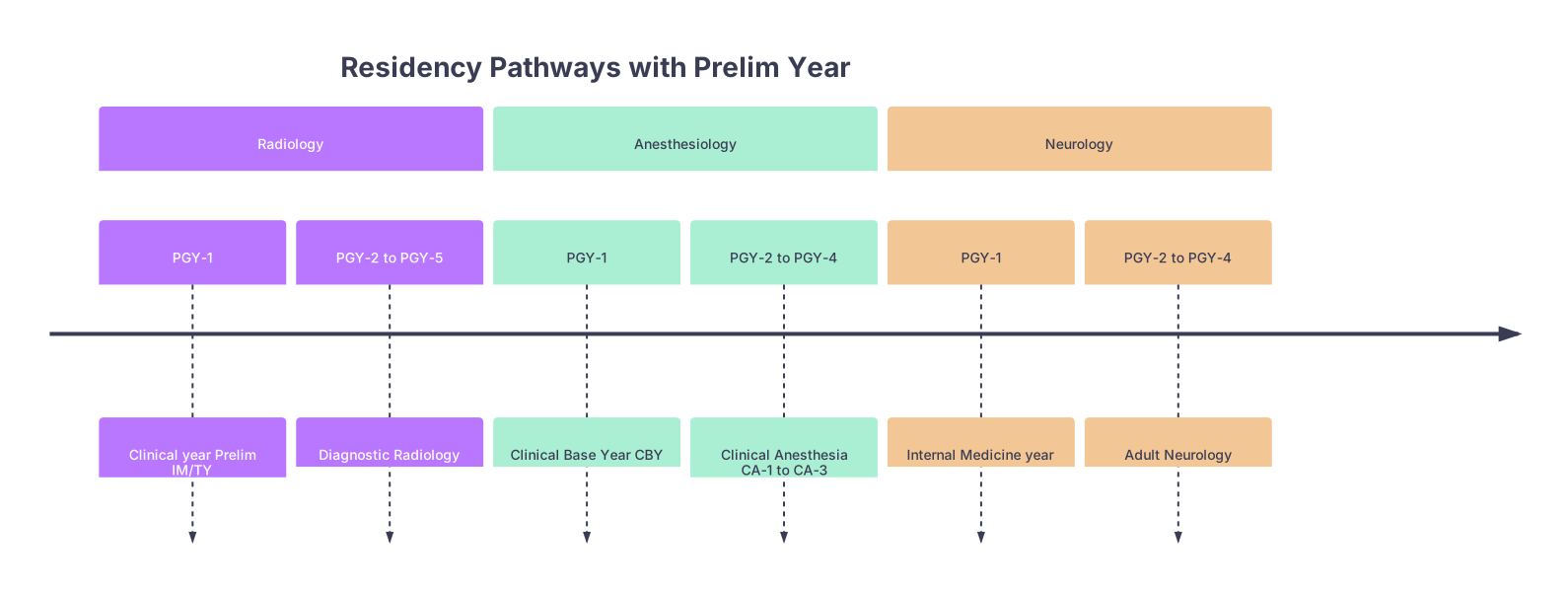
| Period | Event |
|---|---|
| Radiology - PGY-1 | Clinical year Prelim IM/TY |
| Radiology - PGY-2 to PGY-5 | Diagnostic Radiology |
| Anesthesiology - PGY-1 | Clinical Base Year CBY |
| Anesthesiology - PGY-2 to PGY-4 | Clinical Anesthesia CA-1 to CA-3 |
| Neurology - PGY-1 | Internal Medicine year |
| Neurology - PGY-2 to PGY-4 | Adult Neurology |
This is why the prelim year is not “just one year” you can freestyle. Boards embed it into the full pathway.
Quick Reality Check: How Often Does This Actually Blow Up?
Not often. Most prelim and TY programs that regularly feed radiology, anesthesia, and neurology have tuned their structures to board expectations.
Where disasters happen:
- Applicants picking obscure TYs mainly for lifestyle without checking structure.
- Smaller programs changing schedules over time so that the neurology-bound or radiology-bound intern gets customized outpatient/elective-heavy blocks.
- Fragmented or unconventional paths (switches, international years, non-ACGME positions) without upfront board clarification.
I have seen exactly this:
- A neurologist, fully trained and practicing, stuck because ABPN did not fully accept their PGY‑1 IM year and required additional medicine training.
- A radiology fellow having to produce documentation about a transitional year from 6+ years earlier to clear an ABR question.
You do not want to be hunting down old chief residents to sign off on your ward months when you are preparing for boards.
FAQs
1. Is a Transitional Year always riskier than a Prelim IM year for these boards?
No. That is lazy thinking. A transitional year with 5–6 months inpatient IM, ICU, and EM can be more board-friendly than a prelim IM that quietly loads you up with clinic and electives. What matters is inpatient adult care content, not the marketing label.
2. Can I use a PGY‑1 in surgery to satisfy prelim requirements for radiology, anesthesia, or neurology?
Radiology and anesthesia sometimes yes; neurology usually no. ABR and ABA will often accept a surgery-based year if it truly involves heavy inpatient adult care, ICU, and broad exposure. ABPN is far more IM-focused and expects internal medicine months, so using surgery alone is often inadequate.
3. Will the board actually check my rotation schedule from PGY‑1 years later?
They can and sometimes do, especially if something looks off or if your program director flags non-traditional training. At a minimum, your residency PD must attest that your prelim year met board requirements. In borderline cases, the board may request detailed rotation logs.
4. If my prelim program changes its schedule after I match, can my PGY‑1 suddenly become “unacceptable”?
Yes, in theory. If changes reduce your inpatient adult medicine exposure or otherwise violate the board’s standards, it can create problems. Practically, if this happens, your advanced program PD usually has to negotiate with the board and possibly adjust your rotations to compensate. You should speak up early if your actual schedule differs significantly from what was promised.
5. What is the safest strategy if I am not sure how serious I am about radiology vs neurology vs anesthesia?
Choose an ACGME-accredited prelim internal medicine year at a reputable program with a heavy inpatient footprint. That is the most board-agnostic choice. A classic, medicine-heavy prelim IM year almost never gets questioned by ABR, ABA, or ABPN, and it keeps doors open if you switch advanced specialties.
With the nuances of ABR, ABA, and ABPN prelim requirements on your radar, you are no longer the easy victim of vague “it’ll be fine” assurances. Your next move is to pull the actual sample schedules from programs you are ranking and audit them against the standards I have laid out. Once you start doing that, you are operating at the same level of precision as a good program director—and that is exactly where you want to be before you lock in your rank list. The finer points of how to leverage specific prelim programs for better advanced-match outcomes? That is a conversation for another day.