Most prelim interns waste their electives. Then wonder why their advanced applications feel generic and their skills feel scattered. You are not going to be one of them.
If you are doing (or planning) a preliminary year and you already have a specific advanced specialty in mind—derm, radiology, anesthesia, ophtho, PM&R, neuro, radiation oncology—you cannot just “see what’s available” and plug holes. You need a deliberate, specialty-driven elective strategy.
Let me walk you through exactly how to build that.
1. First, Get Clear On What a Prelim Year Is Actually For
A preliminary year is not a gap year. It is not a year to “explore.” It is paid, high-stakes preparation for your advanced specialty.
Most common setups:
- Prelim Internal Medicine (IM) – 1 year, then advanced match (e.g., Derm, Neuro, Rads).
- Prelim Surgery – 1 year before advanced surgical fields (e.g., Urology, some Ortho spots historically).
- Transitional Year (TY) – Mix of IM, EM, outpatient, electives.
The core year (wards, ICU, clinics) is mostly fixed. Your leverage point is electives. That is where you align your prelim year with your advanced specialty.
Think of your prelim year as serving 4 purposes:
- Give you baseline competence (so your advanced program is not babysitting).
- Build a specific clinical toolbox useful for your future field.
- Generate recent, specialty-relevant letters and advocates.
- Signal commitment and fit to advanced programs.
If your elective plan is not serving these four goals, it is poorly structured.
2. Hard Constraints: What You Can and Cannot Actually Change
Before you design your dream schedule, face the real constraints. Every program has:
- Required inpatient months
- Required ICU time
- Night float / jeopardy
- Sometimes required clinic blocks
Then you get a finite number of electives—often 2–4 months.
You should clarify all of this before you fantasize about “doing 6 months of derm.”
Ask your chief or coordinator very directly:
| Topic | Question To Ask Program |
|---|---|
| Elective Months | How many full elective months do prelim interns typically get? |
| Protected Blocks | Which rotations are absolutely fixed and cannot be changed? |
| Specialty Electives | Which advanced specialty electives are actually available to prelims? |
| External Rotations | Are away electives allowed during intern year? Under what conditions? |
| Scheduling Power | When are electives chosen, and who has final say (chiefs, PD, scheduler)? |
Do this early. Ideally in March–May before starting, or during orientation at the latest. If you wait until November, all the high-yield spots will be gone and you will be stuck on “Research admin” and “Medical informatics” you do not care about.
3. Core Strategy: Backward Design From Your Advanced Specialty
You start from your advanced field and reverse engineer.
The process:
- Name your advanced specialty (Derm, Rads, Anesthesia, etc.).
- List what that specialty actually needs from a prelim grad.
- Map prelim electives that build those skills and relationships.
- Reserve 1–2 blocks for career maintenance (Step 3 prep, interviews, sanity).
If you are unfocused—“maybe derm, maybe rads, maybe anesthesia”—you will sabotage yourself. Pick a primary path. You can hedge later if you absolutely must, but structure as if you know where you are going.
4. Specialty-Specific Elective Blueprints
I am going to be blunt. Some elective choices are clearly better than others for each specialty. You want to bias heavily toward the high-yield ones.
A. Dermatology
Derm wants: smart intern who can handle complex medical patients, is meticulous with details, and has obvious commitment to dermatology.
High-yield electives:
- Dermatology clinic (general + subspecialty if possible)
- Rheumatology (for complex autoimmune / connective tissue disease)
- Infectious disease (HIV, TB, skin manifestations)
- Allergy/Immunology
- Oncology (especially if your derm program is onc-heavy)
- Pathology (dermpath exposure if you can get it)
Low-yield for derm (as an intern):
- Repeating generic wards as “elective”
- Random non-related consults (e.g., GI if you are not interested)
Sample derm-focused prelim schedule (4 elective months):
- 1 month – Dermatology clinic (try to split across multiple faculty; ask to assist in procedures, biopsies)
- 1 month – Rheumatology
- 1 month – Infectious Disease
- 1 month – Pathology (ideally dermpath-heavy) or Allergy/Immunology
During your derm elective month, you:
- Ask at least one derm attending directly: “I am applying to dermatology this cycle. Would you be comfortable writing a strong letter if I continue to work hard and show you my best?”
- Keep a running list of cases and procedures in a simple log.
- Volunteer for resident presentations or small teaching talks.
Your goal: leave that rotation with one excellent letter and at least one attending who will answer an email from a PD about you.
B. Diagnostic Radiology / IR
Radiology wants: interns who can handle sick patients post-call, understand basic clinical urgency, and communicate clearly with other services. They do not care if you can recite every Ranson’s criteria from memory.
High-yield electives:
- Radiology (general, plus any subspecialty exposure like Neuro, Body, MSK)
- Emergency Medicine (fast-paced triage thinking, real indications for imaging)
- ICU (even if already required, any extra time is valuable)
- Pulmonology (chest imaging correlation, pleural, lung pathology)
- Neurology (CT/MRI brain correlation, stroke workflows)
Lower-yield early on:
- Super niche consults that do not significantly touch imaging decisions
Sample rads-focused prelim schedule (3 elective months):
- 1 month – Diagnostic Radiology (shadow multiple subspecialties; sit at the workstation, dictate under supervision)
- 1 month – Emergency Medicine (understand appropriateness of imaging, communication with radiology)
- 1 month – ICU (med or neuro ICU) or Neurology
During your radiology elective:
- Ask to attend readouts consistently with the same attending(s).
- Practice concise, structured case presentations from the referring side.
- Get feedback on your clinical thought process regarding imaging utilization.
C. Anesthesiology
Anesthesia wants: interns who can stabilize patients, understand physiology, and not panic when a pressure drops. They absolutely value ICU and procedural exposure.
High-yield electives:
- Anesthesiology (OR, pre-op clinic if available)
- ICU (SICU, MICU, CTICU—any of them help)
- Cardiology (hemodynamics, pre-op risk)
- Pulmonology (vent management, ABGs)
- Emergency Medicine (airway, trauma initial management)
Pretty meh for anesthesia:
- Long pure outpatient clinic blocks with no procedures or acute management
Sample anesthesia-focused prelim schedule (4 elective months):
- 1 month – Anesthesiology (aim for OR time + pre-op assessment clinic)
- 1 month – ICU (prefer SICU or CTICU if available)
- 1 month – Pulmonology (including bronchoscopy if they allow intern involvement)
- 1 month – Cardiology or Emergency Medicine
Specific behavior on anesthesia elective:
- Show up early to help set up the room.
- Get explicit teaching on induction, maintenance, emergence, and post-op pain control.
- Ask for hands-on airway practice when appropriate (bag-mask, LMA, maybe intubation depending on policy).
This is also a prime place for a recent, targeted letter.
D. Ophthalmology
Ophtho is odd because:
- You match early.
- You might be applying while barely into your prelim year.
So your prelim elective structure has less impact on your initial match and more on your future competence and backup plans. But you can still optimize.
High-yield electives:
- Ophthalmology (clinic + OR, if they let you scrub)
- Neurology (neuro-ophth overlap, visual pathways)
- Rheumatology (uveitis, systemic autoimmune eye disease)
- Endocrinology (diabetic eye disease context)
- Emergency Medicine (ocular trauma, red eye workups)
Sample ophtho-focused prelim schedule (3 elective months):
- 1 month – Ophthalmology (splitting time between clinic, minor procedures, and OR especially for cataracts, retina)
- 1 month – Neurology
- 1 month – Rheumatology or Emergency Medicine
Use ophtho elective to:
- Solidify clinical exam skills (slit lamp, fundoscopy, visual fields).
- Learn how systemic disease shows up in the eye.
- Get a later, performance-based letter if you did not have strong clinical letters from medical school.
E. Neurology (Advanced)
Neurology wants: people who can manage complex medical co-morbidities, recognize emergent neuro situations, and are not terrified of sick patients.
High-yield electives:
- Neurology (ward + consults; if you can get stroke service, all the better)
- ICU (Neuro ICU if present; otherwise any ICU)
- Emergency Medicine (stroke codes, seizures, acute neuro deficits)
- Psychiatry (overlap for neuropsychiatric issues, FND)
- Rheumatology (vasculitis, autoimmune neuro stuff)
Sample neurology-focused prelim schedule (4 elective months):
- 1 month – Neurology (general/consults)
- 1 month – Stroke or Neuro ICU (if separate service)
- 1 month – ICU (if Neuro ICU not available, MICU is fine)
- 1 month – Emergency Medicine or Psychiatry
On neurology elective:
- Own the H&P, especially neuro exam.
- Run through NIHSS fluently.
- Ask for teaching on localization constantly—this makes you stand out instantly.
F. Physical Medicine & Rehabilitation (PM&R)
PM&R wants: functional thinkers who understand the downstream impact of acute illness on mobility, cognition, and independence.
High-yield electives:
- Inpatient Rehab / PM&R
- Neurology (stroke, TBI, MS, neuromuscular)
- Orthopedics (fractures, post-op joint care, spine)
- Rheumatology (inflammatory arthritis, connective tissue disease)
- ICU (for critical illness recovery context)
Sample PM&R-focused prelim schedule (3–4 elective months):
- 1 month – Inpatient PM&R (must-do if available)
- 1 month – Neurology (stroke center preferably)
- 1 month – Orthopedics
- Optional 4th – Rheumatology or ICU
During PM&R elective:
- Learn to write functional, rehab-focused notes (PT/OT, equipment needs, disposition).
- Participate actively in family meetings and team conferences.
- Get to know the PD and core faculty—they often strongly influence advanced match outcomes.
G. Radiation Oncology
Rad Onc wants: residents who understand oncologic disease course, can handle complicated cancer patients, and think longitudinally.
High-yield electives:
- Radiation Oncology
- Medical Oncology (solid tumor or heme-onc)
- Palliative Care
- Radiology (especially if oncologic imaging heavy)
- Surgical Oncology or relevant surgical subspecialty
Sample rad onc-focused prelim schedule (3 elective months):
- 1 month – Radiation Oncology
- 1 month – Medical Oncology
- 1 month – Palliative Care or Radiology
During rad onc elective:
- Sit in on treatment planning, contouring sessions if permitted.
- Follow a few patients longitudinally from consult through simulation to treatment.
- Take ownership of symptom management (pain, nausea, fatigue).
5. Timing: When Each Elective Should Happen in Your Prelim Year
Getting the right elective is step one. Getting it at the right time is step two.
Think about three phases of PGY-1:
- Early (July–October) – You are learning how not to drown.
- Middle (November–February) – You are functional; interviews and Step 3.
- Late (March–June) – Skills consolidation; building targeted competence.
You want to line up electives to match what is happening in your career timeline.
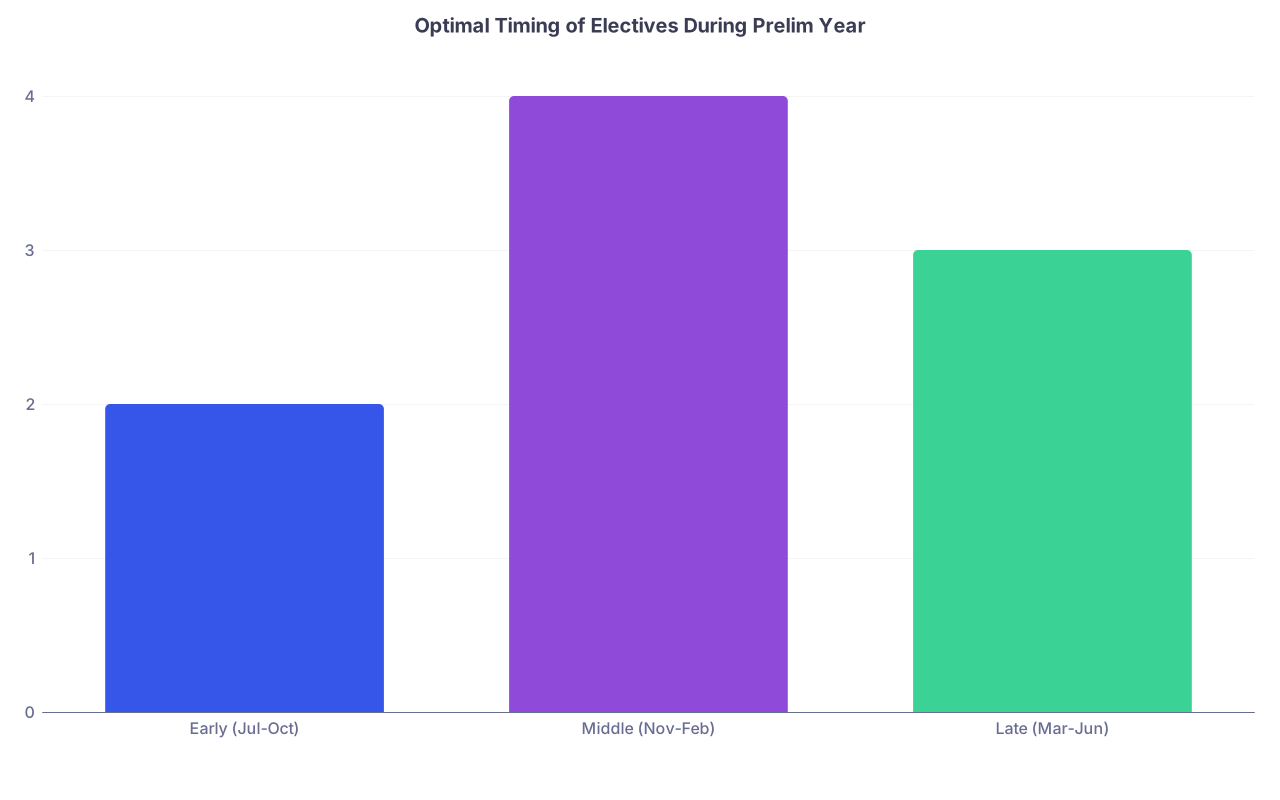
| Category | Value |
|---|---|
| Early (Jul-Oct) | 2 |
| Middle (Nov-Feb) | 4 |
| Late (Mar-Jun) | 3 |
Use this logic:
- If you are still applying for your advanced specialty (e.g., reapplicant) → Have your key specialty elective early to mid-year to generate fresh letters.
- If you already matched advanced (e.g., derm matched from MS4) → Put your key specialty electives mid-to-late to build competence closer to PGY-2 start.
- Step 3 and interviews cluster in middle of the year, so schedule at least one light elective in that window.
Example timing by scenario:
Derm reapplicant:
- Aug – Dermatology (get letter)
- Dec – Light elective for interviews / Step 3
- Apr – Rheum
Rads already matched:
- Jul–Nov – Strong general medicine, ICU
- Jan – Radiology elective
- Mar – EM
You should actively email the chief/scheduler to request timing, not just “Derm elective please.” Spell it out: “Derm elective in August or September if possible to support my ERAS application.”
6. Balancing High-Yield With Survival: Do Not Burn Yourself Out
If you pack your year with ICU, EM, and night-heavy electives, you will be competent and miserable. There is a middle ground.
Rules of thumb:
- No more than 2 heavy rotations in a row (ICU, heavy wards, night float, EM at some places).
- Protect at least 1 lighter elective in the Nov–Feb window for interviews and Step 3.
- Avoid back-to-back ICU + EM if your institution is toxic about hours.
Good “lighter” but still valuable electives:
- Outpatient specialty clinic related to your field (e.g., rheum, allergy, endo).
- Radiology (often more controlled hours).
- Palliative care in many programs.
- Pathology.
Bad idea:
- Stacking ICU → EM → Wards with no apparent break “because I want to be hardcore.” Seen that movie. Ends in burnout, mistakes, and mediocre evaluations.
7. How To Actually Get The Electives You Want
This is where most interns fail. They assume the system will offer them good options automatically. It will not.
Use this playbook:
Find the scheduler and decision-maker.
- Sometimes this is chief residents.
- Sometimes the residency coordinator.
- Sometimes PD must approve external rotations.
Email early, plainly, and with a plan.
Something like:
“I am prelim IM, starting in July, matching into anesthesiology PGY-2. I would like to request 1 month each of Anesthesia, ICU, and Pulmonology, ideally with Anesthesia in November–January to align with my advanced training. Is that feasible?”Offer flexibility.
Add: “I am flexible on specific months and happy to shift to help the schedule work.”Follow up.
If you do not hear back in 2 weeks, send a short, polite follow-up. Do not assume silence means approval.Confirm in writing.
When rotations are assigned, keep that email. Schedules “change mysteriously.” Documentation helps you argue your case later if something gets bumped.
8. Using Electives to Get Strong Letters and Advocates
Electives are not just about knowledge. They are prime real estate for LORs that matter.
Here is the structure:
Step 1: Target the right people
- For derm → Derm faculty who are academic, publish, or are PD/APD.
- For anesthesia → Core anesthesia faculty, ideally involved in residency selection.
- For rads → Section chiefs or PDs if possible.
Ask senior residents quietly: “Whose letter carries weight? Who actually knows the PDs at X/Y/Z program?”
Step 2: Perform like it matters (because it does)
On that elective, your personal rules:
- Never be late. Not even once.
- Take full ownership of your patients, even if the service is “light.”
- Offer to present at conference or do a short teaching talk.
- Read daily about your cases. Mention what you read once in a while, naturally.
Step 3: Ask for the letter directly and correctly
Timing: last week of elective.
Phrase:
“I have really valued working with you this month. I am applying to anesthesiology and would be honored to have a strong letter of recommendation from you if you feel you can write one.”
That phrase “strong letter” gives them an out if they are lukewarm.
Then:
- Send your CV, personal statement draft, and a short bullet list of memorable cases you shared.
- Remind them of timelines (ERAS submission date, any advanced program deadlines).
This is how you convert an elective from “it was fine” into actual application firepower.
9. Special Situations: Reapplicants, Switchers, and Transitional Years
You might not be a straight-through, clean match story. Fine. Then you have different priorities.
Reapplicant to the Same Field
Your prelim year is your redemption arc.
Your goals:
- At least two recent, stellar letters from that specialty.
- Clear upward trajectory in evaluations.
- Concrete contributions (research, QI, teaching) tied to that field.
Elective structure:
- Put your target specialty early in the year (Aug–Oct) for letters.
- Add one or two adjacent specialties for depth (e.g., derm + rheum + ID).
- Secure protected time or lighter electives mid-year for interviews / reapplication logistics.
Switching Fields Mid-Year
Example: You started as “future cardiologist,” now you want radiology.
You cannot rewrite the entire schedule, but you can salvage plenty:
- Immediately email PD and chief once you are serious, not “thinking about it.”
- Request to swap a future non-critical elective for a field-relevant one (e.g., add Radiology, drop Endocrine clinic).
- Use whatever related rotations you have (ICU, EM) to show relevant skills in your personal statement and in conversations.
The key: act decisively once your mind is made up. Quietly hoping the system will adjust to you is naïve.
Transitional Year Nuances
If you have a TY instead of pure prelim medicine, great. You typically have more elective slack.
Do not waste that luxury.
- Ensure you still get enough hard medicine (wards + ICU) so you are not clinically fragile.
- Use the extra outpatient and elective space to stack your target specialty and high-yield adjuncts.
- Guard against turning TY into a “vacation year” just because you matched advanced early. Future you, exhausted in PGY-2, will resent current you for that.
10. Common Mistakes That Wreck a Prelim Elective Strategy
You can avoid 80% of problems by not doing these:
Scheduling key specialty electives in June.
Way too late for letters, and you are half out the door mentally.Using electives as pure vacation.
One lighter month is sanity. Four months of “Derm research lite” where you barely show up? PDs talk.Failing to communicate your specialty goals to your program.
If your PD does not know you are going into radiology, do not be surprised when your schedule is generic.Ignoring Step 3 and interviews when planning.
Cramming Step 3 between ICU calls is masochistic. Give yourself a lighter elective then.Over-hedging with unrelated fields.
If you are 90% sure about derm, do not spend your electives on random GI and renal because “medicine is useful.” Focus. You will still get plenty of generic medicine from required rotations.
11. A Simple, Repeatable Planning Framework
To pull this together, use this 6-step framework. On paper. Right now.
- Write down your advanced specialty in big letters at the top of a page.
- List 5–7 skills or knowledge areas that specialty wants from an intern (e.g., for anesthesia: airway management, hemodynamics, ICU comfort, acute pain).
- Map 3–5 prelim electives that build those skills directly.
- Overlay the calendar (July–June) and place:
- Heavy rotations spaced with lighter ones.
- Key specialty elective early/mid depending on your application timing.
- At least one lighter month Nov–Feb for Step 3/interviews.
- Email your PD/chief with a concrete proposal and stated rationale tied to your advanced field.
- Revisit in 3–4 months and adjust if your plans or needs change.
12. What You Should Do Today
Open a blank page and write three things:
- Your advanced specialty.
- The three most important electives for that specialty during prelim year.
- The top three months you want those electives to happen.
Then draft a short, direct email to your chief or coordinator requesting that structure. Not a novel. Four to six sentences, max.
Send a version of that email this week. Not “later this year.” Because by then, the schedule will be full and you will be stuck with whatever is left.