

Can I Count Two Different Prelim Years Toward My Training Requirements?
What actually happens if you do two prelim years at different programs and then try to make them both “count” toward your eventual residency or board requirements?
Here’s the blunt answer:
You usually can’t just stack two random preliminary years and expect them to fully count. Some of the time, pieces of each year can be credited. Some of the time, one is basically wasted from a training-requirement standpoint. And if you aren’t careful, you can lose a year of your life in a way that doesn’t help you finish residency any faster.
Let’s break it down cleanly.
First, quick refresher: what’s a prelim year actually “for”?
A preliminary year is a one-year internship, usually in:
- Internal Medicine (prelim IM)
- General Surgery (prelim Surgery)
- Transitional Year (TY)
- Occasionally other one-year formats
You typically do it:
- As a required PGY-1 for an advanced specialty (e.g., Radiology, Anesthesiology, Neurology, PM&R, Derm, Rad Onc)
- As a stand‑alone internship when you didn’t match categorical and want more experience/stronger application
- As a stopgap after a change or problem (failed to advance, non-renewal, visa, personal issues)
The key point:
Board certifying bodies (ABR, ABA, ABPN, ABPMR, etc.) and ACGME specialties specify what kind of PGY-1 they will accept and how much of it has to be continuous, supervised, and relevant.
They don’t think in terms of “I did two random years, just add them together.”
They think in terms of:
“Did you complete the internship requirement specified in our rules at an approved program under supervision and evaluation?”
The core question: Can I count two different prelim years?
Short version:
- You can’t usually combine two unrelated/split prelim years to substitute for a required single internship.
- You often can get partial credit when changing programs or paths, but it’s not automatic.
- The final decision-maker is your ultimate specialty board and your new residency program director, not your prelim program.
Let’s go scenario by scenario, because that’s how this actually plays out.
Scenario 1: Two prelim years in the same field (e.g., two prelim IM years)
Say you did:
- PGY‑1: Prelim Internal Medicine at Hospital A
- PGY‑1 (again): Prelim Internal Medicine at Hospital B (because you didn’t secure an advanced spot, or changed path)
Now you match into a categorical Internal Medicine program or need an “acceptable clinical year” for Radiology, Anesthesiology, etc.
What happens?
For Internal Medicine categorical
You generally need three years of ACGME‑accredited IM training. Programs and the ABIM care that you completed PGY-1, PGY-2, PGY-3 in approved IM positions.- If you come in with two prior prelim IM years, the new IM program might grant you advanced standing and let you enter as a PGY‑2.
- Or they might say: “We’ll accept only one of those years; you’ll still need full 3 years here” or something in between.
- The program director has a lot of discretion, but they must comply with board rules.
For advanced specialties needing one clinical year (Radiology, Anesthesia, etc.)
Most boards say: you must complete one accredited clinical year (usually in IM, Surgery, Transition, or a mix allowed by their rules).- If one of your prelim years meets their criteria, that one year often suffices.
- The second prelim year doesn’t usually buy you anything additional from a requirements standpoint, though it may help your skillset or application.
Key takeaway:
Two prelim years in the same field usually don’t stack to shorten your total years beyond what one good, properly structured year would do. You might salvage one year’s worth of credit; the other can be functionally redundant.
Scenario 2: One prelim IM + one prelim Surgery (or TY + something else)
This is where people get burned.
Example:
- Year 1: Prelim Surgery (no categorical spot)
- Year 2: Prelim Internal Medicine
- Then you match into Radiology, which wants “a clinical base year including at least X months of direct patient care, usually in IM, Surgery, or TY.”
Can you mash both years together to meet that requirement? Maybe. But often not cleanly.
Here’s how it tends to work:
- Boards usually want a clearly defined, supervised PGY‑1 year that fulfills their specified content.
- They may allow some mixed background (e.g., a TY with rotations across IM, Surgery, ER, etc.).
- But doing two separate prelim contracts at two different places doesn’t automatically create a “custom fused PGY‑1.”
What can help you:
- If your second year is a clean, board‑acceptable prelim (e.g., Prelim IM with enough inpatient months), that year may alone satisfy your internship requirement.
- Your first prelim year might then be “extra” training that doesn’t reduce the years you need for your advanced specialty.
Bottom line:
Combining a patchwork of prelim years is rarely how boards want you to meet basic PGY‑1 requirements. They want one clear, acceptable clinical base year, not your DIY Lego set of rotations across two institutions.
Scenario 3: You left or were non‑renewed, then did another prelim year
This one’s touchy but common.
Example:
- Prelim IM at Program A, you completed 6–12 months but had performance, professionalism, or visa issues. You don’t advance.
- You find a new prelim spot at Program B and complete another year.
- Now you’re asking: “Do both of these years count so I can be PGY‑2 or skip time?”
Here’s the reality:
Your new program can choose to recognize some prior time.
They may say:- “We’ll count 6–12 months and you’ll enter as PGY‑2.”
- Or: “You need to redo PGY‑1 with us; we can’t trust the prior evaluations or they don’t meet our requirements.”
Boards care about continuity and quality
If there was a break, a non‑renewal, or a major concern, many program directors play it conservative and treat your new position as a fresh start.
You don’t get to insist they recognize your past year; they decide based on documentation and their comfort level.
So yes, technically two prelim years can sometimes be combined conceptually into required time if a program and board agree. But in practice, you’re often repeating work, and the second year is the one that truly “counts.”
Scenario 4: Switching specialties and trying to reuse prelim time
Classic example:
- You do a prelim Surgery year thinking you’ll become a surgeon.
- You realize: I hate being in the OR. You want Internal Medicine or Neurology now.
- You then ask, “Can that prelim Surgery year count toward my IM or Neuro training?”
Here’s how this usually shakes out:
- Categorical Internal Medicine: Surgery prelim time is usually not accepted as full PGY‑1 IM.
You may get some elective credit or recognition for experience, but the ABIM and most IM programs want a true IM PGY‑1. - Neurology: Requirements typically call for a certain number of months in Internal Medicine, stroke, ICU, etc. Some surgical time may be irrelevant.
- PM&R or others: They require a defined number of months in IM, Neuro, etc. Again, pure surgery time may not fit.
So can two prelim years in different areas jointly satisfy a future path? Only if:
- The new specialty’s board allows that mix, and
- Your new program director is willing to accept and document that prior time.
That’s not standard. It’s case‑by‑case and heavily dependent on the specific specialty rules.
Who actually decides what counts?
Three main players:
Your new residency program director
They decide:- Your entry level (PGY‑1 vs PGY‑2 vs some hybrid)
- How much prior time they accept
- Whether they’re comfortable signing off on your competence and time for the board
The relevant specialty board (ABIM, ABR, ABA, ABPN, etc.)
They define:- Required number of years total
- What kind of PGY‑1 is acceptable (IM, Surgery, TY, etc.)
- Whether non‑continuous or multiple prelim years can count
ACGME (or Royal College / provincial colleges if in Canada)
They define:- What counts as accredited training
- Program requirements your PD must follow
Your prelim programs do not get the final word. They only provide documentation and evaluations.
How to protect yourself if you’re facing multiple prelim years
If you’re even asking this question, you’re probably already in a non‑standard path. That’s fine. But you need to be tactical.
Here’s what I’d do if I were in your shoes:
Define your target specialty clearly.
Stop thinking in “prelim” generic terms.
Decide: Are you aiming for Radiology? IM? Neurology? Anesthesia? PM&R? Surg? That choice dictates which prelim year “matters.”Read the actual board requirements.
Go to the specialty board’s website and read the training requirements page. Don’t skim; this is your future.
Look specifically for:- “Acceptable clinical base year”
- “PGY‑1 requirements”
- “Credit for prior training” or “advanced standing”
Email or meet with your target specialty PD(s) before assuming anything counts.
Send them:- Your CV
- A short summary of your completed rotations (with months and settings)
Ask explicitly:
“If I match to your program, how much of this prior prelim time would you be able to count toward your training requirements?”
Get program letters and rotation logs from your prelim years.
Don’t lose this paperwork.
Boards and PDs may need:- Official verification of training
- Rotation schedules
- Procedure logs, if relevant
- Summative evaluations
Assume at least one year might not shorten your path.
Emotionally, plan for the possibility that one of your prelim years is basically an educational detour—not wasted, but not shaving time off.
When can two prelim years actually help?
There are cases where two prelim years are genuinely useful:
- You use the first as experience + stronger letters, then land a much better second prelim that’s clean, board‑compliant, and gets you into your desired advanced specialty.
- You started in the wrong field (e.g., Surgery), learned you hate it, then did a second prelim more aligned with your real goal (e.g., IM). That second year is what counts, but the first year gave you clinical maturity and a story.
- A new program gives you advanced standing and counts much of your prior year(s), allowing you to graduate slightly earlier than starting from scratch.
But. This all hinges on talking to actual program directors and aligning your path with real board rules, not assumptions.
| Situation | What Usually Counts |
|---|---|
| Two prelim IM years, then IM categorical | 1 year often counted; 2nd is redundant |
| Prelim Surgery + Prelim IM, then Radiology | The clean IM year usually counts |
| Prelim Surgery, then IM categorical | Surgery year rarely counts as IM PGY-1 |
| Non-renewed year + new prelim year | New year often treated as “real” PGY-1 |
| Two prelims, then advanced Anesthesia | One acceptable clinical year is enough |
| Switching specialties midstream | Depends on board rules + PD discretion |
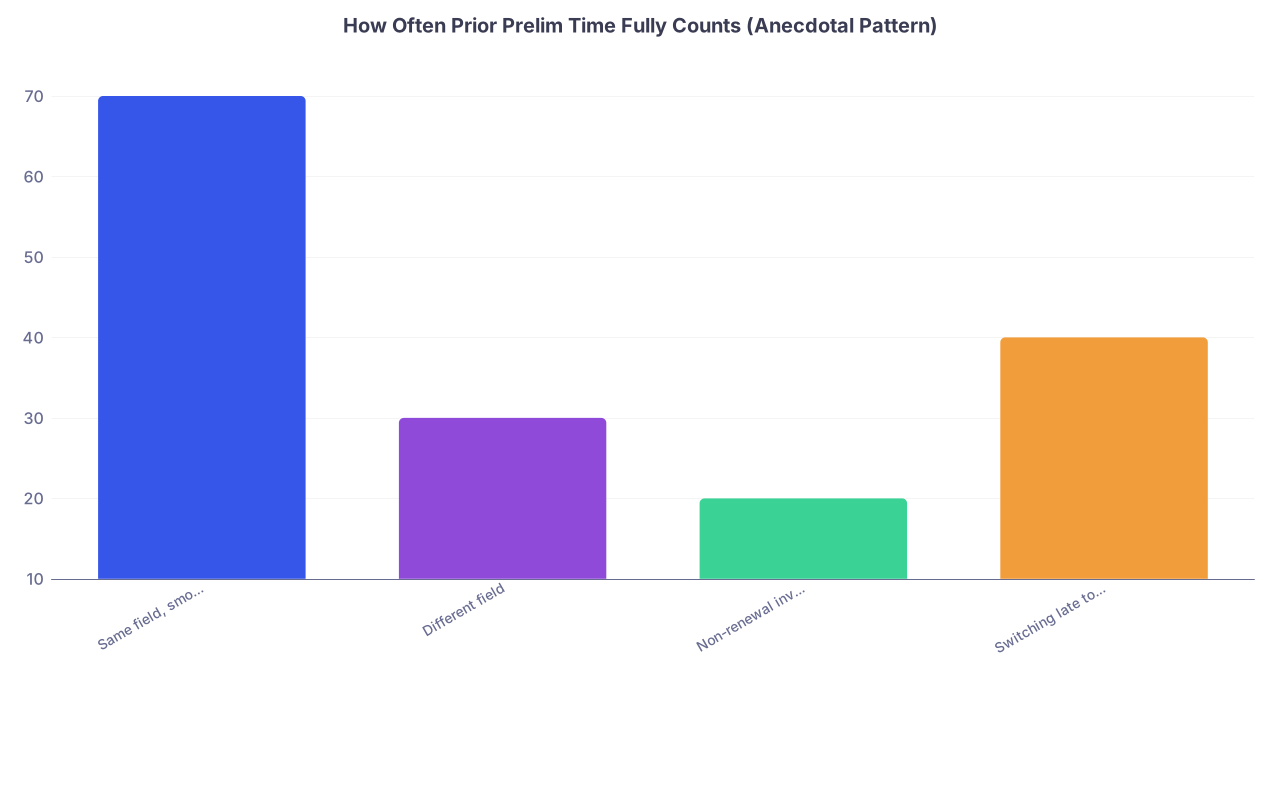
| Category | Value |
|---|---|
| Same field, smooth record | 70 |
| Different field | 30 |
| Non-renewal involved | 20 |
| Switching late to new specialty | 40 |

| Step | Description |
|---|---|
| Step 1 | Have 2 prelim years |
| Step 2 | PD may grant advanced standing |
| Step 3 | Board rules decide partial credit |
| Step 4 | Use that year as base year |
| Step 5 | Likely need fresh PGY1 |
| Step 6 | Confirm with specialty board |
| Step 7 | Same field? |
| Step 8 | Target specialty matches field? |
| Step 9 | One year board-acceptable alone? |
FAQ: Two Different Prelim Years and Training Requirements
1. If I do two prelim years, will I definitely shorten my total training by a year?
No. Don’t count on that. Many people end up doing an extra year that doesn’t reduce the total years needed for board-eligible training. Only when a future program and board both accept prior time as credit do you actually “shorten” anything.
2. Can I combine 6 months from one prelim and 6 months from another to make a full PGY-1?
Usually no, at least not the way people imagine. Boards want a coherent, supervised, fully evaluated PGY‑1 that meets their content requirements. Some may accept non-continuous time in special circumstances, but this is rare, and absolutely not something you should assume without written clarification from the board or your new PD.
3. Does a Transitional Year plus a Prelim IM year give me extra credit?
It can make you more experienced and more attractive as a candidate, but for most advanced specialties, only one acceptable clinical base year is required. Having two doesn’t turn a 4‑year residency into 3 years. At best, a program might grant advanced standing, but that’s not automatic.
4. If I struggled or was non-renewed during my first prelim year, will that year still count?
From a board perspective, it might be usable in theory, but from a program director perspective, many will treat your new position as a fresh PGY‑1. They’re cautious about claiming credit for a year where evaluations were weak or incomplete. So practically, that first year often doesn’t shorten your ultimate training time.
5. I’m switching from Surgery to Internal Medicine after a prelim Surgery year. Will that prelim year count?
Almost always, no as formal IM PGY‑1 time. You may get informal credit for experience or a slightly different rotation plan, but you’ll usually still need a full accredited Internal Medicine PGY‑1 that meets ABIM requirements.
6. What’s the safest way to know how much of my two prelim years will count?
Do three things:
- Read the training requirements for your target specialty board.
- Email or meet with a program director in that specialty and share your rotation history.
- Ask them explicitly what PGY level they’d slot you into and what they’d certify to the board. Their answer is far more reliable than anecdotes from co-residents or Reddit.
Key points:
- Two different prelim years rarely “stack” the way people hope; at best, one clean, board-acceptable year usually does the heavy lifting.
- What counts is determined by your future specialty board and program director, not your prelim programs or wishful thinking.
- If you’re in a multi‑prelim situation, get brutally clear on your target specialty and talk to real PDs before assuming anything about credit or shortened training.


