

The fear that a prelim year will “set you back” is exaggerated and often wrong.
If you plan it correctly, doing a preliminary year usually does not delay fellowship or board eligibility. It can, but only in a few specific situations that you can see coming and avoid.
Let’s walk through, specialty by specialty, when a prelim year fits cleanly into your training timeline—and when it truly costs you an extra year.
The core answer: when a prelim year DOES and does NOT delay you
Here’s the bottom line up front:
For specialties that require a prelim/transitional year (neuro, rads, ophtho, anesthesia, derm, rad onc, PM&R in many cases), a prelim year is part of the normal path and usually does not delay fellowship or boards at all.
For people using a prelim year as a bridge (reapplying to a categorical spot, switching specialties, strengthening their application), it can delay you by 1 year—unless you match into a PGY‑2 or advanced spot that lines up seamlessly.
For board eligibility, your prelim year often counts toward total required clinical training, but only if:
- It’s in the right specialty (usually internal medicine, surgery, or a well-structured transitional year), and
- Your eventual specialty board actually allows it.
Here’s a quick comparison so you see where you stand:
| Future Specialty | Prelim Year Part of Normal Path? | Typically Delays? |
|---|---|---|
| Neurology | Yes (IM prelim or TY) | No |
| Radiology (Dx/IR) | Yes (IM/Surg/TY) | No |
| Anesthesiology | Yes (IM/Surg/TY) | No |
| Ophthalmology | Yes (PGY‑1 separate match) | No |
| Dermatology | Yes (IM/Peds/TY) | No |
| Categorical IM/Surg | No (already PGY‑1 built in) | Sometimes |
| Switching specialties | No | Often |
If you understand where your prelim year fits in this grid, you already know 80% of the answer.
How prelim years interact with fellowship timing
Fellowship timing is not random. It’s tied to the PGY level in your core specialty, not the exact flavor of your PGY‑1.
Most internal medicine fellowships, for example, require completion of an ACGME-accredited 3-year IM residency. They don’t care if your first year was “prelim” vs “categorical” as long as it counts as one of those three IM years.
Here’s how it plays out in practice.
Scenario 1: You’re entering a specialty that requires a separate PGY‑1 (no delay)
Examples:
- Diagnostic radiology
- Interventional radiology (integrated)
- Neurology (advanced programs)
- Anesthesiology
- Dermatology
- Radiation oncology
- Ophthalmology
- PM&R (for some programs)
Typical path:
- Match MS4 → Prelim IM / Prelim Surg / Transitional Year (PGY‑1)
- Already matched or separately match into advanced program (PGY‑2+)
- Finish required core residency (usually 3–4 years total after PGY‑1)
- Apply for fellowship at the standard time
Timeline looks like this:

| Step | Description |
|---|---|
| Step 1 | MS4 |
| Step 2 | Match Prelim or TY PGY1 |
| Step 3 | Match Advanced PGY2 spot |
| Step 4 | Finish Core Residency |
| Step 5 | Fellowship at Normal Time |
In this setup, your prelim year is built into your training. It does not “add” a year. Radiology, neurology, anesthesia PDs see this as the default, not a delay.
Board eligibility in these paths:
- The relevant specialty board (e.g., American Board of Radiology) expects one clinical year + 3–4 years of specialty training.
- Your prelim year typically fulfills that clinical requirement directly.
So: if you match correctly (prelim/TY + advanced) and stay in that lane, no delay.
Scenario 2: You do a prelim year, then reapply for a new categorical spot (often a 1-year delay)
This is where people usually get burned.
Classic example:
- You matched into a Prelim Medicine year only.
- You didn’t match into categorical IM or your desired advanced specialty.
- You use your prelim year to reapply.
What happens?
You start:
- PGY‑1: Prelim IM
Then you re-match into: - PGY‑1 again: Categorical IM (or another specialty)
Then: - PGY‑2: IM
- PGY‑3: IM
You’ve effectively done 4 years of residency time to finish a 3‑year IM residency. That’s an extra year before fellowship and board eligibility.
Can your prelim year sometimes count toward categorical training? Yes, but only if:
- You move into the same field (e.g., prelim IM → categorical IM),
- The new program director and the American Board of Internal Medicine (or equivalent) approve credit for that year.
Here’s the trick: many programs won’t guarantee full credit upfront. They’ll say some version of, “We’ll see what the board approves later.” In real life, I’ve seen people get 6–12 months of credit, but I’ve also watched others repeat a full PGY‑1.
Assume this: if you’re re-entering at the PGY‑1 level again, your fellowship timeline is almost certainly pushed back by one year.
How prelim years affect board eligibility, specialty by specialty
Let’s deal with the board question directly. Because that’s what actually matters long term.
Internal Medicine
ABIM generally requires:
- 36 months of accredited internal medicine training.
A prelim IM year can count if:
- It was ACGME-accredited IM,
- The content was appropriate (not a weird mix with tons of off-service), and
- Your categorical PD requests advanced credit from ABIM.
Reality:
- If you move prelim IM → categorical IM at the same institution, your chances of getting full credit are much better.
- If you change institutions, boards may still grant 12 months, but PDs are sometimes cautious and may still want you for 3 full years (they have service needs and educational structure).
If you get full credit, no delay. If you’re asked to do 3 more years, you’ve lost a year.
General Surgery
The American Board of Surgery is stricter.
- A “prelim surgery” year does not automatically count toward the 5 years of required categorical surgery training.
- Some programs can convert you from prelim → categorical and count that PGY‑1 as year one—but only if you stay put and if the resident rotation structure aligns.
If you do a random prelim surg year then match into a new categorical GS program somewhere else, expect to start as PGY‑1 again. That means:
- 1 prelim year + 5 categorical years
= 6 total years before you’re board-eligible in surgery.
Radiology, Anesthesia, Neuro, etc.
These boards (ABR, ABA, ABPN, etc.) generally require:
- One clinical year (usually IM, surgery, TY),
- Then their specialty years.
That clinical year is intentionally your prelim or transitional year. It counts.
It doesn’t delay you; it’s baked in.
Using a prelim year for reapplying or switching: when it’s a tool vs. a trap
The prelim year actually makes a lot of sense in three situations:
- You didn’t match categorical, but got a prelim spot.
- You’re trying to switch from one specialty to another and need a bridge year.
- You’re improving your application (scores, letters, US experience for IMGs).
Good use cases:
- IMG with strong Step scores but no US clinical → does a solid Prelim IM year at a reputable program, gets US letters, then matches categorical IM or neuro/rads/anesthesia.
- US grad who struck out in derm → does a TY, builds research and connections in derm, then matches into derm PGY‑2.
In those cases, a one-year delay can be a very smart trade: you end up in the specialty you actually want.
Bad use cases:
- Doing a random prelim surg year “just to have something” without a plan, then switching to IM and repeating a full 3-year residency. Now you’ve extended training for no strategic reason.
- Taking a prelim position in a specialty that won’t give you board credit toward your eventual field, when you could have held out for a prelim/TY that would.
The key question you should ask before signing on to any prelim year:
“If I end up in [specialty X], will this prelim year count toward my board-required training, or will I be starting over?”
If nobody gives you a clear, specific answer, assume it won’t count.
The role of transitional years (TY) vs. prelim medicine vs. prelim surgery
Not all prelims are equal. Program directors know the difference; applicants often don’t.
Here’s the quick comparison:
| Type | Typical Strengths | Board Utility |
|---|---|---|
| Transitional Yr | Broad, lighter workload, electives | Great for rads, ophtho, derm, etc |
| Prelim Medicine | Strong IM exposure | Best if ending in IM/Neuro/Anes |
| Prelim Surgery | Heavy OR and floor service | Best if ending in Surg/IR |
For specialties like rads, ophtho, derm, anesthesia:
- TY and Prelim IM are usually interchangeable from a board perspective.
- For future general surgery or surgical subspecialties, prelim surg is more aligned—though, as I said, not always credited fully if you switch programs.
If you’re thinking fellowship-heavy fields like cardiology, GI, heme/onc down the line:
- Don’t obsess over the name of the PGY‑1.
- Obsess over whether your eventual core residency counts that year and lines up with boards.
Timing of fellowship applications with a prelim year
You apply to fellowship based on where you are in your core residency, not by total years since graduation.
Standard example for IM:
- PGY‑1: Categorical IM (or IM prelim that counts)
- PGY‑2: IM – apply to cards/GI/heme-onc in late PGY‑2
- PGY‑3: Finish IM, then start fellowship
If:
- PGY‑1: Prelim IM
- PGY‑1 (again): Categorical IM
- PGY‑2: IM – now your “PGY‑2 in IM” is actually your third year post-graduation. But fellowship apps care that you’re a second-year IM resident, not your absolute PGY.
So yes, your fellowship application moves one calendar year later, because you became a true PGY‑2 in IM one year later.
To visualize how the total training time stacks up:
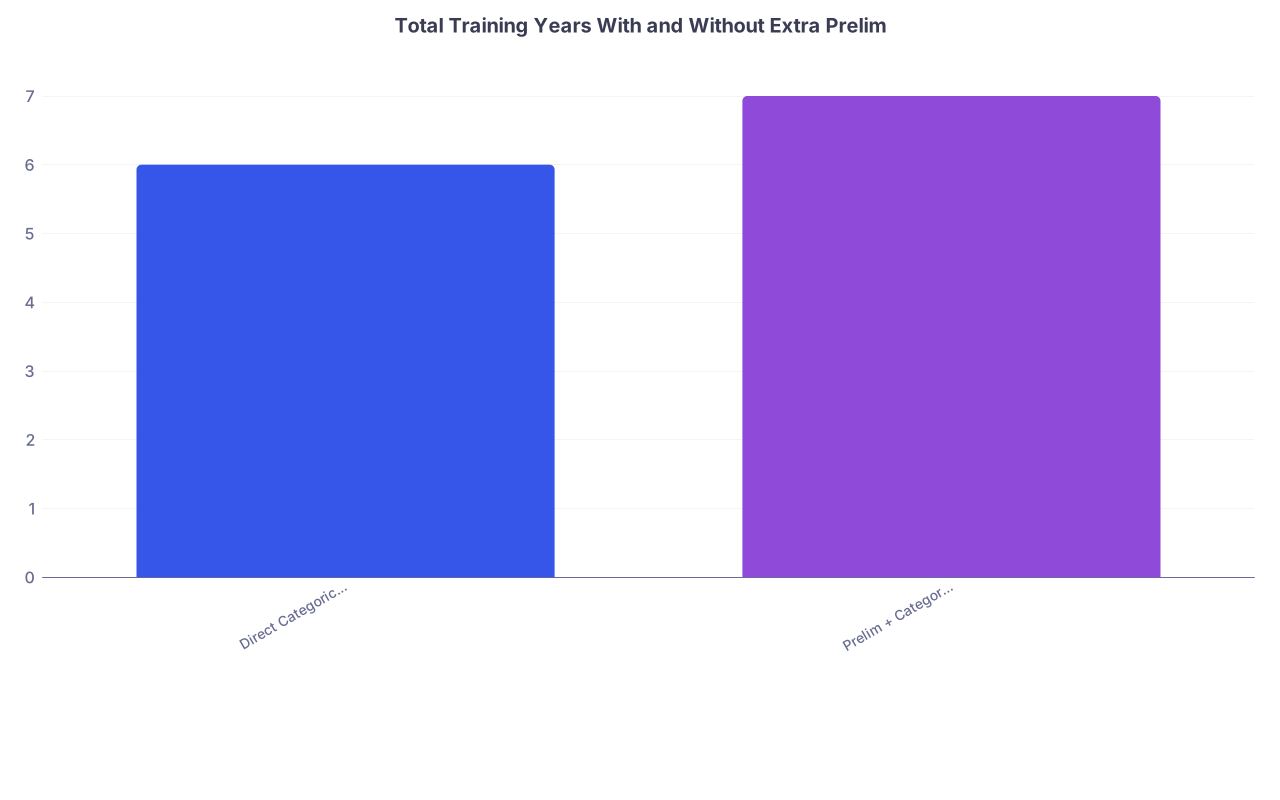
| Category | Value |
|---|---|
| Direct Categorical IM + Cards | 6 |
| Prelim + Categorical IM + Cards | 7 |
- Direct path: 3 years IM + 3 years cardiology = 6 years
- Prelim first, then 3 years IM + 3 years cardiology = 7 years
Again, not right or wrong—just know what you’re signing up for.
How to prevent unwanted delays: practical rules
To keep a prelim year from silently stealing 12 months from your life, use these rules:
If your future specialty normally uses a prelim/TY:
- Make sure that year is exactly what that specialty prefers (e.g., TY/IM for rads, ophtho, derm; IM/TY for neuro; Surg/IM/TY for IR/anesthesia).
- Confirm it’s ACGME-accredited PGY‑1 in an acceptable discipline.
If you might go into internal medicine:
- Strongly favor prelim IM or a robust TY over prelim surgery if you can.
- Ask bluntly: “If I later join your IM program, can this year be credited as PGY‑1 toward ABIM requirements?”
If you’re reapplying after a prelim:
- Try to match into PGY‑2/advanced positions when possible; that’s the cleanest way to avoid delays.
- If you only get new PGY‑1 offers in a different field, assume you’re adding a year.
Always ask 2 people:
- The current prelim PD: “Is this year structured to be board-creditable?”
- The target specialty PD: “Will your board accept this year for credit if I join you later?”
If they sound vague or dodgy, interpret that as “probably not.”
FAQ (exactly 7 questions)
1. Will a preliminary internal medicine year count toward my 3-year IM requirement for ABIM?
Often yes, but not automatically. It must be an ACGME-accredited IM prelim year, and your future categorical PD has to request credit from ABIM. If you stay at the same institution and transition from prelim to categorical IM, full credit is common. If you switch institutions, credit is possible but less guaranteed. Always ask explicitly before you sign a contract.
2. Does a prelim year delay my ability to apply for fellowship?
It delays fellowship only if it delays completion of your core residency. If your prelim year is part of the normal path (e.g., TY + advanced radiology) and fully counts, you’ll apply at the standard PGY level. If you restart PGY‑1 in a new categorical program, your fellowship application usually shifts one year later.
3. Does doing a preliminary surgery year help with surgical subspecialty fellowships later (ortho, vascular, etc.)?
A prelim surgery year can help with experience, skills, and letters, but it rarely shortens your total time. Most surgical boards and categorical programs still want you to complete the full 5-year categorical surgery residency. Think of it as a stepping stone or audition year, not a year that automatically counts toward board certification.
4. For radiology, anesthesia, or neurology, is there any downside to doing a transitional year instead of a prelim medicine year?
For most programs, no. Transitional years are specifically designed as PGY‑1 years for advanced specialties and are fully acceptable to their boards. Some programs might prefer prelim IM (especially neuro-heavy or ICU-heavy programs), but for rads, derm, ophtho, and anesthesia, a strong TY is usually ideal and doesn’t delay anything.
5. I matched into a prelim year but not into my advanced specialty. Should I take it or reapply as a SOAP or next cycle?
Take it if: you have a clear plan to use that year—solid letters, US experience, or time to reapply to a competitive field. Skip it if: the prelim is in a field that won’t help your eventual path or obviously won’t count for boards in your likely future specialty. A “random” prelim with no strategy attached is how people quietly lose a year.
6. Can I be board-eligible in two specialties using one prelim year?
Practically, no. Boards look at total, specialty-specific accredited training. A single prelim year can sometimes be credited toward one later pathway (e.g., IM), but it won’t double-count to make you board-eligible in both IM and something else. To be dual-boarded, you need full, approved training in each field (or a combined program), not just a shared prelim.
7. As an IMG, does a prelim year improve my chances for categorical and future fellowship?
If chosen wisely, yes. A strong prelim IM or TY at a reputable US institution can give you crucial US letters, show you can function in the system, and open doors for categorical IM, neurology, rads, or anesthesia. It probably adds at least one year to your total path if you end up restarting PGY‑1 in a new program, but for many IMGs, that’s an acceptable trade to break into the US system.
Key points:
- A prelim year usually doesn’t delay you if it’s the standard PGY‑1 for your advanced specialty and is board-acceptable.
- You lose time when you repeat PGY‑1 in a new categorical field or when boards/programs don’t credit your prelim year.
- Ask directly—before committing—whether your prelim year will count toward your eventual specialty’s board requirements and total residency length.


