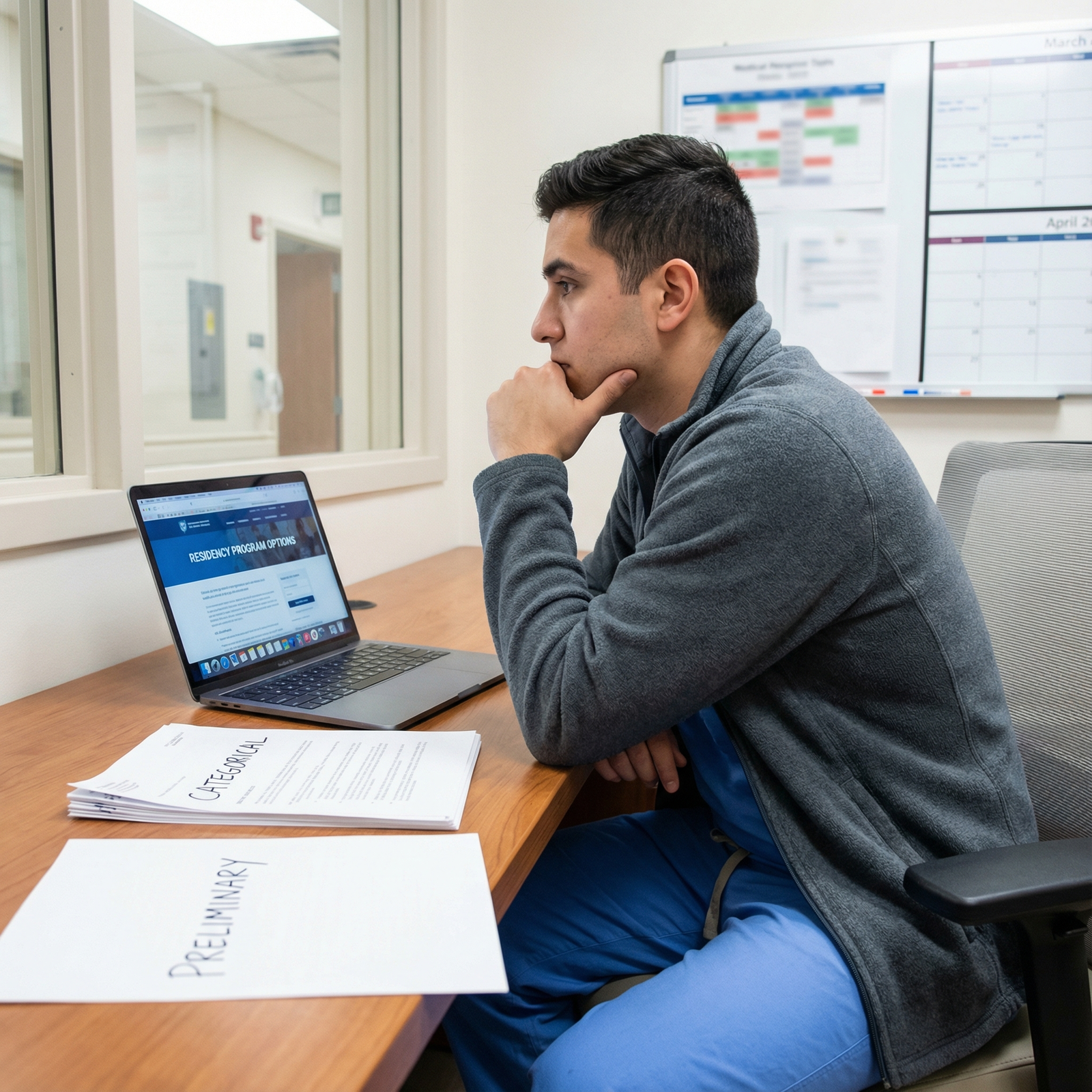
What happens if you start a prelim year, realize you actually want to stay in that program, and now you’re wondering if you can convert to a categorical spot without redoing the whole Match circus?
Here’s the blunt answer:
Yes, it can happen. But it is not automatic, it is not guaranteed, and if you bank on it without a backup plan, you are playing with fire.
Let’s break this down like someone who has watched this go right… and very wrong… multiple times.
1. The Short Answer: Is It Possible?
Yes, you can sometimes switch from a preliminary track to a categorical position in the same program. I’ve seen:
- A prelim medicine intern slide into an unexpected PGY‑2 categorical spot when someone left for a fellowship early.
- A prelim surgery intern get picked up as categorical when a matched categorical resident resigned in October.
- A prelim year “test drive” turn into a categorical home when the program always used prelims as an unofficial pipeline.
But I’ve also seen:
- Prelim interns told from day one: “We never convert prelims to categorical, do not count on that.”
- People who worked like maniacs, got glowing evaluations… and still had to reapply because there were simply no positions.
- Residents who skipped applying broadly in the Match because they “heard” there might be a spot. Then were scrambling in the SOAP.
So yes, it’s possible. But whether it’s probable for you depends on three things:
- Program culture and historical behavior
- Actual available positions (or anticipated attrition)
- Your performance, relationships, and timing
2. Prelim vs Categorical: Why This Even Matters
Preliminary = one‑year, non‑continuity.
Categorical = full-residency spot from PGY‑1 through graduation.
Prelim years are common in:
- Internal Medicine (for Neurology, Radiology, Anesthesiology, Derm, etc.)
- Surgery (for advanced surgical subspecialties, IR, urology, etc.)
- Transitional Year (broad general year, not tied to one specialty)
Why people want to convert to categorical at the same place:
- They decide they like the core specialty (e.g., a TY who decides “Actually, I want IM.”)
- Their advanced position falls through or they do not match into it.
- Life happens: personal reasons, geography, partner, kids, visa issues.
- They realize their current program is decent and the thought of restarting in a new hospital feels miserable.
Here’s the catch: categorical positions are planned years in advance with tight funding and ACGME caps. Programs do not just “upgrade” prelims because you ask nicely.
3. How Often Do Programs Convert Prelims to Categorical?
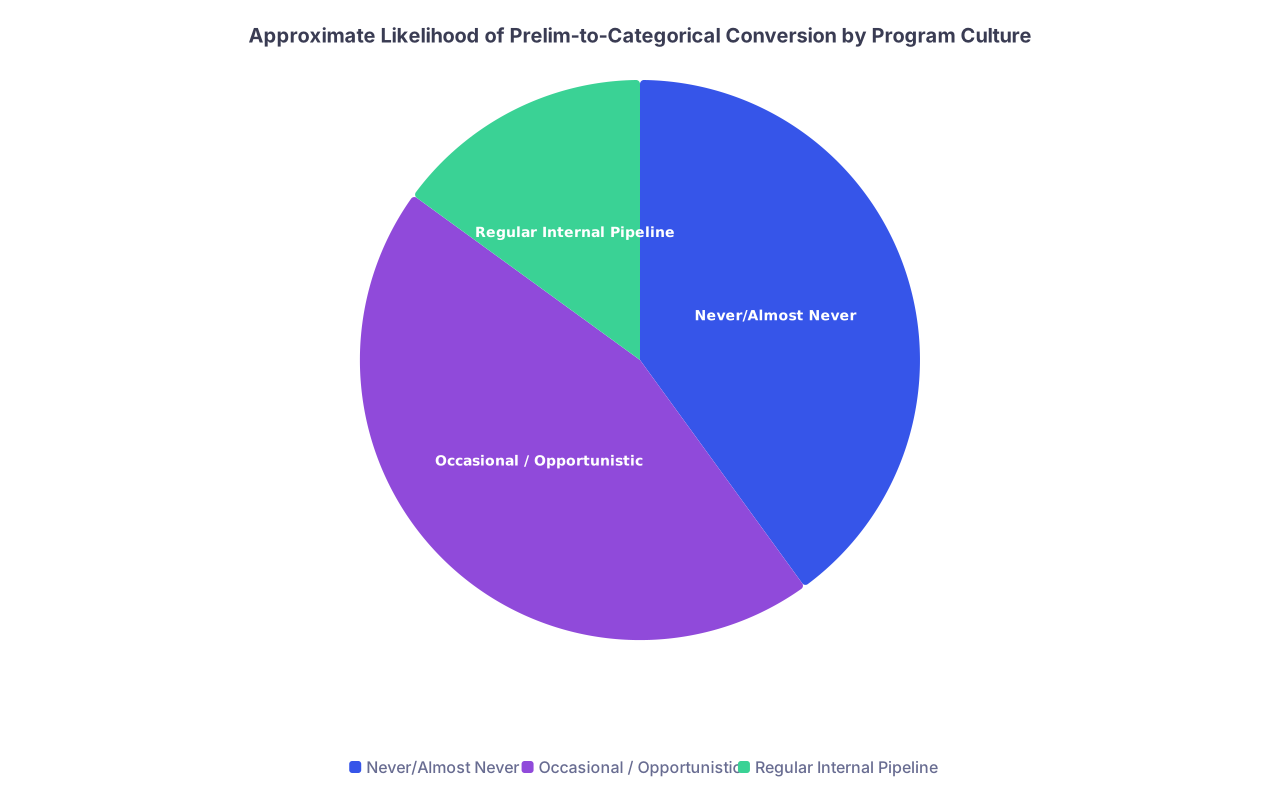
Short version: some do it regularly; some never do it. You need to know which is which.
| Category | Value |
|---|---|
| Never/Almost Never | 40 |
| Occasional / Opportunistic | 45 |
| Regular Internal Pipeline | 15 |
This is not hard data; it’s how it actually feels on the ground:
- About 40% of programs: basically never convert. Prelim is a one‑year service job. Full stop.
- About 45%: might convert if there’s unexpected attrition and a prelim has been outstanding.
- About 15%: quietly (or openly) treat prelims as a feeder group, especially in IM or TY.
You can usually sniff this out by:
- Asking current prelims: “Has anyone in the last 3 years converted here?”
- Reading between the lines on interview day: when PDs say “We value our prelims” but cannot name a single one who became categorical, that tells you something.
- Checking old program rosters on their website/LinkedIn to see if prelims show up later as PGY‑2s there.
If there’s no history of conversion, the odds you’ll be the magical exception are low.
4. What Needs to Happen for You to Convert?
Think of it as a three‑gate process. All three have to say “yes.”

| Step | Description |
|---|---|
| Step 1 | Prelim Intern |
| Step 2 | Must reapply externally |
| Step 3 | PD interest |
| Step 4 | Institution approval |
| Step 5 | Converted to categorical |
| Step 6 | Program converts prelims? |
| Step 7 | Categorical slot available? |
| Step 8 | Strong performance? |
Gate 1: Program philosophy
Does the program ever convert prelims?
If the PD explicitly says, “We do not have a pathway for prelims to become categorical here,” take that at face value. That’s not reverse psychology. That’s them trying to prevent misunderstandings and future rage.
Gate 2: An actual spot exists
Even if they like you, they need:
- An unfilled categorical position (rare), or
- A categorical resident who quits, transfers, gets dismissed, or switches specialties, and
- Funding and ACGME approval to backfill at your PGY level
If everyone in your categorical class is happy and stable, there’s literally nowhere for you to go.
Gate 3: You’re the obvious choice
This part you control:
- Strong evaluations from key rotations
- PD and APD know you well
- You act like a team player, not a desperate climber
- You make it clear you’d seriously consider staying, without being entitled about it
Programs are not going to risk their whole class dynamic to save one prelim who’s mediocre or difficult. They might for the one who’s already functioning like a stellar categorical.
5. When and How to Ask About Converting
There’s a way to do this that works. And a way that gets you labeled “problematic” in week 2.
Before you start (during interviews / pre‑Match)
If you’re still applying and this question affects ranking:
Ask directly but professionally:
- “In the last few years, have any prelim interns been able to stay on as categorical here?”
- “Is there a defined or informal pathway from prelim to categorical if a spot opens?”
- “For someone who might be open to staying, how do you recommend we position ourselves?”
If they shut it down with “No, that’s not how our program works,” believe them. Do not rank the prelim thinking “I’ll convince them later.” You won’t.
During the year
Timing matters:
- Don’t ask during orientation week. You look wildly premature.
- Wait until you’ve done enough rotations that they know your work (often late fall / early winter).
How to bring it up with your PD:
“Dr. X, I’ve really enjoyed working here and could see myself completing full training in this specialty. I know there may not be positions, and I am applying broadly, but if a categorical spot were to open, I’d be very interested in being considered. What would that realistically look like in this program?”
That does a few things:
- Shows interest without assuming availability
- Reassures them you’re not putting all your eggs in their basket
- Opens the door for honest intel: “Yes, we occasionally do that” versus “No, it basically never happens”
6. Should You Still Apply in the Match?
Yes. Almost always yes.
The biggest mistake I see prelims make:
They hear a vague “maybe” from the PD, take that as a handshake deal, and pull back on the Match.
“When I was a prelim, our PD said, ‘We’ll try to keep you.’ Two interns stopped applying seriously elsewhere. One spot opened. One got it. The other was scrambling in SOAP with a mediocre application and no plan B.”
Unless you have a signed contract or an official ERAS position offered outside the Match (rare, but can happen), assume you’ll need to apply normally:
- Apply in the ERAS cycle for categorical PGY‑1 or PGY‑2 positions as appropriate
- List your current prelim year prominently, with strong letters from your current institution
- If your own program wants to convert you, they’ll usually tell you clearly and early enough to adjust
Do not rely on hallway comments like “We love having you” as a career plan.
7. Strategic Pros and Cons of Trying to Convert
Here’s the realistic balance sheet.
| Aspect | Pro if You Convert | Risk if You Rely on It |
|---|---|---|
| Continuity | No move, same EMR, same team | If no spot, you still must move |
| Reputation | Known quantity, trusted by faculty | If they are lukewarm, that follows you |
| Stress | Avoid full reapplication scramble | Massive stress if spot never appears |
| Geography | Stay in same city/support network | May limit options if you ignore external programs |
| Career trajectory | Smoother, less paperwork | Potential gap year or mismatch if plan fails |
Bottom line: treat conversion as a bonus, not a plan.
8. How to Maximize Your Chances (Without Being Annoying)
If you want to keep the door open at your current program:
Perform like a top categorical intern.
Show up on time. Answer pages. Know your patients. Anticipate needs. This isn’t complicated, but many don’t do it.Crush key rotations where decision‑makers see you.
In IM: wards with PD/APD coverage, ICU.
In surgery: main service, trauma, night float.
You want your name coming up in faculty meetings in a good way.Get local letters early.
Ask attendings who genuinely like your work: “Would you be comfortable writing a strong letter if I apply to categorical programs, including possibly here?”Be transparent but not clingy.
PDs hate the sense that you’re hedging but they’re your only “real” plan. Be explicit:
“I’m applying broadly, but staying here would be a strong option for me if it were possible.”Keep doing your job even if you get bad news.
I’ve seen programs rescind interest in someone because they emotionally checked out after hearing “probably no spot.” Your reputation follows you beyond that prelim year.
9. Special Cases: Transitional Year and Surgery Prelims
Transitional Year (TY)
TY programs almost never have categorical pathways because they’re not tied to a single specialty. But:
- You may rotate with a home IM, FM, or Neuro program that does have categorical positions.
- Conversion would then be into that other department, not “TY categorical.”
Here, your strategy is to impress the core specialty teams, not the TY office.
Surgery prelims
Blunt truth: many surgery prelims are service workhorses with zero conversion expectation.
Some large academic departments do occasionally convert a prelim to categorical when there's attrition, but it’s often one or two spots for a massive prelim pool.
If the program tells you, “We do not anticipate categorical spots for prelims,” they are not lying. They’re trying to keep you from building false hope.
10. When the Answer Is Clearly “No”
Sometimes you’ll get a clean, honest “we don’t convert prelims” or “we haven’t in 10 years.” Believe that.
What you do then:
- Treat the prelim year as your audition for other programs
- Collect strong evaluations and letters
- Fix whatever made you end up in a prelim track if you want categorical now (Step scores, weak MSPE, late decision, etc.)
- Apply widely and strategically in the next cycle
You are not stuck. But you are not owed a spot where you are.
FAQ: Switching From Prelim to Categorical in the Same Program
1. Can I switch from a prelim to categorical spot mid‑year?
Rarely. Most conversions, when they happen, are arranged for the next PGY year (e.g., you become a PGY‑2 categorical). Mid‑year switches usually require someone exiting abruptly and fast institutional approval. Do not expect this.
2. Do I have to re‑enter the Match to become categorical at my current program?
Not always. Programs can sometimes fill off‑cycle or PGY‑2 positions outside the Match. If they want you, they’ll tell you the mechanism. But unless there is a concrete discussion with your PD about bypassing the Match, assume you must apply through ERAS again.
3. Should I tell my PD I want to stay, or will that hurt my chances elsewhere?
Tell them. A good PD will both advocate for you locally and support your external applications. Hiding your interest helps no one. Just be clear you’re applying broadly and are not counting on them to “save” you.
4. Does being a prelim at a place give me any real advantage over external applicants?
Yes, if they already like you. You’re a known quantity: they’ve seen your work ethic, culture fit, and reliability. That can absolutely outweigh a slightly weaker Step score compared with an unknown external applicant. But it only matters if a spot exists.
5. What if my advanced position (Neuro, Derm, Rads, etc.) falls through—can I stay in IM or Surgery categorically?
Sometimes. I’ve seen prelim IMs whose Neuro plans imploded convert to IM categorical when a spot opened. Same for Rads > IM. You need to talk to your PD early, be clear about the change in your career direction, and then apply broadly to categorical positions in that specialty, including your home program.
6. How do I know if my program is stringing me along about a potential categorical spot?
Red flags: vague compliments (“You’re doing great, we’ll see”), no history of previous prelims converting, no concrete timeline, no mention of actual available positions. If by mid‑winter you haven’t heard specific talk about a real slot (year, level, contract), assume it’s not happening and prioritize your external applications.
Key takeaways:
- Yes, switching from prelim to categorical in the same program is sometimes possible, but never guaranteed.
- Treat it as a bonus option, not your primary plan—still apply broadly through the Match.
- Your best move: perform like a top resident, ask clear questions, and believe the program when they tell you how they actually handle prelims.