
What if Match Week comes and you realize you matched into your advanced spot… but did not match to a prelim year? Now you are scrambling for any PGY‑1 position you can find. That’s exactly the scenario you are trying to avoid with this question.
Let me be direct: if you are applying to any advanced specialty (radiology, anesthesia, derm, PM&R, ophtho via the Supplemental Offer and Acceptance Program year, etc.), you must treat the prelim year as a separate, real, competitive application. Not an afterthought.
This includes how many prelim programs you rank.
The Short Answer: Core Numbers to Aim For
Here’s the baseline framework I recommend for most U.S. MD/DO seniors applying to an advanced specialty:
- Advanced programs ranked: 10–15+
- Preliminary (and/or TY) programs ranked:
- Absolute minimum: 8–10
- Safer target: 12–15
- Risk‑averse / slightly weaker applicants: 15–20
If you’re asking, “Can I just rank 3–5 prelims?” — my answer is no. That’s gambling with a year of your life.
The NRMP’s own data make this clear: failing to match a PGY‑1 spot when you have an advanced position lined up is miserable and avoidable. You need enough prelim ranks to roughly match or exceed your advanced ranks.
Here’s a quick comparison to ground you:
| Applicant Profile | Advanced Ranks | Prelim/TY Ranks |
|---|---|---|
| Strong, no red flags | 10–15 | 10–15 |
| Average applicant | 12–15 | 12–18 |
| Below‑average / red flags | 15–20 | 15–25 |
Notice the pattern: you should usually rank at least as many prelim programs as advanced programs — and often more.
Step 1: Understand What a Preliminary Year Actually Is
A lot of bad decisions start because people do not really understand what they’re applying for.
A preliminary year is:
- A one‑year (PGY‑1) position
- Often medicine, surgery, or a transitional year (TY)
- Designed either for:
- Applicants entering an advanced residency (e.g., radiology, anesthesia, derm, PM&R, neuro, ophtho, rad onc), or
- People who only want one year of training (e.g., going into research, certain fellowships, or undecided)
It is not a guarantee of continuation into that program’s categorical track. You are hired for one year only.
Advanced programs (like DR or anesthesia) start at PGY‑2, so NRMP forces you to pair them with at least one PGY‑1 option on your rank list. That PGY‑1 can be:
- A prelim medicine year
- A prelim surgery year
- A transitional year (TY)
- Occasionally other designations depending on specialty
So you’re essentially running two parallel matches inside the same system:
- Advanced (PGY‑2+) rank list
- Preliminary/TY (PGY‑1) rank list
If one hits and the other misses, you have a very real problem.
Step 2: Core Rule – Pair Your Advanced List with a Robust Prelim List
Here’s the principle I use to advise students:
You should have at least as many prelim/TY programs on your rank list as advanced programs. Preferably more.
Why?
Because prelim spots are:
- Concentrated in certain regions (often big cities, academic centers)
- Filled by multiple groups (advanced applicants + people doing a single year + backup applicants)
- Sometimes less predictable in how they rank advanced‑track candidates
Meanwhile, your advanced list might have programs that:
- Have their own linked/guaranteed prelims (rare but gold if you can get them)
- Expect you to find your own prelim, without help
- Explicitly say they do not help with prelim placement
If you rank 15 advanced programs and only 6 prelims, you’re hoping NRMP’s algorithm lines up two independent match outcomes perfectly in your favor. That’s optimism, not planning.
Step 3: Adjust Your Number Based on Your Risk Profile
Now let’s get practical. How many prelim programs should you rank?
Consider three major factors:
- Your overall competitiveness
- Your geographic flexibility
- Whether you have linked / joint prelim spots through an advanced program
1. Competitiveness
Be blunt with yourself. Look at Step/COMLEX scores, class rank, red flags, and specialty competitiveness.
Rough guide:
Strong applicant (no red flags, good scores, strong letters):
- Advanced: 10–15
- Prelim/TY: 10–15
Average applicant:
- Advanced: 12–15
- Prelim/TY: 12–18
Below‑average / red flags / changing specialty late:
- Advanced: 15–20
- Prelim/TY: 15–25
If that sounds like a lot, remember: ranking a program does not hurt you. It’s free insurance.
2. Geographic Flexibility
If you are rigid geographically (e.g., “partner is locked into one city,” “kids in school,” “visas restrict mobility”), you must cushion that with more prelim ranks in that area.
Example:
- You want to stay in the Midwest, ideally Chicago.
- Advanced: 12 programs (mostly Midwest)
- Prelim/TY: 15–18 programs (Chicago, Milwaukee, St. Louis, Indianapolis, maybe stretching to Minneapolis)
If you’re open to moving anywhere, you can get away with slightly fewer, but I still like 10–15 as a floor.
3. Linked Prelim Positions
Some programs offer:
- A “categorical‑like” arrangement: you match into the advanced spot and they reserve prelim spots for their incoming class.
- Or an NRMP‑linked prelim track (e.g., “Radiology w/ linked prelim medicine at same institution”).
These are safer.
If you have a bunch of these on your advanced list, your prelim burden is somewhat lower. But not zero — because you usually still rank them separately or might not match your top advanced choice.
In that case, maybe your numbers look like:
- Advanced: 12
- 5 have their own linked prelims
- Prelim/TY: 10–12 total
- Including the linked ones, plus extra stand‑alone prelims as backup
Visual: How Your Two Rank Lists Interact

| Step | Description |
|---|---|
| Step 1 | Apply to Advanced Programs |
| Step 2 | Apply to Prelim TY Programs |
| Step 3 | Create Advanced Rank List |
| Step 4 | Create Prelim TY Rank List |
| Step 5 | NRMP Algorithm Runs |
| Step 6 | PGY1 and PGY2 Secured |
| Step 7 | Need PGY1 Scramble |
| Step 8 | PGY1 Only - No Advanced Spot |
| Step 9 | Unmatched in SOAP |
| Step 10 | Did both match? |
You want to live in branch G. Every extra prelim rank nudges you away from H and J.
Step 4: Transitional Year vs Prelim Medicine vs Prelim Surgery
You’re not just deciding how many, but also what type of prelim to rank.
Quick hierarchy for most advanced specialties (radiology, anesthesia, derm, PM&R, neuro):
- Best lifestyle: Transitional Year (TY)
- Most academically solid / easiest fit: Prelim Medicine
- Most brutal / often less relevant: Prelim Surgery
This can influence where and how many programs you apply to.
For example:
- You might apply to:
- 8–10 TY programs
- 8–10 prelim medicine
- 2–4 prelim surgery as a deep backup
You rank them all together on the prelim/TY rank list, ordered by your true preference (lifestyle, location, reputation, call schedule, etc.).
Step 5: Common Mistakes That Get People Burned
I’ve watched people blow this part of the Match for dumb reasons. Here’s what to avoid.
Mistake 1: Treating Prelim as an Afterthought
The logic goes: “I’m a strong candidate in radiology, so prelim will be easy.”
Then:
- They apply to 5 prelims.
- Rank 4.
- One doesn’t interview them.
- Another ranks them low.
- Then they match their #3 radiology spot but match no prelim.
Result: nightmare scramble for a PGY‑1 spot in SOAP, sometimes in a completely different city than their PGY‑2.
Mistake 2: Over‑concentrating in one city
“I only applied to prelims in Boston because my partner is there.”
Okay — but then you need depth. Instead of 5 Boston prelims, think 10–12 in that metro and nearby cities. Include community hospitals, smaller academic affiliates, less glamorous programs.
Mistake 3: Not Ranking Programs You Dislike “On Principle”
I’ve heard: “I would never go there; I hated that program. I’m not ranking it.”
Careful. There’s a difference between:
- Truly toxic / unsafe / unethical environments → fine, do not rank.
- Just not your favorite → still better than going unmatched.
Ask yourself: “Would I rather spend 1 year at this meh prelim or risk SOAP chaos and maybe not match?” Often the honest answer is “I’d rather suck it up for a year.”
Mistake 4: Ignoring How Competitive Some TYs Are
Top TYs in nice locations with chill schedules? Wildly competitive. Sometimes more competitive than the core advanced specialty. So if your plan is “I’ll just get a cush TY in California,” you’d better apply broadly and also have prelim medicine programs as backup.
Step 6: Putting It All Together – Sample Strategies
Here are a few concrete scenarios.
Scenario 1: Strong Radiology Applicant, Flexible Location
- U.S. MD, good scores, solid letters, no red flags
- Wants diagnostic radiology, happy to move
Plan:
- Advanced DR ranks: 12–15 programs, mix of academic and strong community
- Prelim/TY ranks:
- 6–8 TY
- 6–8 prelim medicine
- Total prelim ranks: ~12–16
Scenario 2: Average Anesthesia Applicant, Wants to Stay Close to Family in the Midwest
- U.S. DO or MD, mid‑range scores, average CV
- Needs to stay roughly 2–3 states from home
Plan:
- Advanced anesthesia ranks: 12–15 (Midwest heavy)
- Prelim/TY ranks:
- 4–6 TY
- 10–12 prelim medicine
- Maybe 2–3 prelim surgery
- Aim for 15–18 prelim ranks total, mostly Midwest
Scenario 3: Below‑Average Derm Applicant, High Risk, Some Red Flags
- Needs every advantage
- Has a few advanced derm options plus a few backup advanced programs (like prelim medicine only, or another specialty)
Plan:
- Advanced ranks: 15–20 (mix derm and backup advanced options)
- Prelim/TY ranks:
- 8–10 prelim medicine
- 5–7 TY
- 3–5 prelim surgery
- Total prelim/TY ranks: 18–22
This person cannot afford to be “picky” about prelims. They need volume.
Quick Reality Check: Are You Under‑Ranking Prelims?
Use this self‑audit:
- Count your advanced programs ranked.
- Count your prelim/TY programs ranked.
- If prelim/TY < advanced → you’re probably under‑ranked.
- If prelim/TY only 5–7 total → dangerous for an advanced applicant.
- If you are geographically rigid and below‑average stats → aim higher than you think (15–20).
Where Data Fit In
NRMP data over and over show: more ranks = higher match probability, up to a point. For advanced applicants, it’s not just “how many total programs” but “do I have enough programs in both categories?”
Here’s a simple conceptual picture:
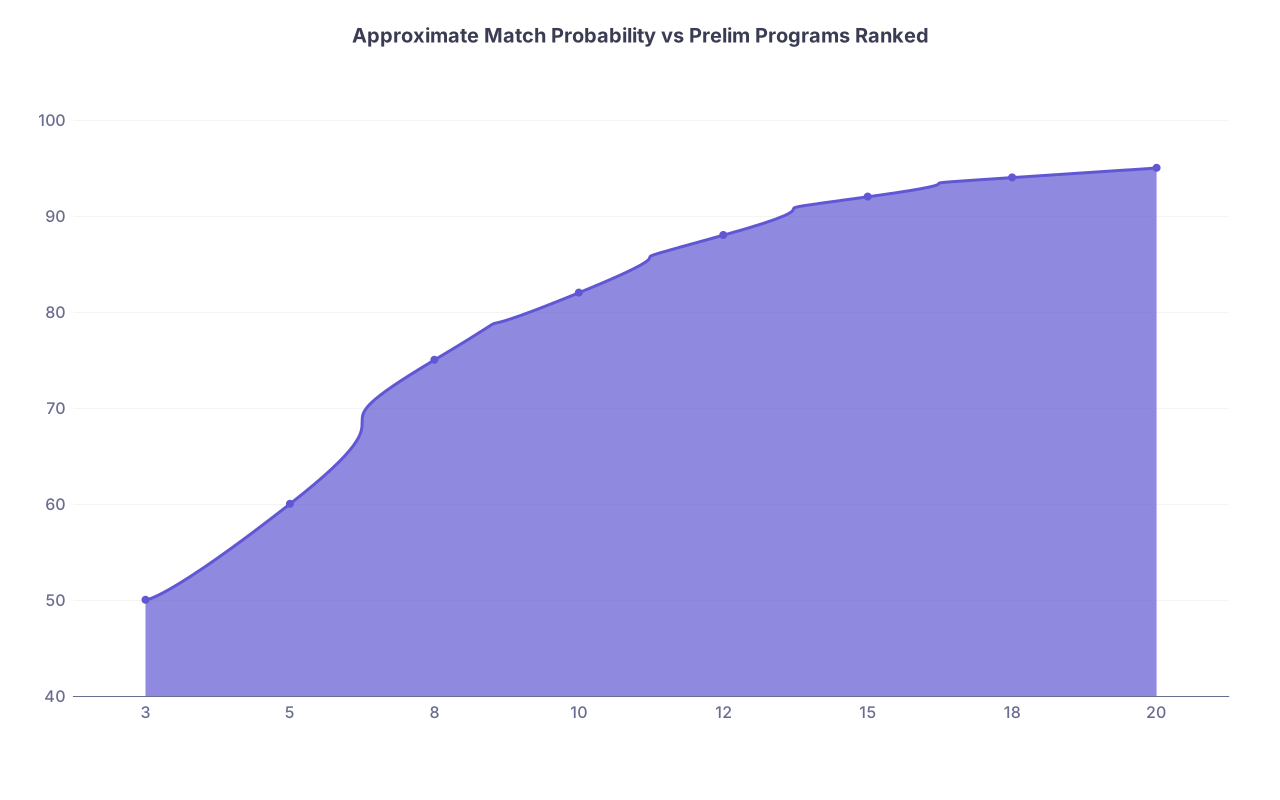
| Category | Value |
|---|---|
| 3 | 50 |
| 5 | 60 |
| 8 | 75 |
| 10 | 82 |
| 12 | 88 |
| 15 | 92 |
| 18 | 94 |
| 20 | 95 |
These are illustrative, not exact NRMP numbers. The point stands: going from 3 to 10 prelim ranks makes a huge difference. Going from 15 to 20 is marginal but still insurance.
Don’t Forget the Logistics
A couple of practical notes people forget while obsessing over numbers:
- Interview season fatigue: Yes, more prelim apps mean more interviews. But skipping a few evenings now is better than losing a whole year later.
- Program type balance: Aim for a mix of TY and prelim medicine where possible. Use prelim surgery as a deeper backup if you’re willing to accept a tougher year.
- Ask residents directly: On interview day, ask current advanced residents, “Did anyone in your class struggle with prelim matching? How many prelims did you rank?” You’ll hear real stories that reinforce this.
FAQ: Prelim Years and Rank Lists (Exactly 7 Questions)
1. If I have a guaranteed linked prelim with my top advanced program, do I still need many other prelim ranks?
Yes. Unless you are 100% certain you’ll match that one advanced program (you’re not), you need backup prelims for the rest of your advanced list. I’d still aim for 8–12 total prelim/TY ranks even with a “guaranteed” linked option.
2. Can I rank the same prelim program multiple times paired with different advanced programs?
No. You create two separate rank lists: one for advanced, one for prelim/TY. The NRMP algorithm independently matches both lists and then aligns them by year. You do not manually “pair” individual prelims to specific advanced programs beyond using preferences and any official NRMP linked tracks.
3. Is it okay to not rank any prelim surgery programs if I really don’t want that lifestyle?
Yes, if you have enough TY and prelim medicine options (e.g., 12–18 ranks total) and you’d truly rather go unmatched than do a prelim surgery year. But if your priority is “I must match a PGY‑1 no matter what,” then adding a few prelim surgery programs is smart insurance.
4. What if I match a prelim but not an advanced program?
Then you complete that prelim year as planned and usually apply again to advanced programs in the next cycle, sometimes as a PGY‑2 or research year. It’s not ideal, but it’s far better than being entirely unmatched. Just remember that prelim alone does not guarantee entry into a categorical spot later.
5. Do I need a prelim year if my specialty is categorical (like internal medicine or general surgery categorical)?
No. If you’re applying to categorical internal medicine, general surgery, peds, OB/GYN, EM (where offered as categorical), etc., you do not need or rank prelim programs. Your PGY‑1 is built into the categorical position.
6. Are Transitional Year programs always easier or lighter than prelim medicine?
Not always. Many are cush, but some TYs are just prelim medicine in disguise with extra electives. You need to read schedules, ask residents, and look at call structure. Do not assume “TY = easy”; some are brutal.
7. What’s the single biggest sign I’m under‑prepared on the prelim side?
Two red flags:
- You have fewer prelim/TY ranks than advanced ranks, and
- Your total prelim/TY ranks are under 8–10.
If both are true and you are not a superstar with multiple linked prelims, you’re taking an unnecessary risk.
Key points to walk away with:
- If you’re applying to an advanced specialty, treat the prelim year as a real match, not a box to check.
- Aim to rank at least as many prelim/TY programs as advanced programs — usually 10–15+ prelims is reasonable.
- When you’re unsure, err on the side of more prelim ranks, not fewer. A slightly annoying PGY‑1 beats going unmatched every single time.