
You’re sitting in your tiny call room between pages, scrolling through future program websites. You matched prelim-only. The advanced spot did not happen. And now the same questions loop in your head:
“How do I explain this next cycle?”
“Are they going to assume I was a problem resident?”
“Do I say the word ‘failed’ out loud or pretend it never happened?”
Here’s the answer you’re looking for: you absolutely can explain a preliminary-only match in a way that’s honest, concise, and does not tank your chances. But you need a plan, not improv.
Let’s build that plan.
What “Prelim-Only Match” Actually Signals To Programs
Before you script anything, you need to understand what’s going through an interviewer’s head when they see:
- Prelim Internal Medicine PGY‑1 (current)
- No advanced PGY‑2 listed / Reapplying
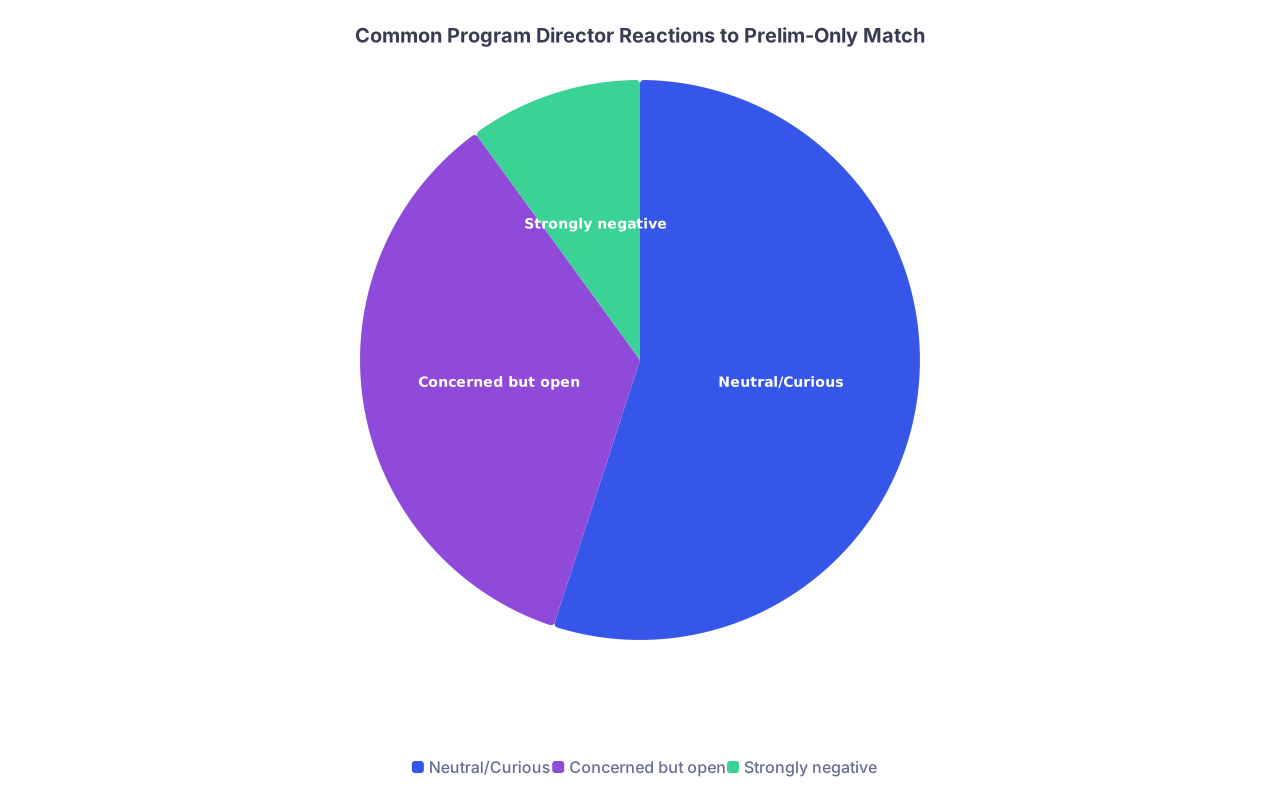
| Category | Value |
|---|---|
| Neutral/Curious | 55 |
| Concerned but open | 35 |
| Strongly negative | 10 |
They’re usually wondering three things:
Was this a strategy or a salvage?
Did you choose a prelim year as part of a pathway (e.g., derm, rads, anesthesia) or did you not match categorical/advanced and scramble into prelim?Is there a performance or professionalism issue?
Are there red flags—failed Step, bad evaluations, probations, gaps—that explain why you’re not in a categorical seat now?What’s different this time?
Why should they believe the outcome will be better in this application cycle?
If you do not answer those three questions clearly and quickly, they will fill in the blanks themselves. And their version will be worse than the truth.
So your job in interviews is to give them a clean, structured story that:
- Owns what happened
- Explains what you learned
- Shows what’s changed and why you’re a safer bet now
Key Principles For Explaining a Preliminary-Only Match

Let me be direct. If you go into interviews rambling, apologizing, or oversharing, you will shoot yourself in the foot. Here’s the framework that actually works.
1. Lead With Facts, Not Emotion
Bad version:
“I was devastated, I felt like a failure, I didn’t understand why I didn’t match…”
Good version:
“In my first application cycle, I applied to X specialty with Y number of programs and did not match into an advanced or categorical position. I accepted a preliminary Internal Medicine year at [Hospital] to continue my clinical training and strengthen my application.”
You’re not on a therapy couch. You’re presenting a professional timeline.
2. Own Your Role Without Self-Destruction
Programs hate two extremes:
- “It was all politics / bad luck / toxic program.”
- “I’m just terrible, I failed, it was all my fault.”
You want accountable, specific, and fixable.
Example:
“I applied very narrowly and underestimated how competitive [specialty] is with my Step 2 score. I also applied late in the season. That combination hurt my chances significantly. Since then, I’ve focused on addressing those weaknesses directly.”
That tells them:
- You have insight
- The issues were strategic and fixable, not “I’m impossible to train”
- You’re not going to blame them when things get hard
3. Frame the Prelim Year as Deliberate Growth
A prelim year is not a consolation prize in your story. It’s your evidence.
You want to be able to say something like:
“My preliminary year has given me extensive exposure to acutely ill patients, cross-cover responsibilities, and multidisciplinary teamwork. I’ve used this time to improve my clinical judgment, efficiency, and communication. My recent evaluations reflect that growth.”
You are repositioning the prelim year as:
“I didn’t stall. I got better.”
4. Be Specific About What’s Different Now
If nothing is actually different, programs will assume the same outcome is coming. You need concrete upgrades:
- New/stronger letters (especially from residency)
- Cleaner Step / COMLEX story (improved scores, passed boards)
- Research or projects completed
- Evaluations that show reliability and teamwork
- A more realistic specialty or a broader application strategy
You must be able to say:
“This application is different from my last one in three ways: A, B, and C.”
How To Answer The Question Word-for-Word
You will get some version of:
“So tell me about your path. I see you’re in a prelim position now—what happened with your previous match?”
Here’s a structure that works almost every time.
Step 1: One-Sentence Summary
“During my first application cycle, I applied to [specialty] only, did not match into an advanced or categorical spot, and accepted a preliminary Internal Medicine year at [institution] to continue training and strengthen my application.”
That’s it. No drama. Just facts.
Step 2: Brief Explanation of Why
Then 2–3 sentences on why you think that happened.
Example for overreach:
“I aimed for a very competitive specialty with a Step 2 score of 224 and limited home-program support. I also applied late and somewhat narrowly. In hindsight, my application profile didn’t match the level of programs I was targeting.”
Example for academic bump:
“I had a Step 1 failure that I retook and passed, but some programs screened it out automatically. I underestimated how heavily that would impact my chances despite stronger clinical grades.”
Step 3: What You Did About It
Now the part programs actually care about.
“I accepted the prelim year because I didn’t want to pause my clinical growth. Since starting residency, I’ve worked on the core skills I knew I needed to improve: efficiency, independent decision-making, and communication with nursing and consultants. My current evaluations describe me as reliable, responsive, and easy to work with, which I’m proud of.”
If you have concrete wins, add them:
- “I was selected as one of the night float seniors midway through the year.”
- “I was asked to help onboard the incoming interns.”
- “I presented at M&M on [topic].”
Step 4: Why You’re Applying (Again) to This Field
Do not forget to pivot back to the specialty in front of you. Interviewers want to see persistence and clarity.
“I still feel strongly that [specialty] is the best fit for my skills and interests. My time on [relevant rotation] this year has reinforced that. I’m particularly drawn to [specific aspect], and I’m looking for a program where I can bring the work ethic and resilience I’ve built during this prelim year.”
Then stop talking. Let them ask follow-ups if they want.
Different Scenarios: Tailoring Your Explanation
Not all prelim-only stories are the same. You need to match your script to your reality.
| Scenario | Main Angle | Key Evidence |
|---|---|---|
| Overreach in an ultra-competitive specialty | Poor targeting, now more realistic | Broader list, mentors' input |
| Late / disorganized first application | Process error, now corrected | Early ERAS, complete file |
| Exam issues (Step/COMLEX) | Addressed, improved, stable now | Score improvement, no recent fails |
| Personal/family disruption | Life event, now stable | Clear support system, consistent work |
| Program/fit issue | Misalignment, not pathology | Neutral language, strong current evals |
1. You Overreached in a Hyper-Competitive Field
Common with dermatology, ortho, plastics, neurosurgery, some radiology.
Angle:
- “I misjudged competitiveness relative to my scores / school / research.”
- “I didn’t have realistic advising.”
- “I’ve now broadened my applications or shifted to a specialty that fits my profile better.”
You must show:
- You understand where you stand statistically
- You’re not repeating the exact same mistake
2. You Were Disorganized the First Time
You applied late, incomplete secondaries, weak letters, etc.
You say:
“In my first application, I submitted late and didn’t have all my letters ready. That significantly limited interviews. This year, my ERAS is already complete, my letters are in, and I’ve worked with my PD and mentors to submit on time and to a more comprehensive list of programs.”
You’re telling them: this isn’t a chronic executive-function disaster.
3. You Had an Exam or Academic Problem
Step 1 failure, low Step 2, remediation. Be direct.
“I had a Step 1 failure during medical school. I retook it and passed, and since then I’ve passed Step 2 and my in-training exam on the first try. The prelim year has allowed me to show consistent performance in a demanding clinical environment, and my program director is supportive of my application.”
You must connect the dots: “That past pattern is not who I am now.”
4. You Had a Personal Crisis
Family illness, health issue, etc. You tell enough to make it believable, not enough to turn it into melodrama.
“During my initial application year, I was managing a significant family medical issue that pulled focus from my application process. That situation is now stable, and I’ve been able to fully engage in my prelim year and this application.”
Then pivot hard to your current stability and performance. Program leadership wants reliability, not ongoing chaos.
What To Avoid Saying (Because It Backfires)
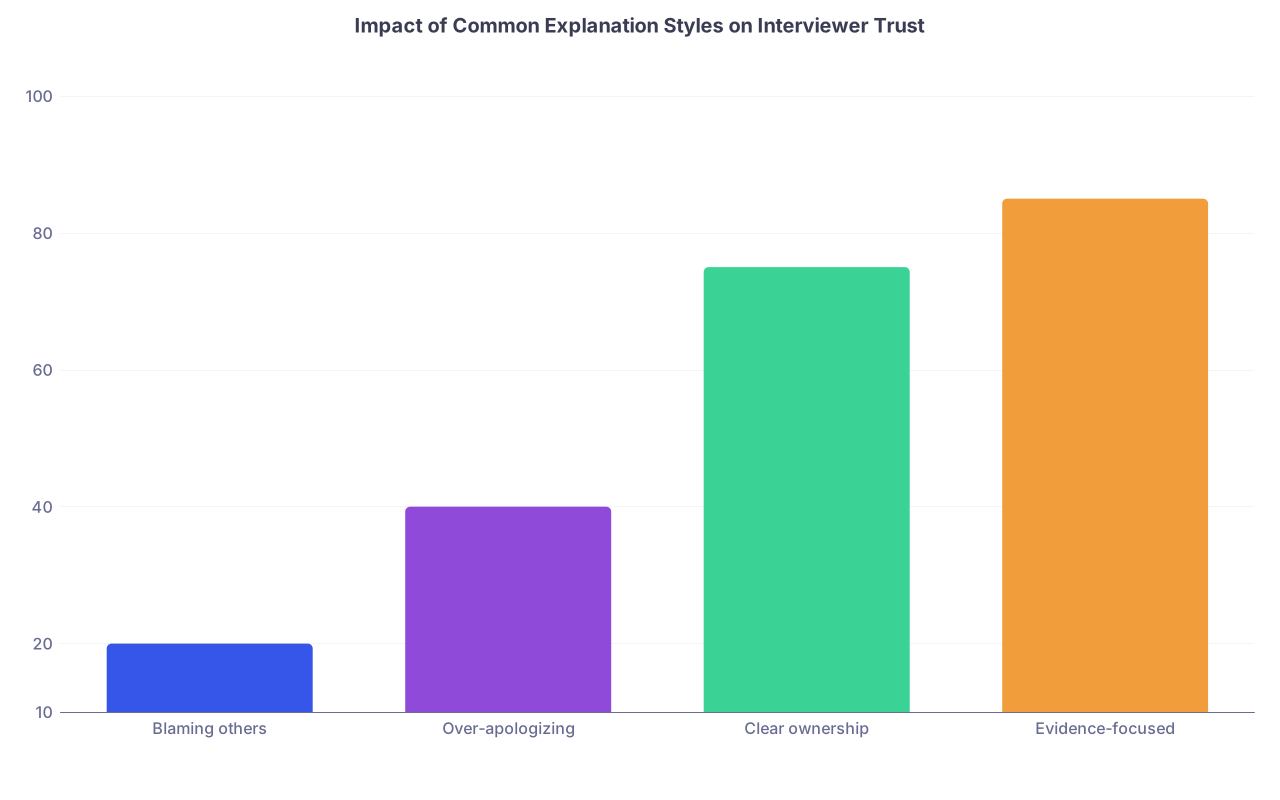
| Category | Value |
|---|---|
| Blaming others | 20 |
| Over-apologizing | 40 |
| Clear ownership | 75 |
| Evidence-focused | 85 |
A few landmines I’ve seen sink otherwise decent candidates:
Trashing your current program.
“They were toxic,” “the culture was horrible,” “they didn’t support me.” Even if it’s true, it makes interviewers think: “You’ll say this about us next.”Blaming the Match entirely.
“The algorithm failed me,” “I was unlucky,” “COVID ruined everything.” Everyone had COVID. Everyone uses the same algorithm.Over-sharing emotional detail.
Crying in the answer, lengthy descriptions of depression, talking about “identity as a failure.” Real issues, but your job is to show you’re functioning and ready to train.Sounding entitled.
“I should have matched the first time,” “I was surprised they didn’t rank me higher.” Arrogance + no introspection = automatic no.Being vague or evasive.
If you dodge the question or speak in circles, they assume there’s a serious hidden problem. Clear, brief, and honest beats polished vagueness every time.
How To Prepare Before You Ever Sit Down in an Interview

| Step | Description |
|---|---|
| Step 1 | Clarify Your Story |
| Step 2 | Get PD Letter |
| Step 3 | Identify Application Changes |
| Step 4 | Write 3-Sentence Explanation |
| Step 5 | Practice Out Loud |
| Step 6 | Use in Interviews |
Do the work now so you are not inventing answers on the fly.
Talk with your program director early.
You want them in the loop and, ideally, supportive. Ask directly: “Would you feel comfortable writing me a strong letter for [specialty] applications?”Get your timeline straight.
Write out your path: med school → first application → prelim match → current status. No contradictions.Script your 3–5 sentence core answer.
Literally write it. Refine it until it’s clear and free of self-sabotaging language.Practice out loud with someone who will be blunt.
Another resident, a mentor, not your nicest friend. Ask: “Does this sound defensive? Does it sound like I’m hiding anything?”Accept the story.
This happened. It’s on your CV forever. The more at peace you are with it, the less weird you’ll sound when you explain it.
FAQs About Explaining a Preliminary-Only Match

1. Should I use the word “didn’t match” or soften it?
Say it plainly: “I did not match into an advanced/categorical position that cycle.” Everyone interviewing you knows how the Match works. Euphemisms like “I had a less successful outcome” just sound like spin. You can keep the tone matter-of-fact, but don’t pretend it didn’t happen.
2. Do I need to address this in my personal statement too?
Briefly, yes. One or two sentences is plenty, usually in the “why now / why me” section:
“After not matching into an advanced position in my initial application cycle, I pursued a preliminary Internal Medicine year at [institution]. This experience has strengthened my clinical foundation and confirmed my commitment to [specialty].”
Then move on. Save the fuller explanation for interviews and, if needed, the ERAS “Additional Information” section.
3. What if my prelim performance was rocky early on?
You focus on the trajectory. Example:
“My first few months were an adjustment, and my early evaluations reflected that. With feedback and support, I improved my time management and communication. My later evaluations and my program director’s letter show this growth.”
Programs care more about the slope than the starting point. But you need at least one senior/PD who agrees the slope is up, not flat or down.
4. Can I switch specialties after a prelim-only match?
Yes, but the bar is higher. Your explanation then has two layers:
- Why you didn’t match before
- Why you’re changing fields now
You must show genuine exposure and fit to the new specialty (rotations, mentorship, maybe a project), and you need to avoid sounding like you’re fleeing rather than choosing. Something like:
“While completing my prelim year, I found myself drawn consistently to [new specialty] during multidisciplinary care. After discussing with mentors and spending focused time on that service, I realized the field is a better fit for my skills and long-term goals.”
5. Is a preliminary-only match a permanent scar on my application?
No. It’s a chapter. I’ve seen plenty of residents go prelim → categorical IM, prelim → anesthesiology PGY‑2, prelim → radiology, even prelim → competitive subspecialties after strong performance. The permanent scar is not the prelim-only match; it’s a bad story about it. If you show insight, growth, and stable performance, this becomes a “resilience and persistence” story, not a “red flag” story.
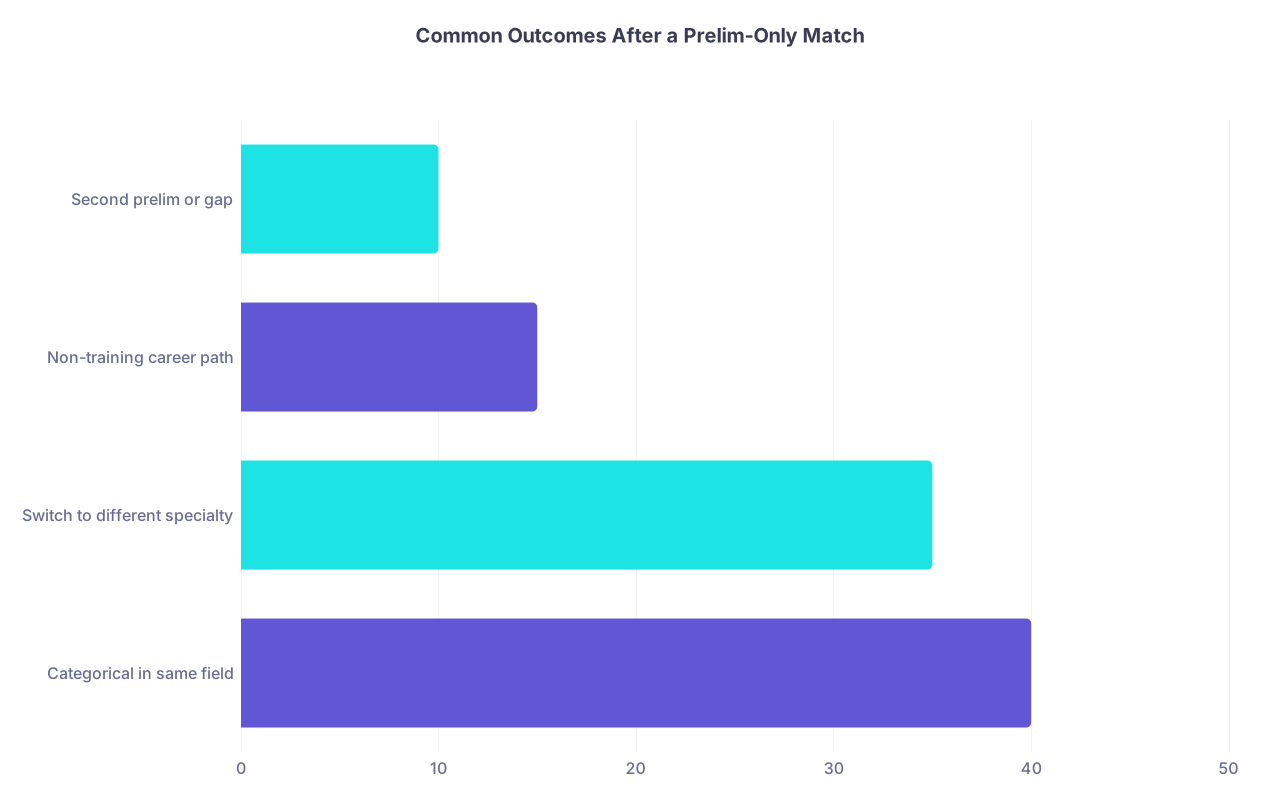
| Category | Value |
|---|---|
| Categorical in same field | 40 |
| Switch to different specialty | 35 |
| Non-training career path | 15 |
| Second prelim or gap | 10 |

Bottom Line
Three things to keep in focus as you walk into those interviews:
- Tell the truth, cleanly. One or two sentences on not matching, one or two on why, no drama, no blame.
- Show the upgrade. Use your prelim year as evidence: stronger skills, better evaluations, clearer fit for the specialty.
- Pivot to the future. End your explanation with why you’re ready now and what you bring to their program.
Do that consistently, and a preliminary-only match becomes part of your story—not the end of it.