
The prestige of your prelim program matters less than people think—and more than some advisors admit—if you’re aiming for a competitive field.
Let me be blunt: for competitive specialties (derm, ophtho, rad onc, radiology, ortho, plastics, ENT, etc.), your prelim program’s name is not what gets you in. But the environment and support at that prelim program can absolutely make or break your application.
You’re not asking, “Will a big-name prelim guarantee my match?” You’re asking the smarter question: “Can where I do my prelim help or hurt me when I’m going for a competitive specialty?” Let’s break it down properly.
Quick Answer: How Much Does Prelim Reputation Actually Matter?
Here’s the short version, since that’s what you really want:
- Your categorical specialty application (Step scores, med school, research, LORs from your target field, away rotations, prior performance) matters far more than your prelim program’s brand.
- For truly competitive fields, prelim reputation is a tiebreaker, not a driver. But being at a place with strong mentorship and connections absolutely helps.
- A malignant, overworked, undersupported prelim year can quietly destroy your odds by:
- Blocking you from doing research or away rotations
- Preventing you from getting strong letters
- Burning you out before you can build a competitive application
So no, you don’t need a “top 10” prelim program. But yes, you should care whether your prelim year is set up to support your competitive match, not sabotage it.
What Program Directors Actually Look At (vs What Students Obsess Over)
Let’s start with what competitive specialty program directors truly care about. Because if you get this wrong, you’ll overvalue the wrong things.
| Factor | Impact on Competitive Match |
|---|---|
| Step/COMLEX scores (if used) | Very High |
| Med school (home reputation) | High |
| Research in that field | Very High |
| LORs from specialty faculty | Very High |
| Away/audition rotations | Very High |
| Prelim program *performance* | Moderate |
| Prelim program *name brand* | Low–Moderate |
Program directors in derm, ophtho, rad onc, etc. will usually see your prelim as:
- Necessary logistics (you have to do it)
- Evidence you can survive residency-level work
- A source of letters or red flags
They’re not sitting in rank meetings arguing whether a prelim at “Midwest General” is better than “Fancy Coastal University.” They’re asking:
- Did this person perform well as an intern?
- Any professionalism issues?
- Do their letters say “top 5% resident I’ve worked with” or “satisfactory”?
- Did they keep up with research, interest, and growth in the target specialty?
If you’re applying to, say, radiology after a prelim in medicine, they care a lot more that your radiology letters are phenomenal than what badge you wore during night float.
When Prelim Reputation Actually Starts to Matter
Now where it does start to matter:
For “hyper-elite” goals
- You’re aiming for places like Mass General derm, UCSF ophtho, HSS ortho.
- These departments are small, insular, and political.
- Prelim at the same institution or another highly respected academic center can give:
- Visibility to faculty who know each other
- Easier “back-channel” calls: “Hey, how is this intern actually doing?”
- Is it required? No. Is it a mild boost if everything else is already stellar? Yes.
For networking and backdoor opportunities
- Some prelim programs have leadership who are:
- Well connected in specific specialties
- Willing to call in favors or send emails
- A PD who calls and says, “This is the best intern I’ve had in five years” matters more than whether your hospital is ranked #6 or #46.
- Some prelim programs have leadership who are:
For perception when the rest of your app is borderline
- Middle-of-the-road Step, average research, okay letters.
- A strong prelim at a serious, well-known teaching hospital can be a small signal that:
- You can hang in a high-expectation environment
- You’re not a disaster under pressure
- It won’t rescue a weak application, but it can help prevent doubt.
So yes, reputation can matter as a signal. But it’s never the main character. Just a supporting actor.
What Actually Matters More Than Name: The Day-to-Day Reality
Here’s where most people screw up. They chase “reputation” and ignore the stuff that actually changes their match outcome.
You want a prelim program that gives you:
Access to your target specialty
- Ability to rotate in that field (or at least nearby)
- Faculty in that specialty who are willing to:
- Mentor you
- Let you do a small project
- Write you letters
Time and schedule flexibility
- You can’t do serious research or take interviews if:
- You’re q3 call with no golden weekends
- You’re constantly covering for unsafe understaffing
- Look for:
- Reasonable caps on patient load
- Some elective time
- Not every rotation being 80 hours plus scut
- You can’t do serious research or take interviews if:
A sane, non-toxic culture
- I’ve seen capable would-be derm and rads applicants completely flame out at malignant prelim programs:
- Late evals
- PDs who “don’t believe in” competitive specialties
- Sabotage-y chiefs
- You need:
- Leadership who are at least neutral, ideally supportive, about you going into another field
- Colleagues who won’t resent your interviews and electives
- I’ve seen capable would-be derm and rads applicants completely flame out at malignant prelim programs:
People who will write you real letters
- Not “Resident X completed their duties satisfactorily.”
- You want “This is one of the top interns I’ve worked with in 10 years.”
- That means:
- Not being one of 60 interns the attending barely sees
- Having some continuity with a few faculty who actually know your work
This is why a smaller, lesser-known but supportive academic prelim program can be a better choice than a huge name-brand place where you’re anonymous and drowning.
Competitive Field by Field: How Much Does Prelim Choice Matter?
Let’s talk specialties people stress most about.
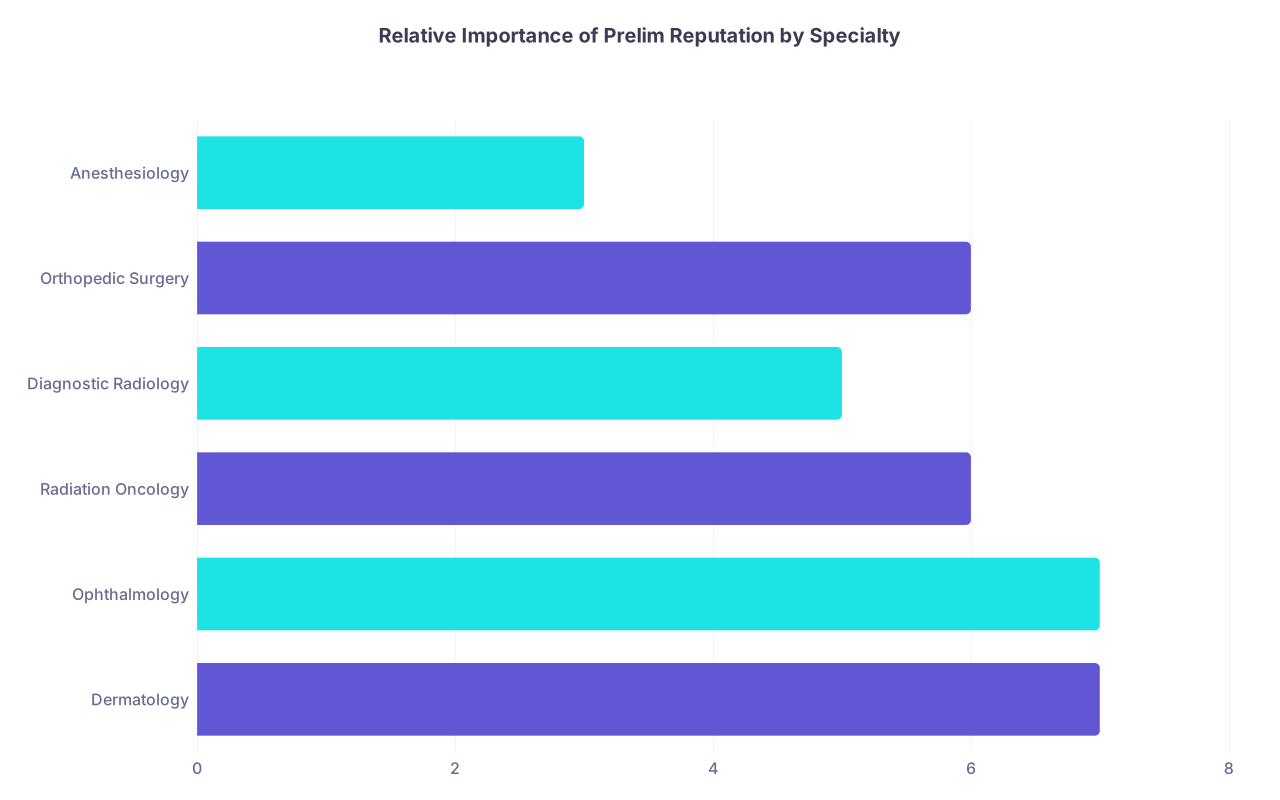
| Category | Value |
|---|---|
| Dermatology | 7 |
| Ophthalmology | 7 |
| Radiation Oncology | 6 |
| Diagnostic Radiology | 5 |
| Orthopedic Surgery | 6 |
| Anesthesiology | 3 |
(Scale 1–10: 1 = almost irrelevant, 10 = very important. Rough, but reflects how people in those fields actually talk.)
Dermatology
- Hyper-competitive.
- What really counts:
- Derm research
- Derm letters
- Derm aways
- Prelim year:
- Mostly seen as a hoop to jump through
- Big-name internal medicine prelim can help if:
- It’s at the same place you want to match in derm
- The derm department there knows/respects the IM PD and residents
Ophthalmology
- SF Match before prelim often starts.
- Often you already know where you’re going for ophtho when ranking prelims.
- For reapplicants or late-deciders:
- A prelim with strong support and some ophtho exposure = helpful
- But again, the name is less important than the access and advocacy.
Radiation Oncology / Diagnostic Radiology
- Your prelim is usually in medicine/surgery/transition year.
- What matters:
- Radiology or rad onc research
- Letters from that field
- Where prelim matters:
- If your prelim department has a strong rads department that knows you.
- A prelim at a place with an attached rad onc/rads residency can give informal exposure and connections.
Ortho / ENT / Plastics (for those doing a prelim surgery year)
- Here, prelim surgery at a place known for good surgical training can help.
- Reputation matters more because:
- Surgical fields care about “can this person operate / handle OR life?”
- Letters from surgeons carry heavy weight.
- But again:
- A known malignant surgery prelim with dumpster-fire culture can hurt you more than “average-reputation but solid” training.
Anesthesiology, EM, Less-Insane-But-Still-Competitive Fields
- Prelim reputation matters even less.
- A good TY or prelim with humane hours and some flexibility is usually better than chasing prestige.
How to Choose: A Simple Decision Framework
Here’s how I’d have you think about prelim rank lists if you’re targeting a competitive field.

| Step | Description |
|---|---|
| Step 1 | Target competitive specialty? |
| Step 2 | Pick best fit and location |
| Step 3 | Can you rotate in that specialty? |
| Step 4 | Nearby institution or mentors? |
| Step 5 | Strong LOR and research potential |
| Step 6 | Rank highly |
| Step 7 | Move lower on list |
| Step 8 | Program has your specialty on-site? |
| Step 9 | Culture and workload reasonable? |
Ask these questions:
Can I realistically get:
- A letter from a respected faculty member?
- A small project or involvement in my target specialty?
- Time for interviews and academic work?
Do I trust:
- The PD not to punish me for leaving the field after a year?
- The chiefs not to block my elective requests?
Is the reputation:
- Strong enough that program directors won’t side-eye it?
- Not infamous for dysfunction or toxicity?
If a program checks those boxes, it’s “good enough” from a name standpoint. Past that, focus on your mental health, schedule, and support system.
Red Flags: When Prelim Choice Can Screw Your Competitive Chances
Here’s where I’d tell you to be careful, even if the name is shiny.
- “We discourage people from using this year to prepare for another specialty.”
- Translation: you’re ours, and we’re not helping you get out.
- “You’ll be very busy; there’s basically no time for research or electives.”
- If you’re already weak on research, this is a big problem.
- “Most of our interns are categorical; prelims get the leftover rotations.”
- Prelims often get the worst schedules and least continuity with attendings.
- No mention of:
- Where their prelims actually matched after that year
- Any history of placing people into derm/rads/ophtho/etc.
You don’t want to be the first person trying to launch into a competitive specialty from a program that has literally never done it.
Some Realistic Scenarios
Let me make this concrete.
Scenario 1: Student A
- Wants dermatology.
- Already matched into derm at X institution.
- Choosing prelim between:
- Prestigious, very malignant IM at Big Name U
- Slightly lesser-known but humane TY with good schedule
Answer: Choose the humane TY. You already have your derm spot. Your job now is to survive and not burn out.
Scenario 2: Student B
- Wants diagnostic radiology; did some research, Step decent but not insane.
- No advanced spot yet; applying again after prelim.
- Offers:
- Prelim medicine at high-volume academic center with active radiology department
- Prelim medicine at community hospital with no radiology residency and minimal research
Answer: The academic prelim with active rads wins. Not because of name alone, but because of proximity to your field and potential letters.
Scenario 3: Student C
- Wants ortho, struck out, reapplying.
- Options:
- Prelim surgery at huge-name program known for grinding prelims into dust and giving them no operative experience.
- Prelim surgery at regional program where PD personally says, “We’ve helped several prelims into ortho, I’ll support you.”
Answer: Take the regional program with explicit support. That PD is worth more than the logo.
FAQ: Prelim Reputation and Competitive Fields
1. Will doing my prelim at a top-10 IM or surgery program significantly boost my chances in a competitive specialty?
Not “significantly.” It may help at the margins—especially if it’s the same institution as your target specialty—but it’s not a core driver. Scores, research, aways, and specialty letters still dominate. Think of a top-10 prelim as a nice bonus, not a solution.
2. If I already matched my advanced spot (e.g., derm, rads), does prelim reputation matter at all?
Barely. Your advanced program already chose you. Focus on:
- Not getting professionalism red flags
- Actually learning medicine/surgery basics
- Protecting your sanity. A reasonable, supportive prelim is better than a prestigious-but-malignant one.
3. I’m a reapplicant to a competitive field. Should I pick the “biggest name” prelim I can get?
No. You should pick the prelim that:
- Gives you real access to your target specialty
- Offers time for research and networking
- Has leadership committed to helping you match A slightly lower-tier but strongly supportive program beats a big name that treats you as disposable.
4. How much do bad prelim evaluations hurt my competitive specialty chances?
They can hurt a lot. Red flags like “unprofessional,” “poor teamwork,” or “patient safety concerns” can kill your application no matter how good the rest looks. Mediocre but clean is survivable. Anything that screams “problem resident” is poison.
5. Can I match into a competitive specialty from a purely community prelim program?
Yes, people do. But you’ll have to work harder to:
- Find mentors and research (often at nearby academic centers)
- Get letters from recognized names It’s harder, not impossible. If the community program is extremely supportive and flexible, it can be a good launch pad.
6. What’s the single most important prelim-related factor for a competitive specialty match?
Your performance and advocacy in that prelim year. That means:
- Being an obviously excellent intern (reliable, hardworking, pleasant)
- Getting at least one strong letter from a respected faculty member
- Having a PD who will actively say good things about you when called
Key takeaways:
- Prelim reputation is a mild plus, not a primary driver, even for competitive fields.
- The real power is in prelim environment: support, time, mentorship, and letters.
- Choose the prelim that lets you perform well, stay sane, and build your competitive application—not just the one with the flashiest name.