It is January. You just got your Step 2 score back and you are staring at two very different rank lists for your “intern year”: one stacked with Preliminary Internal Medicine programs, the other with Transitional Years. You know you want a procedural field — anesthesia, radiology, derm with cosmetics, maybe cards down the line — and you are wondering: will I actually get my hands on procedures during this year, or spend twelve months clicking boxes and signing orders?
Let me break this down specifically. Because “Prelim IM vs TY” is usually discussed like lifestyle vs pain. For a future specialist, especially one headed toward a procedural career, that framing is shallow. The real question is: where will you get meaningful, supervised procedural reps without risking burnout or torpedoing your Step 3 and fellowship apps?
We will go through:
- What a prelim medicine year actually looks like from a procedural standpoint
- What a true Transitional Year is (and how wildly variable they are)
- How different specialties (anesthesia, rads, ophtho, radiation oncology, derm, neurology, PM&R, EM) should think about this choice
- Concrete red flags / green flags when comparing programs
- How to read between the lines on “procedural exposure” during interviews
1. What “procedural exposure” really means in an intern year
A lot of applicants fantasize about “doing procedures” in intern year without being clear what that entails. So let’s define what we are actually talking about.
For most Internal Medicine and Transitional Year interns, “procedural exposure” in a hospital-based program means some combination of:
- Central venous catheters (IJ, subclavian, femoral)
- Arterial lines
- Paracenteses
- Thoracenteses
- Lumbar punctures
- Joint aspirations / injections
- Bedside ultrasound-guided procedures (mainly for the above)
- Occasionally: NG/OG tube placement, chest tubes in some systems, bedside cardioversion, code leadership tasks, temporary transvenous pacers in a few places
If you are TY at a community hospital with surgery and EM involvement, add:
- Simple laceration repairs
- Incision and drainage of abscesses
- Basic procedural sedation
- Maybe a few chest tubes, central lines in the ED
- OR time: intubations, lines, regional blocks (if anesthesia-friendly), basic surgical assisting
Now, volume and ownership matter more than the list. Ten supervised, self-performed paracenteses beat thirty “I was there while senior did them.” So when we talk about prelim vs TY for procedural exposure, we are not just counting procedures — we are asking:
- Who owns the procedures? IM team? Procedure team? IR? ED?
- Are interns allowed to do them, or just watch / “assist”?
- Is there a log requirement or competency-based tracking?
- Is ultrasound embedded, or are you “landmarking” everything because the hospital is ten years behind?
If a program cannot answer those questions concretely, whatever they tell you about “lots of procedures” is marketing.
2. Baseline: what a Preliminary Internal Medicine year gives you procedurally
Strip the brochure language away. A typical Prelim Internal Medicine year at a mid- to high-acuity hospital looks like this:
- Heavy inpatient ward months
- Some ICU
- Possibly an admitting/float block
- A few electives, but not many
- Continuity clinic is variable (often minimal for pure prelims)
Procedures in this world are driven by three factors: hospital culture, presence of procedural services, and how aggressively your seniors protect or share procedures.
Typical procedure landscape in Prelim IM
Let me give you the realistic version, not the brochure.
In many academic IM programs:
- Central lines: Done by ICU teams, procedure teams, or anesthesia. Interns may get a handful if they are assertive and there is no fellow hoarding.
- Arterial lines: Usually in ICU; intern participation depends on training culture. IM interns in a closed ICU with residents and fellows might get some, but they are rarely “the owner.”
- Paracenteses and thoracenteses: This is where IM interns commonly get the most real hands-on experience. Floor patients with recurrent ascites or pleural effusions are bread and butter.
- Lumbar punctures: Hit or miss. Neuro may own them. ED may own them. On the IM side, you might see a few, but not guaranteed.
- Joint taps: Sporadic. More common at VA hospitals where IM still owns a lot of bread-and-butter work.
- Ultrasound-guided procedures: Very program dependent. Some IM residencies have robust POCUS and supervised ultrasound-guided procedures. Others are still stuck in 2005.
Community prelim IM programs can be better for procedures, ironically. Fewer fellows, more “resident does all the things” culture. But the trade-off may be less academic teaching and less flexibility.
Where Prelim IM tends to excel procedurally
Prelim IM wins procedurally in certain settings:
- Hospitals without a dedicated “procedure service” that steals all lines/taps
- VA systems where IM teams still do their own procedures
- Community hospitals where anesthesia and IR are not hovering over every needle stick
- Programs that explicitly track procedure numbers for interns (paracenteses, thoracenteses, LPs, arthrocentesis)
In those environments, a motivated intern can come out with:
- 30–80 paracenteses
- 10–30 thoracenteses
- A half-dozen to a dozen LPs
- A scattering of central lines and A-lines, sometimes more if ICU is resident-run
If you are headed into anesthesia, critical care, cardiology, interventional radiology… these reps build basic comfort with sterile technique, ultrasound handling, and talking anxious patients through invasive bedside procedures. They are not equivalent to OR intubations or cath lab skills, but they are not trivial.
Where Prelim IM is weak procedurally
Here are the consistent weaknesses I see:
- Central lines and intubations are often owned by others. Anesthesia, pulmonary/critical care fellows, ED. You may stand there a lot.
- If there is an “IM procedure team,” interns may be shut out until PGY2.
- Outpatient procedural exposure is almost zero. No scopes, no OR, very little derm/small surgery exposure.
- Some programs are pure scut factories. You may be literally too busy writing notes and chasing labs to get to the procedure room before IR took the patient.
So Prelim IM is usually good for medicine-flavored, floor-based bedside procedures. If your future is highly procedural and OR-based (anesthesia, IR, ortho, ENT), you are getting more “supportive” procedural experience than directly relevant skill sets.
3. What a Transitional Year actually is — and why the procedural spectrum is massive
Half the people who say “TY” are actually talking about completely different beasts.
At its core, a Transitional Year is an ACGME-approved PGY-1 with:
- A mix of inpatient medicine, surgery, EM, and electives
- Requirements set by ACGME but a lot of flexibility in how months are allocated
- Often designed for people going into radiology, ophthalmology, dermatology, PM&R, radiation oncology, neurology, anesthesia, etc.
And then the spectrum goes from:
- Lifestyle-heavy, cushy TY with lots of electives, light call, minimal ICU
to - “Transitional Year in name only” that is basically a traditional categorical IM or surgery intern year, just with a nicer label.
Procedurally, TYs fall into a few recognizable patterns.
Pattern 1: Medicine-heavy TY (looks like soft Prelim IM)
These TYs are essentially a slightly kinder, more flexible prelim medicine year:
- Several months of general medicine wards
- 1–2 months of ICU
- A decent EM month
- Remaining time as electives
Procedural exposure here is similar to prelim IM:
- Paracenteses, thoracenteses — decent
- LPs — variable
- Central lines/A-lines — ICU- and culture-dependent
- Minor procedures on electives if you choose wisely (e.g., anesthesia, EM, IR, GI)
You do not automatically get more procedures than in a prelim IM; you just have more control over electives.
Pattern 2: Balanced TY with strong EM/surgery/anesthesia exposure
These are the TYs that future proceduralists fight for. You see them at places like:
- Classic TY programs associated with big anesthesia or radiology departments
- Community hospitals with strong EM and surgery teaching
Typical structure:
- 3–4 months medicine (wards + maybe a little ICU)
- 1–2 months EM
- 1 month ICU or CCU
- 1 month surgery
- 3–5 months electives (anesthesia, rads, derm, ortho, IR, etc.)
Procedurally, this can be gold:
In EM months:
- Laceration repairs
- Abscess I&D
- Basic procedural sedation
- Chest tubes in some settings
- Intubations (if EM is not suffocated by anesthesia or trauma)
- Central lines, IO placements, maybe even joint reductions
In anesthesia electives:
- High-yield airway: bag-mask, LMA, intubations
- A-lines, sometimes central lines
- Maybe a taste of regional blocks
In surgery:
- Chest tubes, central lines, basic OR assisting
In ICU:
- Central lines, A-lines, paracenteses, if the culture allows interns to do them
If you are going into anesthesia, EM, IR, or even cards/EP later, this set-up is far more relevant than floor paracenteses alone.
Pattern 3: Lifestyle TY with minimal acute care
There are also TYs that are designed almost explicitly for radiology / derm / ophtho people who do not want to be crushed during intern year:
- Limited ICU time
- Minimal nights
- Lots of electives that are outpatient or low-acuity
- Minimal procedural pressure
Procedurally, you may come out with:
- A few paracenteses / thoracenteses
- A handful of LPs if you are lucky
- Very few central lines or intubations
- Maybe some biopsies or minor outpatient clips if you choose derm/ENT/ortho electives
These can be excellent for Step 3 studying, wellness, and life. For raw procedural volume: weak.
4. Head-to-head: Prelim IM vs TY by future specialty
This is where people get stuck. They ask a vague question — “Which is better for a procedural specialty?” — when the answer is: depends what you are actually going into and what kind of operator you want to become.
Let’s map it out bluntly.
| Future Specialty | Better Default Choice | Key Reason |
|---|---|---|
| Anesthesiology | Strong TY | Airway + lines in OR/ICU/EM |
| Diagnostic Radiology | Either, slight edge TY | Time + electives + some procedures |
| IR-focused Radiology | Strong TY | EM/ICU/surgery exposure |
| Ophthalmology | TY | Lifestyle, electives, minimal need for heavy procedures |
| Dermatology | TY | Outpatient elective time, minor procedures |
| Radiation Oncology | Either, lifestyle TY | Not a procedure-heavy intern year need |
| Neurology | Prelim IM or Neuro-heavy TY | Medicine foundation, LP exposure |
| PM&R | Either, rehab/EM-focused TY | MSK procedures more later |
| EM | TY | EM months with airways, lines, lacs |
Now, details.
Anesthesiology
If you are anesthesia-bound and have to pick blindly, a procedurally rich TY generally beats straight prelim IM.
Why:
- You need airway reps. Prelim IM usually gives you almost none. Anesthesia/OR and EM blocks in a TY give you real-time airway exposure, even if just mask ventilation and a few intubations under close supervision.
- You benefit from ICU exposure, but not at the cost of being crushed so completely you limp into CA-1. A balanced TY with 1–2 months of ICU is ideal.
- Central lines and A-lines in ICU/OR/EM are much more anesthesia-adjacent than floor paracenteses.
If your choice is between a malignant, super-heavy prelim IM and a solid, anesthesia-friendly TY that includes dedicated anesthesia, EM, and ICU: choose the TY. Every time.
Diagnostic Radiology (non-interventional focus)
You do not need a brutal procedural intern year to be a good diagnostic radiologist. You need:
- Time to study and build foundational clinical reasoning
- Enough inpatient exposure to understand imaging indications and pitfalls
- Enough procedures to not be terrified of needles
Here, either a lighter prelim IM or a well-structured TY can work. Slight edge to TY because:
- Electives in radiology give you early exposure and sometimes a home-field advantage
- Workload is often more humane; that frees up time for reading (imaging, not social media) and Step 3
- Procedures like LPs, US-guided taps, and occasional line placements still happen if the program is not completely soft
If your TY is the lifestyle type with very little ICU or acute care: I would still not lose sleep. You will learn procedural basics later during radiology residency, especially if you touch IR.
Interventional Radiology, procedural cardiology, other heavy operators
If you know you want IR, EP, structural heart, or something similarly needle-and-wire heavy, I lean strongly toward:
- Procedurally rich TY OR community prelim IM with heavy procedures
- Avoid malignant but non-procedural prelim IM (all scut, no skill)
You want:
- ICU months where residents actually do central lines and A-lines
- EM exposure with lines, lacs, chest tubes, reductions
- Robust US-guided paracenteses/thoracenteses
- Early exposure to IR if offered as an elective
Between a big-name academic prelim IM where fellows hoard everything and a smaller TY where you will be literally doing the lines and taps yourself: I would pick the latter for a future operator. Name brand does not help you insert a catheter safely.
Ophthalmology and Dermatology
For ophtho and derm, the intern year is less about procedural skill and more about:
- Satisfying requirements
- Staying alive
- Not tanking your health before a demanding PGY2+
These specialties do a ton of procedures later, but most are specialty-specific and not meaningfully built on intern-year ICU lines.
So:
- For both, a good TY is usually the superior choice.
- Look for: outpatient electives, ophtho or derm time, reasonable call, manageable wards.
- Procedures you might see: skin biopsies, minor excisions, maybe some ophtho lasers or injections if they let you watch or assist.
Choosing a hardcore prelim IM just because it “sounds more rigorous” is unnecessary masochism for these fields. Unless your ophtho or derm program director explicitly pushes you that way, rank the better TY higher.
Radiation Oncology
Radiation oncology needs you to be clinically literate, not a line ninja.
Either of the following is reasonable:
- Balanced TY with some medicine, some oncology exposure, some electives
- Softer prelim IM at a cancer-heavy institution
Procedurally, you need almost nothing from intern year. You will learn simulation, planning, and procedure-light interventions (brachytherapy, etc.) later. I would prioritize:
- Environment where you will not burn out
- Access to oncology/hem-onc electives
- Enough ICU and EM that you do not feel clueless managing an acutely ill patient
Neurology
Neurology sits closer to IM procedurally than the others here.
You benefit from:
- Strong medicine foundation
- LP exposure
- ICU/CCU time for neurocrit context
A prelim IM or a TY with heavy IM/Neuro emphasis works well. If you have the option of:
- Prelim IM with known strong LP and ICU culture
vs - TY that is basically “easy radiology holding pattern”
Choose the former.
PM&R
For PM&R, the key is:
- MSK mindset
- EM, ortho, neurology interfaces
- Rehab exposure
Procedures you will use in practice (injections, EMGs, spasticity management) are not built on ICU line skills. So:
- Either prelim IM or TY can work.
- I lean toward TY where you can get some EM, ortho, sports, and neuro blocks.
- Procedurally, lacs, joint taps, and the occasional MSK-related procedure are nice but not mandatory during intern year.
Emergency Medicine
EM is its own animal, but many EM spots still require or accept a TY year depending on the pathway. If you are in a situation where TY vs prelim IM both lead to EM PGY2:
- Strong EM-heavy TY crushes prelim IM for what you actually need: airways, lines, lacs, chest tubes, I&D, sedation, reductions.
But be careful: not all TYs give EM interns real procedural autonomy. Some EM departments are fellow-heavy or anesthesia-dominated. You want a TY where:
- EM months are staffed by residents with hands-on procedures
- Interns are allowed to intubate, do lines, place chest tubes under supervision
- ICU rotation lets you do lines, not just watch
5. How to evaluate procedural exposure when programs all say “we have lots”
Every program on the trail will swear they have “strong procedural exposure.” Many are lying by omission.
You need to interrogate them with specifics.
Questions that actually get you real information
Ask current interns or recent grads, not just PDs:
“How many paracenteses and thoracenteses did you personally do this year?”
- If the answer is “I don’t know, a few,” that is a red flag. People doing 50+ remember. People doing 3–5 are vague.
“Who typically places central lines and A-lines — residents, fellows, procedure team, anesthesia?”
- If the answer is “procedure team does it all,” your line exposure will be minimal.
“Are there any procedure or ICU months where interns are specifically tasked with getting line and procedure experience?”
- Some programs intentionally structure this. Those are good.
“Is there a procedure log requirement and do people actually meet it?”
- ACGME has minimums, but some programs quietly don’t hit them.
“For EM/anesthesia electives, how many intubations does a typical intern get?”
- It might be 0–5 at some places, 30–50 at others. That is a massive difference.
And then: watch their body language. Interns at high-procedure places talk about it with some pride. They often have specific numbers. At low-exposure places, the answers are vaguer and more hand-wavy.
Interpreting schedules and rotation blocks
Look at an actual block diagram, not the single-slide summary.
You want to see, for a procedural-heavy year:
- At least 1–2 blocks in a real ICU where residents do lines
- An EM month where interns are not glorified scribes
- Availability of anesthesia, IR, GI, or EM electives
- Not every waking minute spent on ward scut
If a “Transitional Year” has 9–10 months of medicine wards and ICU and 1 elective month, call it what it is: a soft prelim IM with a nicer label. Procedurally that can still be fine, but at least be honest with yourself about the lifestyle.
6. Strategy: matching your intern year to your long-term procedural goals
Let’s tie this together with a few concrete scenarios.
Scenario 1: Anesthesia-bound, options are:
- University Prelim IM: strong name, but fellows do most lines, no anesthesia elective, heavy call
- Community TY: 3 months medicine, 1 month ICU, 2 EM, 1 surgery, 2 anesthesia, 3 electives
If your future is in the OR, the community TY looks far better. You will be in the OR early, intubating under supervision, placing A-lines, doing real EM procedures, and not being crushed as much by IM scut.
Scenario 2: IR-curious Radiology, options are:
- Prestigious academic Prelim IM: known to have procedure teams that own lines, IR does all taps
- Solid regional TY: EM-heavy, residents own paracenteses, thoracenteses, lots of US guidance
If you actually want to be comfortable with needles when you walk into IR, pick the regional TY. Name prestige does not beat actual needle stick reps.
Scenario 3: Ophtho matched at top-5 program, choice is:
- Hard-core Prelim IM at same institution
- Well-known cushy TY across town, outpatient-heavy, limited call
You do not need 80 paracenteses to be a good ophthalmologist. You do need to survive intern year without trashing your mental health. Rank the cushy TY first unless your ophtho PD explicitly says they prefer internal candidates.
Scenario 4: Neurology future, borderline Step scores, academically anxious
Here, a prelim IM with solid teaching, consistent LP exposure, and structured ICU time is probably better than a very soft TY that hides you from sick patients. You need to walk into PGY2 neurology able to manage common medical issues and not panic at first status epilepticus or septic shock consult.
7. Quick comparison: what kind of procedures you likely get
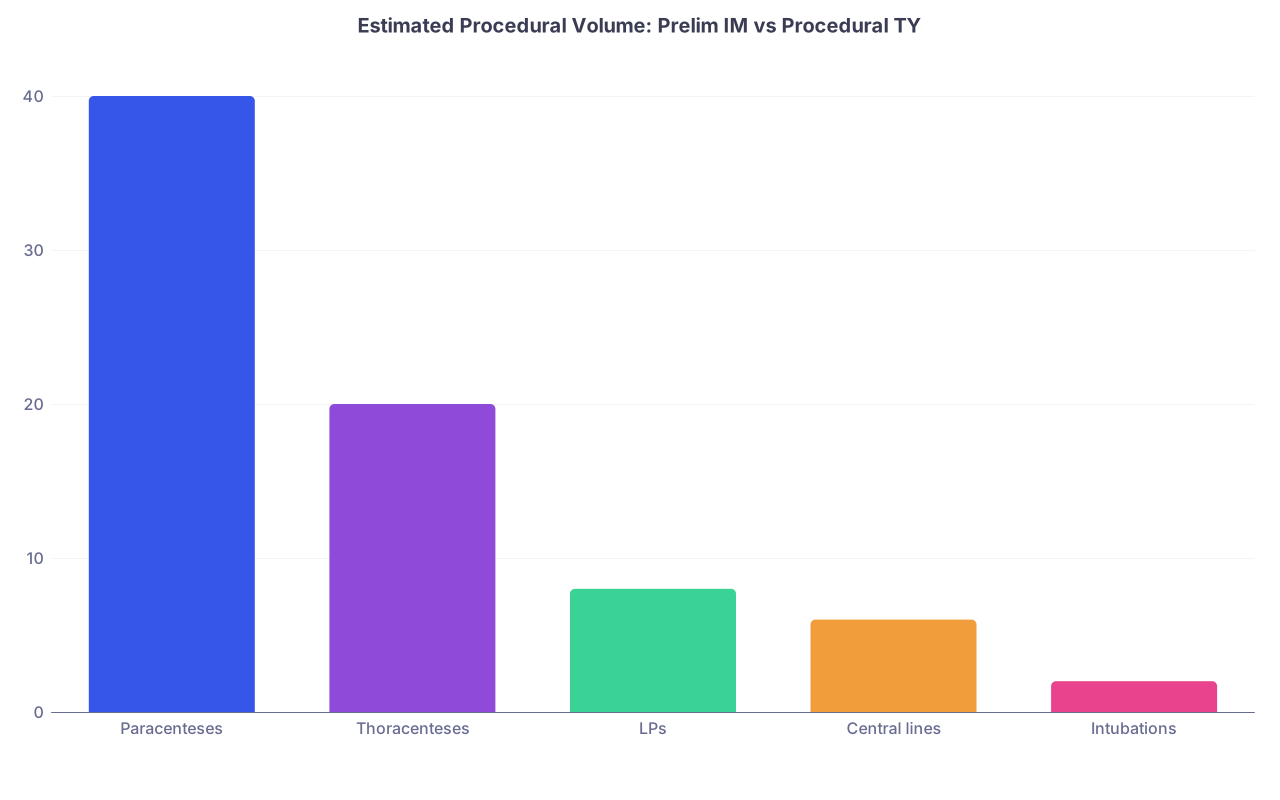
To make this concrete, think of typical volumes you might see in a reasonably procedural-friendly environment. These are ballpark numbers, not guarantees.
| Category | Value |
|---|---|
| Paracenteses | 40 |
| Thoracenteses | 20 |
| LPs | 8 |
| Central lines | 6 |
| Intubations | 2 |
For a prelim IM at a decent procedural site, intern year might give you roughly:
- 30–60 paracenteses
- 10–30 thoracenteses
- 3–10 LPs
- 2–10 central lines
- 0–3 intubations
Now compare to a procedurally rich TY with EM, ICU, anesthesia:
| Category | Value |
|---|---|
| Paracenteses | 40 |
| Thoracenteses | 20 |
| LPs | 8 |
| Central lines | 6 |
| Intubations | 2 |
A strong TY could realistically generate:
- 15–40 paracenteses (fewer floor months)
- 10–25 thoracenteses
- 3–8 LPs
- 10–30 central lines (ICU + EM + anesthesia)
- 15–50 intubations (EM + anesthesia)
You see the pattern. TY can sacrifice some floor procedure volume to gain airway and ICU/EM line experience. For a future operator, that trade is usually favorable.
8. One more subtle point: confidence vs competence
People obsess over absolute procedure counts. “I did 60 paracenteses” vs “I did only 15.” That is the wrong focus.
What you want from intern year is:
- Comfort with sterile technique and procedural consent
- The ability to set up a procedure from scratch without chaos
- Pattern recognition for complication risk — who you should not tap, who needs IR, when to back off
- A developed “needle sense”: spatial awareness, hand stability, ultrasound-brain connection
You do not become an expert operator in intern year. You just decide whether procedural work feels natural in your hands, or if you need extra reps and guidance as you move forward.
I have seen residents who did 20–30 well-supervised procedures with thoughtful attendings and ended intern year far more competent than those who did 70 rushed, unsupervised, “just stick until fluid comes out” paracenteses.
So when choosing between prelim IM and TY:
- Do not chase sheer numbers alone
- Chase a culture where procedures are taught, not just logged
- Ask how often attendings are physically present versus “supervising” from the computer
9. What this means practically for your rank list
So you are building a rank list and trying to weigh all this. Here is the blunt hierarchy for a future procedural specialist:
- Healthy, non-malignant culture (no amount of procedures makes up for a toxic program)
- Reasonable workload so you do not walk into PGY2 burned out or failing Step 3
- Structured, resident-owned procedural exposure in the settings most relevant to your future field
- Elective flexibility to align with your specialty (anesthesia, EM, IR, ophtho, derm, etc.)
- Program name/reputation (last, not first)
Transitional Years give you more variance — both the best and the worst setups. Prelim IM is more predictable: medicine-heavy, decent floor procedures, limited OR airway time. For many specialists, a strong, balanced TY is the sweet spot. For neurology and some PM&R paths, a solid prelim IM is perfectly appropriate and sometimes superior.

| Step | Description |
|---|---|
| Step 1 | Future Specialty |
| Step 2 | Prefer Procedural TY |
| Step 3 | Prelim IM or Medicine heavy TY |
| Step 4 | Flexible TY with electives |
| Step 5 | Procedural and OR heavy? |
| Step 6 | Needs strong medicine base? |
Key takeaways
- Prelim IM usually gives you solid floor-based procedures (paracenteses, thoracenteses, some LPs), but limited airway and OR experience; Transitional Years can range from soft holding patterns to very procedure-heavy setups with EM, ICU, and anesthesia exposure.
- For future high-procedure, OR-centric specialties (anesthesia, EM, IR), a procedurally rich TY almost always beats a standard prelim IM; for neurology and some PM&R paths, a strong prelim IM or medicine-heavy TY is often better.
- When ranking programs, ignore vague “we have lots of procedures” talk and drill into specifics: who owns lines, how many procedures interns actually perform, how much ICU/EM/anesthesia time you get, and whether the culture genuinely supports supervised, resident-driven procedural learning.