Most prelims waste their leverage and ask for rotations the wrong way. Then they blame the system when schedules do not budge. The truth: you can negotiate a lot more than you think—if you understand how your prelim year actually works and approach it like a professional, not a desperate applicant.
You are in a narrow window:
- You need letters and specific rotations to match into your advanced specialty.
- You are working 60–80 hours a week.
- The schedule looks “set in stone.”
It is not. But it also is not a free-for-all. Here is how to request and negotiate the rotations you need during a busy preliminary (PGY‑1) year without burning bridges or getting labeled “high maintenance.”
1. Understand What a Preliminary Year Really Is (And How It Limits You)
Before you start asking for anything, you need to understand the playing field.
A preliminary year is a stand‑alone PGY‑1 year, usually in:
- Internal medicine
- Surgery
- Transitional year
- Occasionally other specialties (anesthesia prelims, etc.)
You are:
- A fully employed resident of that department.
- Not guaranteed a categorical spot.
- There for one year, then gone.
From the program’s perspective:
- Your primary job: staff the service reliably.
- Your rotation schedule: designed around service needs first, your specialty ambitions second.
- You are short‑term labor that still needs to be trained and supervised.
That sounds harsh, but it is your starting point for negotiation. You only get traction if you show:
- You understand your role.
- You are not asking for special treatment that harms the team.
- You are organized and easy to work with.
If you look like an extra task or a scheduling headache, your requests die quickly.
2. Get Clear on What You Actually Need From Your Prelim Year
Most prelims flop here. They say, “I need electives” without being specific. Programs cannot accommodate vague wishes.
You need a target list, not a wish list.
Step 1: Clarify your advanced specialty’s expectations
For example:
Radiology / Anesthesiology / Neurology
Commonly valued:- Strong medicine wards
- ICU experience (MICU, SICU)
- At least one EM rotation
- A radiology/anesthesia/neuro elective for letters
Dermatology / Ophthalmology / Radiation Oncology
Commonly valued:- Outpatient exposure and continuity clinic experience
- Dermatology/ophtho/rad onc electives
- Letters from faculty in the target field and strong medicine faculty
PM&R
Commonly valued:- Inpatient rehab or consult PM&R rotations
- Neurology, ortho, ICU experience
- Strong letter from a PM&R physician
Look at 3–5 program websites for your target specialty and see what they like to see from the PGY‑1 year. Ask seniors in that field what actually mattered for their interviews.
Step 2: Translate that into specific rotation requests
You should come up with a specific list like:
- 1 rotation in [target specialty] for a letter.
- 1–2 ICU rotations before ERAS opens (Aug–Sept).
- 1 EM rotation before ERAS opens.
- As many medicine wards as required by your prelim program, scheduled in a way that still lets you work on applications.
If you are aiming for a competitive field (derm, ortho, ophtho, rad onc), letters from your field during PGY‑1 can be critical. That means you cannot “just see what happens” with your schedule.
3. Map Your Timeline Before You Ask For Anything
You have two overlapping timelines:
- Residency application / Match timeline
- Prelim year rotation calendar
You need them to mesh.
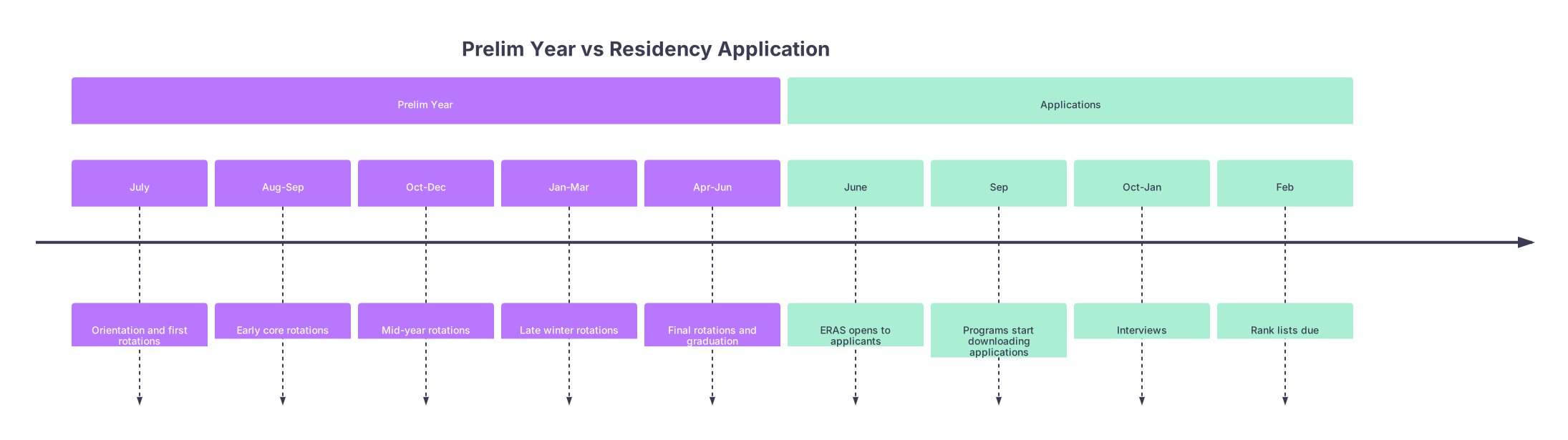
| Period | Event |
|---|---|
| Prelim Year - July | Orientation and first rotations |
| Prelim Year - Aug-Sep | Early core rotations |
| Prelim Year - Oct-Dec | Mid-year rotations |
| Prelim Year - Jan-Mar | Late winter rotations |
| Prelim Year - Apr-Jun | Final rotations and graduation |
| Applications - June | ERAS opens to applicants |
| Applications - Sep | Programs start downloading applications |
| Applications - Oct-Jan | Interviews |
| Applications - Feb | Rank lists due |
What that means for rotation planning
You want:
- Key letter‑generating rotations before September.
- Less brutal rotations (if possible) during heavy interview months (Nov–Jan).
- Critical required rotations (like ICU or night float) placed where they do not completely sabotage your ability to answer interview emails or hop on Zoom.
So, your planning question becomes:
“Which 2–4 rotations absolutely matter before September, and which months would be best for them?”
Write that down. Literally. Example:
- July: Wards (fine, I will learn the system).
- August: ICU (strong letter potential).
- September: Target specialty elective (letter).
- October: Wards.
- November–December: Clinic or consults (easier for interviews).
- January–February: Night float / ICU.
- March–June: Whatever is left.
Now you have a proposal, not a plea.
4. How Scheduling Actually Works (And Who Really Has Power)
Too many residents ask the wrong person or at the wrong time. Then get told “No changes allowed” when that is not fully true.
Typical players:
- Program Director (PD)
Sets big rules, approves exceptions that matter (out‑of‑network electives, major swaps, off‑cycle time). - Associate PDs / Assistant PDs
Often manage day‑to‑day resident issues and can advocate for you. - Chief residents / chief schedulers
Actually build the schedule, track coverage, and know where the “give” is. - GME office
Approves outside rotations, away rotations, contract issues.
Reality:
- Chiefs control the nuts and bolts.
- PD approves policy‑level exceptions.
- You need both on your side, but you usually start with the chiefs, unless your program specifically tells you otherwise.
And here is the key timing rule:
The earlier you ask, the more flexible the schedule.
If you wait until:
- July 15 to ask for September ICU.
- Or September 1 to ask for October derm elective.
Your chances drop sharply.
5. The Right Way to Request Specific Rotations
You are asking a busy program to rework a thousand-piece puzzle for your benefit. So you do the work for them.
Step 1: Do your homework
Before you send a single email:
Review your program’s prelim curriculum document.
Know:- Required rotations and minimums (e.g., 5 ward months, 1 ICU, 1 EM).
- Available electives and how many are allowed.
- Any stated rules about scheduling or away rotations.
Talk quietly to a current PGY‑2 or former prelim from your program. Ask:
- “Which electives were easiest to get?”
- “Who actually adjusts the schedule?”
- “When do they usually lock things in?”
Do this first. It prevents rookie questions that make you look unprepared.
Step 2: Draft a clear, concise email to the right person
Usually: chief residents and PD cc’d, or whatever your program expects.
Template you can adapt:
Subject: Preliminary schedule – request for [Specialty] elective before ERAS
Dear Dr. [PD] and Dr. [Chief],
I am very grateful for the opportunity to train here this year. I wanted to ask about the possibility of scheduling a [your target specialty – e.g., anesthesiology] elective and ICU rotation before September if feasible.
I am applying to [Specialty] this cycle, and based on guidance from mentors in the field, an early ICU month and a [Specialty] elective would be very helpful for letters and preparation. I have reviewed our curriculum requirements and tried to outline a version of my schedule that maintains all required rotations while shifting the timing:
- ICU in [Month A or B]
- [Specialty] elective in [Month B or C]
- Wards/other required rotations moved to later months as needed
I completely understand service needs come first, and I am happy to be flexible or take less popular rotations at other times of the year to make this work. If possible, I would appreciate a brief meeting to discuss options and make sure I am meeting all program requirements.
Thank you for considering this, and for your support of prelim residents applying to advanced positions.
Best regards,
[Your Name, PGY‑1 Preliminary Internal Medicine]
Notice:
- You show you did your homework.
- You keep it tied to program requirements.
- You offer to compensate by taking tough months later.
- You do not demand; you propose.
Step 3: Follow up the right way
If no response in 5–7 business days:
- Send a polite one‑liner:
“Just wanted to follow up on my earlier email about potential schedule adjustments for ICU and [specialty] elective. I am happy to meet briefly at your convenience or talk with the chiefs about what is realistic.”
Do not send a wall of text. Busy PDs will ignore it.
6. Negotiating When the First Answer Is “No”
You will hear some version of:
- “Schedule is already set.”
- “We do not do away rotations.”
- “Electives are limited this year due to coverage.”
Do not fold at the first no. But do not fight it directly either.
Your job is to shrink the ask and offer trades.
Strategy 1: Narrow the request
Instead of:
“I need 2 electives before September.”
Say:
“If we cannot do two, is there any chance of at least one [specialty] elective before September for a letter, even if the second elective is later in the year?”
Or:
“If ICU cannot move, could I at least have EM or a consult rotation during August/September so I can attend interviews and still be useful?”
You are trying to get something that advances your application, even if you do not get the full ideal plan.
Strategy 2: Offer to take less desirable blocks
Programs always struggle with:
- Holiday coverage (Dec/Jan wards, ICU).
- Summer coverage with new interns.
- Nights.
Offer it, calmly:
“I am happy to take a heavier block later in the year—nights, a holiday month, or an extra ward month—if it allows an ICU or [specialty] elective in August or September.”
That language signals:
- You understand the pain points.
- You are not just trying to cherry-pick easy rotations.
Programs reward that attitude.
Strategy 3: Use the PD meet as a reset
If chiefs say no or seem stuck, request a brief PD meeting.
You say:
“I wanted to make sure I am planning this year correctly for my application to [specialty]. I fully understand service needs and requirements, and I am committed to those. I just want to confirm whether there is any flexibility to have one [specialty] elective and one ICU rotation before September, even if that means I take holiday or night coverage later.”
Most PDs respect this level of maturity. They might not give you exactly what you want, but you often get some movement.
7. How to Handle Away Rotations or Rotations in Your Target Department
This is where prelims mess up the most. They ask for:
- Away rotations at outside hospitals.
- Time in departments that are not officially part of their prelim program.
Both are possible. Both require a different process.
A. Away rotations at other institutions
Many prelim programs either:
- Do not allow this.
- Or only allow late in the year after you have met core requirements.
If you want an away rotation:
Check the handbook / GME policy first.
Some explicitly ban away rotations for prelims. If so, you are likely done.If allowed, you need:
- PD approval.
- GME approval.
- An affiliation or contract between the hospitals (takes time).
- Malpractice and liability coverage confirmed.
Do not email, “Can I do an away derm rotation at [Famous Hospital] this fall?” with no details.
Instead:
“I am interested in a single 4‑week [specialty] away elective at [Institution], which accepts visiting residents and is willing to sign an institutional agreement. I will ensure all malpractice, onboarding, and compliance requirements are completed. Are away rotations allowed for prelims here, and if so, what is the process and timeline to request PD and GME approval?”
If your program hates away rotations, pivot to internal rotations (within your own institution) with your target specialty. Those are much easier to get approved.
B. Rotations within your target department at your institution
Example: You are a prelim medicine resident at Hospital X, and Hospital X has a radiology department that sponsors advanced positions.
This is your best bet.
What you do:
Identify the radiology/derm/ophtho PD or assistant PD at your institution.
Ask for a brief meeting or email them:
- “I am a prelim medicine intern applying to radiology this cycle. Is there a resident elective or shadowing opportunity within the radiology department for PGY‑1s?”
Once they show interest, go back to your prelim chiefs:
- “Radiology has an available 4‑week elective for PGY‑1s. Is there any chance we can plug that into August or September or another open elective slot?”
You want the target department on your side, offering a slot. That makes it easier for your prelim program to say yes.
8. Protecting Your Application While Doing Heavy Rotations
Sometimes you lose the negotiation. You get:
- ICU in August.
- Wards in September.
- Nights in October.
And you still have to submit ERAS and attend interviews. This is survivable, but you have to run a tight system.
Practical rules that work
Frontload application work
- Personal statement, CV, ERAS activities: Done in MS4 spring or early summer, not during your first ICU month.
- Letters: Line up attendings from MS4 or early PGY‑1 as soon as you see they like your work.
Use call days strategically
- On lighter post‑call afternoons or pre‑call mornings, batch:
- Program research.
- Email responses.
- Interview scheduling.
- Do not “just rest” every time. You are in a one‑year sprint.
- On lighter post‑call afternoons or pre‑call mornings, batch:
Schedule-heavy vs light months smartly when you can
- If chiefs ask for preferences, do not say, “Anything is fine.”
- Say, “If possible, I would prefer to avoid ICU in November–January to allow some flexibility for interviews, but I am happy to take those blocks earlier or later.”
Be brutally realistic about travel
- If you are on nights or ICU, same‑day travel to in‑person interviews will break you.
- Push for zoom when on those rotations or ask chiefs early if one specific day off is possible for a critical in‑person interview.
9. What To Say (And Not Say) To Attendings About Your Plans
Your attendings and fellows can either:
- Become your biggest advocates.
- Or mention in passing to chiefs, “He seems disengaged; he only cares about derm.”
This depends heavily on how you talk about your advanced specialty.
Do this:
On day 1 or 2 of a rotation, say to your attending privately:
“Just so you know, I am doing a preliminary year here and applying to [specialty]. I still really care about doing a strong job on this rotation and learning medicine well, since it will make me a better [specialty]. I would appreciate any feedback you have for me along the way.”
Then actually be excellent on the rotation:
- Show up early.
- Own your patients.
- Learn the bread‑and‑butter.
Strong performance plus clear context = great letters and behind‑the‑scenes advocacy.
Do not do this:
- Complain about your schedule to attendings.
- Say, “This does not matter for me, I am going into…”
- Constantly talk about your Step score and “competitiveness.”
You want them to think:
“This prelim is serious, reliable, and clearly on an upward trajectory. I want to help them.”
10. Red Flags That You Are Mishandling Negotiations
If you see yourself in any of these, correct course now:
You send long emotional emails about “fairness” or “my dream specialty.”
Programs respond to logistics, not emotion.You try to bypass chiefs and go straight to the department chair because “they have more power.”
This gets back to the PD. Not in a good way.You suggest that your goals are more important than coverage:
“I cannot do nights; I have interviews.”
Say instead:
“If nights are essential, that is completely fine. If there is any flexibility to avoid nights during the peak interview weeks, I would be very grateful, and I am happy to take harder blocks at other times.”You bad‑mouth your prelim program to your target specialty faculty.
They all talk. You lose.
11. Sample Rotation Priority Map and Negotiation Plan
To make this concrete, here is a simple priority map you can adapt.
| Priority Level | Rotation Type | Ideal Timing |
|---|---|---|
| 1 (Critical) | Target specialty Elective | Jul–Sep |
| 1 (Critical) | ICU | Jul–Sep |
| 2 (High) | Emergency Medicine | Jul–Oct |
| 2 (High) | Lighter block for interviews | Nov–Jan |
| 3 (Flexible) | Extra Wards | Any time |
| 3 (Flexible) | Nights / Holidays | Oct–Mar |
And a sample negotiation sequence:
- May–June (before or early in prelim year)
- Meet with PD/chiefs. Present priority plan.
- July–August
- Confirm letters from ICU / specialty elective.
- September
- Finalize ERAS, get letters uploaded.
- October–January
- Take lighter block if granted. If not, use strategies above to protect application time.
12. When You Truly Cannot Get the Rotations You Wanted
Sometimes, despite your best efforts:
- The ICU is full.
- The elective vanished.
- The program genuinely has no flexibility.
You still have options.
Make the rotations you have work for you
On any strong inpatient month:
Identify 1–2 attendings who like your work.
Ask them for letters framed around your target specialty:
“Would you feel comfortable writing a strong letter for my [specialty] application focused on my work ethic, clinical reasoning, and communication skills?”
On a non‑specialty elective:
- Ask to see consults or cases related to your field.
- For example, on GI consults for a future radiologist:
“Can we briefly review the CTs together when we staff cases? I want to understand what radiology is thinking.”
Strong performance and smart framing can compensate for a non‑ideal schedule.
Use off-service time for shadowing
If you cannot get a full 4‑week specialty elective:
- Ask for structured half‑day shadowing blocks:
- “Is it possible to spend one afternoon per week for 4 weeks in [specialty] when I am on a lighter clinic block?”
Some departments are happy to do this. It gives you exposure and a letter opportunity with less scheduling upheaval.

| Step | Description |
|---|---|
| Step 1 | Identify lighter rotation |
| Step 2 | Email target specialty PD |
| Step 3 | Arrange half day per week |
| Step 4 | Inform prelim chiefs |
| Step 5 | Confirm coverage is adequate |
| Step 6 | Start structured shadowing |
13. Quick Reality Check: What Actually Matters Most
To keep you from spiraling into schedule obsession, here is the hierarchy:
, Exact Rotations](https://cdn.residencyadvisor.com/images/articles_svg/chart-relative-impact-on-advanced-match-success-4002.svg "Relative Impact on Advanced Match Success")
| Category | Value |
|---|---|
| Letters | 95 |
| Clinical Reputation | 90 |
| USMLE Scores | 85 |
| [Research](https://residencyadvisor.com/resources/preliminary-year-vs-categorical/concrete-steps-to-maximize-research-time-during-a-demanding-prelim-year) | 70 |
| Exact Rotations | 60 |
Interpretation:
- Strong letters from faculty who know you well beat a “perfect” set of rotations without good advocates.
- Your day‑to‑day performance on any rotation matters more than the label of the elective.
- Scores and research are mostly fixed by the time you hit prelim year.
- Rotation timing is a force multiplier, not the foundation.
So yes, negotiate hard for the right blocks. But then drop the anxiety and be excellent where you are placed.
14. Putting It All Together: A Simple 7‑Step Playbook

| Step | Description |
|---|---|
| Step 1 | Clarify target specialty needs |
| Step 2 | Map application timeline |
| Step 3 | Review prelim program requirements |
| Step 4 | Draft ideal rotation plan |
| Step 5 | Meet with chiefs and PD |
| Step 6 | Negotiate and offer trades |
| Step 7 | Lock in letters and performance |
| Step 8 | Adapt if schedule changes |
Use this as your backbone:
- Clarify what your advanced specialty actually expects from PGY‑1.
- Map those needs to specific rotations and months.
- Study your prelim program’s rules and talk to current residents.
- Propose a concrete, coverage‑respecting schedule early.
- Negotiate calmly when you hear no; scale down the ask, offer trades.
- Perform at a high level on whatever rotations you get; secure strong letters.
- Adjust without drama when constraints are real; protect your application through planning.

Final Takeaways
- You are not powerless in a prelim year. You just need to approach rotations like a negotiation with real constraints, not a wishlist.
- The combination that works: early, specific, and coverage‑aware requests plus excellent performance wherever you land.
- If you walk out with 1–2 strong letters, a credible ICU or core experience, and a reputation as a reliable intern, you have used your prelim year correctly—even if the schedule was not perfect.