
Most residents find out the hard way: converting a preliminary spot to a categorical position is less about “being a hard worker” and more about quiet, unspoken politics.
You’ve probably heard some version of the fairy tale: “Just crush intern year and they’ll offer you a categorical spot.” That’s not how it actually works in most places. Let me show you what really happens behind the conference room door when faculty and PDs discuss prelims.
First: What a Preliminary Year Really Is (Behind the Brochure Language)
On paper, a preliminary year is simple: a one-year, non-advancing residency position, usually in internal medicine, surgery, or transitional year, often used as the first year for advanced specialties (radiology, anesthesia, derm, ophtho, PM&R, neuro, etc.).
That’s the brochure version.
The insider version: prelim spots are pressure valves. Programs use them to:
- Fill service needs without committing to you for 3+ years.
- Buffer against funding and volume changes.
- Keep a pool of “maybe” candidates they can convert if a categorical resident leaves, fails, or implodes.
Most program websites will never say this. But I’ve sat in those meetings where PDs say, very plainly:
“Let’s rank a few strong prelims high. If one of our categoricals doesn’t work out, we’ll have options.”
You, as a prelim, are an “option.” Not a promise.
And that framing explains 90% of the politics of converting to categorical.
Who Actually Gets Converted (And Why)
Let me be blunt: converting a prelim to categorical is not a standardized process. There’s no universal rule. Every program has its own unwritten rules, most of which live inside the PD’s head and among a few key faculty.
But there are consistent patterns.
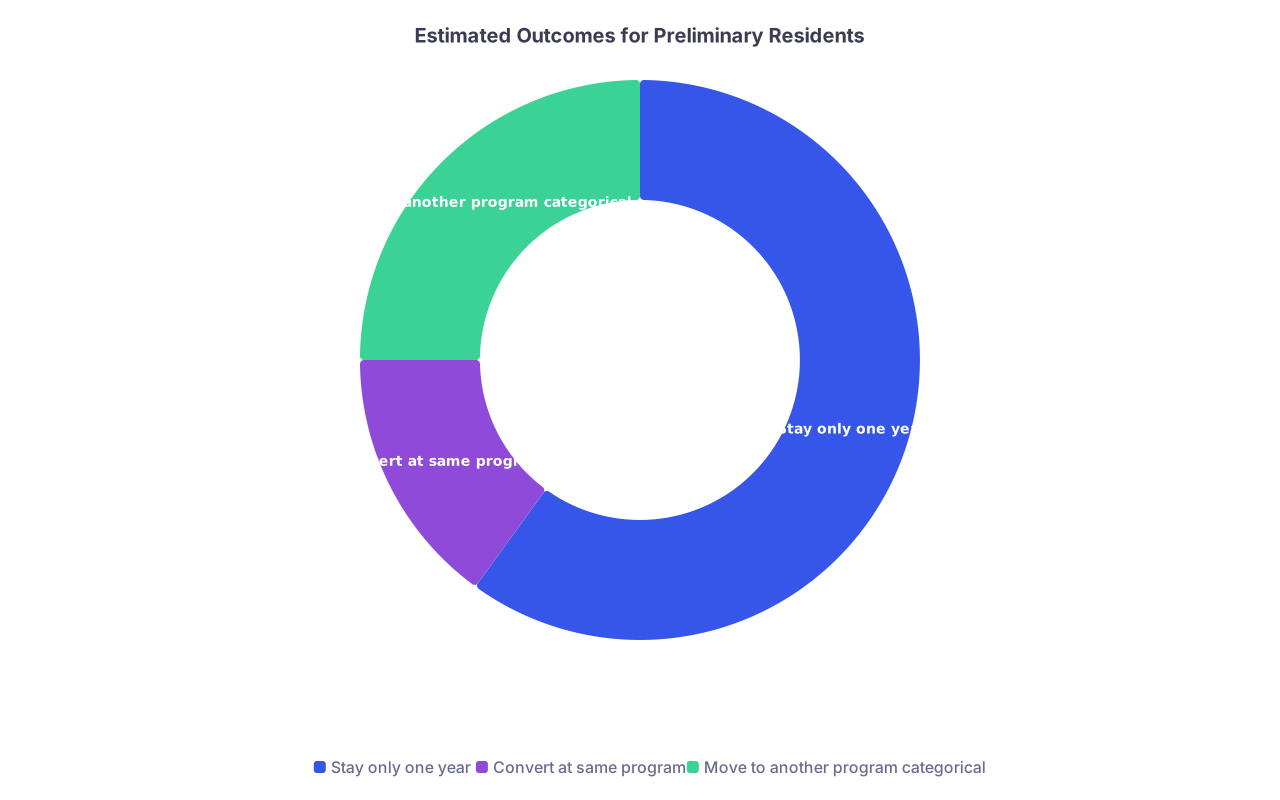
| Category | Value |
|---|---|
| Stay only one year | 60 |
| Convert at same program | 15 |
| Move to another program categorical | 25 |
Those numbers aren’t official NRMP data. They’re what you hear when you talk to enough chiefs, PDs, and coordinators over years and watch what actually happens.
The residents who successfully convert usually fall into one of these buckets:
The pre-identified “backup” for the program
Someone the PD already likes and quietly considers a top candidate to fill any sudden opening. Often known before July 1. They may have been just below the categorical cutoff on the rank list.The high-need, high-performing workhorse
You’re covering extra shifts, never complaining, saving their service from collapsing. The attendings lobby for you. The chiefs say you’re essential. When a categorical spot opens, you’re the safest and easiest choice.The strategically aligned candidate
You match a specific program need: fluent in a language the patient population needs, strong research in the PD’s interest area, diversity goals, local ties, or you intend to stay in that city long-term. You’re not just good—you’re useful.
Notice what’s missing: “nicest,” “smartest,” “gets the best test scores.” Those help. But they’re not what flips the switch.
What flips it is risk and convenience: picking you solves a problem for the program with minimal drama. That’s the real currency.
How Programs Quietly Decide Which Prelims Are “Convertible”
Let me walk you through a typical behind-the-scenes process.
Sometime between October and February, a few things start happening:
- A categorical resident might be struggling, on remediation, or hinting about switching specialties.
- A spouse gets a job across the country; a resident talks about leaving.
- A PGY-1 or PGY-2 fails Step 3 more than once.
- Funding shifts; the GME office hints that positions might be re-allocated.
The PD starts thinking: “If someone leaves, who can I plug in?”
You might think they’d send out a formal announcement. They rarely do. Instead, it looks like this:
- Private emails from attendings:
“Prelim X is excellent, would be an asset if a spot opens.” - Hallway conversations with chiefs:
“If we needed to convert someone, who would you be comfortable with?” - PD scribbling names on a piece of paper: 2–3 “convertible” prelims they’d consider.
That’s the short list.
You get on that list months before any official opportunity appears, often before you even know something might open.
So what actually gets you onto that list?

The Real Evaluation Criteria
When faculty talk about prelims, the language is very different from MSPE letters.
You’ll hear:
- “Is this someone I’d trust with my sickest patient at 3 am?”
- “Do they make my life easier or harder on rounds?”
- “If I give them feedback, do they get defensive or do they fix it next time?”
- “Would chiefs be okay having them around for 3 years?”
Notice what’s baked into that: reliability, teachability, interpersonal ease. Being “brilliant” but annoying is death for conversion.
If you want the unvarnished framework they’re using, it’s something like this:
| Domain | What They Actually Look For |
|---|---|
| Clinical Safety | No scary errors, logs completed, follow-through solid |
| Work Ethic | Shows up, covers, finishes notes, no chronic excuses |
| Team Fit | Not toxic, not dramatic, gets along with nurses & peers |
| Trajectory | Clear improvement over first 6 months |
| Risk Profile | No professionalism flags, no big personal instability |
You do not need to be the “star.” You do need to be boringly dependable and low-drama. Programs are tired. They will almost always choose safe and steady over flashy and complicated.
The Ugly Truth: Funding, Headcount, and GME Politics
Let me tell you the part no one mentions to students: sometimes you will never be converted, no matter how amazing you are, because the money isn’t there.
Conversion is not just a PD decision. There are three layers:
- Program level – Does the PD want you? Do the faculty/chiefs support this?
- Department level – Does the chair approve an extra categorical? Does the clinical revenue support another upper-level resident covering services?
- GME/Institution level – Is there funded cap space? Does Medicare/GME funding allow another advanced year? Are there politics with other departments?
A PD might be 100% on your side and still be blocked by:
- GME saying: “We’re at cap; any new PGY-2 slot must be offset by losing someone else.”
- Department leaders wanting to divert funding to another specialty.
- A new fellowship or new service line that “needs” the FTE more.
I’ve seen PDs tell a prelim: “If it were up to me, you’d be categorical yesterday.” And they meant it. Didn’t matter. They were capped out.
This is why you never, ever anchor your entire future on a “soft” promise of conversion.
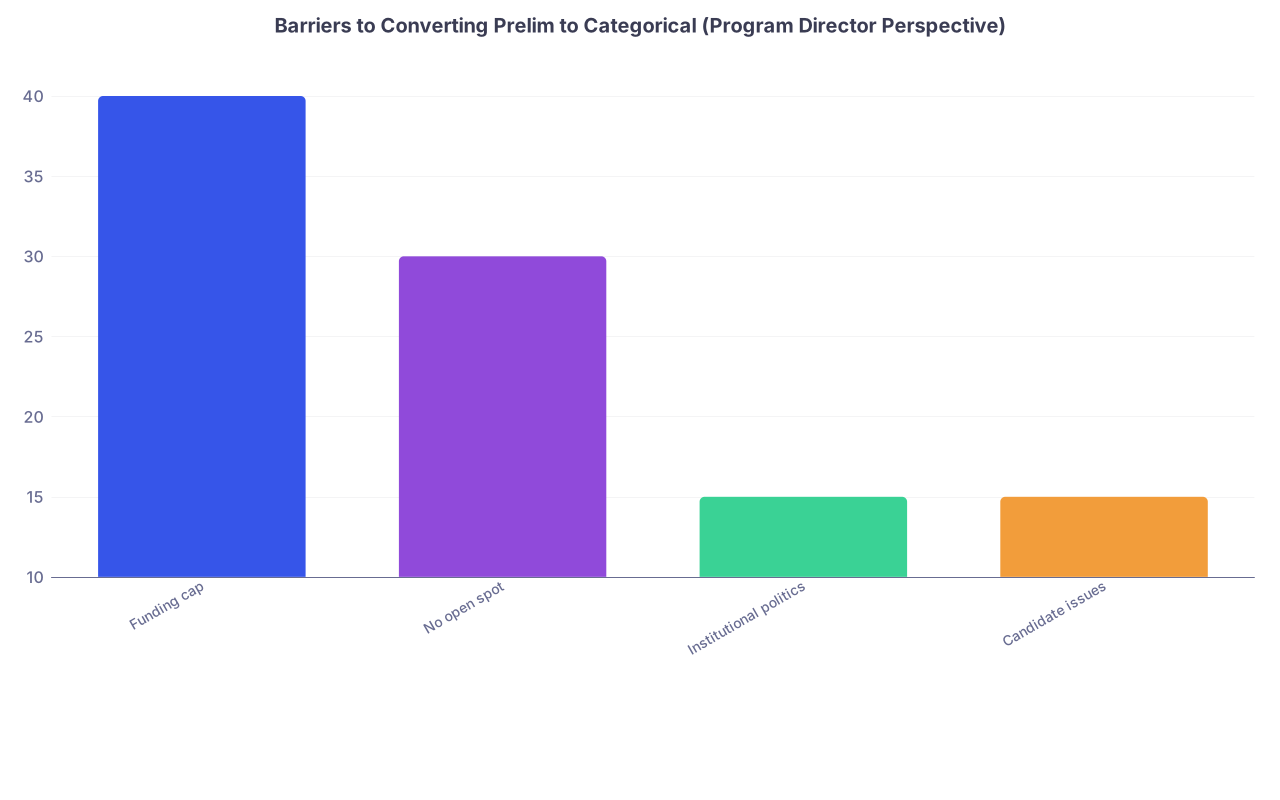
| Category | Value |
|---|---|
| Funding cap | 40 |
| No open spot | 30 |
| Institutional politics | 15 |
| Candidate issues | 15 |
Half of the time, the main barrier isn’t you. It’s the spreadsheet upstairs.
How and When to Signal You Want Conversion (Without Shooting Yourself)
Here’s where people screw this up.
Some prelims stay “polite,” assume if they work hard, someone will magically tap them on the shoulder with good news. Others open July by announcing: “I’m really hoping to convert to categorical here.” Both extremes are mistakes.
You have to play this more strategically.
Timeline: What Actually Works
Here’s the rough cadence I’ve seen work:
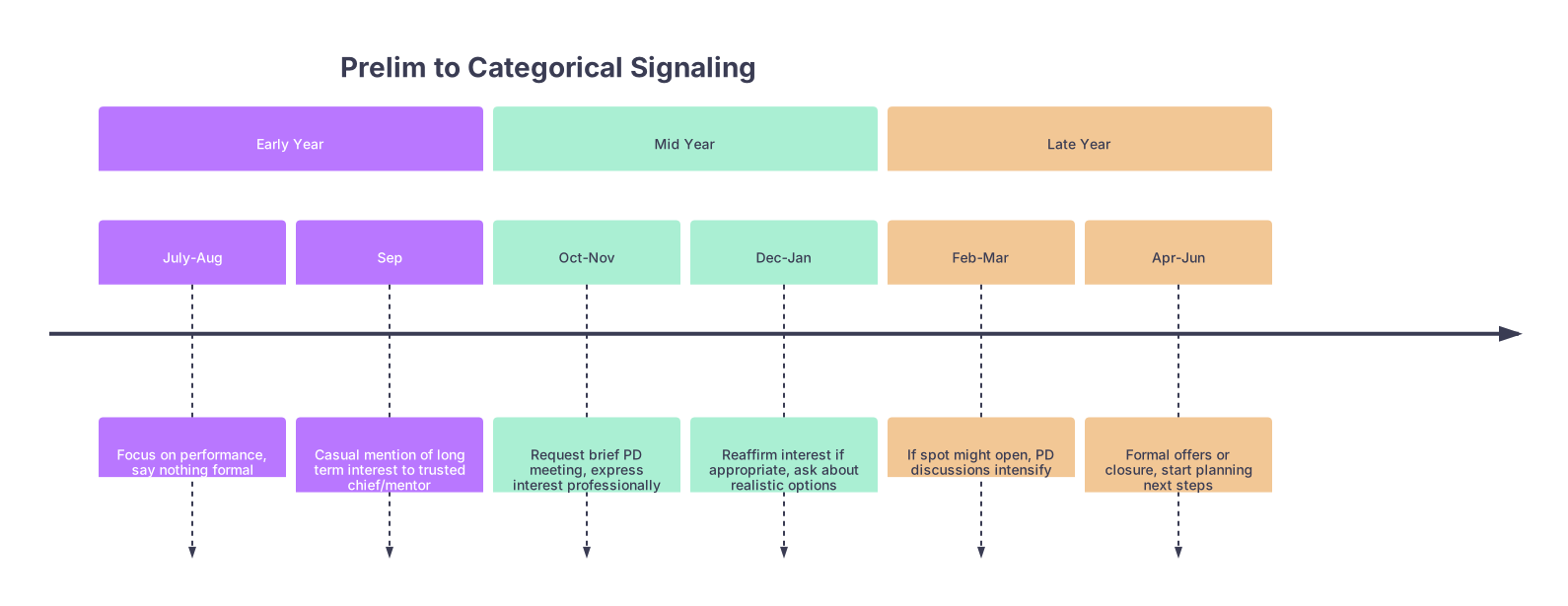
| Period | Event |
|---|---|
| Early Year - July-Aug | Focus on performance, say nothing formal |
| Early Year - Sep | Casual mention of long term interest to trusted chief/mentor |
| Mid Year - Oct-Nov | Request brief PD meeting, express interest professionally |
| Mid Year - Dec-Jan | Reaffirm interest if appropriate, ask about realistic options |
| Late Year - Feb-Mar | If spot might open, PD discussions intensify |
| Late Year - Apr-Jun | Formal offers or closure, start planning next steps |
Early on (July–August), your only job is to be unquestionably competent. No one wants to hear your conversion ambitions while you’re still figuring out how to place orders correctly.
Around September, you can start quietly telling a trusted chief or one or two faculty who like you:
“I came in as a prelim planning to go on to [X], but I could really see myself staying in [IM/Surgery/etc.] here long-term if there were ever an opportunity.”
That phrasing matters. You’re not demanding anything. You’re planting a seed.
By October or November, you should ask for a brief meeting with the PD. Fifteen minutes, max. You say something like:
“I want to be transparent about my goals. I’m currently a prelim, originally matched with the idea of going into [X]. After working here, I’ve realized I’d be very interested in staying on categorically in [specialty] at this program if a position ever opens and if you felt I’d be a good fit. I’d really appreciate any feedback on what I should be focusing on to be a strong candidate for that, here or elsewhere.”
Key moves there:
- You clearly state your interest.
- You give them an out (“if a position ever opens”).
- You show you’re realistic (“here or elsewhere”).
- You invite feedback (which tells them you’re coachable).
That conversation is when the PD mentally categorizes you as either:
- “Definitely keep in mind if a spot opens.”
- “Fine, but probably not top priority.”
- “No way; keep it polite but distant.”
You will not always get a clear answer. But watch their body language. If they immediately talk specifics—“We might have something if X happens” or “Here’s what I need to see from you”—that’s a good sign.
The Competition You Don’t See: Transfers, Off-Cycle Candidates, and Nepotism
Here’s the part almost no prelim realizes: you are not just competing with other prelims. You’re competing with:
- Residents at other programs trying to transfer in.
- Prior grads who want to re-enter.
- Off-cycle residents whose spouse just matched at your hospital.
- Children or relatives of faculty, alumni, or donors. Yes, it happens.
When a spot opens—say a PGY-2 leaves—the PD gets emails. A lot of emails. From their network, from GME, from other PDs asking for a favor:
“I’ve got this excellent PGY-1 looking to relocate to your area, any chance you have room?”
Or:
“This is Dr. X’s mentee; can we find a home for them?”
You’re already in-house, which is a massive advantage. They know you. They’ve seen you at 3 am. You’re a known quantity.
But do not fool yourself: if the PD’s old colleague at another institution calls about an outstanding transfer candidate, that person is absolutely in the running against you.
This is why being strongly supported by your faculty and chiefs is non-negotiable. If three attendings independently email the PD:
“If you’re considering someone for categorical, [your name] is excellent—safe, dependable, and great with patients.”
You move to the top of the stack. Because you come with real, current, local data. You’re less risky than an unknown transfer.
Reading the Signals: Are You Actually in Contention or Being Strung Along?
You deserve to know if you’re chasing something real or a mirage. Here are some patterns I’ve seen over and over.
Signs You’re a Real Candidate
- PD brings up specific timing: “If X resident ends up leaving, we’ll know by February, and I’ll need to make a decision quickly.”
- You hear from multiple attendings: “I told the PD we should keep you if we can.”
- Chiefs pull you aside and ask seriously about your long-term plans.
- PD or APD starts giving you targeted opportunities: QI project, committee work, clinic continuity, not just scut.
Signs You’re Being Politely Managed
- PD says things like: “We’ll see what happens; you’re doing great, just keep working hard,” month after month, with no new information.
- No one gives you any timeline whatsoever, even vague.
- You’re not being proactively offered chances that would make you look more like a categorical (e.g., continuity assignments, leadership roles).
- Program has a history of never converting prelims, yet people keep telling you “it’s possible.”
If your gut says you’re being placated, trust it enough to protect yourself. Continue performing, but aggressively pursue external categorical spots as if conversion will not happen.

Strategy if You’re a Prelim Right Now
Let’s translate all this politics into a concrete survival plan.
1. Decide your true priority early
Are you:
- Using the prelim as a bridge year before an advanced spot you already have?
- Hoping to switch into that same specialty categorically?
- Realizing you’re in the wrong specialty and want out entirely?
You have to be honest with yourself. PDs can smell indecision. “Maybe I want to stay, maybe I want something else” doesn’t inspire investment.
2. Build a coalition, not just one champion
One glowing attending isn’t enough. PDs look for pattern recognition. If three different attendings and a chief say similar things about you, that’s powerful.
You want:
- 2–3 attendings who will speak up for you unprompted.
- Chiefs who like working with you and would happily keep you another two years.
- A PD who at least doesn’t see you as a risk.
You build that by doing boring, simple things exceptionally well: knowing your patients cold, answering pages promptly, staying a bit later when things are chaotic—and doing it without public resentment.
3. Protect your external options ruthlessly
Even if you’re getting positive signals, you keep applying out. ERAS, SOAP (if applicable to your situation), emails to PDs about open PGY-2 spots—whatever’s appropriate for your year.
I’ve seen too many prelims bet everything on a “likely” conversion, only to get a last-minute:
“I’m so sorry, the funding didn’t come through.”
Now they’re scrambling in March with no Plan B. Do not be that resident.
4. Learn the program’s real history with prelims
This is a huge one, and almost no one asks.
You quietly ask chiefs or senior residents:
- “In the past 5 years, how many prelims have converted to categorical here?”
- “When that happened, what was the situation?”
- “Does the PD generally like to keep prelims or prefer outside transfers?”
If the answer is “none” or “only once when someone’s family member was involved,” believe that pattern. You are not going to be the magical exception because you’re nice.
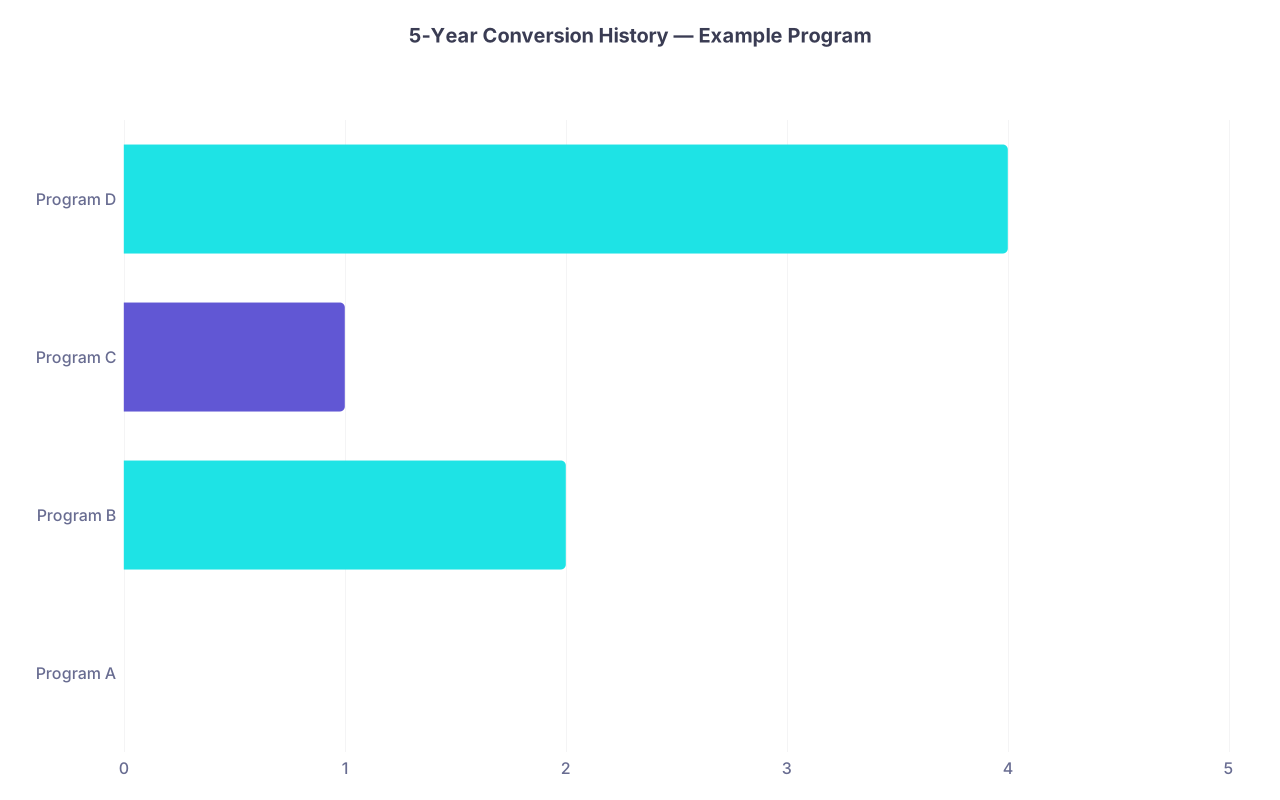
| Category | Value |
|---|---|
| Program A | 0 |
| Program B | 2 |
| Program C | 1 |
| Program D | 4 |
Those numbers, again, are representative, not official. But every program has its own version of that chart.
A Word About “Fairness”
You’re going to see some deeply unfair outcomes.
- A mediocre prelim with the right connections gets converted.
- An excellent prelim who is quiet, foreign medical graduate, or just not socially plugged in is passed over.
- A spot goes to an off-cycle transfer you’ve never met.
You can waste energy on how it should be. Or you can accept how it is and play the game with open eyes.
The reality: PDs are balancing service coverage, politics, funding, reputation, and personal relationships—all while trying to sleep occasionally. They will not always choose “the best” person on paper. They will choose the person who solves the most problems with the least risk.
If that can be you, great. But you don’t get there by being passive and trusting the system to reward “hard work.” You get there by quietly understanding the incentives and moving accordingly.

FAQs
1. Should I tell my PD on day one that I want to convert to categorical?
No. For the first few months, your only job is to be safe and competent. Mentioning conversion in July can come off as entitled or naïve. Start by proving you’re good; then around September–October, have a thoughtful conversation about your interest.
2. If my program has never converted a prelim before, is it still worth trying?
You can still perform well and express interest, but you should behave as if conversion will not happen. Apply broadly to categorical positions elsewhere. History matters; programs are creatures of habit. If they’ve never done it, the default assumption is that they won’t start with you.
3. How do I ask faculty to advocate for me without sounding pushy?
Something like: “I’ve really enjoyed working with you this month. I’m a prelim but would love to stay here categorically if there’s ever an opportunity. If you feel comfortable and truly believe I’d be a good fit, I’d be grateful if you kept me in mind or shared that with the PD.” You’re giving them permission, not pressuring them.
4. Is it better to convert at my current program or try to move to a ‘better’ name-brand program?
For most people, a bird in the hand is worth more than prestige fantasies. Converting where people know and trust you is usually safer than gambling on an upgrade that might not manifest. The only time I strongly push people to move is when their current program is toxic or they’re clearly mismatched with the specialty culture there.
5. If I don’t convert, will doing a prelim year hurt my chances at matching categorical later?
Not inherently. But PDs will ask: “Why didn’t you stay where you were?” Your story has to be clean and coherent—either there were no spots to convert, your original plan was advanced training, or you had a genuine change in interest. Strong letters from your prelim year and clear upward trajectory matter more than the mere fact you were prelim.
Key points to walk away with:
- Conversion from prelim to categorical is driven by politics, funding, and risk tolerance—not just “hard work.”
- You need a coalition of in-house advocates and a clear, early signal to your PD, while simultaneously protecting yourself with external options.
- Never confuse “possible” with “likely.” Treat conversion as a bonus, not a plan, unless your PD gives you concrete, specific assurances backed by the program’s history.