
The way most people apply to both prelim and categorical tracks is a mess.
Not disorganized. Dangerous. I’ve watched strong applicants sink their Match because they treated prelim vs categorical like an afterthought checkbox instead of a strategic decision. You do not want to be that story people whisper about on Match Day.
If you’re applying to advanced specialties (derm, radiology, anesthesia, rad onc, neuro, etc.) and also tossing in prelim and categorical applications “just in case,” you are walking through a minefield. Let me show you where the mines are.
Quick clarity: what a preliminary year actually is (and isn’t)
Let’s kill the biggest misconception up front.
A preliminary year is:
- A one-year position (usually PGY-1) in a core specialty (most commonly Internal Medicine, Surgery, or Transitional Year)
- Intended either:
- As the required clinical base year for an advanced specialty, or
- As a stand‑alone year if you’re reapplying, switching fields, or just trying to stay in the system
A prelim year is not:
- A guaranteed bridge into that same program’s categorical spot
- A “light” or “easier” version of a categorical job
- A backup that magically solves bad planning or a weak application
Categorical = you match into a full program through completion of training (e.g., IM PGY1–3, surgery PGY1–5).
Prelim = 1 year. Clock runs out. Then you need a plan.
| Feature | Preliminary Year | Categorical Track |
|---|---|---|
| Length | 1 year (PGY-1 only) | Full duration of residency |
| Guarantee of PGY-2+ | No | Yes (barring dismissal) |
| Common specialties | TY, IM, Surgery | All core specialties |
| Main purpose | Base year or bridge | Complete training in specialty |
| Match risk if solo | High (reapply needed) | Lower (if matched) |
If that difference isn’t crystal clear in your mind, you are already at risk of one of the worst mistakes I see: accidentally building an application that makes no coherent sense.
Mistake #1: Treating prelim and categorical as the same “flavor” of application
This is the foundational error. People think:
“I’m applying anesthesia, I’ll just add some TY and prelim medicine spots, maybe a few categorical IM ‘for backup,’ and use the same personal statement and experiences. Done.”
No. That’s how you create an application that looks confused, desperate, or dishonest.
Why this is a problem
Program directors are not stupid. They see:
- The same generic personal statement sent to:
- Anesthesia advanced
- TY prelim
- Categorical IM
- Maybe a random categorical FM
Words like “my dream is to be an anesthesiologist” show up on a categorical medicine app. Or your entire narrative screams “radiology or bust” on a categorical surgery application.
What they conclude:
- You’re not actually interested in their specialty
- You’re hedging with no real plan
- You may leave, be disengaged, or struggle with motivation
And when they have 2,000 applications for 12 spots, they do not spend time “figuring out” what you meant.
How to avoid this
You need intentional differentiation, even if your ultimate goal is the advanced specialty.
At minimum:
Separate personal statements:
- One for your advanced specialty (e.g., anesthesia, derm, rads)
- One for medicine-type prelims (IM, TY)
- One for surgery prelims (if you’re going that route)
- A distinct one for categorical IM/FM/surgery if you’re actually willing to complete training in that field
Consistent story:
- If you apply categorical IM as a true backup: your IM statement must plausibly support a career in IM.
- Do not say in IM essays: “I plan to transfer to anesthesia after PGY-1.” That’s the kiss of death.
If you’re about to send the exact same personal statement to both an advanced anesthesia program and a categorical internal medicine program, stop. You are committing this mistake in real time.
Mistake #2: Not understanding how the NRMP treats advanced + prelim + categorical in the rank list
People underestimate how brutal this can get. They just drag programs into the list and assume “the algorithm will figure it out.”
The algorithm is not your babysitter.
Here’s where people ruin their Match:
- Ranking advanced programs without enough prelims below them
- Ranking categorical programs in a way that conflicts with what they actually want
- Forgetting that you can match advanced but not prelim if you do it wrong
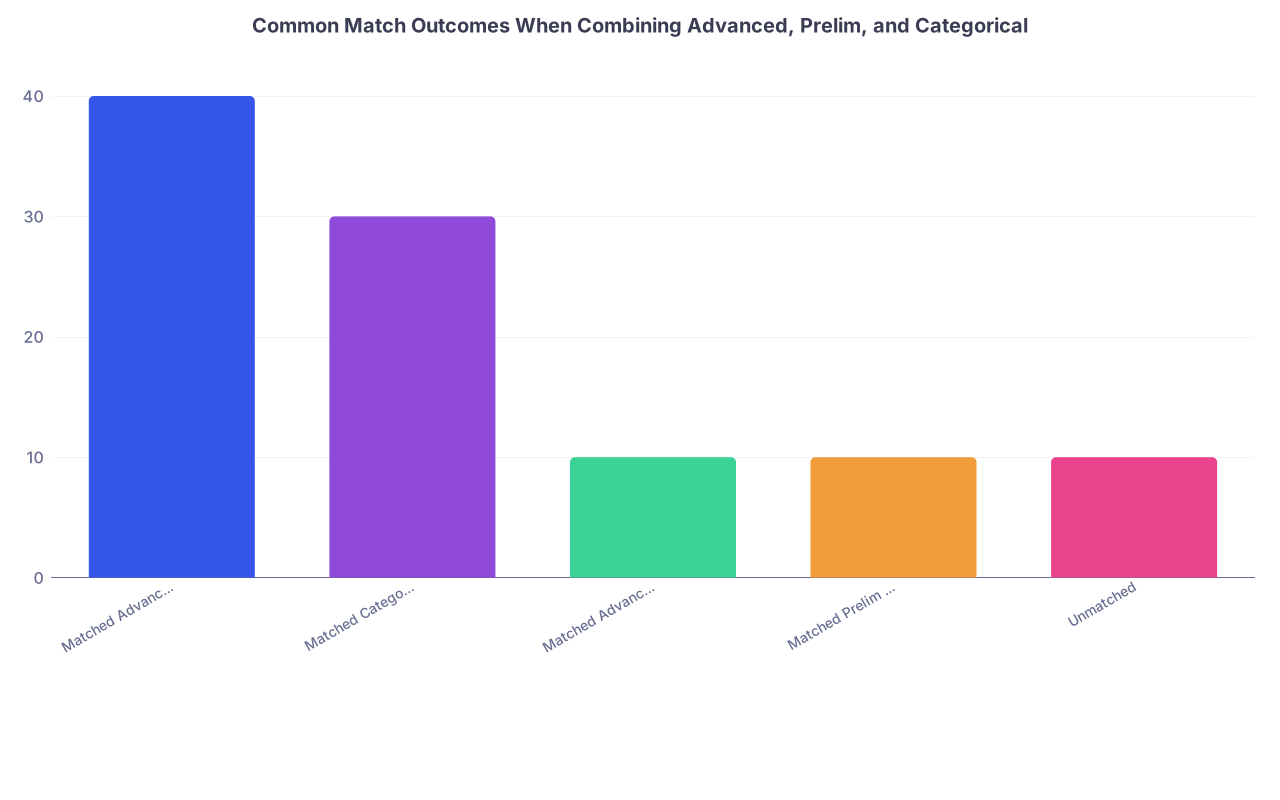
| Category | Value |
|---|---|
| Matched Advanced+Prelim | 40 |
| Matched Categorical | 30 |
| Matched Advanced only | 10 |
| Matched Prelim only | 10 |
| Unmatched | 10 |
The specific ranking mistakes:
Not pairing enough prelim options with each advanced program
For each advanced position you rank high, you need a realistic cluster of prelim/TY programs ranked as supplemental lists.
If you have:
- 10 advanced radiology ranks
- 3 prelim IM ranks
You’re playing roulette. You can:
- Match Rads + no prelim → scramble/SOAP disaster
- Match prelim + no Rads → you just became a prelim with no PGY-2
Randomly interspersing categorical programs without a clear priority
You say: “I’d prefer anesthesia, but I’ll be okay with IM.” Then your rank list looks like:
- Anesthesia Advanced A
- Categorical IM at Big Name Hospital
- Anesthesia Advanced B
- Categorical IM Community
- TY Prelim 1
- Prelim IM 2
If you match #2, you will never be considered for #3 or below. You just told the algorithm you’d rather be a categorical internist at #2 than an anesthesiologist anywhere else on your list. Whether that was intentional or not.
Assuming a categorical can “count” like a prelim for an advanced match
It doesn’t. If you match categorical IM, your NRMP process is done. You are not also matching that anesthesia R2 you had ranked. You’d leave and reapply later (and yes, programs notice that too).
How to avoid this
Decide hierarchy before touching the rank list:
- Question: Would you rather
- Be your advanced specialty anywhere on your list, or
- Be categorical in backup specialty at a top place?
You need to know this answer first.
- Question: Would you rather
Use supplemental rank lists properly:
- For each advanced program, create a supplemental list of prelim/TY that you’d accept if you match that advanced spot.
- And make sure you rank enough prelims in realistic locations (don’t put 8 New York advanced programs and only 2 prelims in California).
Freeze your priorities in writing before you build the list:
- “I prefer:
- Any anesthesia advanced on my list + OK prelim
- Categorical IM at X, Y
- TY year and reapply
- Prelim IM only as last-ditch”
- “I prefer:
If you’re casually guessing when you drag things onto the rank screen at 11:50 pm on the deadline day, you are begging for a match outcome you will regret.
Mistake #3: Applying to prelim without a real plan for PGY‑2+
This one is quieter, but it ruins people two years later.
They say:
“I’ll just do a prelim year and figure it out. Something will open up.”
That “something” is usually: panic, another stressful application season, and sometimes no spot.
What goes wrong
- You match into a prelim IM at a strong academic program
- You don’t match into your advanced specialty
- You enter intern year thinking: “I’ll wait for the perfect opening”
Then reality:
- There are limited PGY-2 positions in your dream specialty
- Internal transfers are rare and political
- Midyear openings go to people with strong connections, faculty advocates, or very specific timing
Worst-case: You finish your prelim year with no PGY-2 spot. Now you’re applying again as “former prelim, currently unplaced,” which is a much weaker posture.
How to avoid this
Before you even apply prelim:
Define realistic scenarios:
- If I match advanced + prelim → easy: follow the plan.
- If I match categorical backup → am I truly willing to complete the whole thing?
- If I match prelim only → what exactly is my next step? Reapply to advanced? Switch to IM/FM? Accept another prelim year?
Research how your prelim programs treat prelims:
- Do they regularly take prelims into categorical spots?
- Is there documented history of prelim-to-advanced transitions internally?
- Or are you just cheap labor for one year?
Talk to current prelims before ranking:
- Are any of them staying on?
- Did anyone successfully move into their dream specialty from there?
- Or are most of them scrambling again?
If your entire “plan” is “I’ll crush intern year and someone will notice,” you are relying on fantasy, not strategy.
Mistake #4: Being honest in the wrong way about your intentions
You should not lie. But you also should not self-sabotage.
Typical self-sabotage line I’ve seen in personal statements or interviews:
- “I’m applying to your categorical IM program mainly as a backup because I hope to match anesthesia.”
- “I see your prelim year as time to explore different specialties and keep my options open.”
- “I want to use this prelim year to reapply to dermatology.”
Programs hear:
- You’re not committed
- You’re planning to leave
- You’re not interested in their specialty’s identity or culture
How to be honest without tanking your chances
Better framing:
For prelim IM/TY when you’re ultimately going anesthesia/rads/etc.:
Instead of:
“I want a prelim year to reapply to anesthesia.”Use:
“I’m applying to this preliminary track to build a strong clinical foundation in internal medicine that will make me a better physician in my eventual specialty. I care about learning to manage complex inpatients, work in multidisciplinary teams, and handle high-acuity situations.”That’s truthful and aligned with what they want: someone who will take the year seriously.
For categorical IM/FM you’d truly consider as a career:
Avoid:
“I might still switch later.”Use:
“I’ve seriously considered a career in internal medicine and can see myself fulfilled in this field. I’m drawn to long-term patient relationships, complex diagnostic work, and broad clinical exposure. While I’ve explored other interests, I’m applying here because internal medicine is a path I would genuinely be proud to pursue long term.”
That’s also honest. You’re not promising you’ll never consider anything else; you’re stating that IM is a genuine option.
If you’re planning to walk in on July 1 telling your PD, “Yeah I’m just here until I can jump to ortho,” you’re underestimating how quickly doors close.
Mistake #5: Underestimating how different prelim tracks are (especially TY vs IM vs Surgery)
Another big one: treating “any prelim” as interchangeable.
They’re not.
You’ve got:
Transitional Year (TY) – usually:
- More elective time
- Often considered “lighter” schedules at many programs
- Often favored by radiology, rad onc, ophtho, derm folks who want broad exposure, more time to study
Prelim Internal Medicine – usually:
- Heavy inpatient service
- Similar to categorical IM PGY1 schedule
- Intense call, lots of cross-cover, serious responsibility
Prelim Surgery – often:
- Brutal hours
- High acuity, high stress
- Least flexibility, and low chance of sliding into a categorical without explicit track
And then inside each of those, some programs treat prelims like valued team members; others like expendable coverage.

The mistake
You rank:
- Prestigious-name prelim surgery in a city you like
- Random prelim IMs without looking at actual call schedules
- A few TYs but don’t prioritize them because “prelim is prelim”
Then you land in:
- A soul-crushing surg prelim year that leaves you with zero bandwidth to reapply, no elective time, and burnt out before your advanced specialty even starts.
How to avoid this
Read schedules like your life depends on it (because your happiness does):
- How many ward months?
- Night float vs 24-hour call?
- How many ICU blocks?
- Actual duty hours reported by current interns, not just what’s on the glossy website.
Ask current prelims the hard questions:
- “Do you have time to work on applications during the year?”
- “How often do people call out from pure exhaustion?”
- “Has anyone transferred into categorical or advanced spots from here recently?”
Align prelim choice with your advanced specialty:
- Radiology/derm/ophtho: often better served by TY or lighter IM prelim
- Anesthesia: IM or TY can both work well
- Neurology: many prefer medicine prelim, depending on program
- Certain fields: some advanced programs explicitly prefer IM vs TY. Believe them.
If you’re ranking a surgery prelim as your #1 with no intention of ever being a surgeon, pause. You may be volunteering for a miserable year for the wrong reasons.
Mistake #6: Overpaying in time and money for “backup” applications you don’t actually want
I’ve seen people apply to:
- 60+ advanced spots
- 30+ prelims
- 25+ categorical IM/FM as “safety”
They spend thousands of dollars and hundreds of hours on programs they would never be happy at.
Then they match… somewhere they never truly considered, and spend PGY1 wondering how they ended up there.
The danger here
- Massive application bloat dilutes your attention.
- You:
- Write weaker personal statements
- Send sloppier program-specific messages
- Interview at places you don’t care about while missing opportunities at ones you do
- End up ranking programs “just to use the interview” instead of intentionally
How to avoid this
Ask yourself, brutally:
- “If this categorical IM program were my only offer, would I be willing to complete residency here? Honestly?”
- “If I match only at this prelim, in this city, with this schedule, and don’t match advanced – can I live with doing a year there and reapplying?”
If the honest answer is “absolutely not,” then why are you spending money and energy on them? You’re building pathways you secretly hope you’ll never walk.
Cut that list down to places and tracks you would actually accept. You’ll write stronger materials for the rest.
Mistake #7: Letting letters of recommendation contradict your application story
One more subtle trap.
You apply to:
- Categorical IM programs
- Prelim IM
- Advanced anesthesia
And your letters say:
- “She has been committed to anesthesia from early in medical school and I cannot imagine her happy in another specialty.”
That’s great for anesthesia. It’s damaging for categorical IM.
Or you have a surgery chair letter gushing about how you’re “born to be a surgeon” while you’re applying TY + radiology. Again: mismatch.
How to avoid this
Curate letters per track:
- For the advanced specialty: strongest specialty-specific letters.
- For categorical IM: at least two strong IM letters from people who can credibly praise your potential as a lifelong internist.
- For TY/prelim IM: letters highlighting your reliability, work ethic, adaptability, and team function.
Give letter writers context:
- Tell IM faculty: “I’m applying to both advanced anesthesia and some categorical IM programs. I’d really appreciate if you could speak to my potential as an internist and my enjoyment of internal medicine, since some programs may be viewing me as a possible categorical resident.”
- Don’t hide your plans but don’t ask for a letter that screams “this person hates medicine and only cares about derm.”
If your narrative, personal statement, and letters are telling three different stories, you will get filtered out long before anyone gives you the benefit of the doubt.
Mistake #8: Assuming “I’ll just SOAP into a prelim if I need to”
This is one of the riskiest assumptions I hear.
Maybe you’re applying only to advanced spots and planning: “If I don’t match, I’ll SOAP into a prelim year and try again.”
Here’s reality:
SOAP prelim spots are:
- Highly unpredictable
- Often in locations or programs you would never have applied to originally
- Competitive because every unmatched advanced applicant is also scrambling for them
The quality of what’s left is highly variable:
- Some are perfectly fine, under-the-radar programs
- Some are malignant, grossly understaffed, and infamous for burning out interns

| Step | Description |
|---|---|
| Step 1 | Apply Advanced Only |
| Step 2 | Do Not Match |
| Step 3 | Enter SOAP |
| Step 4 | High Competition |
| Step 5 | Uncertain Program Quality |
| Step 6 | Risk of Remaining Unmatched |
| Step 7 | Risk of Malignant Training |
| Step 8 | Prelim Spots Available? |
How to avoid this
- If you must match this cycle, treat prelims as core, not optional add-ons.
- Rank real prelim programs you’ve vetted, in places you’d actually go.
- Do not build your plan on “I’ll fix it in SOAP.” That’s not a strategy. That’s gambling.
Your move: audit your current strategy today
Do not just nod and move on. This is one of those stages where small planning errors explode into life-altering outcomes.
Here’s what to do today:
Open your program list and sort it into four columns:
- Advanced
- Prelim
- Transitional Year
- Categorical (backup)
For each column, write one sentence describing why you’re applying to that category and what your actual goal is.
Then check:
- Do your personal statements, letters, and planned rank strategy match those goals?
- Or are you sending conflicting messages and hoping nobody notices?
If you can’t clearly explain, in writing, why you’re applying to both prelim and categorical tracks and how they fit into a coherent plan, you’re making at least one of the mistakes above. Fix that on paper first, then fix your application.