
Last week a fourth-year sat across from me in the call room, ERAS spreadsheet open, eyes red. “If I don’t match categorical, that’s it, right? I’m done? Should I just throw prelims on my list as a backup… or will that screw me forever?”
I’ve heard some version of that question every single application season. And honestly? I’ve asked it myself in my head more times than I’ll admit.
What a Preliminary Year Actually Is (Without the Sugarcoating)
Let’s strip the vague advice and go straight to the point.
A preliminary year is usually a 1‑year internship (PGY‑1) without a guaranteed PGY‑2+ spot in the same program. You do the work of an intern, but you’re not locked into that residency long term.
There are two big flavors:
Transitional Year (TY)
Generally lighter, more “cush,” broader mix of rotations. Often sought by people going into competitive advanced specialties (derm, radiology, ophtho, anesthesia) because they can get more electives, clinic, and maybe a sane call schedule.Preliminary Medicine / Surgery / Other
Much more like a straight-up intern year in IM or surgery. Heavier wards, more call, fewer electives. You’re basically an IM or surgery intern, just without the security blanket of knowing where PGY‑2 will be.

Here’s the part that fuels the anxiety:
A categorical position = you match into PGY‑1 and have a guaranteed path through residency in that specialty at that program.
A preliminary position = you match for one year, and then… you’re back in the application arena. Again.
So the fear is: If I don’t match categorical and only match a prelim, did I just sign up for one year of pain with no future?
No. But it can be messy if you don’t understand what you’re doing.
Are You Actually at Risk of Not Matching Categorical?
Let’s be harsh and honest for a second, because pretending everything’s fine when it’s not is how people end up scrambling.
Some people absolutely should add prelims.
Some people are over-panicking and using prelims as a security blanket they don’t need.
Key things I always look at when someone asks me this:
Specialty competitiveness
Applying derm, ortho, plastics, ENT, neurosurg, rad onc, integrated IR, etc.? Prelims and/or TYs are standard backup strategies. Not optional. Expected.Your stats vs that specialty
If you’re aiming for, say, categorical general surgery with a Step 2 score in the low 220s, no AOA, weak letters, and a rough MS3 eval or two… yes, you’re in more dangerous territory.
If you’re IM with solid scores (230s+ on Step 2), normal number of interviews, decent letters, average research? You’re probably scaring yourself more than reality justifies.Interview numbers
No one wants to say this out loud, but here’s the reality:- For most non-ultra-competitive categorical specialties, if you end up with 10–12+ interviews, your chance of matching somewhere is usually quite high.
- If you’re sitting at 3–4 categorical interviews total in a competitive specialty? You are on thin ice. That’s the scenario where prelims are not paranoia; they’re survival planning.
Red flags: leaves of absence, multiple failures, unaddressed professionalism concerns, late specialty switch, DO/IMG in a competitive field without strong support. Those all push you more toward needing backup options.
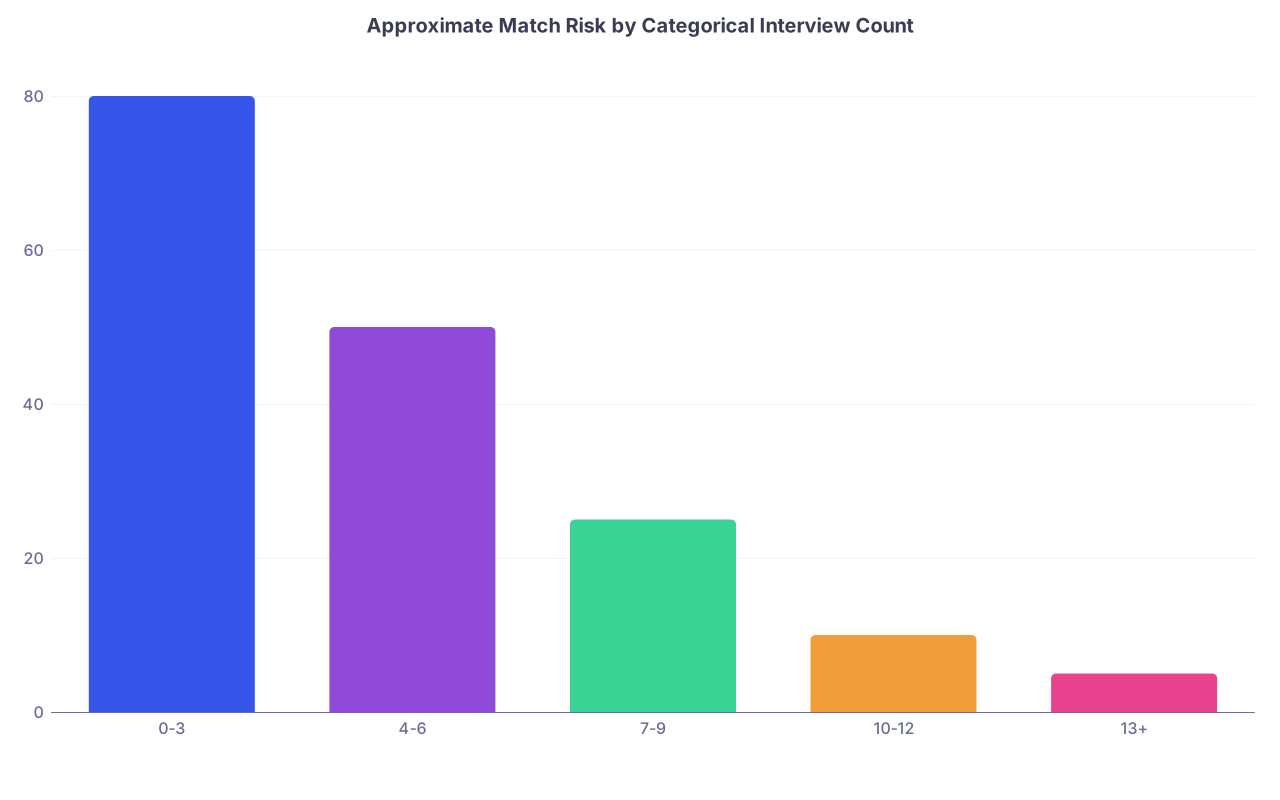
| Category | Value |
|---|---|
| 0-3 | 80 |
| 4-6 | 50 |
| 7-9 | 25 |
| 10-12 | 10 |
| 13+ | 5 |
This isn’t official NRMP data, but it reflects what I’ve actually seen: once you’re past the ~10 interview mark in a non‑crazy‑competitive categorical specialty, the “I will not match at all” risk drops a lot. Before that, things are shakier.
So the question becomes: are you genuinely in a risky situation… or just catastrophizing because that’s what med school trained your brain to do?
Should You Add Preliminary Programs as Backup?
Let’s actually go through the main “if–then” paths, because this gets muddled fast.
Scenario 1: You’re Applying to an Advanced Specialty (Anesthesia, Derm, Rads, Ophtho, etc.)
If your core residency is advanced (starts at PGY‑2), you almost always need either:
- A preliminary year
- Or a transitional year
For people in these fields, the “Should I add prelims?” question is honestly the wrong question. You’re expected to.
The real fear is:
- What if I match a prelim/TY but don’t match the advanced spot?
- Or match the advanced spot but don’t match a prelim/TY?
That’s where strategy matters. You generally rank advanced programs and prelim/TY programs on the same rank list (depending on the specialty’s match system), and you have to check how they pair in your specific year/specialty. Advanced fields have their own elaborate anxiety trees.
But if your core fear is “I’ll be unmatched completely with no job and nothing to do,” then ranking both advanced programs and prelim/TY programs is smart, and honestly standard.
Scenario 2: You’re Applying to Categorical IM, Surgery, Peds, etc.
This is where the real confusion is. You want a categorical spot in something that normally can be done straight through: IM, FM, peds, gen surg, psych, EM (when available), etc.
Should you also add prelims? Or does that send a weird signal?
Here’s how I think about it.
You add preliminary programs if:
- You are not comfortable with your risk of going totally unmatched,
and - You would rather:
- Do a prelim year and reapply
- Or pivot to another path
Rather than: - Sit out a year, do research, work as a scribe, etc.
Because that’s the real choice. You’re not comparing “categorical vs prelim.” You’re comparing:
- Categorical vs
- Prelim year + uncertainty vs
- Total unmatched + scramble/SOAP + maybe a non‑clinical year
For a lot of people, a prelim year is a better bad outcome than full unmatched with no plan.

| Step | Description |
|---|---|
| Step 1 | Apply Categorical Only |
| Step 2 | Start Categorical Residency |
| Step 3 | Unmatched or SOAP |
| Step 4 | Apply Categorical + Prelim |
| Step 5 | Do Prelim Year Reapply |
| Step 6 | Match Categorical |
| Step 7 | Match Categorical |
| Step 8 | Match Prelim |
The upside: a prelim spot means you have a job, a salary, clinical experience, and a clear way to say, “Look, I did a solid intern year, I can do this” when you reapply.
The downside:
You are working brutal intern hours with no guarantee of a PGY‑2 spot. You’ll be reapplying in the fall while also on wards or nights. It’s not theoretical—I’ve watched prelims fill out ERAS during 28‑hour calls. It’s rough.
So you don’t add prelims “just because you’re scared.” You add them if:
- Your risk profile is actually elevated, and
- You’re willing to pay the cost: another whole application cycle, while exhausted.
Will Ranking Prelims Hurt Your Categorical Chances?
This one keeps people up at 2 a.m.
No, simply applying to or ranking prelim programs does not magically make you less likely to match categorical. Programs don’t get some secret report saying, “This person ranked 10 prelims, clearly they lack confidence.”
The match algorithm is blind to your inner panic.
Programs do see what you’ve applied to. If a PD pulls up your ERAS and sees:
- 80 categorical IM programs
- 20 prelim medicine programs
That doesn’t look weird. It actually reads like, “Okay, this person is serious about having a backup.”
Where it can get messy is in interviews and signals:
- If you tell a program, “You’re my top choice,” and they know you’re also heavily applying to a bunch of surgical prelims and maybe another specialty, they might doubt your commitment.
- If you clearly look like you’re hedging toward something unrelated (like applying categorical IM + prelim surgery + derm advanced) without a coherent story, you can come off scattered or non‑committal.
But programs generally understand:
- Categorical spots = your target
- Prelim spots = your parachute
They’re not offended that you packed a parachute.
What Happens If You Only Match a Prelim?
This is the nightmare scenario your brain keeps replaying. So let’s walk through it.
You rank a bunch of categorical programs and some prelims. Match Day comes. You open the email.
You matched… but only to a preliminary year.
That means:
- You have a job for PGY‑1.
- You do not have a guaranteed PGY‑2+ spot.
Is that the end? No. But the next 12–18 months will be… intense.
Here’s reality, not brochure-speak:
- You’ll start intern year, probably overwhelmed like everyone else.
- By late summer / early fall, you’ll be applying again. Updating letters, rewriting your personal statement, begging attendings for last‑minute support while working 60–80 hours a week.
- Some people match into PGY‑2 spots in the same specialty they originally wanted. Others pivot to something more realistic based on their application and intern performance. Some end up doing two prelim years (yes, it happens) before landing a categorical.
| Path After Prelim Year | How Often It Happens (Anecdotal) | Main Tradeoff |
|---|---|---|
| Match PGY-2 in target field | Fairly common | One extra stressful application |
| Switch to another specialty | Also common | Give up first-choice specialty |
| Need a second prelim year | Less common but real | Two years of limbo, more burnout |
| Leave clinical medicine | Uncommon but not rare | Major career pivot |
The part people don’t say out loud:
Some prelims do great, get powerful letters, show they can grind, and become stronger applicants.
Some burn out, struggle, and their reapplication doesn’t improve much.
But if you’re thinking in pure worst-case spirals: prelim ≠ death sentence. It’s not “I failed and there’s no path forward.” It’s “This is going to be a longer, messier road than I wanted.”
When Adding Preliminary Programs Makes Sense (and When It Doesn’t)
Let me draw some lines, because otherwise the anxiety just expands to fill the space.
You probably should add prelims if:
- You’re applying to a highly competitive specialty as your main target.
- You have few categorical interviews or anticipate a weak interview season based on your application.
- You’d be more devastated by being completely unmatched than by working an extra hard year and reapplying.
- You could live with pivoting to another specialty after a prelim if you had to.
You probably don’t need prelims (though you still can add them if it helps you sleep) if:
- You’re applying to a non-ultra-competitive categorical specialty.
- Your application is roughly in line with that specialty’s matched residents at mid-tier programs.
- You end up with 10+ categorical interviews and no huge red flags.
Could you still add 2–3 prelims for mental insurance? Sure. The match doesn’t punish you for that.
The real trap is this:
Using prelims as a psychological crutch so you don’t confront the actual problem—like you’re wildly overreaching on all your categorical programs or ignoring a major red flag.
Prelims don’t fix poor targeting. They just soften the landing if things go wrong.
How to Stop the Spiral (At Least Enough to Function)
You’re not going to fully stop worrying. That’s baked into this whole process. But you can bring the panic down from “I’ll be living in a box under a bridge” to “I’m making conscious tradeoffs.”
A few grounding moves:
- Talk to someone who actually knows your file. A dean, advisor, PD, or mentor who’s honest. Not your equally-panicked classmates.
- Ask them directly: “Based on my stats and interviews, how real is my risk of going completely unmatched?”
If they say “moderate to high,” prelims are reasonable.
If they say “low,” prelims become optional mental padding. - Decide what’s worse for you personally:
- One year of prelim + uncertainty
- Or unmatched and potentially non‑clinical gap time
Once you answer that, the prelim question becomes less abstract and more like choosing the lesser of two evils that you can actually live with.
FAQ (Exactly 5 Questions)
1. If I rank prelim programs, will categorical programs think I’m less committed to their specialty?
Not automatically. Programs see lots of applicants who rank both categorical and prelim positions. What raises eyebrows isn’t the presence of prelims; it’s an incoherent story. If your application, personal statement, and interviews clearly state why you’re committed to that specialty, prelims in the background don’t undercut that. Just avoid sending mixed messages like strongly hinting you want cards fellowship during a surgery interview while also applying prelim surgery and categorical IM.
2. Is it better to go unmatched and do a research year, or match a prelim and reapply?
It depends on your specialty and your stamina. For many IM, peds, and surgery hopefuls, a strong prelim year with good evals can be a huge boost and avoids an unexplained gap. For some very academic or ultra‑competitive specialties, a dedicated research year at a big-name institution can actually be more valuable than grinding a prelim year where you never have time to publish. This is where a real conversation with someone in your target specialty matters more than generic advice.
3. Can I turn a preliminary spot into a categorical spot at the same program?
Sometimes, yes. I’ve seen prelims get “upgraded” when a categorical resident drops out, transfers, or is let go. But you absolutely cannot count on that. Some programs tell prelims up front, “We rarely convert.” Others quietly prefer to fill from their prelim pool. You should treat it like a nice possible upside, not part of your core plan.
4. How many prelim programs should I apply to if I’m worried?
If you’re truly at elevated risk and consciously using prelims as a backup, people often apply to a dozen or more prelim/TY programs, especially in big metro areas. But you don’t need to go overboard and apply to 40 prelims “just in case.” That’s usually just feeding the anxiety. A smaller, targeted list that you’d realistically be willing to attend is better than blasting every prelim in the country.
5. What if I match a prelim in one city and then match categorical somewhere else the next year—is that common?
Yes, it happens all the time. You might do a prelim in, say, New York, then match categorical IM in Ohio the next cycle. The biggest annoyances are moving again, onboarding again, and sometimes repeating certain rotations because requirements differ. Emotionally, it’s frustrating to feel like you’re “starting over,” but programs are used to PGY‑1s coming from prelim backgrounds. It doesn’t brand you as damaged; it just means your path wasn’t the straight line you hoped for.
If you strip away the noise, there are really three things to remember:
You add prelims if your real risk, not just your anxiety, of not matching categorical is high.
A prelim year is a painful but legitimate backup, not a career death sentence.
And none of this is about being perfect—it’s about choosing the version of “this might suck” that you can actually live with.