
The idea that your preliminary year is a “throwaway” is one of the most dangerous myths in residency training. It is not a warm-up lap. It can quietly wreck your career if you treat it like one.
You only get one shot at how your prelim year looks to fellowship directors, advanced programs, and future employers. If you blow it, there’s no magical “do-over” PGY‑1.
Let me walk you through the mistakes I see over and over—and the fallout people never see coming until it’s too late.
First, What a Preliminary Year Actually Is (And What It Is Not)
A preliminary year is:
- A one-year internship (PGY‑1) in medicine, surgery, or transitional year
- Required for many advanced specialties:
- Radiology (diagnostic, IR)
- Anesthesiology
- Dermatology
- Ophthalmology
- PM&R
- Radiation oncology
- Neurology (sometimes)
- Usually separate from your advanced (PGY‑2+) program
It is not:
- An automatic formality nobody cares about
- A free year to “just survive” before your “real” specialty
- A place where professionalism “doesn’t count” because you’re leaving anyway
Your prelim year generates:
- An entire year of evaluations
- A clinical reputation in a real hospital system
- Letters of recommendation
- A transcript and final summary that some programs do read carefully
And yes, advanced programs will absolutely pull your file and ask, “What happened during their intern year?” if something looks off.
Mistake #1: Thinking “As Long As I Don’t Get Fired, I’m Fine”
This is the bare-minimum mindset that quietly ruins people.
The belief:
“As long as I show up, don’t kill anyone, and don’t get written up, who cares? I’m going into derm/rads/anesthesia; this is irrelevant.”
The reality:
- Prelim programs do share concerns with your advanced program.
- You can do enormous damage without ever getting formally disciplined.
- Being “barely adequate” becomes your brand—and it follows you.
Common patterns I’ve seen:
- The “ghost”: does tasks when pushed but never volunteers, always hard to find, answers pages slowly.
- The “clock‑watcher”: legendary for being packed up and ready at 4:59 pm daily, no matter what’s happening with patients.
- The “complainer”: loudly reminds everyone they’re “just here for one year” and that their “real program” is somewhere else.
None of these residents are fired.
All of them are remembered.
And not in the way they think.
Why this backfires:
- Your advanced program may hear from your prelim PD before you start: “Capable but not a team player.” Translation: proceed with caution.
- If your advanced specialty is competitive, any whiff of “low effort intern” spreads fast in that small specialty community.
- When you need a strong letter later (fellowship, job), that prelim PD or attending may be your only general internal medicine/surgery letter—and it’s lukewarm at best.
You do not want “adequate but disengaged” immortalized in writing.
Mistake #2: Underestimating How Hard It Is to Recover From a Bad Reputation
Once you get tagged as “lazy,” “checked out,” or “high-maintenance,” it is brutally difficult to shake.
I’ve seen this scenario more than once:
- Prelim intern in medicine, matched to rads
- Treats the year like a chore: late notes, constantly on their phone, rolls eyes at scut
- PD writes a truthful but reserved final summary: “Met minimum expectations; required frequent reminders regarding timely documentation and responsiveness to nursing staff.”
Now look at that through the eyes of a radiology or anesthesia PD. Do you want the resident who needed “frequent reminders” to answer pages and write notes?
Key problem:
Your prelim PD’s letter or evaluation is often:
- Required for credentialing
- Requested for fellowship or job apps (especially early on)
- Informally discussed with other PDs at conferences
And you do not see those conversations. You just notice fewer opportunities coming your way and vague “fit” concerns.
Mistake #3: Ignoring That Your Prelim Year Is a Year-Long Job Interview
You’re not just passing time; you’re auditioning.
For what?
- Future letters
- Future jobs at that institution
- Moonlighting opportunities
- Fellowships that quietly ask, “What was this person like as an intern?”
The people silently evaluating you:
- Senior residents
- Nurses
- APPs
- Program coordinator
- Chief residents
- PD and APDs
- Consultants who see your notes and signoffs
They remember things like:
- Who helped with that 2 a.m. rapid response
- Who disappeared during cross-cover
- Who would always pitch in during sign-out vs. who always had “one more note”
Let me be blunt:
Some of the harshest feedback I’ve seen about prelims came not from attendings but from nurses and senior residents who had to pick up slack.
You might think, “But they’re not in my specialty.”
Doesn’t matter.
Their feedback fuels your formal evals and shapes the tone of end-of-year summaries.
Mistake #4: Assuming Your Advanced Program “Doesn’t Care” How Your Prelim Year Goes
This one is just false.
Advanced programs differ in how closely they track your PGY‑1, but several things are common:
- They request a final summative evaluation from your prelim PD.
- They see any major incidents, professionalism flags, or remediation.
- They hear informal feedback—especially if both programs are in the same institution or region.
| Use Case | What They Look For |
|---|---|
| Onboarding decisions | Any red flags or professionalism issues |
| Schedule planning | Who might need closer supervision |
| Fellowship recommendations | Pattern of reliability vs. concern |
| Promotion/renewal reviews | Consistency between PGY-1 and PGY-2 behavior |
You may not realize:
- A problematic prelim year can affect whether your advanced program:
- Feels comfortable backing you for a competitive fellowship
- Gives you high-responsibility roles (chief resident, QI leadership)
- Writes an enthusiastic vs. generic letter
I’ve literally heard attendings say about a transitioning PGY‑2:
“We heard from medicine that he did the minimum. Let’s see how he does here before we invest too much.”
That is not how you want to start PGY‑2.
Mistake #5: Blowing Off Basic Clinical Competence as “Not My Field”
I know the thought process:
- “I’m going into derm. Why does it matter if I’m slow at cross-covering heart failure?”
- “I’m anesthesia; I don’t need to be an inpatient medicine superstar.”
You’re right that you don’t need to be a cardiology fellow as an intern. But if you can’t:
- Write a safe, coherent admission plan
- Recognize a sick patient early
- Communicate clearly on the phone
…people question your overall clinical judgment. Not just your “medicine skills.”
You know who cares about that?
- Radiology programs who want residents that can triage urgent consults and recognize life-threatening findings.
- Anesthesia programs who require you to manage complications and recognize decompensation.
- Derm programs whose patients still have actual medical comorbidities.
Basic competence in a general field is a proxy for:
- Work ethic
- Critical thinking
- Ability to function under pressure
If your charts are chaos, your plans are vague, and you constantly need hand-holding, it sends one loud message:
“This is someone who doesn’t take medicine seriously if it’s not their favorite subject.”
That attitude is radioactive.
Mistake #6: Treating the Prelim Year Like a Vacation From Your Chosen Field
Another bad move: emotionally divorcing yourself from the year.
You’ll hear people say during orientation:
- “I’m just here for a year; then I’m gone.”
- “This is my gap year before real residency.”
If that’s your inner script, here’s what tends to happen:
- You disengage from conferences (you’re “not staying here anyway”).
- You don’t pursue any research, QI, or teaching opportunities.
- You avoid building relationships with faculty because “they’re not in my specialty.”
Then, when you finally start your advanced program:
- You have no new scholarly work since med school.
- You haven’t grown as a teacher or leader.
- You’re a year behind your peers who actually used intern year to get sharper.
And you really feel it when fellowship season comes.
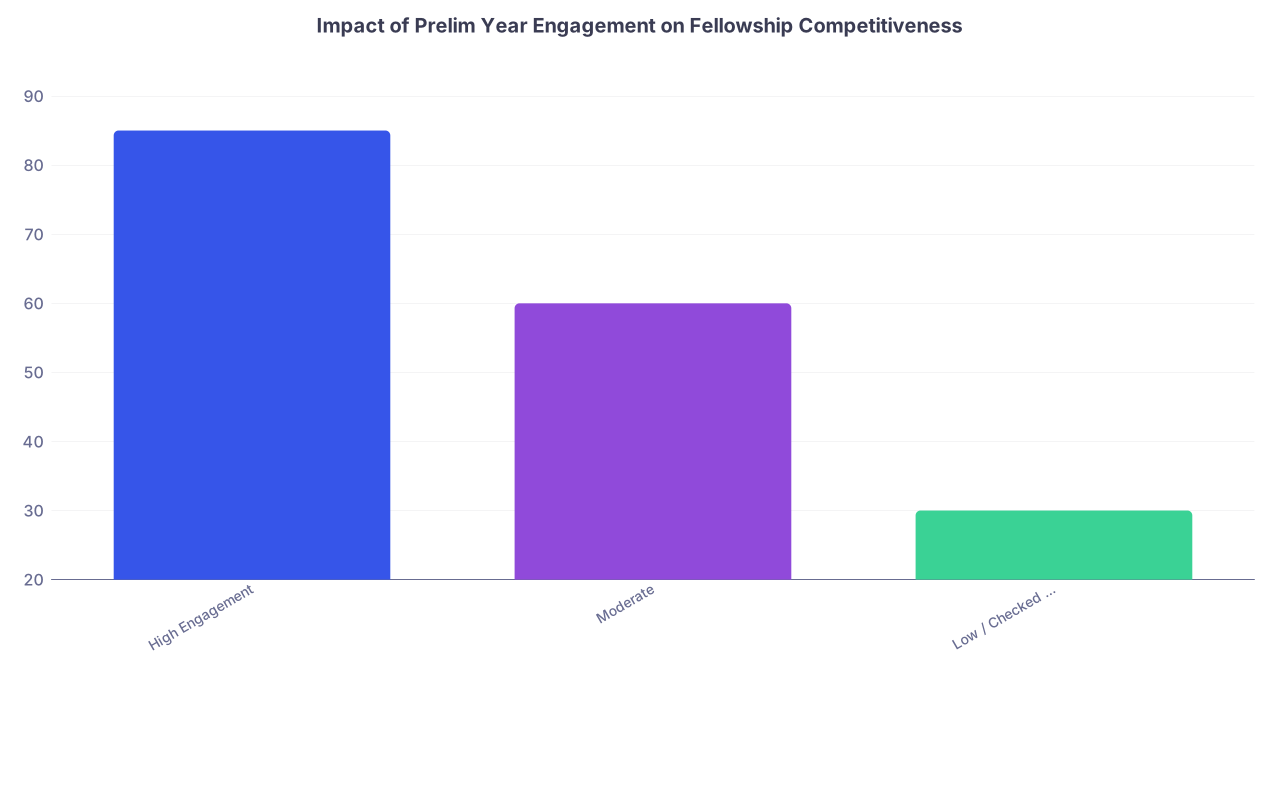
| Category | Value |
|---|---|
| High Engagement | 85 |
| Moderate | 60 |
| Low / Checked Out | 30 |
(Think of those numbers as relative odds of having a strong fellowship application—not actual percentages, but you get the point.)
The intern who:
- Did a small QI project
- Got involved in teaching medical students
- Earned a reputation as reliable
…shows up to PGY‑2 with momentum. You show up tired, cynical, and flat.
Mistake #7: Ignoring Burnout Until It Shows Up On Your Evaluations
Prelim years can be brutal. Medicine prelim at a county hospital? Surgery prelim on heavy call? Transitional year at a malignant site? I’ve watched very capable people get crushed.
The mistake is pretending you can “white-knuckle” an entire year and nobody will notice the cracks.
What burnout looks like to everyone else:
- You become short with nurses and consultants.
- You start making more dumb errors (missed labs, unfinished orders).
- You come in late, leave as early as possible, and visibly resent the work.
- Your notes get sloppier and sloppier.
Eventually, that shows up in formal language:
- “Struggled with professional communication when under stress.”
- “Needs improvement in organization and follow-through.”
- “At times appeared disengaged or frustrated on rounds.”
That’s burnout in code. But advanced programs don’t just see “burnout.” They see “risk.”
Let me be clear:
The mistake isn’t getting burned out. That’s human. The mistake is:
- Not seeking help early
- Not asking for schedule adjustments, mentorship, or coping strategies
- Letting it progress to the point that your behavior changes in obvious ways
PDs are much more willing to support “tired but transparent and trying” than “irritable and checked out.”
Mistake #8: Missing the Networking and Letter-Writing Gold Mine Right In Front of You
People forget this: your prelim year can produce some of the strongest letters of your entire career.
Why?
- You’re in the trenches with attendings, seniors, and chiefs daily.
- They see your work ethic, reliability, and growth up close.
- They often train lots of prelims and know exactly how to distinguish “average” from “exceptional.”
Common screw-up:
Prelim residents treat everyone like temporary colleagues and never invest in relationships.
What you’re throwing away when you don’t engage:
- A medicine attending who can write: “Among the best interns I’ve worked with in five years, regardless of future specialty.”
- A chief resident who can say: “We would have happily kept them for our own program.”
- A PD who, when called by another PD, answers, “Yes, I’d absolutely take them again.”
Those comments carry weight in fellowships and jobs—especially early in your career when your track record is short.
Contrast that with what happens when you’re forgettable or mildly negative:
- Nobody volunteers to write a strong letter.
- You get generic “met expectations” statements that read like placeholders.
- When someone calls off-record, they hear: “Yeah, they were… fine.”
“Fine” doesn’t get you the competitive fellowship, the best job, or the leadership role.
Mistake #9: Failing to Use the Year to Fix Known Weaknesses
You already know your weak points:
- Time management
- Communication under stress
- Clinical reasoning on the fly
- Documentation quality
- Confidence calling consults
Prelim year is basically a structured, supervised environment designed for you to get better at all of that. On someone else’s liability insurance.
The mistake? Coasting.
Common internal monologue:
“I’ll really focus on improving once I’m in my actual specialty.”
By then:
- Expectations are higher
- You get less hand-holding
- Your mistakes count more
You do not want to be the PGY‑2 in radiology who still:
- Struggles to give a clear, concise, confident read to an ED physician
- Avoids phone calls because they’re anxious
- Documents poorly when called into clinical situations
You could have chipped away at those in PGY‑1 while everyone still expected you to be learning basic stuff.
Prelim year is the cheapest time to fail constructively—if you lean into it instead of hiding from it.
Mistake #10: Planning Your Life Around the Advanced Program and Treating the Prelim Like a Side Quest
This shows up in three predictable ways:
Logistics obsession
- Spending more energy planning your move, your new city, and your PGY‑2 vacation schedule than your actual current patients and responsibilities.
Social disengagement
- Skipping intern bonding, ignoring social events, never learning people’s names because “I’m leaving anyway.”
Curricular apathy
- Blowing off didactics, clinics, and conferences because they’re “not relevant to my future.”
The problem is simple: everyone feels it.
The team notices:
- You’re never fully “there”
- You don’t see the year as real training
- You view the hospital as a layover, not an employer
No one is excited to go the extra mile for the person who already has one foot out the door.
How To Avoid These Traps Without Burning Yourself Out
You don’t need to win “Intern of the Year.” But you do need to avoid the landmines.
Here’s the sane version of “taking prelim year seriously”:
Define your floor, not your ceiling
- Always:
- Be on time
- Answer pages promptly
- Close the loop on tasks
- Be respectful and calm on bad days
- This alone puts you in the “solid, reliable” category.
- Always:
Choose 1–2 growth targets
Examples:
- “I want to be really good at cross-cover calls by month 6.”
- “I want my documentation to be clean, clear, and efficient.”
- “I want to be the intern nurses trust when something feels off.”
Then actually tell a senior or attending:
“I’m working on getting more efficient with cross-cover. Please call me out if I’m missing anything.”Secure at least 1–2 strong letters
- Identify attendings who:
- Saw you on busy rotations
- Gave you direct feedback
- Seemed to like your attitude
- Near the end of the rotation, say:
“I’m going into [specialty], but this year means a lot for my training. If you feel you could write a strong letter based on our work together, I’d be very grateful.”
- Identify attendings who:
Address burnout early and explicitly
- Talk to your chiefs or PD if you’re drowning.
- Ask for advice on workflow, boundaries, and realistic expectations.
- Use mental health resources without shame; PDs would rather see a proactive intern than a collapsing one.
Act like this is your profession, not your penalty year
- Show curiosity, even if it’s not your field.
- Take pride in doing basic things well: notes, sign-out, follow-up.
- See each patient as a live-fire exercise in clinical thinking, not a checklist item.
A Quick Reality Check
No one is asking you to:
- Cure sepsis single-handedly as an intern
- Be the smartest person in morning report
- Stay two hours late every day to “go above and beyond”
You just cannot afford to:
- Be chronically late, absent, or unresponsive
- Act openly disinterested because “this isn’t my specialty”
- Let burnout transform you into someone bitter, snappy, or unreliable
- Waste the year as if it won’t show up again on paper or in conversations
Your prelim year is not a detour. It is chapter one of your residency story. People do read chapter one.
Do This Today
If you’re already in (or about to start) a preliminary year, do one concrete thing right now:
Write down three names of potential mentors or attendings at your prelim program—by role if not by name yet (e.g., “night float senior,” “clinic attending,” “ICU attending”).
Your job over the next 2–3 months:
Make sure at least one of those people could honestly say, “I’d take them back in a heartbeat.”
That one decision alone will keep your prelim year from becoming the “throwaway” that comes back to bite you.