
Should I Apply Prelim Only If I’m Unsure About My Specialty Choice?
What actually happens if you lock yourself into a prelim year… and then realize you chose the wrong path?
Let me be blunt: using a preliminary year as a “holding pattern” because you’re unsure about your specialty is one of the most common strategic mistakes I see. It’s fixable sometimes. But it can cost you time, money, and options if you don’t understand how the system works.
Let’s walk through how to think about this the right way.
First: What A Prelim Year Really Is (And Isn’t)
Quick definitions so we’re talking about the same thing:
Preliminary (prelim) year:
A 1‑year internship in a specialty like internal medicine, surgery, or transitional year (TY). It can be:- Required as the first year before an advanced specialty (e.g., anesthesia, radiology, derm, rad onc, PM&R).
- Standalone with no guaranteed PGY‑2 spot afterward.
Categorical position:
A spot that covers full training in that specialty from PGY‑1 all the way to completion (e.g., 3 years IM categorical, 4 years psychiatry).
Here’s the key:
A prelim‑only strategy means you are applying only to 1‑year positions (IM prelim, surgery prelim, TY) without a clear advanced specialty lined up.
That’s very different from:
- Applying anesthesia + TY
- Applying PM&R + IM prelim
- Or having categorical programs as your main target and prelims as backup
Those other scenarios can make sense. Prelim‑only as a “I don’t know what I want, let’s just do something” usually doesn’t.
The Core Question: Should You Apply Prelim Only If You’re Unsure?
Short answer: usually no. Only in very specific situations is “prelim‑only” a smart move.
Here’s the decision framework I use with students:

| Step | Description |
|---|---|
| Step 1 | Unsure about specialty |
| Step 2 | Apply advanced plus prelim |
| Step 3 | Consider prelim as gap year with plan |
| Step 4 | Do not apply prelim only |
| Step 5 | Define goal and backup specialty |
| Step 6 | Focus on categorical apps and clarity |
| Step 7 | Need a required prelim for advanced spot this year? |
| Step 8 | Failed to match or very low competitiveness? |
If you’re just “unsure” and thinking prelim as a generic placeholder year, problems pop up fast:
- You can’t guarantee a PGY‑2 spot afterward
- You may burn your one clean shot at the Match
- You may end up doing a hard, service‑heavy year in a specialty you’ll never pursue
- You risk looking unfocused on later applications if you can’t explain the detour
So when does prelim‑only make sense? We’ll get there. But first, understand what you’re actually signing up for.
What A Prelim Year Does To Your Options
A prelim year changes your trajectory in specific ways. Some good, some annoying.
Real advantages
You keep moving forward
You’re not “just doing research” or sitting out. You’re training, getting paid, building real clinical experience.You get fresh US clinical performance
Strong intern‑year evaluations and new LORs can partially offset weaker med school grades or old Step scores.You can pivot into certain fields
Especially from medicine prelim or TY into:- Internal medicine categorical
- Neurology
- PM&R
- Anesthesia (occasionally)
- Some hospitalist‑style careers, later
Visa and personal reasons
For IMGs, a prelim spot may keep you in the U.S. system and maintain visa status while you re‑apply more competitively.
Real downsides
No guaranteed PGY‑2 position
You can finish the year and still be… unmatched again, now at PGY‑2 level.Program reputation and workload
Many prelim spots are notorious for rough schedules, limited education, and being service workhorses. Some are excellent. Many are not.Harder second‑round match
Applying from a prelim year gets tricky:- You’re juggling a 80‑hour week + applications
- PDs may be suspicious: “Why didn’t they match categorical the first time?”
- Programs may prefer fresh grads over someone mid‑stream
You burn time and money
One year of your life, salary that’s not amazing, and another full Match cycle.
So if you think of prelim as “I’ll just figure it out later,” you’re underestimating the cost.
Good Reasons To Use A Prelim Year
Let’s separate smart strategy from panic moves.
Reasonable scenarios to choose prelim (with intention)
You’re not just “unsure.” You have a concrete plan like:
You’re targeting an advanced specialty, but it’s late or complicated
For example:- You want anesthesia or radiology but discovered it late, didn’t get enough strong letters or experiences this cycle.
- You apply to a few advanced spots plus a solid number of IM prelim/TY years, planning to be a stronger re‑applicant next cycle if you don’t land advanced this time.
You missed your top specialty, have a clear backup, and need time to reposition
Classic case:- You didn’t match derm or ortho.
- You don’t want to pivot to IM categorical just yet.
- You grab a TY or prelim IM spot with a specific plan: do strong work, get letters, and apply next year to a more realistic target (e.g., anesthesia, PM&R, IM).
You’re an IMG needing US training exposure
You know your stats limit you this year for categorical. You intentionally aim for:- Prelim Internal Medicine or TY
- Goal: strong evals, US LORs, maybe research
- Then re‑apply to IM categorical, neuro, etc., from a better position
You have genuine uncertainty between a small set of related fields
Something like:- You’re truly between IM and neurology.
- You take an IM prelim with a program that has both IM and neuro and a PD who’s open to potential internal transfer. Still risky, but at least there’s a clear strategy.

Not great reasons
- “I don’t know what I want, I’ll just do a prelim and see.”
- “I’m scared of not matching, so I’ll rank any prelim spot I can.”
- “Everyone says transitional year is chill; I’ll figure it out then.” (Many TYs are not chill.)
Those are how people end up exhausted, boxed in, and scrambling for a PGY‑2 spot with no strong narrative.
Better Alternatives If You’re Unsure About Your Specialty
If your main issue is genuine uncertainty, not competitiveness, there are usually better moves.
Option 1: Apply broadly to categorical programs in 1–2 realistic fields
If you’re between, say, internal medicine and psychiatry, or IM and neurology, your best play is almost always:
- Commit to ranking categorical programs in both fields
- Be very honest in each personal statement about why you’d be happy in that specialty
- Use advisors to sanity‑check competitiveness and list mix
A categorical spot in an okay‑but-solid program beats a random prelim in a weak program 99% of the time.
Option 2: Take a dedicated application improvement year
If your application is weak and you’re unsure what you want, a non‑clinical gap year can be far smarter than a random prelim:
- Clinical research with real responsibility
- Extra rotations/sub‑internships (if possible)
- Improve Step 2 if needed (for those who still have that lever)
- Build strong mentoring relationships and letters
One intentional year improving your file and clarifying your path often gives you a cleaner second shot than a messy “I did a prelim and still don’t know what I want” story.
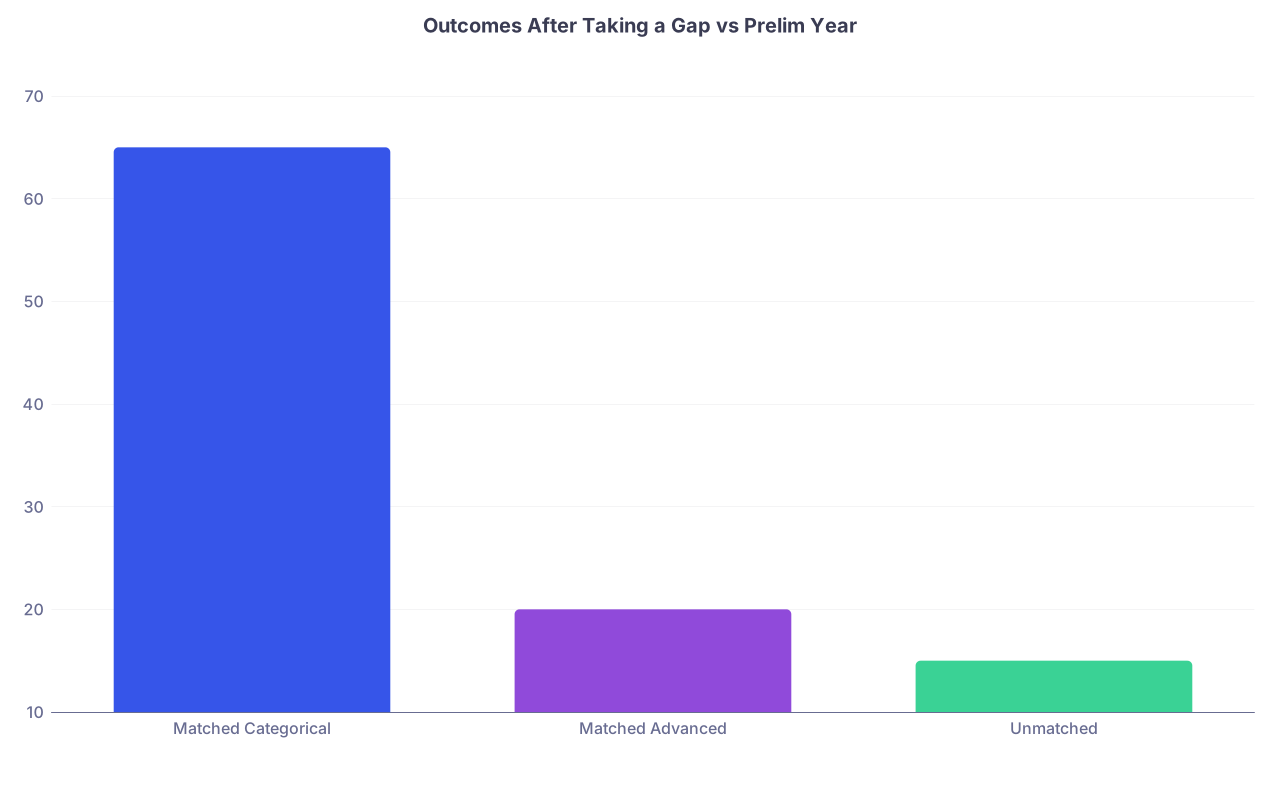
| Category | Value |
|---|---|
| Matched Categorical | 65 |
| Matched Advanced | 20 |
| Unmatched | 15 |
(Think of this as a rough pattern I see: focused improvement years tend to give you a better categorical match rate than scattershot prelim years.)
Option 3: If you already SOAPed into a prelim
If you’re reading this late and already SOAPed into a prelim you didn’t really want, then the question flips:
“Should I use this prelim year to figure out my specialty?”
In that case:
- Yes, use it to clarify.
- But do it deliberately:
- Meet PD and mentors early.
- Tell them your honest goals.
- Get on rotations that help you decide and build letters.
- Start plotting your re‑application EARLY (July–August).
Choosing Between Prelim Medicine, Surgery, And TY If You Must
If you’ve decided a prelim year is actually your best play (after real thinking), here’s how to choose type.
| Prelim Type | Best For | Biggest Risk |
|---|---|---|
| Transitional Year | Broad undecided or advanced fields | Some TYs are super malignant |
| Prelim IM | Future IM, Neuro, Cards, Heme/Onc | High service, less teaching |
| Prelim Surgery | Future Ortho, ENT, Urology, some GS | Brutal hours, limited pivot |
General guidance:
- If you’re truly unsure and have flexibility → a good TY is usually best. Offers mix of medicine, electives, sometimes outpatient.
- If you might land in IM, neuro, PM&R, or cards → prelim IM is safer and more pivot‑friendly.
- If you’re still hoping for a surgical specialty → prelim surgery if you’re realistic about lifestyle and odds.
But again, this is for people who already know they’re going the prelim route, not as a way to avoid choosing.

How Programs View “Prelim‑Only Because I Was Unsure”
Here’s the part most students don’t realize.
When you later apply to a categorical or advanced spot, PDs will ask:
- Why a prelim and not categorical from the start?
- Why this specialty now?
- What changed?
- Did you try to transfer internally?
A vague answer like “I just wasn’t sure what I wanted yet” doesn’t reassure them. It can sound like:
- Poor planning
- Lack of commitment
- Potential flight risk if you get restless again
What actually plays well:
- “I initially aimed for X, didn’t match. I took a prelim in Y, where I discovered [specific experiences] that made me realize [Z specialty] fits me better. I worked closely with Dr. Smith, rotated on [service], and here’s what I’ve done since to commit to Z.”
Specific. Concrete. Narrative arc.
If your only explanation is confusion and passivity, it hurts more than helps.
So, Should You Apply Prelim Only If You’re Unsure?
My answer:
If you’re just unsure about specialty choice and reasonably competitive:
No. Apply broadly to categorical programs in 1–2 realistic fields instead.If you’re both:
- unsure,
- and not competitive for any categorical spot this year,
AND you have a very clear, mentor‑backed plan for how you’ll use a prelim year to pivot → Maybe. But do it eyes wide open.
If you need a prelim as part of an advanced specialty plan (anesthesia, rads, etc.):
Yes, but that’s not “prelim‑only because I’m unsure.” That’s prelim as part of a defined path.
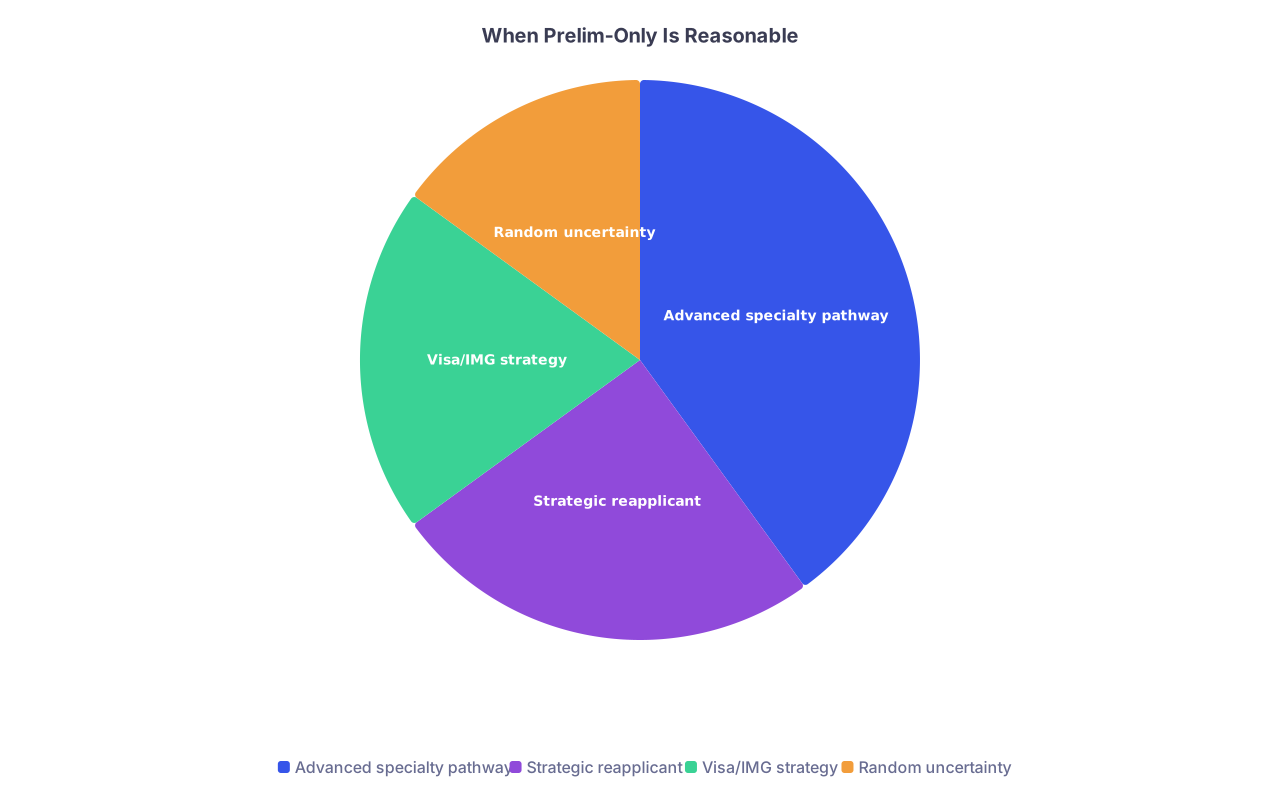
| Category | Value |
|---|---|
| Advanced specialty pathway | 40 |
| Strategic reapplicant | 25 |
| Visa/IMG strategy | 20 |
| Random uncertainty | 15 |
That “random uncertainty” slice? That’s the piece you want to shrink in your own decision‑making.
Practical Next Steps If You’re Stuck Right Now
If you’re in the “I don’t know my specialty and prelim is tempting” camp, do this within the next 1–2 weeks:
- Talk to 2–3 honest faculty who know you (not just your school’s “be nice to everyone” advisor).
- Force yourself to name 2 specialties max you’d actually be okay doing for life.
- Build an application plan anchored on categorical spots in those fields.
- Only add prelim options if:
- You’re also applying advanced spots, OR
- You already know you’ll need a re‑application year and have a concrete plan.

If you’re late in the cycle and panicking, don’t default to “anything prelim.” Panic decisions are almost always bad in the Match.
FAQ: Prelim Years And Specialty Uncertainty
1. Is a prelim year looked down on by residency programs later?
Not automatically. Programs care more about:
- Why you did it
- How you performed
- What you did with that year
If your story is coherent and your evaluations/letters are strong, a prelim year can be neutral or even positive. A vague “I was lost” story isn’t.
2. Is a transitional year better than a prelim IM or surgery year if I’m undecided?
If you can get a good TY, yes, usually. More electives, broader exposure, less brutal call schedules than surgery prelim, and better flexibility to explore. But “good TY” is doing a lot of work here—some are as malignant as any surgery year. Ask current interns before you rank.
3. Can I switch from a prelim spot into a categorical position in the same program?
Sometimes. It depends on:
- Whether they have an open categorical slot
- Your performance and relationships
- Program politics and funding
You can’t count on it. Treat it as a possible bonus, not a plan.
4. If I’m an IMG, is a prelim year better than a research year?
Depends on your profile. A strong prelim IM year with excellent US LORs and good evaluations can help a lot. But some IMGs do better with a focused research year at a big‑name institution that leads to publications and strong letters. You need tailored advice from someone who’s seen many IMGs from your background.
5. What if I already know I hate my prelim specialty halfway through intern year?
First: survive the year and keep evaluations decent. Quietly start:
- Talking with trusted mentors (not blasting it to everyone).
- Exploring realistic alternate specialties (IM, psych, PM&R, etc.).
- Preparing for ERAS early.
You’ll need a strong explanation, clear pivot, and solid letters to make the jump. It’s doable—I’ve seen surgery prelims become great internists—but it takes planning and humility.
Bottom line: Don’t use a prelim year as a parking lot for indecision. Use it only when it’s part of a clear, thought‑through strategy—or skip it and focus on landing a categorical spot where you can actually build a career.