It’s January. You just got an email from a prelim internal medicine program: “We sponsor only J‑1 visas. Categorical positions only.”
Your stomach drops. You matched (or are applying) to a PGY‑1 preliminary year, but your actual specialty is anesthesiology, radiology, neurology, or something else that starts PGY‑2. You need two programs to line up: the prelim and the advanced program. And you need a visa that makes sense for both.
This is where people get burned. Not because they’re lazy. Because the system is fragmented, HR is rigid, and nobody feels responsible for seeing your entire visa path from PGY‑1 to board eligibility.
Let me walk you through how to handle this like an adult who has read the fine print.
1. First, be brutally clear on your situation
You’re in (or aiming for) one of these setups:
- Prelim year + advanced program in the same institution
- Prelim year + advanced program at different institutions
- You’ve matched prelim only and will apply to advanced later
- You’re doing a transitional year as a buffer and then advanced
All of these combine with one of these immigration realities:
- You’re already on F‑1 with OPT
- You’re on another status (H‑4, H‑1B from spouse, etc.)
- You’ll need visa sponsorship from scratch (no US status)
Now add one more axis: visa type.
| Status | Typical Use | Years Allowed | Needs Sponsoring Employer? |
|---|---|---|---|
| J-1 | Most IMGs | Up to 7 yrs | Yes, via ECFMG |
| H-1B | Some IMGs | Max 6 yrs | Yes, directly by hospital |
| F-1 OPT | Fresh grads | 1–3 yrs | No, but only temporary |
If you don’t nail down how your prelim year and advanced years connect from an immigration perspective, you risk a gap year you didn’t want, or worse, not being able to start your PGY‑2.
2. The core problem with preliminary years for visas
Here’s the structural issue:
A categorical program covers PGY‑1 to completion. One employer. One visa plan. Straightforward.
A preliminary + advanced combo is at least two employers with two HR teams, two sets of lawyers, and usually no communication between them.
Common failure modes I’ve seen:
Prelim program: “We only do J‑1.”
Advanced program: “We only do H‑1B.”
Result: You’re stuck unless one side bends. Usually they don’t.Advanced program requires USMLE Step 3 before H‑1B filing.
Prelim program doesn’t give enough time off or doesn’t care.
Result: You can’t get H‑1B filed in time for PGY‑2 start.J‑1 maximum years run out.
You did a prelim in medicine, then changed your mind, did neurology, plus extra research years. Now you’re pushing the 7‑year limit.
Result: ECFMG may refuse extension.
So your job is not just “get a visa.” It’s “design a visa path that covers PGY‑1 through completion of residency without breaking mid‑way.”
3. J‑1 vs H‑1B when your first year is preliminary
Let’s be blunt.
If either your prelim or advanced program is J‑1‑only, you need to assume you will be J‑1 for the entire training period. Yes, switching from J‑1 to H‑1B midway is sometimes possible. It’s also slow, risky, and not something you can depend on.
When J‑1 is usually the path of least resistance
- Both prelim and advanced are happy with J‑1
- You’re not doing a super long path (e.g., IM + cards + EP + extra research)
- You’re okay with the J‑1 2‑year home residency requirement and future waiver grind
Key J‑1 points in a prelim situation:
- Sponsorship is via ECFMG, not directly from hospital
- You can move institutions between prelim and advanced as long as ECFMG approves the transfer and total years don’t exceed the limit
- You need a DS‑2019 for each year; there’s bureaucracy with each extension/transfer
Where people mess up: they accept a long research year between prelim and advanced on J‑1 and then later realize they’re out of J‑1 years before finishing all fellowship plans.
When H‑1B might make sense (but is harder with prelim)
H‑1B is attractive if:
- You want to avoid the J‑1 2‑year home requirement
- Your long‑term plan depends on easier transition to attending jobs or O‑1 etc.
But with prelim years, H‑1B has some traps.
Most programs that sponsor H‑1B for residency:
- Require USMLE Step 3 passed before they file
- Prefer direct H‑1B from PGY‑1 (categorical) because splitting petitions (PGY‑1 at one hospital, PGY‑2+ at another) is more paperwork
If your prelim program says “we don’t do H‑1B,” and your advanced does, a common viable sequence is:
- PGY‑1 on J‑1
- PGY‑2+ on H‑1B
This is technically possible but requires all of the following to align:
- Advanced program HR and lawyers are willing to petition for H‑1B for someone currently on J‑1 (yes, you still have the 2‑year home rule if you go back later; it gets messy).
- Timing works for Step 3 and H‑1B filing.
- ECFMG is okay with ending your J‑1 training early.
You cannot bank on this without explicit written confirmation from the advanced program’s GME office and legal.
My usual stance:
If your prelim program is J‑1–only, you should mentally commit to a J‑1 training track unless you have a very strong, written, attorney‑reviewed plan otherwise.
4. Step‑by‑step: what to do before you rank prelim programs
If you’re still in the application/ranking phase, you actually have leverage. Use it.
Here’s the order of operations I’d follow.
Step 1: Build a simple visa grid for every prelim and advanced program
Yes, literally make a grid.
| Program | Type | J-1? | H-1B? | Step 3 Required for H1? |
|---|---|---|---|---|
| Hospital A IM | Prelim | Yes | No | N/A |
| Hospital B Neuro | Advanced | Yes | Yes | Yes, before April 1 |
| Hospital C Anes | Advanced | No | Yes | Before contract sign |
Email GME offices (not just coordinators) and ask very targeted questions:
- “For PGY‑1 preliminary residents, which visa types do you sponsor (J‑1, H‑1B, other)?”
- “Have you ever sponsored H‑1B for a preliminary resident? If yes, how often?”
- “Do you anticipate any policy changes for the upcoming year regarding visa sponsorship?”
For advanced programs:
- “For PGY‑2+ advanced positions, which visas do you sponsor?”
- “If a resident begins PGY‑1 on J‑1 at another institution, have you previously transferred them to H‑1B for PGY‑2, or do they typically remain on J‑1?”
- “Is USMLE Step 3 required for H‑1B filing, and by what deadline (month/year)?”
Anyone who answers vaguely: assume the stricter, less helpful policy.
Step 2: Rank with visa alignment in mind, not just prestige
You might be tempted to rank the “brand name” prelim or advanced program higher.
If you’re an IMG needing sponsorship, that’s often a bad trade if their visa policies are inflexible. A mid‑tier program that reliably supports J‑1 or H‑1B consistently is better than a big‑name program that “might” sponsor you this year.
When in doubt:
- Same‑institution prelim + advanced with a clear, written visa plan > fancy disconnected institutions with unclear policies.
Step 3: Put your situation in your communication
If you’re emailing PDs or coordinators:
- Be explicit: “I will require visa sponsorship for residency. I’m particularly concerned about continuity between a preliminary year and my advanced position. Has your program successfully handled this scenario before?”
You’re not asking for legal advice. You’re forcing them to tell you if this is a solved problem for them or you’ll be their first experiment.
5. If you’ve already matched prelim and your visa path looks shaky
Okay, you matched. Now you’re realizing the policy clash:
- Prelim J‑1 only
- Advanced prefers H‑1B only
- Or you matched prelim only and haven’t locked advanced yet
This is salvageable in some cases, but you need to act early and systematically.
Step 1: Talk to both GME offices – on record, but not adversarial
You email something like:
“Dear [GME Director/Coordinator],
I’m excited to start my PGY‑1 preliminary year in [specialty] in July. I’ll need visa sponsorship for residency and want to plan a continuous path from PGY‑1 through completion of my advanced training.
Could you please confirm:
- Which visa types your institution sponsors for preliminary residents?
- Whether you have previously had residents transition from your prelim program to an advanced program at another institution, and how their visas were handled?
I want to be sure I plan Step 3 timing and any required documentation properly to avoid interruptions in training.
Best regards,
[Your Name]”
Do the same with the advanced program (if you’ve matched or are heavily targeting them).
You want written confirmation of policy and prior experience.
Step 2: Get an immigration attorney involved early
Do not rely solely on “the hospital lawyer said it’s fine.” Their job is to protect the institution, not your career.
You want an attorney who:
- Knows J‑1 and H‑1B specifically for GME
- Has seen prelim + advanced transfers before
- Is willing to tell you “this is too risky, don’t do it”
Let them map scenarios like:
- J‑1 for prelim → J‑1 for advanced
- J‑1 for prelim → H‑1B for advanced
- F‑1 OPT for prelim → H‑1B for advanced
- Direct H‑1B from PGY‑1 (if somehow an option)
Have them flag red‑line constraints: timing of Step 3, cap‑exempt vs cap‑subject H‑1B, total J‑1 years, any home country funding you’ve had that could complicate things.
Step 3: Time your Step 3 like it’s mission critical (because it is)
If there’s any shot of H‑1B at the advanced program, you usually need:
- Step 3 passed by late winter/early spring of PGY‑1
- Score report in hand before their internal H‑1B filing deadline (which can be much earlier than USCIS deadlines)
Map this out with a simple timeline.
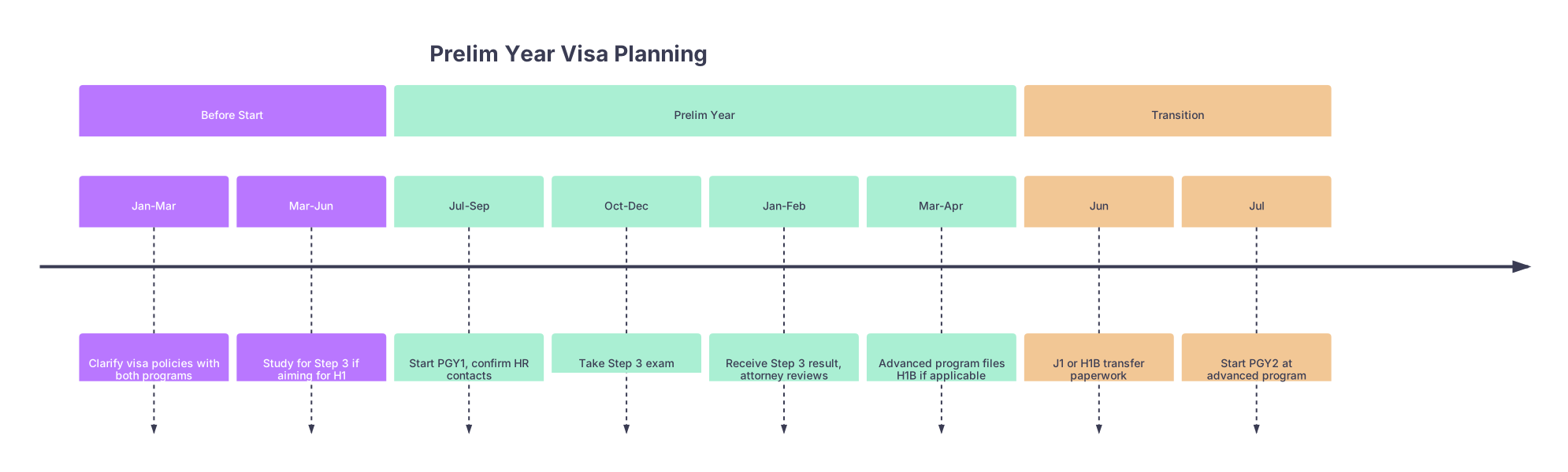
| Period | Event |
|---|---|
| Before Start - Jan-Mar | Clarify visa policies with both programs |
| Before Start - Mar-Jun | Study for Step 3 if aiming for H1 |
| Prelim Year - Jul-Sep | Start PGY1, confirm HR contacts |
| Prelim Year - Oct-Dec | Take Step 3 exam |
| Prelim Year - Jan-Feb | Receive Step 3 result, attorney reviews |
| Prelim Year - Mar-Apr | Advanced program files H1B if applicable |
| Transition - Jun | J1 or H1B transfer paperwork |
| Transition - Jul | Start PGY2 at advanced program |
If your prelim schedule is brutal (surgery, busy IM) and Step 3 timing looks impossible, that’s a strong argument against any plan that hinges on H‑1B for PGY‑2.
6. Special case: F‑1 OPT + preliminary year
If you’re graduating from a US med school on F‑1, sometimes schools push a neat‑sounding idea:
“Just use OPT for the prelim year, then convert to H‑1B for your advanced program.”
Sometimes it works. Sometimes it’s a trap.
Pros:
- You don’t need visa sponsorship for the prelim year
- You buy some time to pass Step 3 and let the advanced program plan H‑1B
Cons and gotchas:
- OPT is usually 12 months. Most prelim years are 12 months. Any start delays, onboarding delays, or bureaucratic glitches can leave you with a gap at the end.
- If your advanced program wants your H‑1B effective July 1, you need to file months earlier. But you might still be on F‑1 OPT at that time. This can be fine if handled well, or a mess if not.
- If you’re planning a gap or research year between prelim and advanced, OPT often won’t cover it cleanly.
Again, you need an actual immigration lawyer to look at your dates, not generic internet advice.
7. Programs that change their mind after you match
Yes, it happens.
You matched. Then:
- New GME director.
- New institutional policy: “We are moving away from H‑1B.”
- Suddenly, your carefully planned path is gone.
This is what I’d do:
- Pull your email trail. If anyone at the program gave you written assurances about visa sponsorship prior to ranking, that’s leverage. Not legal leverage necessarily, but moral/relationship leverage.
- Ask for a meeting with the PD + GME office, not just a coordinator. Calm, clear, not emotional. “I ranked your program assuming [X visa path]. The policy change puts my ability to train at risk. What options can we explore?”
- Get your attorney to outline alternatives that are possible (e.g., J‑1 instead of H‑1B, adjusted timing, etc.). Offer concrete paths, not just complaints.
Programs sometimes make exceptions to general policies when:
- They realize they already committed informally
- You show them a clear, feasible legal path
- You’re early enough in the cycle that paperwork is still doable
If they absolutely won’t budge, you at least know early and can explore worst‑case options: reapplying, deferring, or re‑designing your training sequence.
8. What to watch out for in contracts and onboarding packets
Don’t just sign the contract and toss the handbook in a drawer.
Watch for:
- Language that says: “Visa sponsorship is at the sole discretion of the institution and may change at any time” – that’s standard, but see if there’s any more detailed visa section or policy attachment.
- Any explicit mention: “Institution does not sponsor H‑1B for preliminary positions.” If you see this in writing and your plan was H‑1B, you need to renegotiate your expectations immediately.
- Timelines they give for credentialing and visa paperwork. If the onboarding form says “Return visa documents by March 1,” meet that. Early.
If something does not match what you were told by email, screenshot everything and ask, in writing: “Can you confirm that despite the general policy, my specific situation will be handled as we discussed on [date]?”
You want them to reconcile those differences explicitly.
9. How to think strategically about specialty choice + prelim + visas
Some specialties practically force a prelim + advanced structure (anesthesia, radiology, neurology, PM&R, derm in many places).
If you’re an IMG with visa needs, you should be more conservative about:
- Highly competitive advanced specialties that offer very few H‑1B sponsorships
- Niches that require extra research years that may push your J‑1 clock
If you are not yet locked into a specialty and your visa situation is complex, a categorical IM or FM program that reliably sponsors J‑1 could be a far more stable long‑term path than trying to juggle prelim + advanced + H‑1B fantasies in something ultra‑competitive.
I’ve watched people spend 3–4 years on J‑1 in various prelim/transitional/research roles, then run out of J‑1 years and realize they can’t finish the advanced residency + fellowship they wanted. That’s a devastating way to learn about visa math.
10. Concrete checklist for “I’m starting a prelim year soon and need to not get screwed”
Use this as a sanity check:
- Do I know, in writing, which visas my prelim program will sponsor for me?
- Do I know, in writing, which visas my advanced (current or target) program sponsors?
- Have I confirmed whether they’ve successfully handled prelim‑to‑advanced visa transitions before?
- Have I spoken to an independent immigration attorney about my specific sequence and years needed?
- If H‑1B is in the plan:
- Do I have a realistic Step 3 study + exam timeline?
- Do I know the advanced program’s internal H‑1B deadlines?
- If J‑1 is in the plan:
- Have I counted total expected training years (prelim + advanced + possible fellowship + any research)?
- Am I okay with the 2‑year home requirement and waiver process later?
- Are all key promises and clarifications from programs documented in email, not just verbal?
If you can’t answer “yes” to most of that, your first priority is not “finding housing” or “ordering a white coat.” It’s fixing your visa map.