

The year between your prelim and advanced spot can either launch your career forward—or quietly wreck it.
First, be brutally clear on what situation you’re in
Before you “use the gap productively,” you need to know exactly what kind of gap this is. The details change the rules.
Common gap scenarios
| Scenario | Match Outcome | Typical Risk Level |
|---|---|---|
| Matched Prelim + Advanced Same Year | Planned gap (rare) | Low–Medium |
| Matched Prelim Only | Need to reapply for advanced | High |
| Matched Advanced Only | Need transitional/PGY-1 spot | High |
| Did Prelim, No Advanced Yet | Taking ad hoc year then reapplying | High |
| SOAP/Off-cycle Prelim | Unplanned, chaotic path to advanced | High |
Here’s what you might be dealing with:
- You matched a prelim year but did not match an advanced spot (e.g., radiology, anesthesia, derm, neuro, PM&R).
- You matched both, but your advanced position starts a year later than your prelim ends (less common but happens with off-cycle or visa issues).
- You finished a prelim or transitional year, things went sideways (evaluation issues, visa, personal crisis), and now you’re staring at an unplanned gap.
Those are very different lives. But the core questions are the same:
- How do you stay clinically relevant and safe?
- How do you stay employable and matchable?
- How do you avoid red flags that will haunt you for years?
Let’s go through this like you’re sitting in my office, telling me, “I have a gap year between prelim and advanced. What do I actually do?”
Non‑negotiable step: Protect your license, record, and sanity
If you ignore everything else, do not ignore this section.
1. Get crystal clear documentation from your prelim program
Do this before you leave. Not 3 months later when GME has moved on and your PD barely remembers you.
Ask for:
- A formal letter from your program director stating:
- Dates of training (exact start and end)
- Level completed (e.g., “completed PGY-1 in internal medicine”)
- Status (in good standing / completed prelim year as expected)
- Confirmation that you’ll receive:
- Final summative evaluation
- Case/procedure logs (if relevant)
- Any milestones or competency assessments
You want language like: “Dr. X successfully completed a preliminary year in internal medicine from July 1, 20XX to June 30, 20XY in good standing.”
If there was probation, significant remediation, or any concerns—know exactly what’s in writing. Programs talk. You do not want to learn later that your PD is quietly telling people, “Yeah, we had issues.”
2. Understand your legal/credentialing status
You need to know:
- Do you have any version of a state license? (training license vs full license)
- When does it expire?
- Do you have any malpractice coverage that extends beyond your prelim year? (Tail coverage for past activity is normal; coverage for new clinical work is not.)
If you’re going to moonlight, locum, or do any independent clinical work during the gap, the combo of license + malpractice + hospital privileges must all be correct. If any of those are wrong, you are one bad case away from a career-ending problem.
3. Set a mental health baseline
You’re coming off a brutal prelim year. I’ve seen plenty of people hit the wall in the gap year because:
- Their identity has been “resident” and now they feel purposeless
- They’re anxious about matching into the advanced spot
- They overcommit to “productivity” and burn out in a year that was supposed to help
See your own doctor. If you have a therapist, keep them. If you do not, consider getting one before everything unravels. You are not a machine—this gap will stress you in new ways.
If you already have an advanced spot secured
You hit the lottery of gap years. Still needs structure, though.
Template: you finished prelim, advanced position starts a year later (off-cycle scheduling, military delay, visa timing, spouse issues, etc.).
Your objectives:
- Stay clinically sharp enough that you’re not dangerous on day one
- Avoid any professional red flags
- Use the gap to build skills that your advanced specialty will respect
1. Confirm with your future program what they actually want you to do
Do not guess. Email or meet with your future PD or APD.
Ask them directly:
- “Given that I have this gap year, what would you most like to see me do to prepare?”
- “Are there things you would not want me doing—for example, certain kinds of non-clinical work, travel, etc.?”
- “Can I do research or a clinical role affiliated with your department before my official start date?”
Sometimes they’ll say: “Honestly, rest, travel a bit, then do some light clinical work or research. We don’t need you grinding.”
Other times, especially in procedurally heavy fields: “Do a surgical prelim/ICU or clinically intensive year if you can swing it.”
Get their preferences in writing (even an email) and align with that. It also reassures them you’re serious.
2. Pick 1–2 main pillars for the year, not 6
The biggest mistake I see: people try to do everything. Research + moonlighting + teaching + fellowship-level reading + traveling. They end up exhausted and scattered.
Better approach: choose one or two primary focuses and do them well.
Possible pillar combinations:
- Research + light clinical shifts
- Teaching/academics + research
- Family/life recovery + part-time clinic
- Industry/consulting experience + structured board review
Your PD will respect depth over frantic activity.
3. If you do clinical work, keep it structured and supervised
A very sane option: stay affiliated with your prelim institution or another academic center in a defined role:
- Clinical instructor/junior hospitalist with strong supervision
- Research fellow with some clinical time
- Post-doctoral clinical research position with call shifts
What you want:
- Clear attending backup
- Clear scope of practice
- Documented teaching and performance you can later show
What you don’t want:
- Random urgent care in a strip mall with sketchy malpractice
- Locums gigs in understaffed rural hospitals where you’re basically the only doctor overnight as a fresh PGY-1 graduate
Could you technically do the latter with the right license? Maybe. Would I advise it during a gap year tied to your future specialty? Almost never. Too much risk, not enough upside.
4. Use the time to pre-hab for your field
Examples:
- Going into anesthesiology or critical care–heavy field:
- Pick up extra ICU exposure if possible
- Systematically review ventilators, hemodynamics, sedation, procedures
- Going into radiology:
- Structured radiology curriculum (Core Radiology, radprimer, etc.)
- Maybe a research fellowship in radiology at your future institution
- Going into derm:
- High-quality derm clinic time, derm research, imaging review projects
One hidden benefit: if you show up day 1 of advanced training obviously better prepared than expected, your reputation starts on an upslope.
If you don’t have an advanced spot yet (reapplying)
This is where the gap can save you or sink you.
You’re in the “matched prelim only” or “did prelim, no advanced yet” group. The question from every PD will be:
“What did you do with that year?”
They are not asking out of curiosity. They are screening for red flags.
1. Decide your story first, then build the year to match
Your story needs to sound like this, in some version:
“I used this year to strengthen the exact weaknesses that kept me from matching, stay clinically engaged, and prove that I function well as a physician.”
So you need to know: why didn’t you match?
Potential reasons:
- Step/COMLEX scores weak for the specialty
- Applied too narrowly or too few programs
- Weak letters, no one went to bat for you
- Late app, poor personal statement, scattered application
- Interview performance was flat or awkward
- Visa issues or other logistical problems
You don’t fix those by vaguely “doing research” or “working in a clinic.”
You fix those by targeted decisions:
- Weak clinical evals? You need a tightly supervised, documented clinical role with strong letters.
- Weak scores? You need to crush Step 3 or other exams during this year.
- Weak specialty exposure? You need meaningful work in that exact specialty, not random FM clinic.
2. Concrete options that actually help you match
Here are realistic, defensible paths I’ve seen work.
A. Chief resident / junior faculty role at your prelim program
If they like you and have funding, this can be gold. Example titles:
- “Clinical associate”
- “Junior faculty hospitalist”
- “Prelim chief resident” (in some smaller IM programs)
Why this works:
- Shows continuity, trust, responsibility
- Generates strong new letters
- Clear explanation: “I stayed to teach and strengthen my clinical skills while reapplying.”
The risk: you get overworked and have no time for applications. You must have protected time early in the cycle for ERAS, letters, and interviews. Negotiate that up front.
B. Formal research year in your target specialty
This is especially powerful for:
- Derm
- Rad onc
- Neurosurgery
- Ortho
- ENT
- Competitive fields where research is a quasi-requirement
You want:
- A research mentor who has matched people before
- Projects that can realistically lead to abstracts/pubs in 6–12 months
- A clinical component if at all possible (clinic sessions, tumor boards, case conferences)
Be honest with yourself: “Gap year research” that turns into 0 publications, no posters, and a generic letter is almost useless. Choose carefully.
C. Another structured clinical year (second prelim, TY, or categorical in another field)
Sometimes, your best move is to pivot into a categorical position in a less competitive field and then later try to transfer.
Or you repeat intern year in a field closer to your target (e.g., IM prelim → neurology advanced attempts again with a second year and stronger letters).
This is advanced maneuvering and needs faculty guidance. Blindly collecting intern years without a plan just looks chaotic.
3. Avoid the “I kind of floated for a year” trap
Here’s what sounds bad to PDs:
- “I did some moonlighting here and there, helped in a clinic, traveled a bit, and reapplied.”
- “I took time off for personal reasons” with no specific, verifiable structure (unless it’s a genuine health/family crisis, in which case it needs to be framed clearly and honestly).
You don’t have to be on 80-hour weeks. But you need:
- A clear primary affiliation (hospital, university, lab, organization)
- A responsible-sounding title
- Someone who can write a letter this year and say: “I saw them work, and they’re good.”
4. Get ahead of the ERAS timeline and your application strategy
You no longer have the excuse of “I was an intern working 80 hours; I didn’t have time to refine my application.”
Your gap year timeline should be aggressive:
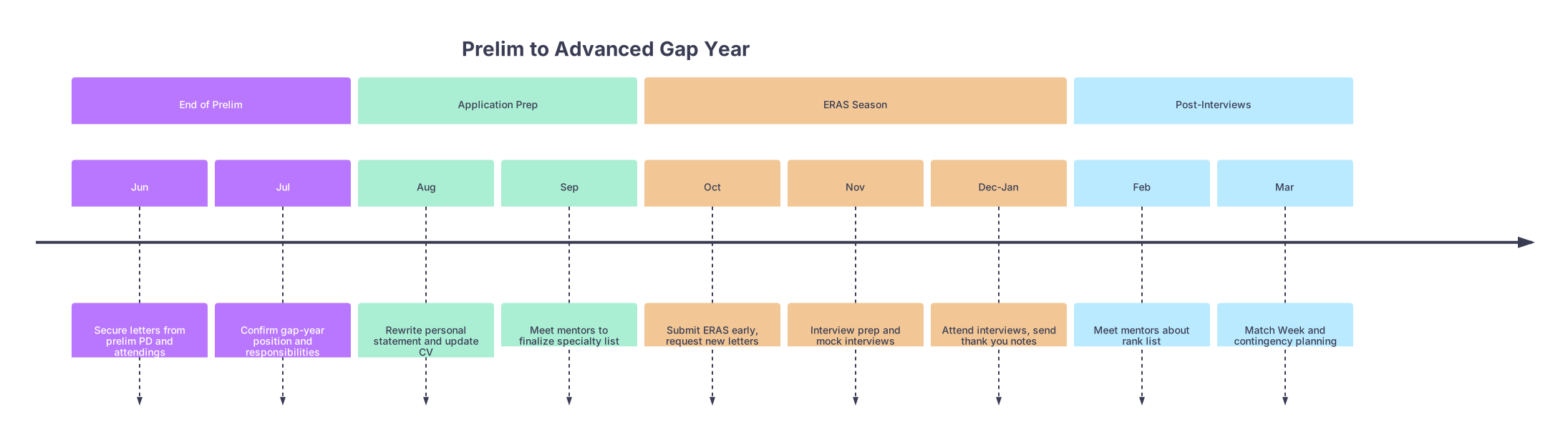
| Period | Event |
|---|---|
| End of Prelim - Jun | Secure letters from prelim PD and attendings |
| End of Prelim - Jul | Confirm gap-year position and responsibilities |
| Application Prep - Aug | Rewrite personal statement and update CV |
| Application Prep - Sep | Meet mentors to finalize specialty list |
| ERAS Season - Oct | Submit ERAS early, request new letters |
| ERAS Season - Nov | Interview prep and mock interviews |
| ERAS Season - Dec-Jan | Attend interviews, send thank you notes |
| Post-Interviews - Feb | Meet mentors about rank list |
| Post-Interviews - Mar | Match Week and contingency planning |
Do not sleepwalk into another failed cycle. Use mentors at your prelim program and at your gap-year institution to:
- Build a school list that matches your competitiveness
- Fix your personal statement and experiences
- Practice interviews with people who aren’t afraid to tell you the truth
If your gap was unplanned and messy (probation, leave, health issues)
This group needs the most careful planning.
Maybe:
- You left your prelim year early
- You had extended leave for medical or mental health reasons
- You had professionalism issues and barely finished
First: you’re not done. You’re not “canceled.” But you can’t spin this casually.
You need three things:
- A coherent, honest, non-dramatic explanation
- Evidence that the issue has been addressed and resolved or is under control
- At least one respected physician willing to say, “I would trust this person with my patients”
1. Nail the explanation script
You want a short, repeatable version that:
- Owns the problem
- Explains the correction
- Ends on stability and growth
For example, for a mental health leave:
“I struggled with significant depression during my prelim year, which affected my performance and reliability. I took a leave, got formal treatment, and worked with my physicians to stabilize. Over the last X months, I’ve consistently [worked/volunteered/participated] in [setting], with strong evaluations and no recurrence. I’m now ready to return to structured training with specific supports in place.”
Never throw your program under the bus. Even if they were awful. PDs hate hearing: “My old program was toxic, they didn’t support me.”
2. Choose ultra-structured, supervised work
This is not the time for solo moonlighting heroics. You need:
- Tight supervision
- Clear feedback
- Someone who can truthfully say, “I’d rehire them”
Think:
- Part-time hospital-based clinic work under a known faculty member
- Research assistant/fellow with some clinical exposure
- Teaching-heavy roles (simulation lab, OSCEs, med student courses) plus documented reliability
3. Loop in GME/physician health if needed
If there were formal reports, board notifications, or physician health involvement, you need to understand exactly what’s in your file and what will follow you.
This is where you talk to:
- A trusted attending who’s been a PD or APD
- Possibly a physician attorney or advisor if things got very formal
Better to know the ugly truth and work around it than live in denial and be shocked when future programs bring it up.
Productivity without self-destruction: how to design the actual year
You’ve got the big picture. Now, week to week, what does a “productive and safe” gap year actually look like?
Think in four buckets:
- Clinical engagement
- Application/career building
- Financial survival
- Health and personal life
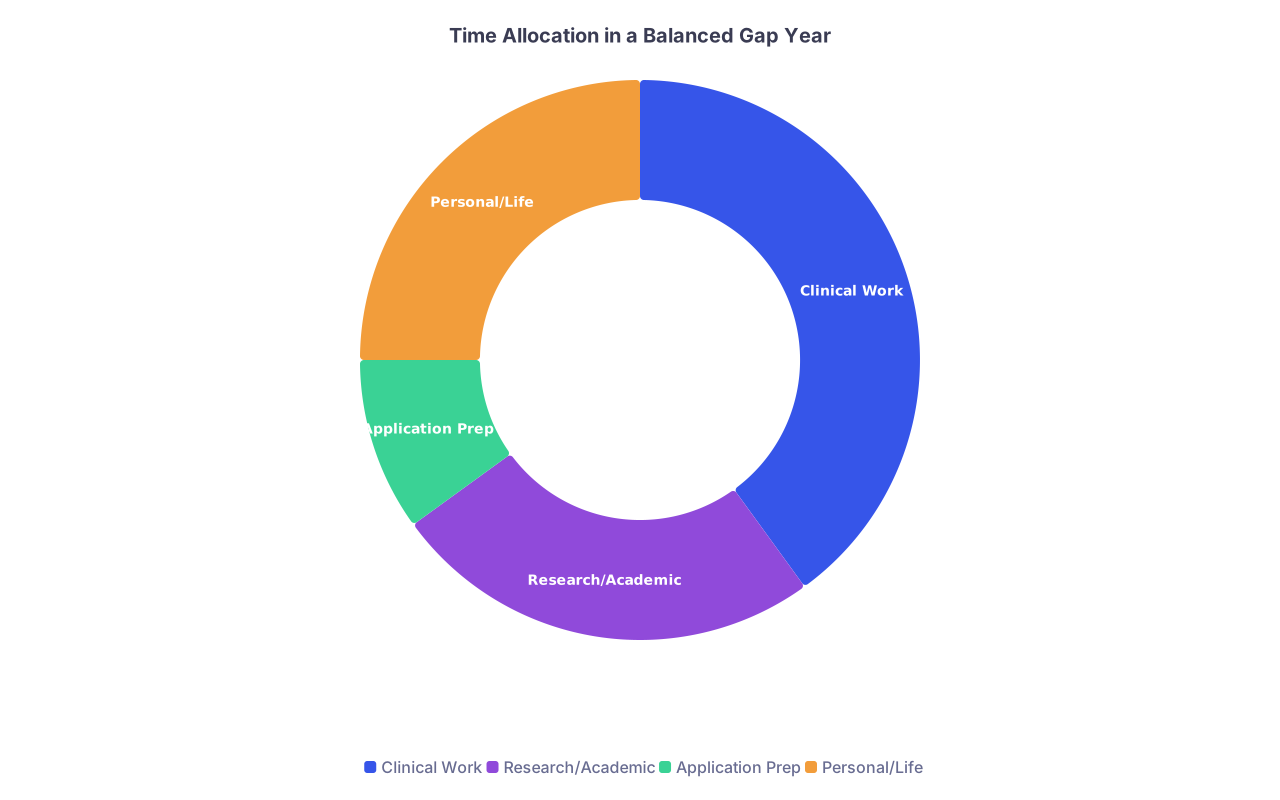
| Category | Value |
|---|---|
| Clinical Work | 40 |
| Research/Academic | 25 |
| Application Prep | 10 |
| Personal/Life | 25 |
You don’t have to match these percentages exactly, but they’re a good sanity check.
Clinical engagement
Goal: do enough that you stay sharp and supervised, not so much that you can’t think straight.
- 1–3 days a week of clinic or inpatient work is often ideal
- If you’re in research, 1 clinic half-day per week is still very valuable
- Pick settings close to your target specialty if you can
Application/career building
Schedule this like it’s a job, not an afterthought.
- Weekly dedicated block for:
- ERAS editing
- Emailing mentors
- Research project progress
- Interview prep
If you wait until August/September and try to “fit it in,” you will half-ass it. And that’s how reapplicants stay reapplicants.
Financial survival
Reality check: you will likely earn less than as a resident, depending on your setup.
Do a basic financial map:
- What’s your minimum monthly burn?
- How much can your gap-year position realistically pay?
- Are there safe, low-risk moonlighting options after you’re established somewhere?
Do not take high-risk, unsupervised clinical gigs purely for money if your record or readiness is questionable. One bad outcome is not worth 12 months of slightly better cash flow.
Health and personal life
Use the gap for things residency normally crushes:
- Fix chronic health issues you’ve ignored
- See specialists you’ve put off
- Address sleep, exercise, diet like a serious adult, not a PGY-1 zombie
You are entering a long career. Use this breathing room strategically, not just for Netflix marathons.
How to talk about the gap without sounding defensive
You will get asked about this. On applications, in interviews, casually on day one of your advanced program.
Your answer should hit three beats:
- Context – “I had a gap between my prelim year and advanced training because…”
- Action – “During that time I…” (be concrete: roles, responsibilities, outputs)
- Growth – “From that experience I gained…” (skills, perspective, stability, maturity)
Keep it short. Confident. No oversharing. No apologies every other sentence.
Example:
“I matched into a preliminary internal medicine position but not an advanced neurology spot on my first attempt. I used the year after prelim to work as a clinical associate on the hospitalist service and joined a stroke outcomes research group. I strengthened my clinical judgment, got to care for a wide range of complex patients, and produced two abstracts that deepened my interest in vascular neurology. It confirmed that neurology is where I want to be, and I’m better prepared for residency because of that year.”
That’s the tone you’re aiming for.
When to say no during the gap year
You will be tempted to say yes to every “opportunity.” You shouldn’t.
Red flags to decline or at least scrutinize hard:
- Clinical work where:
- You’re the only doctor on site with no backup
- Malpractice coverage is vague or cheap-looking
- The expectations clearly exceed your training level
- “Research” with:
- No clear mentor
- No realistic path to outputs within 12 months
- Vague promises and no track record of helping people match
- Roles that:
- Consume all your time but produce nothing you can put on ERAS
- Start late enough that they’ll eat your entire application season
If it doesn’t clearly help you:
- stay safe
- stay employable
- or get closer to your specialty goal
…then you can say no.
Key points to walk away with:
- Start by defining your exact gap scenario and securing your paper trail—letters, evaluations, license, and malpractice status—before the prelim year ends.
- Build a coherent story with your year: one or two main roles, clear supervision, tangible outcomes, and a direct link to your target specialty or your professional rehabilitation.
- Guard your safety and future: avoid sketchy unsupervised clinical work, protect your mental and physical health, and be ready to explain the gap confidently as a period of purposeful growth, not drift.


