

You are three months into your prelim year, already quietly drafting a new personal statement. You ask your PD for a letter or just a simple “we support your re‑application.” They dodge. Or worse, they flat out say no. Now you’re in a program that will gladly use your labor for a year but won’t back you when you try to move on.
If that’s where you are: this is the playbook. No fluff, no “it’ll all work out.” Here’s what to do when your prelim program will not support your re‑match.
Quick Reality Check: What “No Support” Actually Means
First, be very clear about what kind of “no” you’re getting. They are not all equal.

You might be seeing one or more of these:
| Type of “No” | What It Actually Means |
|---|---|
| No letter at all | You are on your own for LORs |
| Letter but not “good” | Risk of neutral or backhanded comments |
| Verbal support only | Nothing concrete for ERAS |
| Refusal to check “eligible” | They will not confirm you can continue |
| Hostility if you apply | They may subtly sabotage or badmouth you |
The most dangerous forms are:
- A PD who refuses to write anything and blocks others from writing.
- A PD willing to write, but clearly angry you’re leaving and likely to poison the letter.
- A program that will not confirm you’re in “good standing” if another place calls.
You can still re‑match from all of these situations. I’ve watched people do it. It just means you must stop assuming your current program is part of your strategy. You build a parallel track.
Step 1: Stop Bleeding – Protect Your Reputation Inside the Program
The instinct is to emotionally check out and start “focusing on applications.” That will get you burned.
You have two jobs right now:
- Do not give them new ammunition.
- Quietly build allies who will speak well of you even if the PD will not.
Concrete actions:
- Be relentlessly on time. Every shift. Every conference you can physically attend.
- Document your work. When you make a big save, did extra work for a service, or covered for someone, keep a tiny log for yourself. Names, dates, details. This becomes talking points for LOR writers outside your PD.
- Be low‑maintenance. Do not complain. Do not badmouth the program to other residents (you have no idea who will repeat what).
- If you’ve already had friction: request a short “feedback meeting” framed as “I want to improve.” Take notes. Use their own words later when you say, “After feedback from my PD, I worked on X, Y, Z…”
You’re not trying to win them over. You’re trying to make it harder for them to justify any narrative that you’re unsafe, lazy, or toxic.
Step 2: Clarify Exactly What Support You’re NOT Getting
You cannot plan around a vague sense of “they’re not supportive.” You need data.
Have one focused conversation. Something like:
“I’m planning to apply for [categorical X / PGY‑2 Y] this cycle. I want to be clear on what, if any, support I can expect from the program.
- Would you be willing to write a letter of recommendation?
- If not, may I ask other faculty in the department or hospital for letters?
- If programs contact you, are you able to confirm I’m in good standing and eligible to continue?
I want to plan realistically and not put you in a position you’re not comfortable with.”
Do this once. By email (for a paper trail) followed by a brief meeting if needed.
Three typical outcomes:
“No letter, but you can ask others.”
Annoying but manageable. You pivot hard to non‑PD letters.“I’ll write a letter, but I don’t support you leaving.”
Translation: high risk of a lukewarm or harmful letter. Decline politely:
“Thank you, I don’t want to put you in a difficult position. I’ll ask others who’ve worked more closely with me on service X/Y.”“I don’t support you applying at all.”
This is the worst. You’re on your own. You act like you will get no help and possibly quiet opposition.
Once you know which box you’re in, you stop wasting time hoping. You start building around it.
Step 3: Build an Alternate Letter Strategy (Without Your PD)
Letters win this game. You just have to get them from different angles.
Who you target for letters
Aim for at least 3 solid letters with the following priority:
Faculty who directly supervised you on rotations
“I saw this resident on nights for 4 weeks; they’re safe, hardworking, teachable.” That matters a lot more than title.Section chiefs / service directors who like you
The ICU director, the hospitalist lead, the surgery attending who runs the acute care service. Not PDs, but in charge of something.Old medical school or prior research mentors
Especially if they can speak to your reliability and trajectory. Yes, they’re older, but they help anchor your narrative: “I’ve known this person for 4+ years.”
If faculty are afraid of crossing your PD, you frame the ask carefully:
“I understand politics here are complicated and I don’t want to put you in an awkward spot. If you’re comfortable writing about your experience supervising me clinically on [rotation X], I’d be grateful. If not, I completely understand.”
Many will still help, especially if they’ve watched you work nights, manage sick patients, etc.
Step 4: Decide Your Actual Target – Categorical, PGY‑2, SOAP, or All Three
You cannot just “reapply broadly” without a clear plan. Different goals need different tactics.
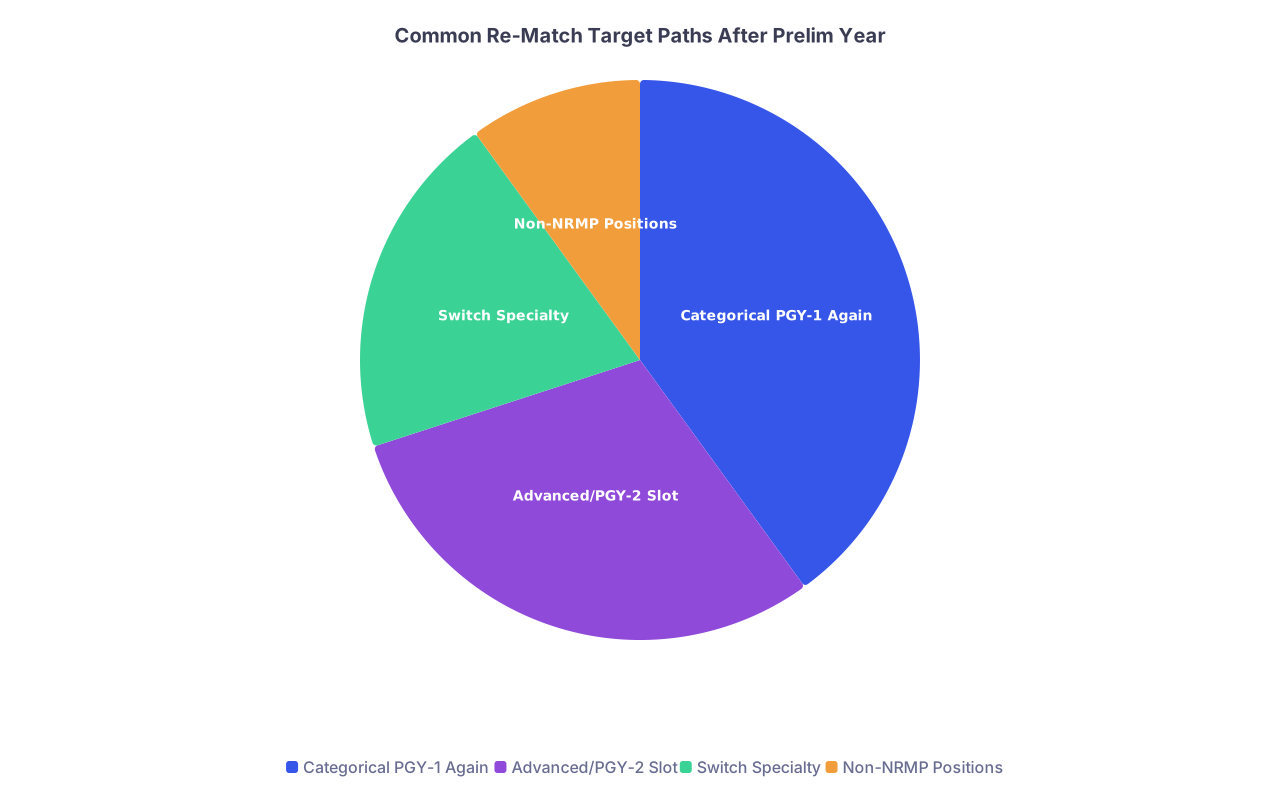
| Category | Value |
|---|---|
| Categorical PGY-1 Again | 40 |
| Advanced/PGY-2 Slot | 30 |
| Switch Specialty | 20 |
| Non-NRMP Positions | 10 |
Path A: Re‑Match to a Categorical PGY‑1 (Same or New Specialty)
This is common if:
- You’re in a prelim medicine/surgery year.
- You want full categorical IM, FM, EM, surgery, etc.
Strategy notes:
- Your prelim year then becomes “experience + proof you can function in a US system.”
- Programs will care a lot about: Are you safe? Are you a problem? Why are you not staying where you are?
You answer that head‑on in your personal statement and interviews:
If your current program is malignant:
You do not rant. You say:
“The position was always designed as a preliminary year without a guaranteed categorical spot. I’m grateful for the training, and I’m now seeking a categorical position where I can commit long‑term.”
Period. No drama.If you actually burned a bridge (performance/fit issues):
Acknowledge, show growth, show concrete change.
“I struggled early with time management and documentation speed, especially on busy ward services. After mid‑year feedback, I worked with senior residents and faculty to improve my workflows, and my evaluations since then have reflected that progress.”
Path B: Apply Directly for PGY‑2/Advanced Slots
This works better if:
- You’re in prelim medicine and applying to things like neurology, anesthesia, radiology, or even IM PGY‑2 spots that appear off‑cycle.
- You’re already performing reasonably well clinically.
Your main levers:
- Scan for PGY‑2 openings constantly (more on this later).
- Highlight specific skills: cross‑cover experience, ICU time, procedures, triage.
Programs taking a PGY‑2 gamble want proof you can be thrown into call without blowing things up.
Path C: Specialty Switch
If your prelim was surgery and you now want IM, or you’re leaving a toxic prelim field entirely, you have an extra burden:
- Explain the switch clearly.
- Show the path wasn’t impulsive.
You lean on:
- Faculty in the new field who’ve seen you clinically.
- Old mentors who can say, “Their interest in [new specialty] is longstanding; this is not a whim.”
Step 5: Outside Allies – Where You Get Real Strategy Help
Trying to figure this out alone while doing 28‑hour calls is dumb. You need help.
Here’s where you go when your own PD is not an option.
1. Your Medical School
Even if you graduated years ago:
Email student affairs or the dean’s office:
“I’m currently in a preliminary [specialty] position, planning to reapply for [specialty]. My current program is unfortunately unable to support my re‑match. Are there any alumni advisors or faculty who might be willing to review my application strategy or write an updated letter based on my progress?”Many schools will set you up with an advisor, even after graduation. Do not assume they are done with you.
2. Alumni from Your Med School or Country
Find residents/fellows in the specialty you want:
- LinkedIn, med Twitter, alumni databases.
- Ask for a 15–20‑minute call: “I’d appreciate your advice on how to position a prelim year with limited program support.”
A few of these conversations can give you crucial intel on which programs are more open to “non‑traditional” paths or rougher stories.
3. Hospital‑Level GME (If Not Captured by Your PD)
Some institutions have an institutional DIO (Designated Institutional Official) or GME office that is separate from your department PD politics.
You’re not asking them for a letter. You’re asking for process guidance:
- Are you in good standing institution‑wide?
- Will they confirm completion of your prelim year if a new program reaches out?
- Are there internal transfers into another department possible?
Sometimes you can quietly move from a hostile prelim department to a more functional one in the same hospital.
Step 6: How to Explain a Lack of PD Letter Without Setting Off Alarms
Programs will notice if your current PD isn’t writing.
You don’t volunteer it, but if asked (and you will be), you answer cleanly:
Version 1: Prelim Structure Reason
“My current position is a one‑year preliminary spot in [X]. Their culture is to reserve PD letters for residents staying in the department or moving within that specialty. Instead, I’ve asked faculty who supervised me closely on wards and in the ICU to comment on my clinical performance.”
This is often believable and non‑dramatic, especially in prelim surgery programs.
Version 2: Misalignment / Politics
If your PD truly blocked you or was hostile:
“There was a mismatch in expectations around my long‑term career path. I was transparent early that I hoped to transition into [new specialty], and that created some tension around support for my re‑application. Rather than put them in a difficult position, I’ve relied on letters from other faculty who directly supervised my clinical work.”
Notice the pattern: brief, non‑emotional, no character assassination.
If interviewers push for more, you do not vent. You repeat the theme: misalignment, not malpractice.
Step 7: Hunting for Positions When You’re the Underdog
You cannot just rely on ERAS and wishful thinking. You need to actively hunt for spots.

| Step | Description |
|---|---|
| Step 1 | Decide Target Specialty |
| Step 2 | Update ERAS Materials |
| Step 3 | Apply Broadly in Match |
| Step 4 | Search PGY2 Openings |
| Step 5 | Cold Email Programs |
| Step 6 | Prepare for Interviews |
| Step 7 | Rank Programs |
| Step 8 | SOAP and Post Match Scramble |
Where to look
ERAS / NRMP for categorical PGY‑1
This is your baseline.FREIDA (AMA)
Look for “Accepts: Second‑year residents” or PGY‑2 transitions.Specialty society job boards
Neurology, anesthesia, radiology, etc. often post PGY‑2 vacancies.Program websites + email your CV
If you hear a rumor of an opening, you send a tight email:- Who you are
- Current prelim status
- Why you’re interested in that program
- Attached CV + brief summary of Step scores / visas if relevant
SOAP
If you’re going through a full re‑match and do not initially match, your prelim year plus good letters can make you competitive in SOAP for some fields (IM, FM, psych, peds, some neurology spots).
You operate with the assumption that your “brand” is slightly damaged by the lack of PD help. So you:
- Apply wider than you think you “deserve.”
- Do not get cute with “only top 50” programs.
- Consider community and smaller academic places that are much more open to “complicated” stories if you can work.
Step 8: Timing – When to Tell, When to Apply, When to Bail
Here’s a rough reality‑based timeline for someone in a prelim year angling for a re‑match the same cycle.
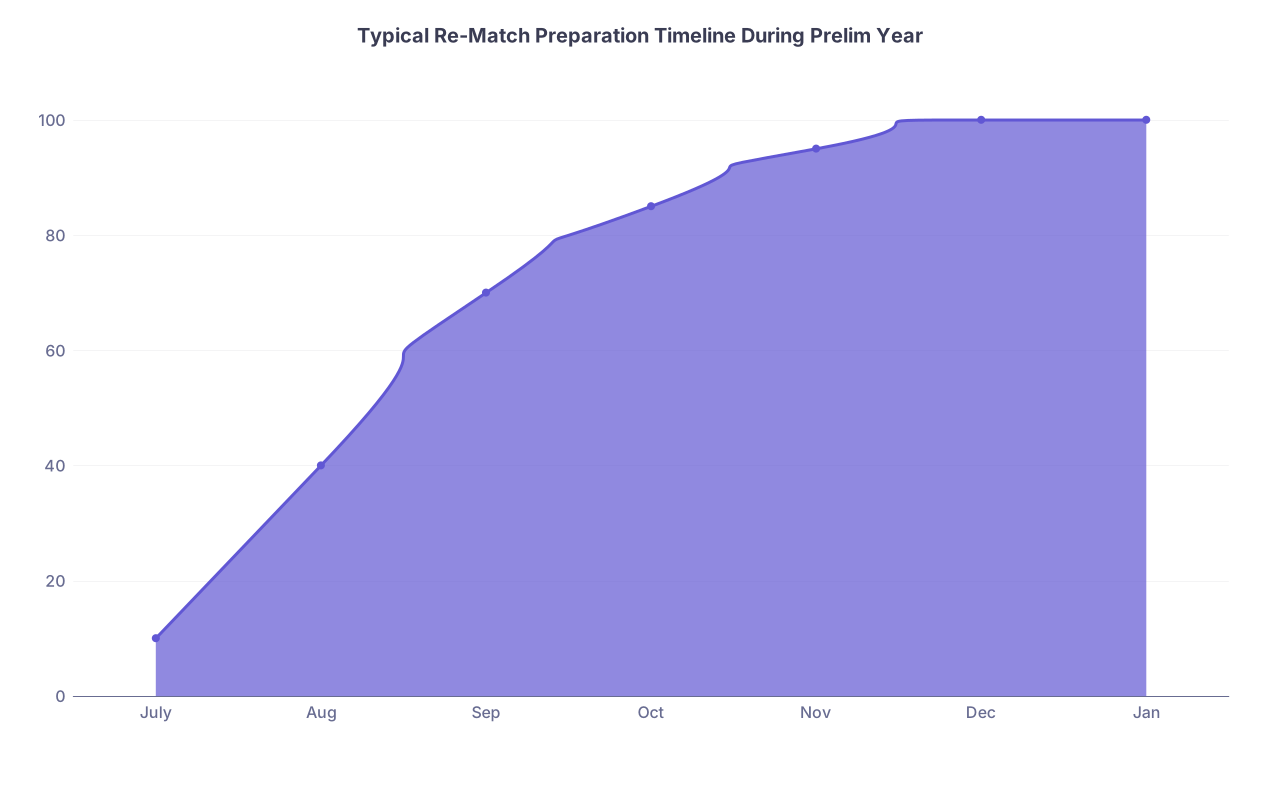
| Category | Value |
|---|---|
| July | 10 |
| Aug | 40 |
| Sep | 70 |
| Oct | 85 |
| Nov | 95 |
| Dec | 100 |
| Jan | 100 |
(Values = percent of application prep completed)
General pattern:
July–August:
- Stabilize in your prelim role. Learn workflows. Avoid disasters.
- Quietly update CV and personal statement.
September–October:
- Letters: secure faculty who’ve worked with you early.
- ERAS: submit for categorical / advanced if aiming for same‑year re‑match.
November–January:
- Interviews: keep PD informed only at the level needed to manage schedules.
- Do not gloat about interviews to co‑residents; assume word travels.
February–March:
- Rank lists and backup plans (SOAP, direct emails, non‑Match positions).
- If match fails: you prepare hard for SOAP and scramble.
Meanwhile, you keep functioning as if you’re staying until you actually have a signed contract elsewhere.
Step 9: Backup Plans That Don’t Involve Suffering Forever
You need at least a skeleton backup plan if everything falls through.
Options that are not glamorous but very real:
Complete the prelim year, then reapply with “graduate” status
A completed intern year + good letters is still valuable next cycle. You can market yourself as a PGY‑2 candidate or re‑do PGY‑1 if needed.Non‑NRMP positions
Some hospitals and new programs hire outside the match; especially in IM, FM, psych, and sometimes surgery. You watch for those like a hawk.Research + moonlighting (if allowed)
One‑year research positions in your target specialty at big places can help reposition you, especially if they come with clinical exposure and new letters. Meanwhile, you moonlight if you’re eligible to keep paying bills.Different specialty that actually wants you
If you’re realistically blocked from your dream field but are strong clinically, it can be smarter to pivot to another specialty that will value your prelim year rather than burn 3 years chasing the impossible.
Step 10: Mental Game – How Not to Let This Destroy You
You will be angry. You will obsess over what your PD might be saying about you. This will not help you.
A few blunt truths:
- Programs are much more interested in: “Can this person work hard and not create problems?” than in the fine details of your PD drama.
- Many PDs quietly understand that some prelim programs are toxic. They read through the lines.
- A clean, controlled, non‑dramatic story + strong non‑PD letters beats an applicant who spends 10 minutes in every interview talking about how victimsed they were.
So you:
- Pick 2–3 people (friend, partner, therapist, mentor) you vent to. That’s it.
- In every professional setting, you use calm, boring language: “mismatch,” “no categorical option,” “seeking a long‑term home.”
- Focus your energy on the part you control: being excellent in your current job, tightening your application materials, and showing up like an adult in every interaction.
FAQs
1. Should I still ask my PD for a letter if they seem lukewarm?
If they’re hesitant, no. A neutral or subtly negative PD letter can sink you faster than not having one. If they do not actively want to endorse you, you’re better off with three strong non‑PD letters from people who’ve seen you work. The only exception: specialties or programs that explicitly require a PD letter. In that case, you try to get at least a short, factual letter and make sure your other letters are stellar.
2. What if my program threatens my contract if I apply out?
If a program is explicitly retaliating for you applying, that crosses into legal and institutional territory. Document everything: emails, meeting notes, who said what and when. Quietly reach out to your institution’s GME office and, if needed, your medical school dean. You do not threaten lawsuits; you calmly say you are seeking guidance because you are concerned about retaliation for participating in the NRMP process. Most institutions do not want that smoke.
3. How many programs should I apply to if I have no PD support?
More than you think. For IM/FM/psych/peds, 60–100 programs is not crazy when your file is complicated. For more competitive fields, you apply to basically every realistic program plus some reaches and some “safeties” (yes, that concept still exists in residency). Your lack of PD support is a red flag; you compensate with volume, strong alternative letters, and very targeted outreach where you have any connection at all.
4. Is it ever smarter to just finish the prelim year and not re‑match during it?
Yes. If your performance early in the year is shaky, your evaluations are mixed, or your story is extremely messy (failures, professionalism flags, major conflict with your program), rushing into a same‑year re‑match can just generate another round of rejections. In those cases, it can be smarter to spend the year cleaning up your performance, getting better letters by spring, completing the prelim year, and then applying as someone with a finished PGY‑1 and a clear pattern of improvement. Long game, but often more successful.
Key points to walk away with:
- You can re‑match without PD support, but you must stop waiting for your program to “see the light” and aggressively build an alternate letter and mentor network.
- Keep your story clean, short, and boring in interviews: mismatch, no categorical spot, looking for a long‑term home—save the full rant for your friends.
- Overcompensate with performance, volume of applications, and strategic outreach; your current program’s hostility is a problem, but it is not a life sentence.


