

What do you actually do when your prelim schedule drops, it’s way heavier than your categorical peers, and everyone tells you to “just suck it up, it’s only a year”?
Let me be blunt: if you stay silent, the default is you get steamrolled. Especially as a prelim. But if you come in swinging wildly, you get labeled “difficult” by week two. The game here is controlled, strategic pushback.
Here’s how to handle it.
1. First: Decide If Your Schedule Is Unfair or Just Hard
Every prelim year is rough. You are not aiming for “pleasant.” You are aiming for “safe and not exploitative.”
You need to separate three things:
- Hard but normal
- Disproportionately heavy
- Flat-out unsafe or non-compliant with duty hours / ACGME standards
To do that, you need data, not vibes.
Start here:
Compare your number of ICU months, night float, and heavy ward blocks to:
- Other prelims in your program
- Categorical interns in the same department
- Prelim schedules at similar hospitals if you can get them (friends, Reddit, old PDFs, whatever)
Look for patterns:
- Are you on the “short call”/admitting team far more often than others?
- Do you have more weekends in a row on than your co-interns?
- Are electives basically missing from your year?
| Rotation Type | You (Prelim) | Other Prelim | Categorical IM |
|---|---|---|---|
| ICU Months | 3 | 2 | 2 |
| Night Float | 2 | 1 | 1 |
| Wards | 5 | 4 | 4 |
| Electives | 1 | 2 | 3 |
| Clinic/OP | 1 | 2 | 2 |
If your table looks skewed like that, you’re not imagining it.
Also ask:
- Were you told, before matching, that prelims do more “scut” or heavier call?
- Is there a clear explanation for the difference (e.g., categoricals have continuity clinic protected time that you don’t)?
If your schedule is simply busy but comparable to others, you’re in “hard but normal” territory. You may still tweak things (for sanity), but you probably will not get major structural changes.
If you substantially carry more nights/ICU/wards with fewer electives than other prelims or categoricals, you are in “disproportionately heavy” territory.
If it’s leading to 90-hour weeks, no days off in 14, constant post-call violations—now we’re in “unsafe / non-compliant.”
You respond differently depending on which bucket you’re in.
2. Before You Speak: Build Your Case Quietly
You do not march into the PD office saying “My schedule is unfair.” That’s how you lose.
You build a clean, unemotional case first.
Document your reality
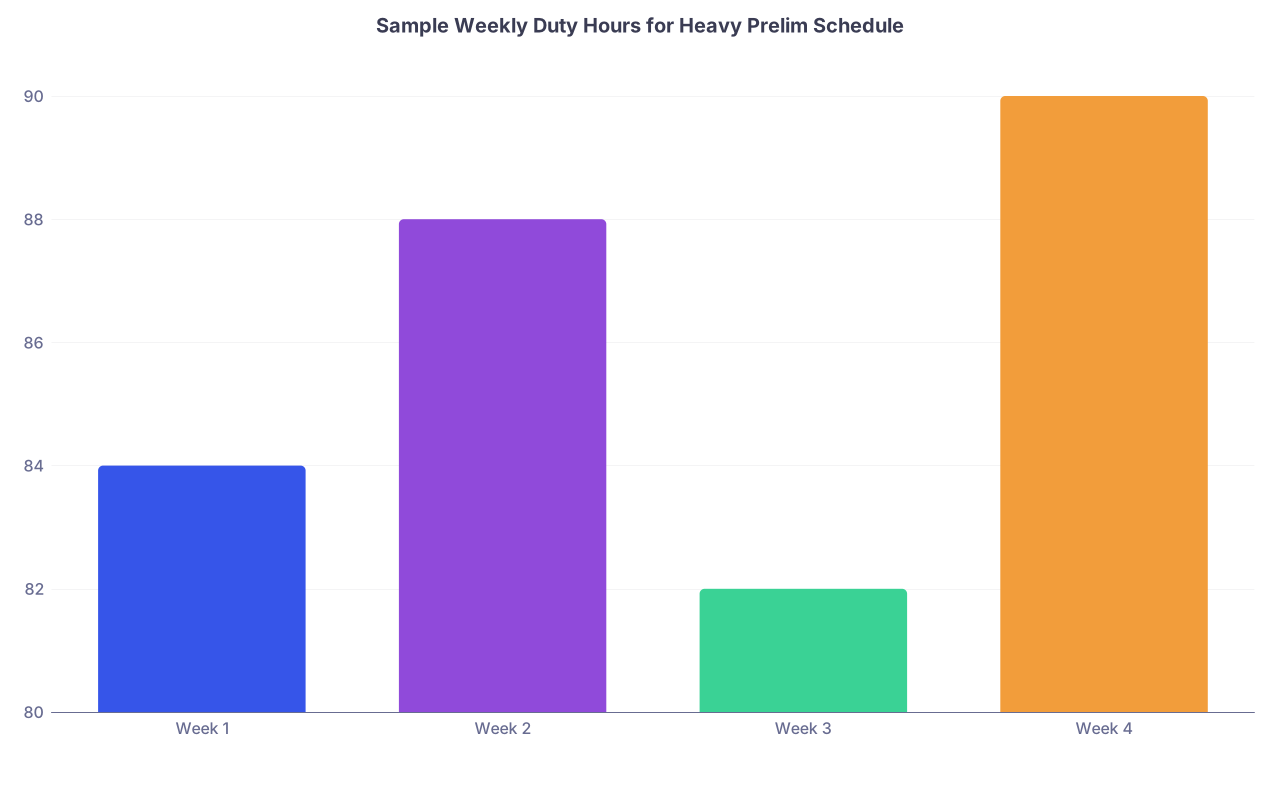
For 2–4 weeks, track:
- Hours in and out (time you arrive, time you leave)
- Call frequency
- Number of patients, especially admits and cross-cover
- Days off (and missed days off)
- Any ACGME violations (more than 80 hours/week averaged over 4 weeks; lack of 1 day off in 7; less than 10 hours between shifts; calls >28+4 hours, etc.)
This can be as simple as a Google Sheet.
| Category | Value |
|---|---|
| Week 1 | 84 |
| Week 2 | 88 |
| Week 3 | 82 |
| Week 4 | 90 |
If you’re consistently over 80 hours, or your days off are disappearing, that’s a problem. Not just “I’m tired.” ACGME-level problem.
Compare schedules
Politely ask co-interns:
- “Hey, can I see your month schedule? I’m trying to figure out how they’re distributing nights and wards.”
- Screenshot or write down their rotations and calls.
- Look for disproportion: you on nights/ICU; them on electives/clinic.
Gather informal intel
Residents will say the quiet part out loud:
- “Yeah, they always dump the worst blocks on prelims.”
- “Surgery prelims here basically staff the ICU.”
- “Last year’s prelims complained and they adjusted it a bit.”
You do not quote them later. But it tells you whether this is a known pattern or a one-off oversight.
3. Decide Your Goal: Fix the Year vs Survive Strategically
You can’t fix everything. You can’t redesign the program. Set realistic goals.
Common reasonable goals:
- Swap 1–2 of the heaviest rotations for electives or clinic
- Reduce number of night float blocks
- Adjust call distribution so weekends are less punishing
- Get at least X weeks of something lighter before your advanced residency starts
Less realistic (but sometimes worth mentioning once, calmly):
- “Prelims should have the same elective blocks as categoricals”
- “This whole structure is exploitative and needs to change now”
Be clear: Are you trying to:
- Make it survivable physically and mentally?
- Protect your future specialty (e.g., need some time to brush up on neurology before PGY-2)?
- Or correct something actually non-compliant?
Know your ask before you walk in.
4. Who To Talk To, In What Order
If you blast the program director first with an angry email, you’ve skipped several rungs. Bad move.
Use this hierarchy as a template:
- Trusted upper-level (chief or senior in your department)
- Chief resident(s) responsible for scheduling
- Associate Program Director (APD) or Prelim Director (if there is one)
- Program Director (PD)
- GME/DIO (if duty hours/safety issues and you’re getting stonewalled)

| Step | Description |
|---|---|
| Step 1 | You notice heavy schedule |
| Step 2 | Document hours and patterns |
| Step 3 | Discuss with trusted senior |
| Step 4 | Talk to chiefs about concrete changes |
| Step 5 | Monitor and follow up |
| Step 6 | Meet APD or prelim director |
| Step 7 | Contact GME or DIO |
| Step 8 | Issue resolved? |
| Step 9 | Still unresolved and unsafe? |
Step 1: Trial run with someone safe
Find a senior or chief you actually trust and ask for honest advice:
“Hey, I’m a prelim and my schedule looks significantly heavier than others’. I tracked my hours and I’m averaging around 85–90 per week with almost no days off. Before I talk to anyone formal, can I run this by you and see if I’m missing something?”
If they say:
- “Yeah, this looks off, you should talk to the chiefs” – good, proceed.
- “It sucks but this is what everyone does here” – still might be worth pushing, but now you know what culture you’re up against.
They might also tell you the political landmines: which chief actually listens, which APD is reasonable, who reacts poorly to complaints.
5. How To Talk To Chiefs About Schedule Changes
Chiefs usually control the schedule. Start there unless they are explicitly hostile or useless.
You’re not going in with emotion. You’re going in with:
- Data
- Comparisons
- Specific, workable requests
Use something like:
“Thanks for meeting with me. I wanted to ask about my schedule as a prelim. I noticed a few things that seem different from others and I wanted to see if there was room to adjust:
- I have 3 ICU months, while the other prelims seem to have 1–2.
- I have 2 night float blocks; others have 0–1.
- I only have 1 elective month; others have at least 2.
Over the last month, I averaged about 86 hours a week and missed two of my supposed days off because of cross-cover and admissions. I’m concerned this might not be sustainable and may be out of duty hour compliance if it continues all year.
Is there any way we could look at:
- Swapping one ICU or night float month for an elective or clinic, and
- Evening out some of the heavier weekend call?”
Key things you’re doing there:
- You’re not whining.
- You’re not attacking them personally.
- You’re showing you understand trade-offs.
- You’re giving concrete levers to pull.

If they say:
- “We didn’t realize it was that skewed; we’ll try to adjust” – ask, “What might that look like, and when should I check back?”
- “This is how prelims are scheduled here” – now you’re moving toward APD/PD, especially if there are ACGME issues.
6. Taking It Up a Level: APD/PD Conversation
If chiefs cannot or will not fix it, you escalate to an APD or prelim director. If none, then PD.
Here you frame it slightly differently: program-level fairness and compliance.
Script framework:
“Dr. X, thanks for meeting with me. I wanted to talk about my schedule as a preliminary intern.
I know prelim years are supposed to be hard, and I’m not asking for an easy year. But when I compare my schedule to the other prelims and categoricals, it seems significantly heavier:
- I have [X] ICU months versus [Y].
- night float versus [Y].
- Only [X] electives versus [Y] for others.
I’ve also been tracking my hours, and over the last 4 weeks, I’m averaging around [X] hours per week, with [specific missed days off or short rest periods]. I’m concerned this might not be sustainable and might put us at risk of duty hour violations.
I tried talking with the chiefs, but the structural issues were hard to solve at that level. I wanted to see if there’s a way to redistribute at least one of my heavy blocks to bring my schedule more in line with the other prelims and ensure we stay compliant.”
You’re hitting:
- Fairness relative to peers
- Compliance language (duty hours, sustainability, patient safety)
- You already tried chiefs (you didn’t jump straight to the top)
Most PDs actually do not want documented ACGME issues, especially for something fixable like one prelim schedule. They may push back a bit (“It’s only a year”, “Everyone’s struggling”), but once you show clean data and clear discrepancy, many will make at least cosmetic adjustments.
7. When It’s Actually an ACGME/Duty Hours Problem
If your schedule is just heavy, you push. If it’s grossly non-compliant and leadership shrugs, that’s different.
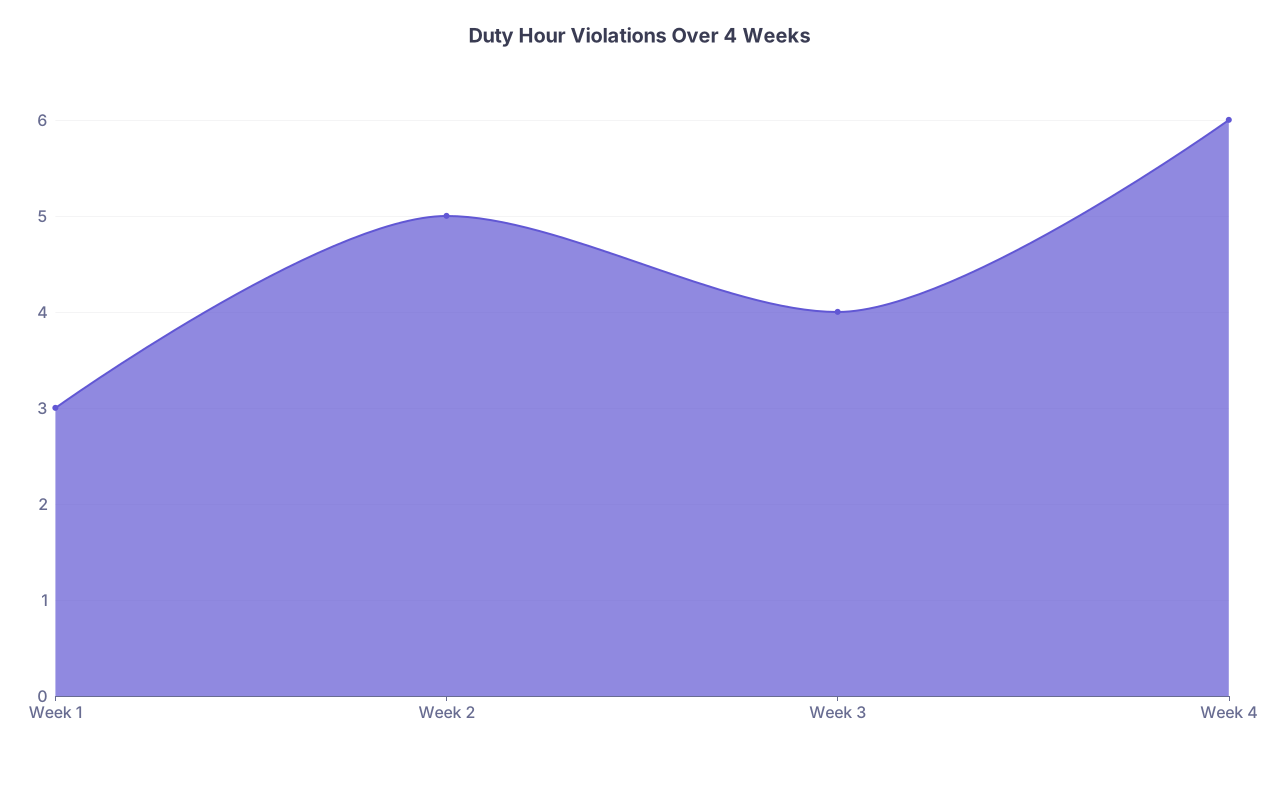
ACGME baseline rules (short version):
- Max 80 hours/week averaged over 4 weeks
- 1 day off in 7, averaged over 4 weeks
- At least 10 hours between shifts (ideally)
- No more than 24 hours of continuous clinical duties plus up to 4 hours of transitions
| Category | Value |
|---|---|
| Week 1 | 3 |
| Week 2 | 5 |
| Week 3 | 4 |
| Week 4 | 6 |
If you’re consistently breaking that and being told to “just under-report it,” that’s a serious flag. Especially for prelims, who are often treated as expendable.
Your options:
- Use your official duty hours logging system honestly.
- If pressured to falsify, document that (date, who said what).
- If still ignored, go to GME office or the Designated Institutional Official (DIO).
You do not need to start with a nuclear email. You can say:
“I’m concerned that my schedule and current workload are putting me consistently over 80 hours/week and sometimes without required days off. I’ve discussed this with my chiefs and PD, but the problem remains. I wanted to ask for guidance on how to ensure we’re compliant with ACGME regulations.”
If your hospital is halfway functional, that gets attention.
8. The Prelim Reality: How Hard To Push Without Burning Bridges
You are in a weird position:
- You’re leaving after a year.
- Your future advanced program will care what this program thinks of you.
- This program may feel less incentive to “invest” in your wellness or schedule.
So you need balance.
Times to push hard:
- Clear duty hour violations
- Dramatically heavier schedule than every other prelim
- Safety issues (you’re covering 30–40 patients alone at night, etc.)
Times to push more softly:
- You want an extra elective for personal interest
- You want a lighter month before you start your PGY-2
- You’d prefer not to do another ICU month but it’s within range of what others are doing
A reasonable compromise:
- Firm, clear, documented push on compliance and big inequities
- One or two specific asks about electives/timing
- Then acceptance of whatever adjustments you get
Do not:
- Bring this up in every meeting for months.
- Trash the program openly to everyone.
- Threaten legal/ACGME action in your first email.
You’re playing a long game. You want a survivable year and a decent letter, not a war.
9. If They Won’t Fix It: How To Survive a Heavy Prelim Year
Sometimes you do everything right and the program still says, in effect, “Too bad, this is what we do to prelims.”
At that point, the question becomes survival and damage control.
Some practical moves:
Strategically schedule appointments/vacation:
Use your rare elective/clinic blocks to actually rest, not fill with research or moonlighting.Protect your transition to PGY-2:
If your advanced program starts July 1 and you’re wrecked, you’re starting behind. Try to get at least 2–4 weeks before you start where things are slightly lighter or you’ve had some recovery.Build quiet alliances:
A few smart attendings or seniors who know you’re solid clinically will write you the honest, strong emails or calls your advanced program may appreciate. That matters more than whether you did 3 or 4 ICU months.Do not martyr yourself:
Say no to “extra favors” that push you into unsafe territory. Agreeing to cover extra shifts constantly because “you’re a prelim and leaving anyway” is how you end up burnt out with no one to show for it.

You’re allowed to protect your own health even in a rough culture.
10. Planning Ahead: Prevent This Before You Match (For Future Applicants)
If you’re still in the residency application phase and just thinking about a prelim year, learn from other people’s pain.
During interviews, ask:
- “How are prelims scheduled compared to categoricals?”
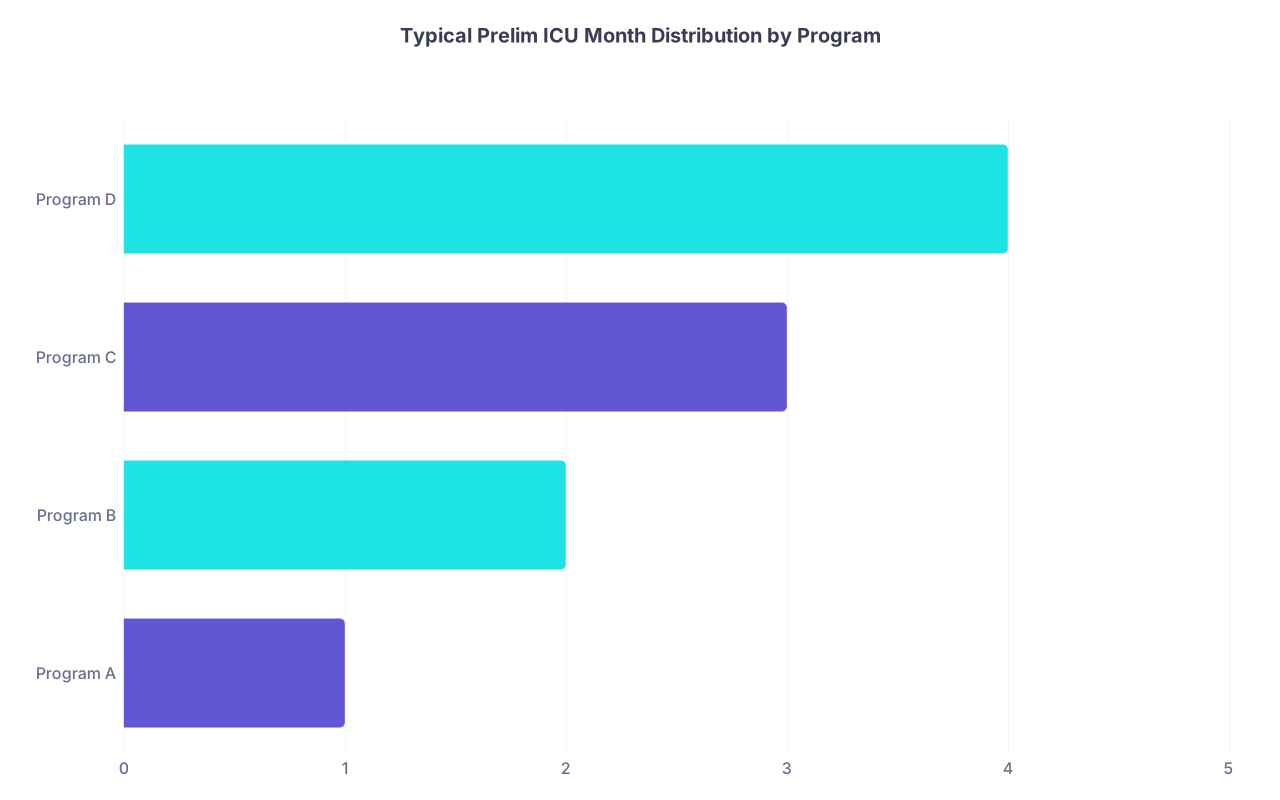
- “How many ICU and night float months do prelims typically have?”
- “Do prelims get electives, and how many?”
- “Can I see a sample prelim schedule from this year?”
Then actually look at it. If they dance around the question or “cannot share” a prelim schedule, that tells you something.
| Category | Value |
|---|---|
| Program A | 1 |
| Program B | 2 |
| Program C | 3 |
| Program D | 4 |
Programs that consistently overload prelims will show it if you look.
FAQs
1. Will advocating for schedule changes as a prelim hurt my future fellowship/applications?
If you approach it rationally, with data and respect, usually not. Most PDs can tell the difference between a complainer and someone flagging real inequity or safety issues. The danger comes from repeated emotional complaints, gossiping, or going nuclear too fast. One or two well-framed conversations rarely ruin anything.
2. What if other prelims are also getting crushed but no one else wants to speak up?
You do not need a union card to advocate. But having at least one co-prelim willing to sign on helps. You can go to chiefs or PD together: “Several of us have noticed X…” If everyone is terrified, you can still present your own data; just avoid speaking for others without their consent.
3. Should I under-report my duty hours to avoid making the program look bad?
No. That’s how abusive patterns get normalized and never fixed. Report honestly. If someone directly pressures you to lie, document it and, if needed, bring it to GME. You’re not being “disloyal” by telling the truth; you’re protecting yourself and, frankly, future residents.
4. Is a heavy prelim year ever actually worth it?
Sometimes. If you’re going into a competitive advanced specialty (derm, radiology, anesthesia, ophtho) and your prelim year gives you strong inpatient skills and solid letters, it can pay off. But “worth it” does not mean “accept anything.” A brutal, unsafe year that leaves you burnt out entering PGY-2 is not a badge of honor. It’s a preventable setback.
Open your schedule right now and compare it line-by-line to another prelim and a categorical intern in your program. If you see clear, specific discrepancies, write them down in a one-page summary—that’s your starting point for your first conversation.


