

It’s late afternoon between cases. You’re a matched prelim (or about to start as one). Your phone buzzes. It’s the program coordinator or PD:
“We might have a categorical spot opening. Would you be interested if it becomes available?”
Or even more abrupt:
“Hi, we have a categorical position that just opened. You are our first call. Are you interested? We need to know pretty quickly.”
Your stomach drops. This is exactly what you hoped for… but not like this. No time to think. No time to compare programs. Maybe you already have a PGY-2 spot elsewhere. Maybe you were planning to reapply. Now you’re supposed to make a career‑level decision in 24–72 hours.
Here’s how to handle this situation without getting steamrolled, burning bridges, or making a rushed decision that boxes you into a miserable three years.
First: Understand Exactly What Is Being Offered
Before you answer anything beyond “thank you,” you need clarity. People get burned here because they assume.
You’re going to calmly gather facts. Script-level.
When they call or email, you say something like:
“Thank you for thinking of me. I’m definitely interested. Before I can give you a real answer, could I clarify a few details so I understand exactly what’s on the table?”
Then you nail down these specifics.

Questions you must get answered
What is the exact position?
- “Is this a categorical position starting PGY-1 this year?”
- “Would my current prelim year fully count toward categorical training?”
- “Will I be a PGY-1 or PGY-2 when the categorical status starts?”
Programs sometimes use “upgrade” loosely. Make them concrete.
Is it guaranteed or conditional?
Huge distinction:- Guaranteed: “If you accept, you are slotted as categorical for the full duration of the program.”
- Conditional: “We’ll consider you strongly for a categorical spot after X months” or “You would switch if funding gets approved.”
Conditional = not an upgrade. It’s a maybe. Treat it that way.
Is there a new contract?
Ask directly:- “Would I receive a new categorical contract and updated letter specifying my status and expected graduation date?”
If they’re serious, the answer is yes. If they waffle—red flag.
- “Would I receive a new categorical contract and updated letter specifying my status and expected graduation date?”
Timeline to respond
They’ll usually say something like “We need to know by tomorrow” or “within 48 hours.”
Your move:- “I understand this is time sensitive. Can I have until [specific time/date] to think through this and confirm with my family and current commitments?”
Push gently. Even 12–24 more hours helps you think and make some calls.
- “I understand this is time sensitive. Can I have until [specific time/date] to think through this and confirm with my family and current commitments?”
Why is the spot open?
Ask neutrally:- “Can you share why the categorical spot opened up?”
Answers might be: - Someone transferred
- Someone resigned
- A resident was dismissed
- Program got new funding lines
You don’t have to grill them. But if three people left last year, that’s information.
- “Can you share why the categorical spot opened up?”
Impact on your schedule and support
Quickly clarify:- “Would my rotation schedule change?”
- “Would there be any extra expectations compared to my current prelim role?”
Some spots are fine. Others turn into, “Oh, and also you’ll be chief of all the scut.”
Once you’ve asked these, you say:
“Thanks, this is really helpful. I am very interested. Let me think this through and I’ll get back to you by [agreed time].”
Now you’re off the phone. You have space to think.
Step Back: What Is Your Current Path Without This Upgrade?
You cannot judge this upgrade in a vacuum. You compare it to your Plan A.
Your starting point: “If I say no, what happens to me?”
Here are the main situations I see:
| Your Situation Now | Your Default Plan Without Upgrade |
|---|---|
| Prelim with **no** PGY-2 secured | Reapply, scramble, or take gap year |
| Prelim with **secured PGY-2** (e.g. neuro, derm) | Move to that advanced program as planned |
| Prelim who already **re-applied** and matched elsewhere | Start categorical next year at new program |
| Incoming matched prelim, not yet started | Do prelim then reapply or pursue research/year off |
Be brutally honest about the real baseline:
If you’re a prelim with nothing lined up after PGY-1
A guaranteed categorical spot, at a decent program, is often a huge win. Because your alternative is reapplying into a competitive field from a weaker position. That’s rough.If you already matched into a strong advanced position in a competitive field
You’re giving up derm, rad onc, ortho, neuro, etc. to stay at this categorical program in something else (usually IM, surgery, or TY → IM/FM/etc.). That’s not a minor fork in the road. That’s a different career.If you re-matched already and are just finishing a prelim
Moving to categorical now might mean reneging on a contract elsewhere. That has consequences.
Write it out in plain text. Two columns on paper:
- Column A: What happens if I stay with my current path?
- Column B: What happens if I accept this categorical upgrade?
Seeing it forces you to confront reality instead of vibes.
How to Evaluate the Upgrade: Five Hard Questions
You’re now in evaluation mode. Here’s the framework I use with residents when this happens.
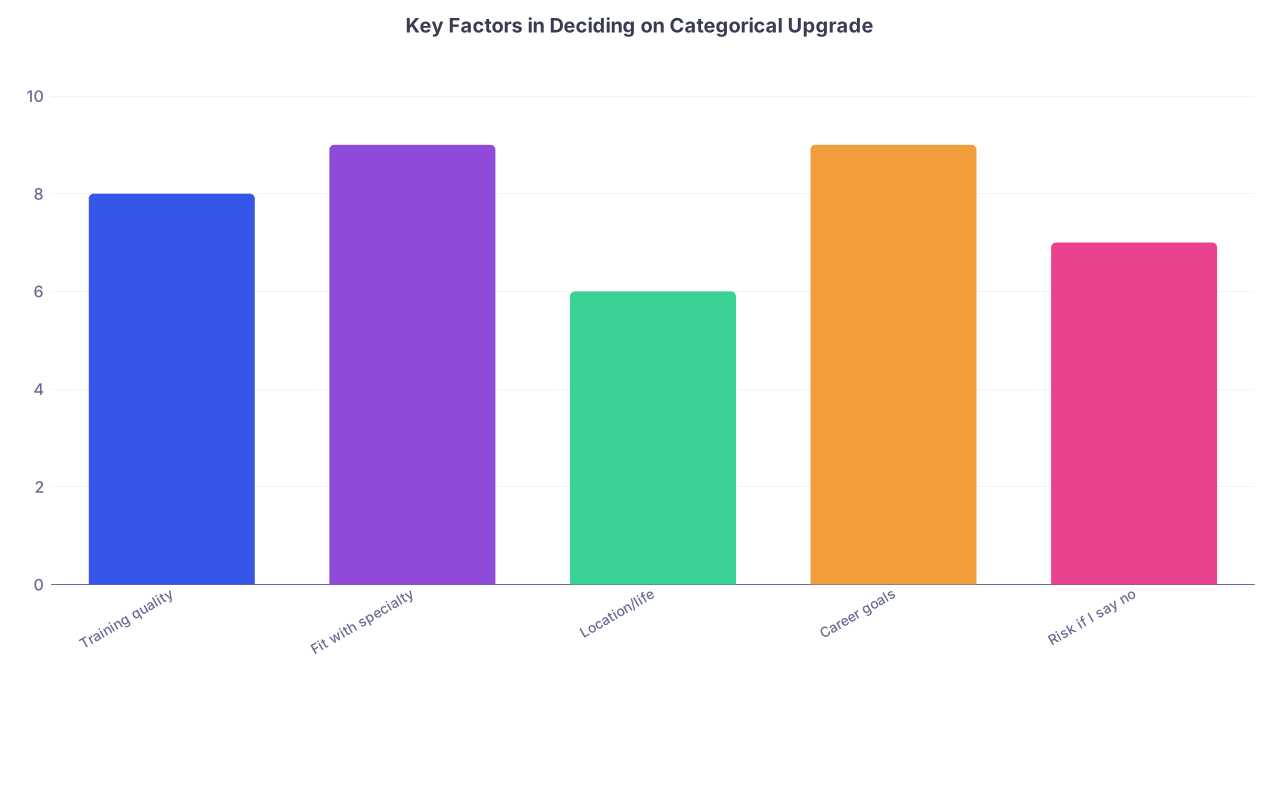
| Category | Value |
|---|---|
| Training quality | 8 |
| Fit with specialty | 9 |
| Location/life | 6 |
| Career goals | 9 |
| Risk if I say no | 7 |
1. Do you actually want this specialty long term?
Seems obvious, but people ignore it under stress.
If you’re a prelim surgery getting offered a categorical IM spot because a PGY-1 IM resident left, ask yourself:
- Did you always kind of like IM anyway?
- Or are you about to abandon surgery/the specialty you really want because you are scared of uncertainty?
If the upgrade is in the same specialty you already planned (prelim IM → categorical IM), easy. That’s alignment.
If it’s switching specialties, say this out loud to yourself:
“If I accept, I am very likely to practice [specialty] for the rest of my life.”
If you can’t say that without flinching, slow down.
2. How does this program rank in training quality and reputation?
You already know some of this—you’re here as a prelim. But categorical status is a longer marriage.
Ask yourself:
- Are the categorical grads matching into fellowship/jobs I’d be happy with?
- Are the upper-levels burned out, bitter, and leaving? Or mostly okay?
- Would I be embarrassed, neutral, or proud to have this program on my CV?
- Could I get to my desired fellowship/location from this program?
This is where quick data helps. Pull up the program’s recent fellowship placement list if they have it. Ask one or two trusted seniors: “Would you stay here categorical if you could?” People will tell you.
3. What’s the culture really like—for categoricals?
Prelims sometimes get a different experience than categoricals. You need intel:
- Are categoricals supported? Or are they warm bodies to staff services?
- Is there any history of mistreatment, retaliation, or chronic ACGME citations?
- How many categorical residents have left mid-training in the last 3–5 years?
Quietly ask:
“I heard a categorical spot opened up—anything I should know about why people leave here?”
You’re not starting a rebellion. You’re doing due diligence.
4. What are you giving up if you say yes?
This is the big one people avoid.
You might be giving up:
- A guaranteed spot in a more competitive specialty
- A position at a better-known academic center
- Living near your partner/family
- A shot at reapplying somewhere you actually prefer
Spell it out.
If you’re prelim IM with a secured neurology PGY-2 at a great program, taking a categorical IM spot at a small community program is not a “no-brainer upgrade.” That’s an entirely different life.
There’s no universal right answer here, but pretending there’s no tradeoff is how people end up miserable.
5. What is the risk if you say no?
On the flip side:
- If you have nothing lined up past PGY-1, saying no to a guaranteed categorical spot is risky.
- If you’re reapplying in an ultra-competitive field after not matching once already, your odds are not suddenly amazing.
- If your Step scores, visa status, or academic record make you fragile as an applicant, safety matters more.
Sometimes the honest answer is: “This is not my dream, but it’s a stable, solid path forward. And that might be smarter than gambling again.”
Legal and Ethical Landmines: Contracts, the Match, and Burning Bridges
This part everyone hand-waves until they get threatened with a NRMP violation or a burned letter.
If you are still in the Match cycle
Scenario: You matched prelim but not categorical in your desired specialty; now a categorical spot opens at your prelim institution before you’ve started.
Generally:
- Programs must respect NRMP rules, but out-of-match positions and off-cycle slots happen.
- If this categorical spot is outside the Match (unfilled, ROL changes not required, or a future-year spot), they may be able to offer it without NRMP drama.
- You should still ask:
- “Will this change anything related to NRMP or my Match status?”
They should say either: - “No, this is an unfilled out-of-Match position”
or - “We will handle NRMP-compliant paperwork and send you updated documents.”
- “Will this change anything related to NRMP or my Match status?”
If their answer is vague, you email NRMP or your med school’s GME/legal liaison anonymously and ask.
If you already signed a future contract elsewhere
This is common:
Prelim IM → matched neurology PGY-2 at Big Academic → now offered categorical IM where you are.
You need to think in layers:
- Legal: Your PGY-2 program has a contract. Reneging can have consequences, rarely legal in the courtroom sense, but institutionally and reputationally, yes.
- Ethical: If you bail late, they’re scrambling to fill your spot. People remember.
- Practical: You might need a release letter from that future program if your new categorical PD wants it.
Bare minimum:
- Do not accept the new categorical position “officially” without talking to the other program.
- Have a straightforward conversation:
- “I’ve been offered a categorical position at my current program and am considering it. I wanted to be transparent and ask what this would mean for my contract with you.”
Some PDs will be disappointed but understanding. Some will be furious. None of that changes one truth: these people will be writing or withholding letters for you later. Act accordingly.
How to Talk to Your Current (and Potential Future) PD
People freeze here and hide. That’s the worst move.
You need two conversations:
- With the PD offering the categorical spot
- With any PD whose future spot you’d be giving up (if applicable)

| Step | Description |
|---|---|
| Step 1 | Receive categorical offer |
| Step 2 | Clarify offer details |
| Step 3 | Talk to future PD |
| Step 4 | Evaluate pros and cons |
| Step 5 | Request written contract |
| Step 6 | Decline professionally |
| Step 7 | Have PGY2/future spot elsewhere |
| Step 8 | Want to accept? |
Conversation with offering PD
Once you’ve thought it through and are leaning yes or no, call (do not just email).
If you’re leaning yes:
“I really appreciate you considering me for this. I’d like to accept the categorical position, contingent on receiving a written contract and confirmation of my PGY level and anticipated graduation date. I’m committed to making this work and staying here for the duration of training.”
Then follow up with an email summarizing exactly that. Paper trail.
If you’re leaning no:
“Thank you again for thinking of me. After talking with my family and considering my long-term goals, I’ve decided to stay with my current path. It was a difficult decision because I’ve really appreciated training here.”
Short. Respectful. No drama.
Conversation with the other program (if you’re leaving one)
Say you have a PGY-2 spot elsewhere and you decide to stay categorical where you are now.
You call that PD:
“Dr. X, I wanted to discuss something important with you directly. My current program has offered me a categorical position, which would allow me to complete full residency here without moving. After careful thought, I’ve decided to accept it. I really appreciate the opportunity you gave me, and I wanted to be transparent and ask what you need from me administratively to release my PGY-2 spot.”
They might be annoyed. Accept that. Don’t get defensive or justify endlessly. You’re giving them as much lead time as possible. That’s all you can reasonably do.
Red Flags: When You Should Be Very Skeptical
Not all “upgrades” are good deals. Some are desperation plays by bad programs.
Major red flags I’ve seen:
No written documentation.
“Don’t worry, we treat our prelims like categoricals and you’re basically guaranteed…”
Translation: You are guaranteed nothing.History of categorical residents leaving or being “encouraged to resign.”
If two or three people left over a short span, this is not random.Vague answers about why the spot is open.
If they will not tell you if the prior resident resigned vs was fired vs transferred, that’s suspicious.Immediate, same-day ultimatums with no reason.
A tight timeline is one thing. “You must decide in the next 2 hours” without NRMP or institutional justification is usually pressure, not necessity.Program already burnt you once.
If they hinted at categorical chances during recruitment, then ghosted, then suddenly “remembered” you when they had a gap, check your trust level.
If multiple red flags are flashing and you already suspected the program wasn’t healthy, think very hard before locking yourself in for three years.
How Different Scenarios Play Out (With Suggested Moves)
Let’s run a few realistic situations.

Scenario 1: Prelim IM, no PGY-2 secured, offered categorical IM at same program
- You like IM.
- You don’t have a PGY-2.
- Program is average but not malignant.
My bias: This is usually a take it situation, unless you have strong reasons to think you can re-match into a much better program or different specialty next year. The stability and guaranteed training often outweigh the gamble.
Your answer: Accept, get it in writing, and commit to making the most of it.
Scenario 2: Prelim surgery, no categorical spot in surgery, offered categorical IM at same program
- You love surgery. That’s why you’re here.
- You didn’t match categorical surgery.
- You’re now being offered categorical IM.
This is more nuanced. Ask:
- Am I okay never being a surgeon?
- Are my stats and letters strong enough that another surgery application cycle gives me a realistic shot?
- Can I financially and emotionally handle another reapplication year?
If surgery is non-negotiable for you and you have a credible path to try again, you might decline and reapply, knowing the risk. If your life situation demands stability now, IM categorical is a perfectly respectable career—just own that you’re pivoting.
Scenario 3: Prelim IM → secured neurology PGY-2 at strong academic, now offered categorical IM at current community program
- Neurology was your goal and you matched it.
- Current program is fine, but not as strong or in as good a location.
Unless you’ve had a major life change (family, location, health) that makes moving impossible, I generally advise: stick with your original matched neurology PGY-2.
Career fit + institutional strength usually beat a sudden convenience upgrade.
Scenario 4: Incoming matched prelim who hasn’t started yet, PD emails about potential categorical upgrade
Here, you:
- Ask if this is a formal offer or just “we might have something.”
- If it’s formal and guaranteed in writing, evaluate just like above.
- If it’s “we’ll see once you start,” do not change your whole life plan based on that. Proceed as prelim, keep reapplying as planned.
How to Protect Yourself on Paper
Last piece: documentation.
Once you accept:
Get an updated, signed categorical contract with:
- Your PGY level for each upcoming year
- Your expected completion date
- The specialty and program name
Ask for an official letter on letterhead stating:
“[Your name] has been appointed to a categorical position in [specialty] at [program], starting [start date], at the PGY-[X] level, with an anticipated completion date of [year].”
Throw that in your personal records folder. If leadership changes or someone “forgets” in 18 months, you’ll be glad you have it.
If they refuse to put it in writing, that’s your answer: this was never a secure offer.
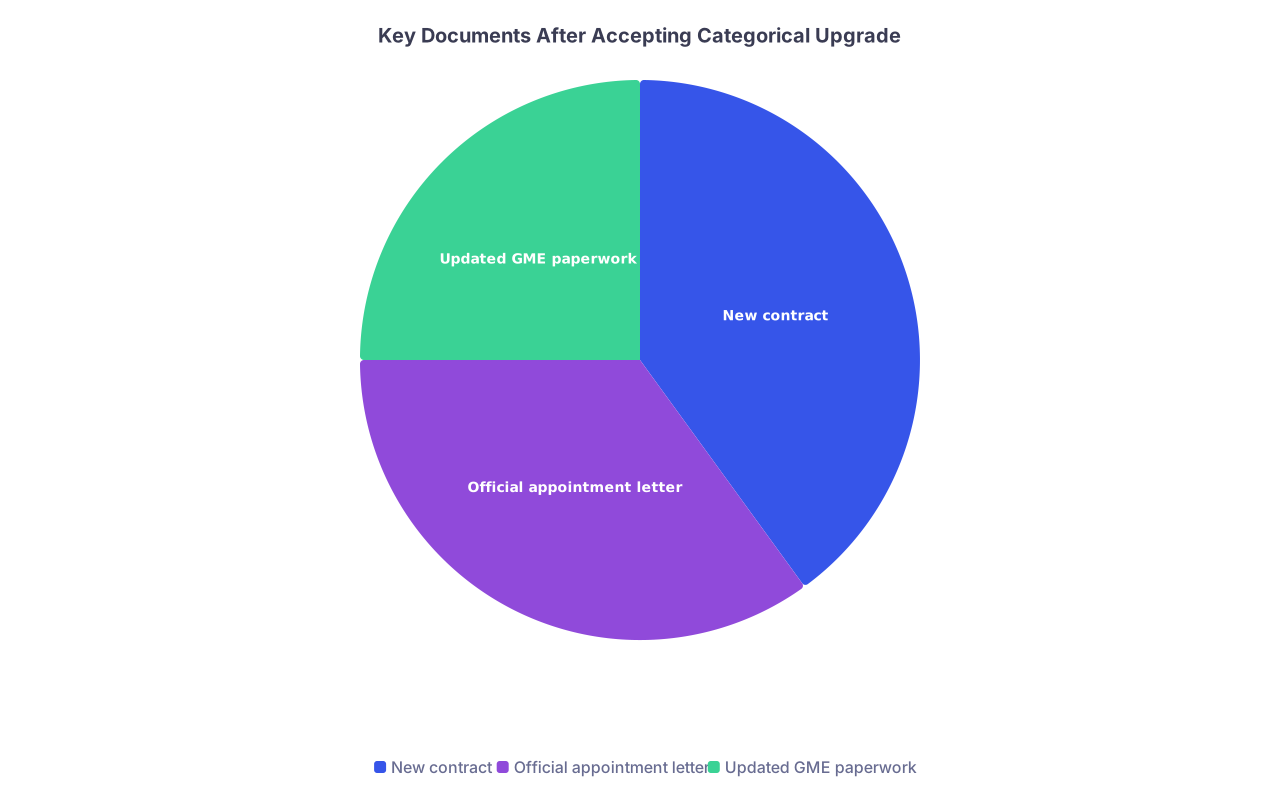
| Category | Value |
|---|---|
| New contract | 40 |
| Official appointment letter | 35 |
| Updated GME paperwork | 25 |
FAQs
1. What if I say yes, then later regret not pursuing my original specialty?
Blunt answer: that’s the risk of any pivot. But residents change specialties midstream all the time. If you later decide you cannot live without your original field, you can still:
- Complete 1–2 years, then apply to switch specialties.
- Use your current PD and colleagues to get strong letters.
- Present your choice as growth and clarity, not flakiness.
It’s harder from some specialties than others, and you may need to repeat years. But saying yes now does not permanently handcuff you—it just changes the path and makes switching costlier. So make the decision as if you’ll stay, but know you’re not trapped forever.
2. Will accepting an off-cycle categorical spot hurt fellowship prospects?
Usually not, assuming the program is decent and you perform well. Fellowship directors care most about:
- Strength of your letters.
- Your clinical performance and reputation.
- Any research/scholarly work.
- The overall reputation of your residency program.
Most of them do not care if you started as a prelim and upgraded. That story can even work in your favor: “I proved myself, earned a categorical position, and thrived.” Just keep your story clean and your performance strong.
3. How fast do I really have to decide?
Programs love to say “we need an answer immediately.” Reality:
- If there’s a real NRMP or GME deadline, there may be a hard stop.
- But you can almost always negotiate at least until the end of the day or 24 hours.
Say:
“I understand the urgency. This is a major decision for me and my family. I can give you a firm answer by [time]. I want to be sure that if I commit, I’m fully committed.”
If they refuse even that minimal window, I’d question how they handle resident welfare in general.
Next step today:
Take 10 minutes and write down, in one sentence each, your top three career priorities (e.g., “Stay in X city,” “Do Y specialty,” “Train at a program with strong Z fellowship placement”). Keep that list handy. If a sudden categorical upgrade offer lands tomorrow, you’ll have a ready-made filter for your decision instead of starting from zero under pressure.


