

The couples match with a prelim year in the mix is a trap for the unprepared. Most people only realize it halfway through ERAS season—when it’s already limiting their options.
If you’re in a couples match and one of you needs a prelim year (or transitional year) before advanced training, you’re dealing with a harder version of an already painful puzzle. You cannot wing this. Programs will not “figure it out” for you. And the NRMP algorithm absolutely does not care that you love each other.
Here’s how to handle it like adults who want jobs, not drama.
1. Get Very Clear On What “Prelim Year” Actually Means
First, vocabulary. Because misunderstanding this is how people blow their rank lists.
There are four main types of positions you care about:
| Position Type | What It Is | Common Specialties |
|---|---|---|
| Categorical | Full training from PGY-1 to finish | IM, FM, Peds, Psych |
| Advanced | Starts at PGY-2, needs a separate PGY-1 | Derm, Rad, Anes, Neuro, PM&R |
| Preliminary | One-year PGY-1, usually medicine or surgery | Used before advanced spots |
| Transitional | One-year PGY-1 with mixed rotations | Often considered cushier/flexible |
In your situation, one partner (call them Partner A) is aiming for an advanced specialty: anesthesia, radiology, derm, PM&R, neurology (in some places), ophtho (SF Match but still relevant), etc. Partner B is probably going for a categorical program (IM, peds, psych, EM, etc.) or an advanced specialty too.
Here’s the core problem:
- Partner A needs two separate matches in NRMP:
- An advanced position (PGY-2+)
- A prelim or transitional year (PGY-1)
- Partner B usually needs one:
- A categorical position or another advanced + prelim structure
When you couple, NRMP tries to match the pair of positions you rank on each line. So you’re not just ranking programs. You’re ranking combinations:
- (Partner A: Advanced Anesthesia, City X) + (Partner B: Categorical IM, City X)
- (Partner A: Prelim IM, City X) + (Partner B: Categorical IM, City X)
- (Partner A: Transitional, City Y) + (Partner B: Categorical Peds, City Y)
You don’t get to say “we’ll figure the prelim out later.” If Partner A needs a PGY-1 to start the advanced job, it must be on the rank list in some form.
2. Decide Your Exact Situation First (No, Really)
Stop reading generic couples match blogs. Your tactics depend on which of these you are:
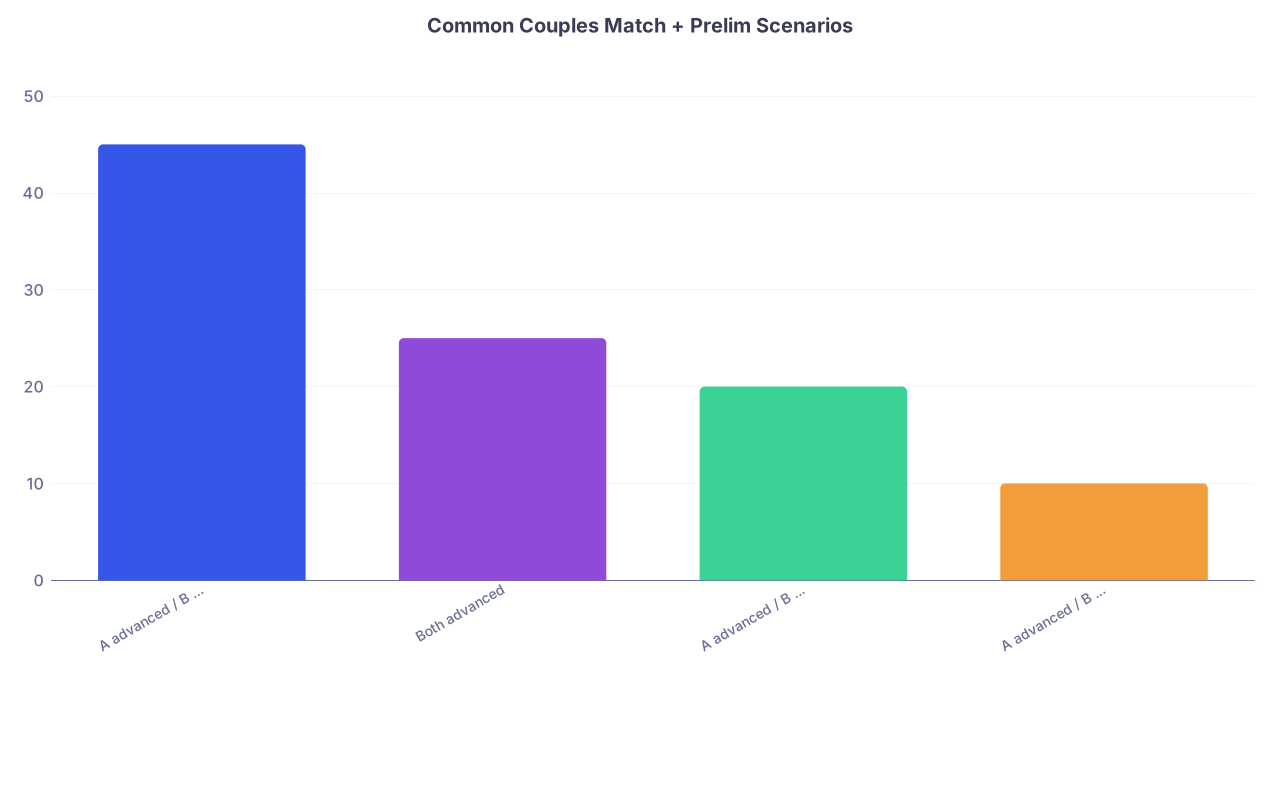
| Category | Value |
|---|---|
| A advanced / B categorical | 45 |
| Both advanced | 25 |
| A advanced / B prelim-then-advanced | 20 |
| A advanced / B undecided | 10 |
Let’s break the three most common real ones.
Scenario 1: One Advanced Partner, One Categorical Partner
Example:
- Partner A: Anesthesia (advanced)
- Partner B: Internal Medicine (categorical)
This is the classic headache scenario.
What you must accept:
- Partner A has two targets in each city: advanced spot + prelim/TY spot
- Partner B has one target in each city: categorical spot
- You’re not choosing between “good programs”; you’re choosing viable program clusters that exist together in real life
Your first step: list cities/metro areas where the combo actually exists.
Make a quick table like this for yourselves:
| City/Region | Partner A Advanced? | Partner A Prelim/TY? | Partner B Categorical? |
|---|---|---|---|
| City A | Yes (Anes) | Yes (TY + Prelim IM) | Yes (IM strong) |
| City B | Yes (Anes) | No TY, only prelim surg | Yes (IM) |
| City C | No Anes | Yes (Prelim IM) | Yes (IM) |
Cities like “C” are lower priority unless you’re willing to split for a year. You need 3–5 regions where all three position types exist.
Scenario 2: Both Are Advanced
Example:
- Partner A: Radiology (advanced)
- Partner B: PM&R (advanced)
Now you’re juggling four things in every city: 2 advanced programs + 2 prelim/TY spots.
In practical terms, you:
- Need fewer cities, more applications in each city
- Must be brutally honest about competitiveness; both of you cannot only chase top-20 name brands in 3 cities and expect this to work
Scenario 3: One Advanced, One “Flexible” (Open to Categorical in Many Places)
Example:
- Partner A: PM&R (advanced)
- Partner B: Open to IM/Peds/FM in many regions
This is actually less painful if the “flexible” partner is truly flexible and not just saying it.
Your tactic here:
- Anchor your geography around where Partner A can realistically get both advanced + prelim
- Partner B then targets categorical programs heavily in those regions first, and only after that sprinkles a few “dream” outliers
If you’re not sure which scenario you are, you’re Scenario 1. Plan for the harder version.
3. Build a Realistic Program List (City-First, Not Program-First)
People mess this up constantly. They start with "what's the best anesthesia program" instead of "where can we both actually work."
You need a city-first strategy:
- Make a city list where both of you have at least one viable program.
- Inside each city, map out all program combinations.
Use something like this on a shared spreadsheet:

| Step | Description |
|---|---|
| Step 1 | Pick City |
| Step 2 | Drop city or use as solo backup |
| Step 3 | Mark city as priority cluster |
| Step 4 | Advanced spot for Partner A? |
| Step 5 | Prelim or TY available? |
| Step 6 | Partner B program present? |
Then, for each priority city, list:
- Partner A: all advanced programs
- Partner A: all prelim/TY options (medicine, surgery, TY)
- Partner B: all categorical/advanced programs
Now you have “clusters” you can rank as combinations later.
If you’re an anesthesia + IM couple, a cluster might look like:
- City X:
- Anes Advanced: University X, Community X
- Prelim/TY: University X TY, Community X Prelim IM
- IM Categorical: University X, Community X, County Hospital X
That’s already dozens of possible combined rank lines from just one region. That’s the point. You want depth in fewer cities, not 1 program per 30 cities.
4. Understand How Ranking Works When a Prelim Year Is Involved
Here’s where people quietly panic in January.
In NRMP, an advanced spot (like Anesthesia) is linked to:
- A joint prelim list (programs you’d like as PGY-1 if you get that advanced spot), and
- Or you can just rank combined positions on the couples list line by line.
In a couples match, you’re ranking paired outcomes:
Line 1:
- Partner A: Anes University X (PGY-2) + Prelim TY University X (PGY-1)
- Partner B: IM University X (categorical)
Line 2:
- Partner A: Anes University X + Prelim IM Community X
- Partner B: IM University X
Line 3:
- Partner A: Anes Community X + Prelim TY University X
- Partner B: IM Community X
It feels insane the first time you do it. That’s normal.
Here’s how to make it survivable:
Pre-rank within each person’s head
- Partner A: Rank your advanced programs alone (no prelims yet) in true order.
- Partner B: Rank your categorical programs alone in true order.
- Partner A: Separately rank your prelim/TY list.
Then layer couples constraints on top
- Start with geography you both love + realistic programs.
- Construct combined lines from the top down, asking: “Would we be happy with this combo more than anything below it?”
What you must not do:
- Do not sacrifice Partner A’s advanced list completely to chase perfect prelims.
- Do not ignore prelim quality altogether; a malignant prelim will ruin your life.
5. Concrete Application Tactics For Each Partner
Let’s get very tactical now.
For the Advanced Partner (Needs Prelim Year)
Your mindset: “I am applying to three things at once: advanced, prelim, TY. I will not neglect any of them.”
Your steps:
Apply Broadly On Both Fronts
- Advanced apps: wide but tiered (reach, realistic, safety).
- Prelim/TY apps: even wider, especially in your top cities.
Favor TY and Medicine Prelim Over Surgical Prelim When Possible
- Surgical prelim years are notoriously brutal and often not designed to care about your future specialty.
- Transitional and medicine prelims tend to give:
- More elective time
- Better schedule balance
- A more normal life for couples
Be Explicit In Your Personal Statements / Emails
- For prelim/TY programs in your target regions, you can say:
“My partner is also applying for residency in [city/region], and we’re participating in the couples match to stay together here.” - Programs do not hate this. Many like it. It signals you may actually stay and not bolt.
- For prelim/TY programs in your target regions, you can say:
-
- Alumni going into your specialty from that prelim
- Reputation: ask upperclassmen, “Who had a survivable prelim year?”
- Call burden and MICU time distribution
If a prelim is known to be a miserable sweatshop, drop it lower—no matter how “prestigious” the name.
For the Categorical Partner
Your mindset: “I am the stabilizer. My job is to create a lot of safe harbor positions in the right places.”
Your steps:
Anchor Hard To The Advanced Partner’s Cities
- Look at where your partner’s advanced specialty is common. Example: anesthesia is everywhere; derm isn’t.
- Apply to nearly all categorical programs in those key cities (unless truly toxic).
Carry A Few Independent ‘I-Can-Do-This-Solo’ Programs
- For worst-case scenarios, both of you need some independent rank lines:
- You match at Good Hospital B
- They scramble/soap or work on a prelim-only solution
- That’s not the goal. It’s the backup.
- For worst-case scenarios, both of you need some independent rank lines:
Use Your Interviews To Scout For Both Of You
- On social events and interview days, ask residents:
- “Do you know if anesthesia/rads/etc. here likes taking their prelims from [local prelim/TY]?”
- “Are there couples in your program? How does the institution treat them?”
- This intel helps you prioritize clusters on the rank list.
- On social events and interview days, ask residents:
6. How To Talk About Being A Couple With A Prelim Need
You will have to explain this. A lot. To PDs, residents, sometimes coordinators.
Here’s how to not sound like a disaster:
Bad way:
“We have to be together or we can’t function and I’ll be miserable.”
Better way:
“We’re in the couples match. I’m applying to [specialty] and my partner is applying to [specialty/advanced+prelim]. We’ve focused our applications in this region because we’d like to build our life and careers here long-term.”
For prelim-specific conversations:
- Emphasize that you’re serious about that city and that PGY-1 year, not just “checking a box” before your advanced start.
- If you’re interviewing at the advanced site and the prelim program is in the same hospital system, ask directly:
“Do your advanced residents typically come through your prelim or TY here?”
Gold information.
7. Rank List Strategy: How To Actually Build It
Let’s walk through what your rank list construction might look like in practice.
Assume:
- Partner A: Anesthesia advanced
- Partner B: Categorical IM
- Cities: Alpha, Beta, Gamma
- Each has multiple programs.
Step 1: Decide Your City Priority Order
Example:
- City Alpha – Both love it, strong programs, family nearby
- City Beta – Good programs, cost of living okay
- City Gamma – Fine, mostly backup
Step 2: List All Viable Combinations In City Alpha
For each city, list combinations in rough “tiered” order first:
City Alpha combos you might consider:
- A: Anes University Alpha + TY University Alpha
B: IM University Alpha - A: Anes University Alpha + Prelim IM Community Alpha
B: IM University Alpha - A: Anes Community Alpha + TY University Alpha
B: IM University Alpha - A: Anes Community Alpha + Prelim IM Community Alpha
B: IM Community Alpha
And so on.
Step 3: Now Consider City Beta Combinations
Do the same. But then, crucial question for every line:
“Would we rather have our top Beta combo than the fourth-best Alpha combo?”
If yes → Beta combo goes above that Alpha combo.
If no → It goes below.
That’s the real work. Not maximizing each person’s ego program, but deciding which actual lifestyles you’d pick in reality.
Step 4: Add “One-Staying, One-Scrambles” Backups
Late in the list, you should seriously consider lines like:
- Line XYZ:
- A: Advanced Anes City Beta + prelim somewhere random / or no prelim paired
- B: IM Categorical City Beta
This allows:
- One of you to land in The Place
- The other to SOAP or work out a delayed start or separate prelim solution
No one loves writing those lines. They are your emergency parachute.
8. Red-Flag Mistakes That Sink Couples With Prelim Needs
I’ve seen these blow up real people’s lives:
Assuming Prelim Spots Are Easy
They’re not automatic. Competitive cities get hammered with prelim applicants. Do not under-apply.Chasing Only “Top” Advanced Programs In 2–3 Cities
With a prelim need and a couple status, this is suicide unless you’re both absolute superstar applicants.Ignoring Prelim Quality And Malignancy
A horrible prelim year will poison your relationship and burn you out before your real specialty starts.Not Clearly Coordinating Communication
Stop telling different stories on interview day. Decide together:- Regions you’re targeting
- How “flexible” you actually are
- How open you are to splitting for 1 year if everything goes sideways
Leaving Rank List Work To The Last Week
Building a sane couples + prelim list is not a one-night job. It takes rounds of discussion, heat-of-the-moment arguments, then calmer revisions.
9. Timeline: What To Do, Month By Month
For a standard 4th-year timeline:
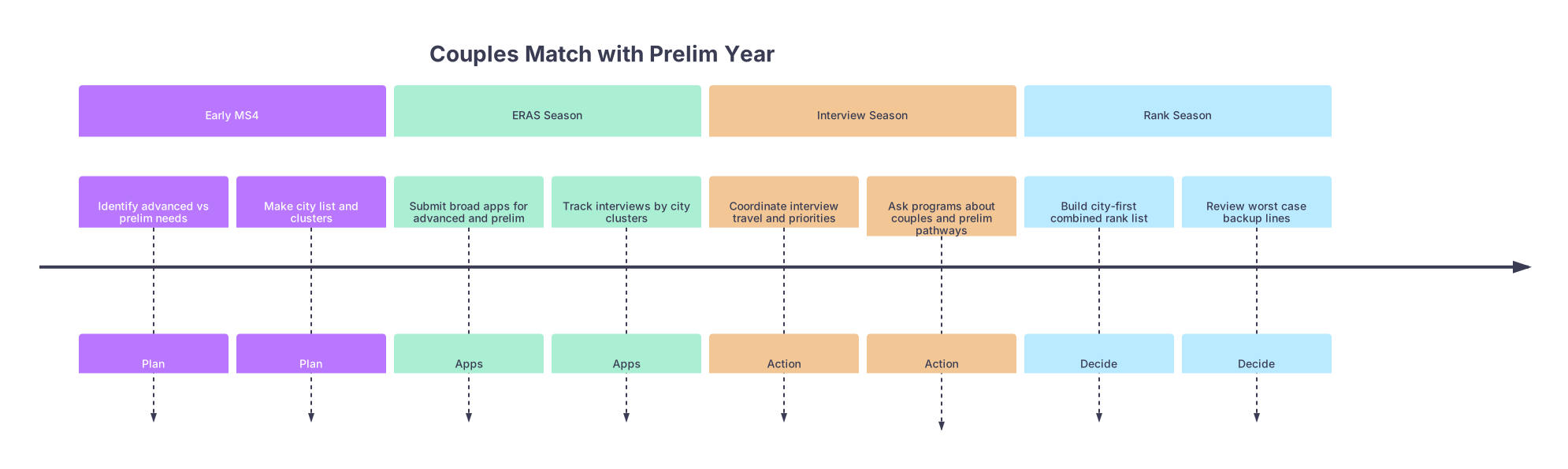
| Period | Event |
|---|---|
| Early MS4 - Identify advanced vs prelim needs | Plan |
| Early MS4 - Make city list and clusters | Plan |
| ERAS Season - Submit broad apps for advanced and prelim | Apps |
| ERAS Season - Track interviews by city clusters | Apps |
| Interview Season - Coordinate interview travel and priorities | Action |
| Interview Season - Ask programs about couples and prelim pathways | Action |
| Rank Season - Build city-first combined rank list | Decide |
| Rank Season - Review worst case backup lines | Decide |
Roughly:
June–August
- Decide exact specialties and whether prelim is required.
- Build your city cluster spreadsheet.
- Apply broadly (advanced + prelim/TY + categorical).
September–January
- Prioritize interviews in your key cities.
- If you have to cancel some, cancel out-of-cluster ones first.
- Take notes after each interview about how each combination would feel in real life.
January–February
- Draft rank list v1 early.
- Sit down together ~3 times to refine: once early, once mid, once just before submission.
- Have a trusted attending or resident couple glance at your logic if possible.
10. How To Keep Your Relationship Intact During This
You’re not just matching jobs. You’re testing your communication.
A few blunt rules:
- No passive-aggressive “do whatever you want” during rank list week. That’s code for “I’m going to resent this later.”
- Each of you gets one non-negotiable:
- Example: “I will not rank a surgical prelim known to be malignant.”
- Example: “I won’t live in City Z for family reasons.”
- Everything else is tradeable. Including prestige.
And remember: the goal is not “two perfect CVs.” It is “two careers that are good enough and a relationship that survives.”

FAQ (Exactly 4 Questions)
1. Should the advanced partner ever rank an advanced program without a prelim attached?
Yes—late in the list. This can allow the advanced partner to match their specialty in a great place, then try to SOAP into a prelim or negotiate a delayed start. But do not put those lines high. They’re backup scenarios, not primary strategy.
2. Is it better to prioritize being at the same hospital or just the same city?
Same city beats same hospital. Being 20–30 minutes apart at two different institutions is usually fine. Trainees handle that all the time. But two different cities, even 1–2 hours apart, becomes logistically and emotionally heavy very quickly, especially if one of you is on q4 call or frequent nights.
3. How many prelim programs should the advanced partner apply to?
More than you think. In competitive cities, 15–25+ prelim/TY programs is not crazy, especially if you’re geographically restricted. If you apply to 30 advanced programs and only 6 prelims, you’ve inverted the risk: you might land an advanced spot and be scrambling in SOAP for a place to do your PGY-1.
4. What if one partner is much more competitive than the other?
You adjust their expectations, not the weaker partner’s humanity. The stronger applicant needs to expand their program list to include solid but less prestigious options in cities where the other partner has real shots. It’s brutal on the ego, but the alternative is often long-distance or one partner going unmatched. Choose which problem you’d rather have.
Open a shared spreadsheet with your partner right now and list your top 5 cities; under each, write every program (advanced, prelim/TY, categorical) that could work for both of you—do not close the laptop until that list exists.


