
The mythology around “easy” prelim years is wrong. The data on duty hours and call frequency show clear, repeatable patterns—and if you ignore them, you will pick the wrong program.
You are not choosing vibes. You are choosing a workload model: how many hours you will be in the hospital, how often you will be up all night, how much your brain and body will be pushed before your advanced residency even starts. There are only a handful of common prelim models. Each has a measurable footprint in hours per week, calls per month, and sleep disruption.
Let’s quantify it.
1. What a Prelim Year Actually Is (Operationally)
A “preliminary year” is a one-year residency position (most commonly in internal medicine, general surgery, or transitional year) that satisfies the PGY-1 requirement for advanced specialties like:
- Anesthesiology
- Radiology
- Dermatology
- Ophthalmology
- Radiation oncology
- Neurology (sometimes)
Structurally, prelim programs fall into three big buckets:
- Preliminary Internal Medicine (IM prelim)
- Preliminary Surgery (Surgery prelim)
- Transitional Year (TY)
From a workload metrics standpoint, here is the blunt reality: all three are constrained by the same ACGME duty hour rules (80 hours/week averaged over 4 weeks, 1 day off in 7, limited in-house call), but they use that allowance very differently.
If you are applying, your core question is not “Is this program malignant?” but “What does the call and duty-hour model look like over 12 months—and can I tolerate that while preparing for my advanced specialty?”
2. Duty Hour Rules vs. Real-World Work
The ACGME framework is simple on paper:
- Maximum 80 hours per week, averaged over 4 weeks
- Minimum 1 day off in 7, averaged over 4 weeks
- In-house call no more often than every 3rd night
- No more than 24 hours of continuous duty (plus 4 hours for transitions)
In reality, prelim residents cluster into three workload bands:
- “Heavy” models: realistic 65–80 hours/week, frequent q4–q5 in-house call, significant night float
- “Moderate” models: 55–65 hours/week, mix of long days and some nights, fewer true 24s
- “Light” models: 45–55 hours/week, more elective and ambulatory time, limited nights
The type of prelim you choose strongly predicts which band you land in. Programs vary, but the pattern is not random.
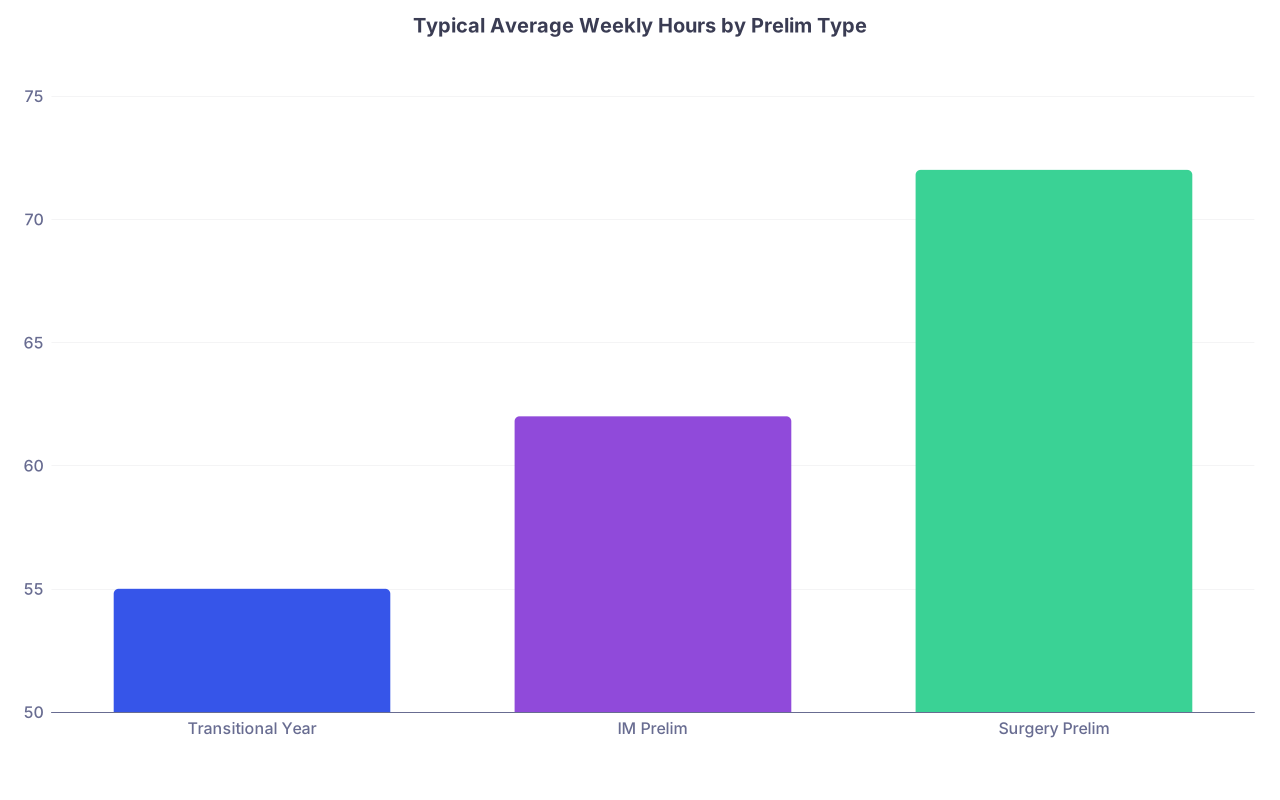
| Category | Value |
|---|---|
| Transitional Year | 55 |
| IM Prelim | 62 |
| Surgery Prelim | 72 |
You can find exceptions, but if you assume this approximate distribution when reading program descriptions and talking to residents, you will be right far more often than wrong.
3. Common Prelim Models: Call and Hours by Type
Let me break down the typical models you actually see on the ground, by prelim category. This is based on composite data from duty-hour reports, sample block schedules, and what residents consistently report when they are being candid and not just “selling the program.”
3.1 Transitional Year (TY): The “Lifestyle” Prelim – Usually
Transitional Year is the program anesthesiology and radiology applicants try to hoard for a reason. On average:
- Weekly hours: 50–60 on inpatient-heavy months, 40–50 on electives
- Nights: clustered into short night float blocks or intermittent night shifts
- Calls: often limited traditional 24s; more programs moving to night float models
A fairly typical TY schedule at a mid-sized community program:
- 4 months inpatient medicine (including 1 ICU)
- 1 month emergency medicine
- 1 month surgery or surgical subspecialty
- 6 months electives/outpatient (neuro, radiology, anesthesia, derm, etc.)
From a numbers standpoint, the key with TY is variance. You will have “peak” blocks that look very much like a full IM prelim, and “valley” blocks that drop below 50 hours/week.
On a heavy inpatient TY month, the duty-hour profile often looks like:
- 6 days/week, 11–12 hour shifts: ~66–72 hours
- One 2–4 week block of nights per year (q4–q6 nights), but usually no chronic q4 24-hour calls
- Some programs still run q4 day/night 28-hour calls on ward months, but that is less common in well-resourced TYs
On a lighter elective month:
- 5 days/week, 8–10 hours/day: ~40–50 hours
- No nights, no weekends or minimal weekend coverage
So the yearly average for a typical TY resident lands around 52–58 hours/week, with maybe 3–4 truly brutal blocks. That is dramatically different from a surgery prelim where “brutal” is the baseline.
3.2 Preliminary Internal Medicine: Middle of the Pack
IM prelim years often mirror categorical IM for core rotations, but with slightly more elective flexibility. Quantitatively, it looks like this at many academic medical centers:
- 4–6 months floor wards (day team + night float or 24-hour call)
- 1–2 months ICU
- 1–2 months night float
- Remainder: electives, subspecialty consults, ambulatory
The real drivers of workload are:
- How often you pull nights vs day
- Whether the program uses 24-hour call or pure shift-based night float
A realistic average:
- Wards with 24-hour call: 70–80 hours/week on those months
- Wards with day + short-call system: ~60–70 hours/week
- ICU: ~65–75 hours/week
- Electives/ambulatory: ~45–55 hours/week
If you blend that over a typical year, IM prelim residents often sit around 60–65 hours/week. It is not quite as punishing as surgery, but it is not “easy.”
Call frequency on core IM prelim rotations often looks like:
- Night float: 5–6 nights/week for 2–4 weeks per block
- Classic in-house call: q4 (occasionally q5), 24-hour shifts on wards or ICU
- Some community programs: home call on select rotations (e.g., cardiology consults), but that is not dominant
From a life perspective, the major pain point is not the raw hours but the density of nights in a short window. You can average “only” 62 hours/week and still feel wrecked if that includes a run of 6 consecutive night shifts every 4–6 weeks.
3.3 Preliminary Surgery: The Upper Bound
Surgery prelims sit at the top of the workload curve. They are often used as “extra service coverage” in high-volume surgical departments.
Common structure:
- 8–10 months on surgical services (general, trauma, vascular, specialty)
- 1–2 months ICU
- 0–2 months elective
The hours look like this on busy services:
- Day shift: 5:30–6:00 start, 6–7 pm end → 12–14 hours, 5–6 days/week = 60–84 hours
- Call: q4 or q5 24-hour in-house call layered on top of long weeks
- ICU/trauma: similar or higher, particularly at Level I centers
So a realistic band:
- Busier blocks: 75–80 hours/week (some report higher, but programs are incentivized to “round down” in official reporting)
- Slightly lighter blocks: 65–70 hours/week
Yearly average: very often in the 70-hour range.
You also see more “every third night” style call with true 24–28 hour shifts, especially at older-school academic surgery departments. That pattern—q3 or q4 24s—is the most physically punishing call model in all of residency training, not just prelim.
4. Comparing Workload Across Common Models
Summarizing the patterns is useful, but putting the numbers side by side is better.
| Prelim Type | Avg Hours/Week | Nights/Month (Peak) | 24-hr In-House Call | Elective Months |
|---|---|---|---|---|
| Transitional Year | 52–58 | 5–7 (on NF blocks) | Limited/variable | 4–6 |
| IM Prelim | 60–65 | 6–8 (NF or call) | Common on wards/ICU | 2–4 |
| Surgery Prelim | 68–75 | 7–9 (q3–q4 call) | Frequent | 0–2 |
“Peak nights per month” here means how bad it gets on the worst months, not the year-round average. The human body cares about peaks more than averages. Two months of q3 24s can wreck you in a way no “average 60 hours/week” statistic captures.
To visualize differences in call density, especially the “worst-case” scenario per model:
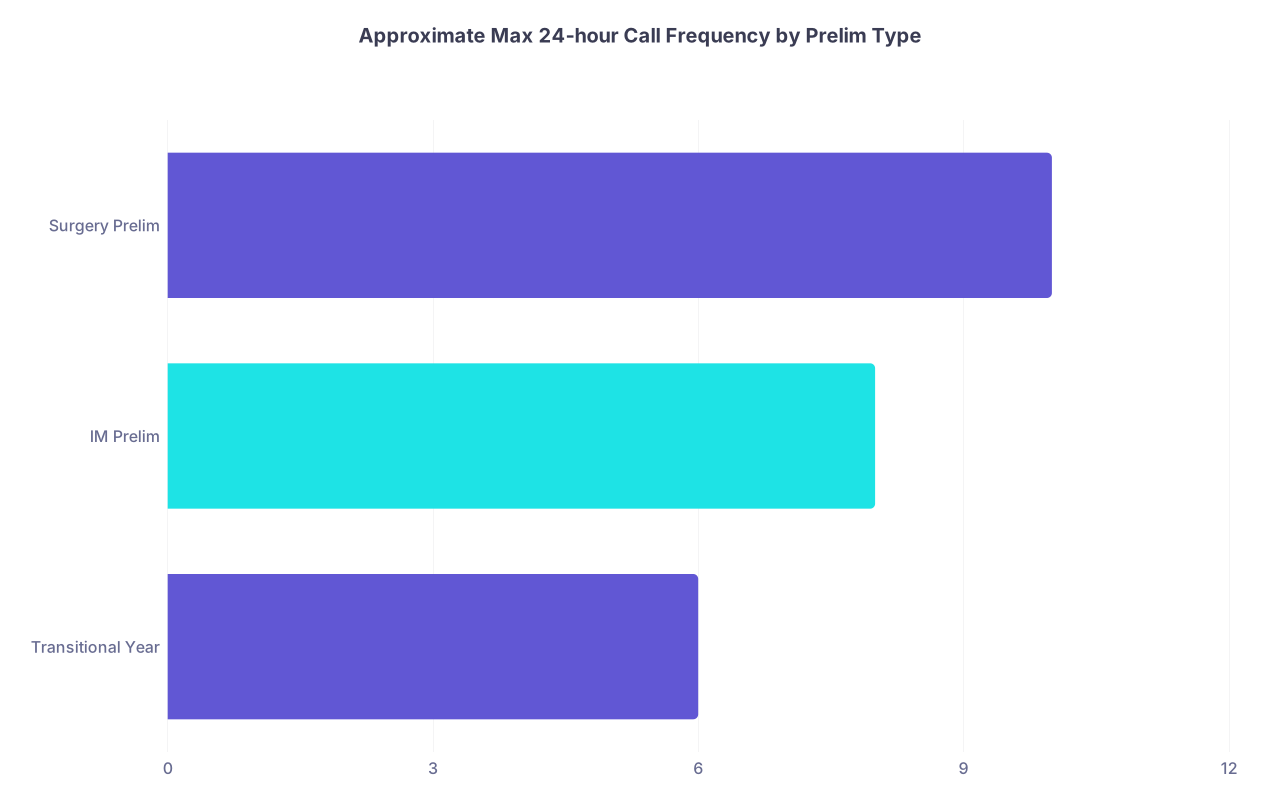
| Category | Value |
|---|---|
| Transitional Year | 6 |
| IM Prelim | 8 |
| Surgery Prelim | 10 |
This can be read as “number of 24-hour (or equivalent) in-house calls on the worst month of the year.” Not perfect, but it tracks well with what residents report.
5. Common Prelim Scheduling Architectures
Hospitals only have a few ways to slice the duty-hour pie. Call models repeat.
5.1 Traditional q3–q4 Call Model
You still see this in:
- Many surgery prelim programs
- Some IM prelim programs at tertiary centers
Pattern:
- 1 intern is “on call” in-house for 24 hours every 3–4 nights
- Post-call day often includes a few hours of work, then “post-call” afternoon off
- Non-call days are still long (10–14 hours)
So in a 4-week block with q4 call (every 4th night), call days alone are 6–7 24-hour shifts. Add 18–20 non-call days at 11–13 hours, and you are right against the 80-hour ceiling.
Effect on your life:
- Sleep fragmentation: basically guaranteed
- Weekends: mostly gone, because call cycles do not respect weekends
- Learning: you see a lot, but retention drops when you run that sleep deficit for months
I have seen surgery prelim residents mark their calendar by “P, NC, C” (post-call, non-call, call) because that is how their lived reality was structured. Everything else was noise.
5.2 Night Float Blocks
More common in:
- Transitional Years
- Internal Medicine prelims
- Some hybrid surgery programs
Pattern:
- 2–4 week block of pure nights: 6–7 nights/week, 11–13 hour shifts
- No 24s, but circadian rhythm annihilated
- Daytime blocks are then free of overnight call
Quantitatively:
- Night float week: ~65–75 hours
- Daytime ward week: often 55–65 hours
Night float makes programs look better on paper (“no 24-hour call”), but the block model creates discrete time periods where your life is essentially on pause. You can survive it, but if your advanced residency prep depends on stable evenings or daytime clinic experiences, a heavy NF system can crush that.
5.3 Shift-Based / ED-Style Call
Seen in:
- Transitional Year (especially at community sites)
- Some IM prelim programs with ED-heavy rotations
Pattern:
- 8–12 hour defined shifts, both day and night
- Predictable start and end times, usually no 24s
- Hours add up, but on a calendar they feel less oppressive
A common TY ED month, for example:
- 16 shifts/month, mostly 8–10 hours → 130–160 hours/month = ~33–40 hours/week
- Add conferences, charting, etc. and you get to ~40–45 hours/week
This is why TYs with robust ED time feel so much lighter. Not because the work is easier, but because it is bounded.
6. How Workload Patterns Impact You (By Future Specialty)
The right workload is not the lowest possible. It is the one that aligns with what you need before PGY-2.
6.1 For Anesthesiology, Radiology, Derm, Ophtho
Your main trade-off:
- Enough inpatient exposure not to be unsafe
- Not so much grind that you burn out before your “real” training
Data point from applicant behaviors: high-scoring, competitive-match applicants in these fields disproportionately rank:
- Strong Transitional Years first
- Lighter IM prelims second
- Surgery prelims rarely, unless forced or very specific circumstances
That is not random. Over the years I have watched multiple anesthesia residents show up in July already exhausted because they did a brutal surgery prelim. They were technically “resilient,” but it delayed when they could actually focus on OR-level learning by months.
The workload that seems to work best for these groups:
- Yearly average 50–60 hours/week
- No more than 1–2 months of heavy q4 24s or equivalent
- At least 4 months of electives or lighter rotations
6.2 For Those Considering Switching Into Categorical IM or Surgery
Different calculus.
If you are treating prelim as a potential audition for categorical IM or general surgery, then a heavier model in that same department can be an advantage, if—and this is the big if—you perform well.
Surgery prelim year with:
- 70–80 hours/week baseline
- q3–q4 call
- Multiple ICU/trauma blocks
…is brutal. But the attendings really do see you in the trenches. In some departments, that’s the only way they take you seriously enough to convert you to a categorical slot.
Internal medicine is a bit more forgiving; the jump from 60-hour IM prelim to categorical IM is smaller. But again, your visibility rises with service time.
The data here is anecdotal but consistent: categorical conversion rates for surgery prelims are higher when residents are embedded heavily in core services. The trade-off is simply your sanity and risk of burnout.
7. Red Flags and Green Flags in Workload Descriptions
When you read program websites and talk to residents, you will not see a clean “Avg 72.4 hours/week” chart. Programs usually under-specify. You have to infer.
7.1 Red Flag Phrases
From a workload metric lens, phrases that often correlate with heavier or more chaotic schedules:
- “Our prelim residents are fully integrated into the categorical call pool.”
- “Extensive exposure to high-acuity surgical services, including trauma and transplant.”
- “Our interns frequently exceed expectations to get the job done.”
- “You will function at the level of a categorical intern from day one.”
Alone, these are not damning. Combined with 8–10 months of core inpatient services and limited elective time, you are almost certainly staring at a 65–80 hour/week experience.
7.2 Green Flag Phrases
Correlated with lighter, more controlled workloads:
- “Significant elective time designed for advanced specialty preparation.”
- “Night float system with limited 24-hour calls.”
- “Emphasis on work-life balance and wellness, with strict duty-hour compliance.”
- “Rotations tailored for anesthesiology/radiology/dermatology-bound interns.”
Again, you confirm this by asking specific questions on interview day:
“How many months of night float? How many 24-hour calls on your heaviest months? What were your average logged hours last year on wards?”
If the chief resident dodges or hand-waves, assume the worst.
8. A Simple Framework to Evaluate Prelim Workload
To make this concrete, use three numbers when comparing programs:
- Heaviest month hours/week
- Number of 24-hour (or equivalent) calls on that month
- Number of elective / light months in the year
That 3-point vector tells you 80% of what matters.
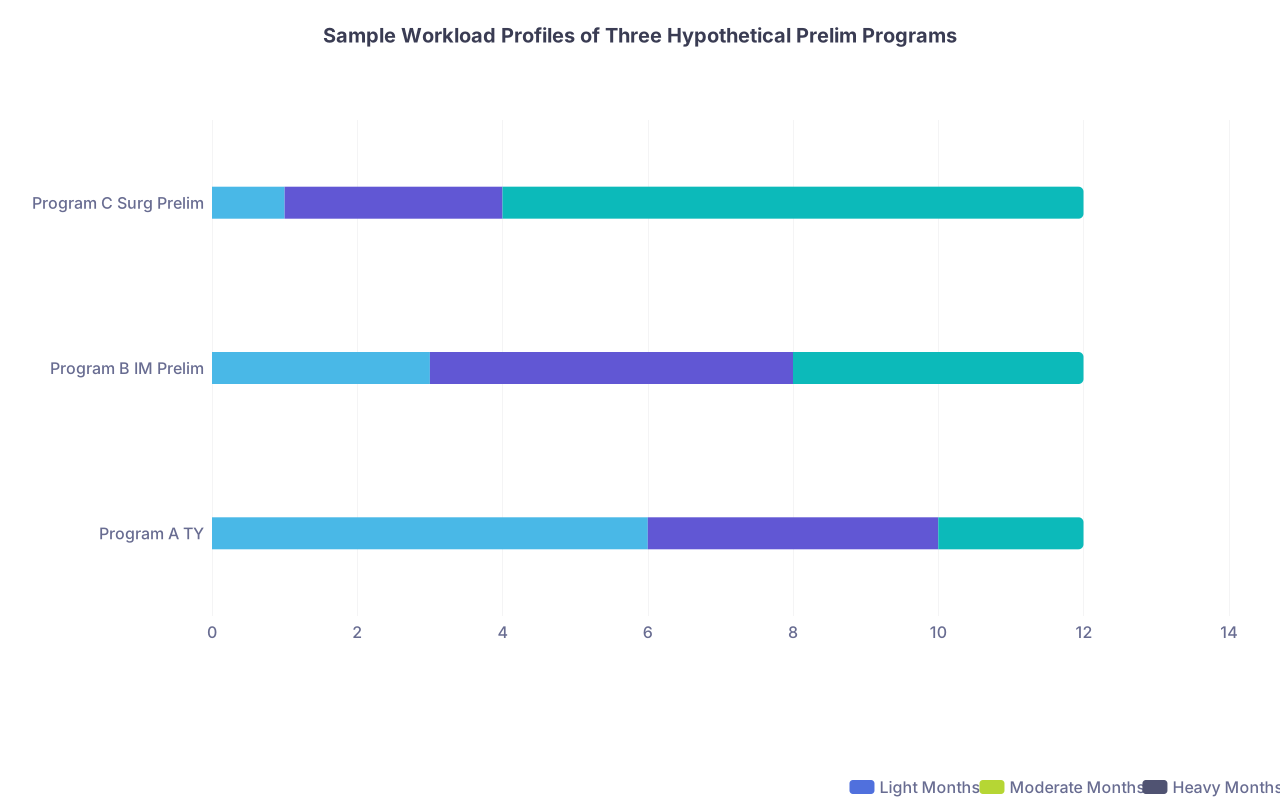
| Category | Light Months | Moderate Months | Heavy Months |
|---|---|---|---|
| Program A TY | 6 | 4 | 2 |
| Program B IM Prelim | 3 | 5 | 4 |
| Program C Surg Prelim | 1 | 3 | 8 |
Program A is the archetypal “good TY” profile. Program C is the surgery prelim that tests your limits. Program B is the middle-ground IM prelim.
If you can get each program to roughly map to one of these patterns from conversations and websites, your decision-making becomes a lot more rational and a lot less about glossy brochures.
9. Bottom Line: How to Use Workload Metrics When Ranking
Strip away the noise and you are deciding between three broad models:
- Transitional Year: lower average hours, fewer 24s, more electives; best if your advanced field is not inpatient-heavy and you want to arrive fresh.
- IM Prelim: moderate hours with genuine medicine exposure; good balance if you want to feel “intern tough” but not crushed.
- Surgery Prelim: maximal hours and call intensity; only smart if you either love surgery, need a categorical audition, or have no alternative.
Three key points to remember:
- Duty hours are capped on paper, but the distribution of those hours (nights, 24s, heavy blocks) is what shapes your real experience.
- You can usually infer a program’s workload model from its rotation breakdown, call description, and how residents talk when they let the mask slip.
- Pick the prelim model whose workload you can sustain while still doing the one thing that matters most: arriving to your advanced residency actually ready to learn, not already running on fumes.