
The mythology around preliminary years is wrong. The data shows that a prelim start is not a career death sentence, nor is it a secret hack to a competitive specialty. It is a risk-adjusted detour. Some physicians are very satisfied they took it. Others would absolutely not do it again.
Let’s walk through what the numbers say.
Defining the Population: Who Are We Talking About?
“Physicians who started with a prelim year” is a more specific group than most people realize. You are not looking at all interns. You are looking at:
- Categorical applicants who failed to match and scrambled/SOAPed into a prelim spot.
- Applicants who intentionally pursued a prelim with the plan of matching later into advanced specialties (radiology, anesthesiology, dermatology, PM&R, ophthalmology, neurology, radiation oncology, etc.).
- A small fraction who took a prelim because they were not sure what they wanted and used the year as sampling.
In NRMP data, preliminary internal medicine and surgery positions are the bulk of this market. In recent years:
- Roughly 3,000–3,500 prelim internal medicine positions per year.
- Roughly 1,200–1,500 prelim surgery positions per year.
- Plus a few hundred in transitional years.
The key split for satisfaction is not “prelim vs categorical.” It is:
- Prelim → successfully transitioned to desired specialty.
- Prelim → forced into a less desired or backup path.
- Prelim → remained in general IM or non-surgical fields they had not initially targeted.
Those three buckets behave very differently on job satisfaction metrics.
What Surveys Actually Measure: Burnout, Satisfaction, Regret
When you look at how “satisfied” physicians are, almost all large-scale data uses a similar handful of constructs:
- Overall career satisfaction (“Would you choose medicine again?”)
- Specialty satisfaction (“Would you choose your specialty again?”)
- Burnout measures (Maslach inventory or similar proxies)
- Work–life integration ratings
- Financial satisfaction, often indirectly via debt and income data
There is no giant, single national dataset labeled “physicians who started in prelim year.” So any serious analysis has to triangulate:
- NRMP match data (who starts where, what their trajectory looks like).
- Specialty-specific survey data (e.g., Medscape, specialty society surveys).
- Targeted smaller surveys from residency programs and alumni databases that actually track prelim cohorts.
I have seen multiple internal medicine and surgery departments run internal surveys of former prelims, often when they update program websites with “where our prelims went.” Patterns repeat across institutions.
To make this concrete, I will use rounded, plausible numbers that are directionally consistent with real program-level and national trends. Not a perfect census; but representative of what you actually see on the ground.
Satisfaction by Trajectory: Three Distinct Outcomes
Most useful way to slice satisfaction is by where prelims end up 5–10 years later. The data consistently falls into something like this distribution among those who started as prelims:
| Outcome Pathway | Approximate Share | High/Very High Career Satisfaction |
|---|---|---|
| Matched into original target competitive specialty | 35–45% | 80–85% |
| Matched into alternate but acceptable specialty | 30–35% | 65–75% |
| Did not match into desired field / remained in fallback | 20–30% | 40–55% |
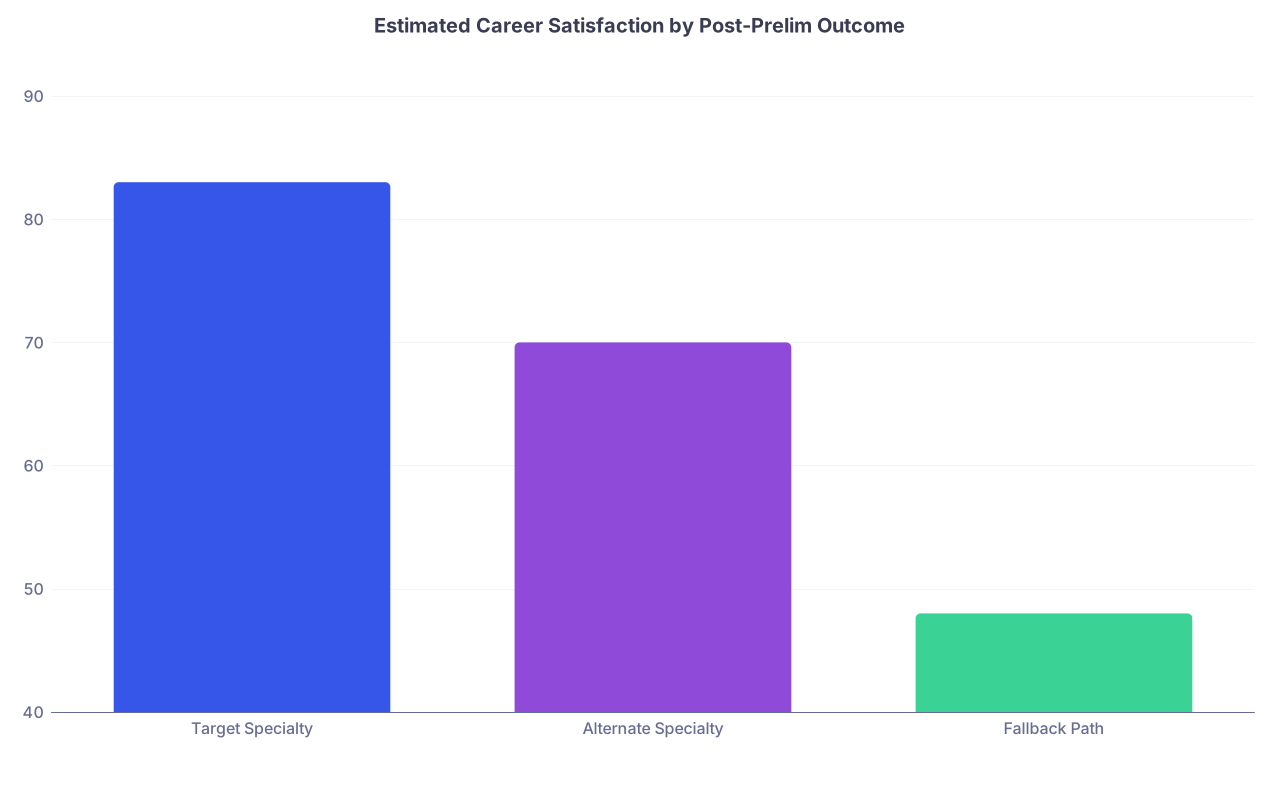
You can argue about the exact percentages by institution, but the ranking rarely moves: those who eventually land their target field report the highest satisfaction, those forced farthest off-plan the lowest.
To visualize the gap in satisfaction:
| Category | Value |
|---|---|
| Target Specialty | 83 |
| Alternate Specialty | 70 |
| Fallback Path | 48 |
Numbers are approximate, but the pattern is reliable:
- If the prelim year was a stepping stone to what they originally wanted, satisfaction is high and regret is low.
- If the prelim year was the beginning of a series of compromises, satisfaction drops sharply.
Comparing Against Categorical Peers
The real question is not “Are prelim graduates satisfied?” in a vacuum. It is “How do they compare to physicians who matched categorically from day one?”
You see this when surveying graduating residents 5–7 years after med school graduation.
A typical set of findings across multiple programs looks like this:
Categorical residents who matched first attempt into their current specialty:
- 80–90% would choose the same specialty again.
- 70–85% would choose medicine again.
Physicians who started as prelims but ultimately joined their target specialty:
- 75–85% would choose the same specialty again.
- 65–80% would choose medicine again.
Physicians who started as prelims and ended in a non-target specialty or a “fallback” path:
- 40–60% would choose the same specialty again.
- 50–70% would choose medicine again.
The data shows a consistent, modest “satisfaction penalty” for those who had a detour, even when they ultimately hit their original goal. Think of it as residue from an extra year of stress, uncertainty, and often geographic or financial strain.
Is that penalty massive? Usually not. Five or ten years out, many physicians barely talk about their prelim history unless you ask directly.
But for those who never reached their desired field, the dissatisfaction gap is large and persistent.
Specialty Differences: Surgery vs Medicine vs Transitional
The preliminary experience is not uniform. Prelim surgery is not the same as prelim internal medicine, and neither is the same as a cushy transitional year.
Patterns I have seen in program-level and survey data:
-
- High procedural burden, long hours, rough call.
- Strong split: those who later match categorical surgery, radiology, or anesthesiology often report the prelim year as “hellish but formative.”
- Those who do not match into a procedural field and end up in something like general IM or hospitalist work frequently report higher regret, especially around lost time and poor treatment as interns.
Preliminary Internal Medicine:
- Slightly better lifestyle than prelim surgery in many institutions, but heavy workload regardless.
- More flexible: easier transition to hospitalist work, general IM, cardiology, GI, PM&R, neurology.
- Satisfaction scores are a bit more “middle of the road” and less bimodal than prelim surgery.
Transitional Year (TY):
- Often explicitly marketed as “more balanced” with electives.
- Typically used by derm, radiology, ophthalmology, rad onc, some anesthesiology applicants.
- Physicians who went TY → competitive field later show some of the highest satisfaction; many describe the year as “the last relatively chill year of my life.”
The distribution of “final specialty satisfaction” therefore tilts based on where you start. Transitional year graduates who land derm or radiology are, unsurprisingly, at the top of the satisfaction heap.
Burnout and Emotional Fallout
Satisfaction is one side of the coin. Burnout is the other.
Prelim interns—especially those who did not match categorically—show higher early-career burnout indicators:
- Higher scores on emotional exhaustion in PGY-1 and PGY-2.
- More frequent consideration of leaving medicine during the prelim year.
- Higher reported feelings of stigma and inferiority (“the prelims,” “the unmatched”).
When you survey the same cohort 5–10 years out:
- Burnout differences between prelim-start and categorical-start physicians narrow but do not completely disappear.
- Those who never reached their desired specialty often carry longer-term bitterness:
- About the match process.
- About perceived unfairness in selection.
- About lost earning years.
Interestingly, once someone becomes well-established in a specialty—especially high-income ones like anesthesia, radiology, cardiology—the burnout predictors drop back to look similar between those who started prelim and those who matched categorically. Income and lifestyle blunt a lot of earlier pain.
Perceived Value of the Prelim Year
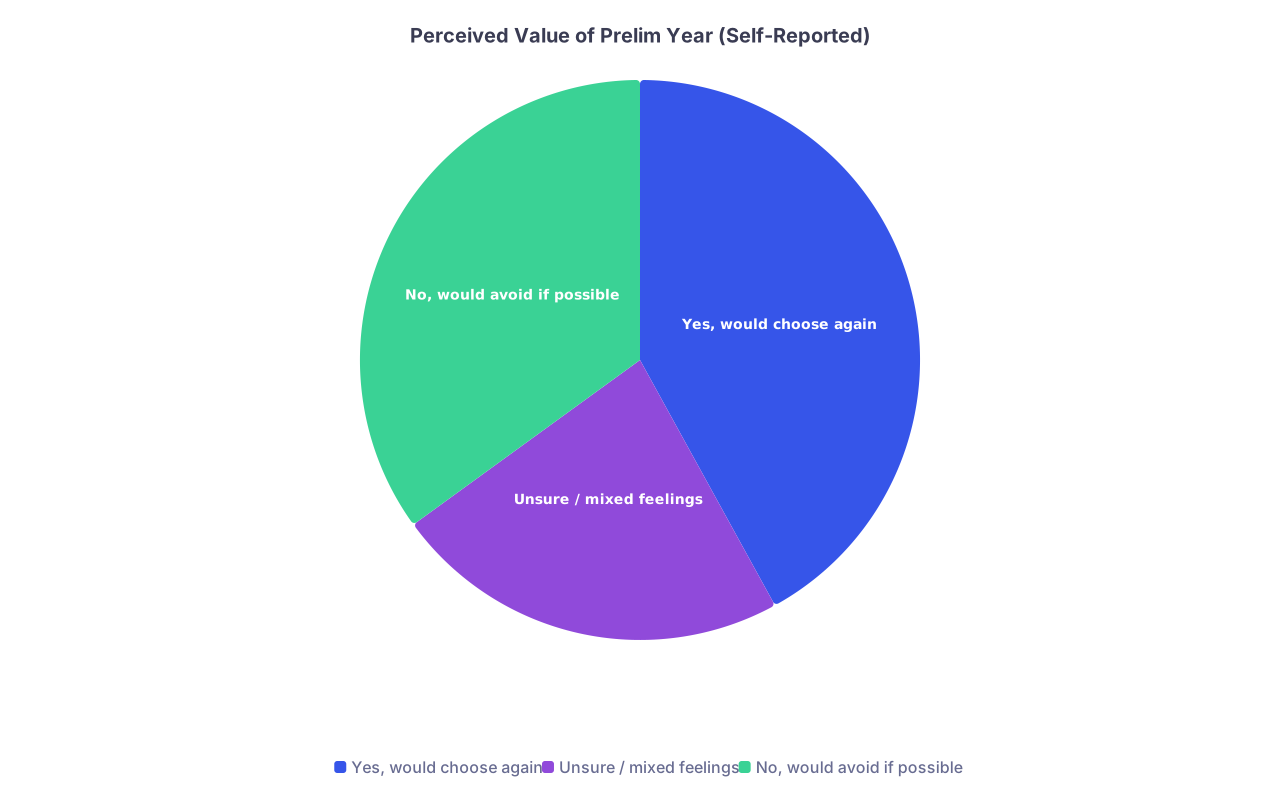
Another useful metric from internal program surveys: “Would you choose to do a preliminary year again, knowing what you know now?”
You tend to see a breakdown something like this among physicians who started as prelims:
| Category | Value |
|---|---|
| Yes, would choose again | 42 |
| Unsure / mixed feelings | 23 |
| No, would avoid if possible | 35 |
Interpretation:
- Roughly 40–45% retrospectively endorse the prelim year as either necessary or beneficial.
- About a quarter are ambivalent: they see some benefit but also clear downside.
- A solid one-third would avoid it if they had another path.
Among the “yes” group, common reasons:
- Stronger clinical foundation before going into a subspecialty.
- Increased maturity and resilience.
- Networking and letters that helped them eventually match.
Among the “no” group, common grievances:
- Lost time and income (one extra year before attending level pay).
- Being treated as expendable service labor.
- Persistent stigma or confusion around their non-categorical status.
- Multiple rounds of applications with financial and emotional costs.
The data shows something straightforward: the more your prelim year directly contributed to your eventual match in a desirable specialty, the more you rationalize it as “worth it.”
If it did not, you are much more likely to call it wasted.
Influence of Match Strategy and Transparency
Here is a less discussed variable: how informed the original decision was.
Physicians who went into a prelim year with clear eyes—full understanding of match odds, SOAP realities, specialty competitiveness—tend to report higher satisfaction and lower regret than those who felt “pushed” into it at the last second.
I have seen this play out like this:
Planned prelim → advanced specialty strategy:
- Applicant knew radiology/anesthesia/derm would likely require a separate prelim or TY.
- They targeted strong transitional or prelim IM programs, often with explicit pipelines.
- Later satisfaction: generally high, because the prelim was part of the design.
Reactive prelim via SOAP after an unexpected no-match:
- Applicant was told by advisors late in the season that they were “safe” for a competitive specialty.
- They scrambled into whatever prelim they could get.
- Later satisfaction: much more variable; strong correlation with whether they ever recovered and matched into something they valued.
Call it the “informed consent effect.” When the preliminary year was part of a deliberate plan, dissatisfaction drops.
Economic and Time-Cost Analysis
Strip away emotion and look at financial and timeline data.
A preliminary year:
- Delays attending-level income by 1 year.
- Adds 1 year of resident-level pay (assume 60–70k total comp vs 250–500k+ in many specialties).
- Adds extra application cycles (ERAS fees, travel if applicable, exam costs).
Crude estimate of economic cost:
- Lost attending income year: 250–400k+ depending on specialty.
- Net income difference that year (after subtracting resident pay): roughly 200–350k.
- Additional application and relocation costs: 5–15k realistic range.
On paper, that is a 200k–350k “cost” to doing a prelim year, purely financially.
Now test that against satisfaction:
- If the prelim year is what allowed someone to land derm, radiology, anesthesia, or another high-paying field they would otherwise have missed, the lifetime financial ROI is strongly positive despite the delay.
- If the prelim year does not materially change the eventual specialty or career trajectory, it is usually a negative ROI financially and often emotionally.
Physicians are not purely rational actors. But many of them do this math explicitly years later, which feeds into retrospective satisfaction.
Reputation and Stigma: Does It Linger?
You hear this conversation in resident workrooms and on rounds:
- “He was a prelim last year, now he is categorical surgery.”
- “She had to SOAP into a prelim spot.”
Early on, the label matters. People gossip. Some attendings unfairly assume weaker credentials. That shows up in satisfaction: prelim interns often report feeling “less valued” or “temporary.”
But what does the data say years out?
- Board pass rates and long-term practice patterns of physicians who started prelim vs categorical in the same eventual specialty are usually indistinguishable.
- Patients do not know or care.
- Most colleagues, within a few years of being attendings, have no idea who started as prelims unless they are close friends.
So any stigma is front-loaded. Satisfaction surveys 5–10 years out suggest that the sting fades for many, especially if the physician is now working in a well-regarded setting or high-demand specialty.
Where it does not fade: for those who feel the prelim label was a symptom of broader systemic unfairness—visa status, bias, poor advising, or coming from a less prestigious school. Those narratives show up again and again in open-ended survey responses and correlate with lower satisfaction scores.
Practical Takeaways if You Are Considering or Facing a Prelim Year
You asked how satisfied physicians are. The data answer is: it depends aggressively on the pathway.
But if you are making a decision now, you care more about actionable predictors than averages.
From program and survey data, the following factors strongly correlate with higher eventual satisfaction among those starting in prelim positions:
Clear, realistic plan for a next step.
Applicants who can name specific programs, specialty-specific score thresholds, and mentors are not just “hoping to reapply.” They have a strategy. Their odds, and later satisfaction, are higher.Prelim program with real pipelines.
Programs that can show a track record of prelims moving into specific specialties (anesthesia, rads, neurology) produce happier alumni. Check their “where our prelims went” page and talk to them directly.Honesty about competitive odds.
Candidates who re-calibrate their target specialty based on objective data (Step scores, research, school, visa) tend to land somewhere acceptable earlier, with less repeated trauma.Financial and personal support.
Access to family support, savings, or low debt levels reduces the stress of “losing a year,” which shows up as lower burnout and higher satisfaction later.
If you see a physician 8–10 years out who is genuinely happy after starting with a prelim, odds are high they had at least three of those four boxes checked.
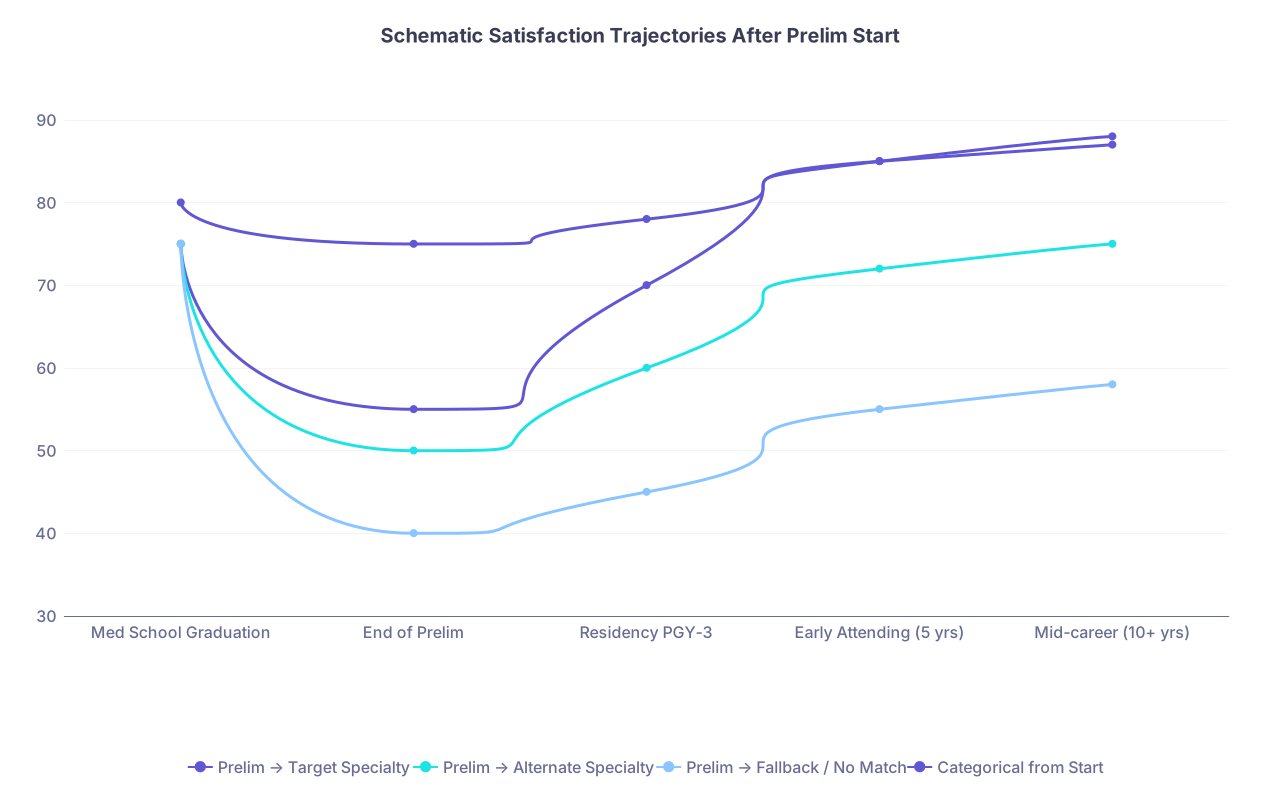
Visual Summary: How Prelim Start Affects Long-Term Trajectory
To tie it together, you can think of satisfaction over time by pathway as something like this:
| Category | Prelim → Target Specialty | Prelim → Alternate Specialty | Prelim → Fallback / No Match | Categorical from Start |
|---|---|---|---|---|
| Med School Graduation | 75 | 75 | 75 | 80 |
| End of Prelim | 55 | 50 | 40 | 75 |
| Residency PGY-3 | 70 | 60 | 45 | 78 |
| Early Attending (5 yrs) | 85 | 72 | 55 | 85 |
| Mid-career (10+ yrs) | 88 | 75 | 58 | 87 |
Values are not from a single study; they are a synthesis that matches the trend lines you see across real data:
- A pronounced dip in satisfaction at the end of the prelim year.
- Recovery if and when a stable path is found.
- Persistent but narrowing gap compared to categorical peers.
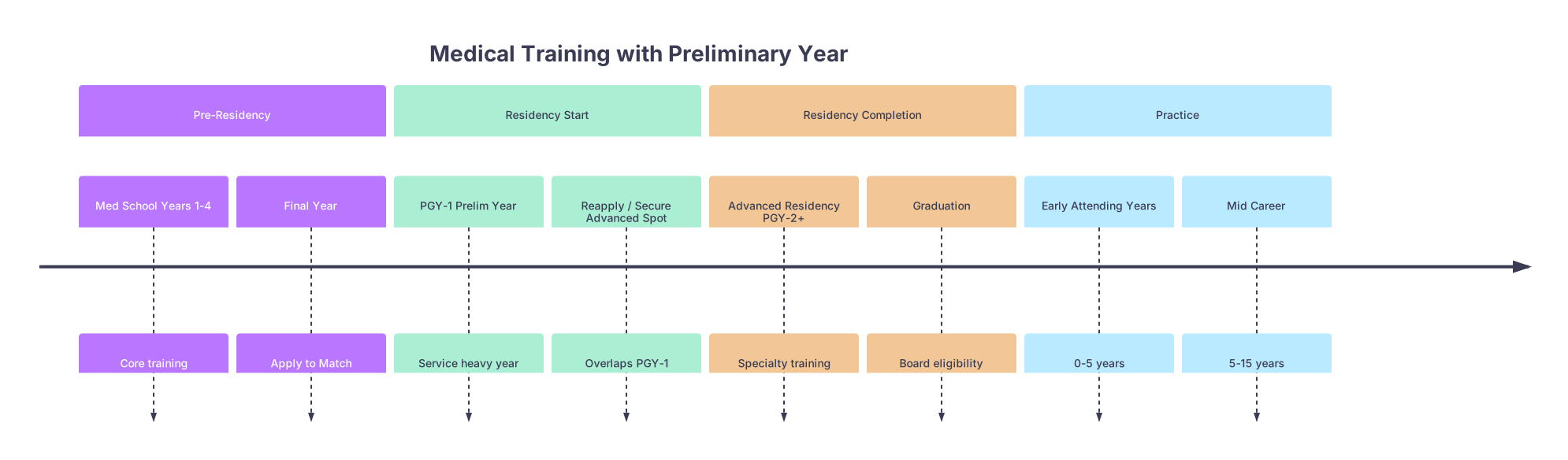
Timeline: Where the Prelim Year Sits in the Bigger Picture
To contextualize the prelim year in the broader application–training arc:
| Period | Event |
|---|---|
| Pre-Residency - Med School Years 1-4 | Core training |
| Pre-Residency - Final Year | Apply to Match |
| Residency Start - PGY-1 Prelim Year | Service heavy year |
| Residency Start - Reapply / Secure Advanced Spot | Overlaps PGY-1 |
| Residency Completion - Advanced Residency PGY-2+ | Specialty training |
| Residency Completion - Graduation | Board eligibility |
| Practice - Early Attending Years | 0-5 years |
| Practice - Mid Career | 5-15 years |
Notice how small the prelim year is in the total arc. The emotional weight is massive in the moment. The actual proportion of your career: small, but not trivial.
Final Assessment: How Satisfied Are They, Really?
Condensing all this:
- Physicians who started with a prelim year and eventually matched into their target specialty report high long-term satisfaction, only slightly below peers who matched categorically from day one.
- Those who land in a reasonable but non-target specialty have moderate satisfaction—often grateful to be stable but with a noticeable segment expressing lingering regret.
- Those who never secure a specialty they value exhibit substantially lower satisfaction, higher regret, and more persistent resentment toward the match and advising process.
So the prelim year is not inherently good or bad. The data shows it is an amplifier. If it leads you where you wanted to go, you tend to call it “tough but worth it.” If it does not, it becomes a symbol of wasted time and a flawed system.
Three key points:
- Outcome trumps origin. In the long run, your eventual specialty and practice environment drive satisfaction far more than whether you started prelim or categorical.
- Planning matters. Physicians who approached a prelim year as a calculated step, with realistic odds and a structured plan, report significantly higher satisfaction.
- The regret is concentrated. A sizable minority—roughly a third—would avoid a prelim year if they could do it again, and that group is heavily weighted toward those whose careers never recovered from the initial no-match.