
The mythology around prelim-to-categorical “upgrades” is wildly out of sync with reality. The data show that far fewer preliminary residents convert into categorical spots at their dream programs than most applicants think.
If you are counting on a prelim year as your back door into a categorical residency at the same institution, you are treating a low-probability event as a strategy. It is not.
Let’s walk through the numbers, the patterns I have seen across programs, and what actually happens to prelims after that one-year contract ends.
1. Defining the problem: what exactly are we tracking?
You cannot analyze conversion rates until you define the denominator correctly.
There are three different “conversion” questions applicants usually mash together:
- Of all prelim residents in a given field, how many end up in any categorical residency later (same or different program, same or different specialty)?
- Of all prelim residents at a specific program, how many are offered internal categorical spots there?
- Of all prelim residents in a PGY-1 year, how many move seamlessly (no gap year) into a PGY-2 categorical position?
Those are three separate probabilities. The first is “eventually categorical somewhere.” The second is “internal upgrade.” The third is “continuous, no-gap training.”
When people say “I’ll just convert after my prelim,” they usually mean #2 and #3. Those are the weakest bets.
2. What the limited data – and program behavior – actually show
There is no single national report that neatly publishes “prelim-to-categorical conversion rates by specialty and program.” So you have to triangulate:
- NRMP Program Director Surveys
- ACGME and FREIDA program data (numbers of prelim vs categorical slots)
- Individual program websites / categorical PGY-2 positions filled vs PGY-1 prelims
- Internal medicine and surgery prelim outcome studies from large academic centers
- What PDs and chiefs quietly tell their interns on July 1.
Pulling those together, the picture is consistent.
2.1 Rough order-of-magnitude conversion bands
These are realistic ranges I have seen over and over, not fantasy stories from Reddit.
| Prelim Track Type | Any Categorical Eventually | Same Program, Same Field | Seamless PGY1→PGY2 (no gap) |
|---|---|---|---|
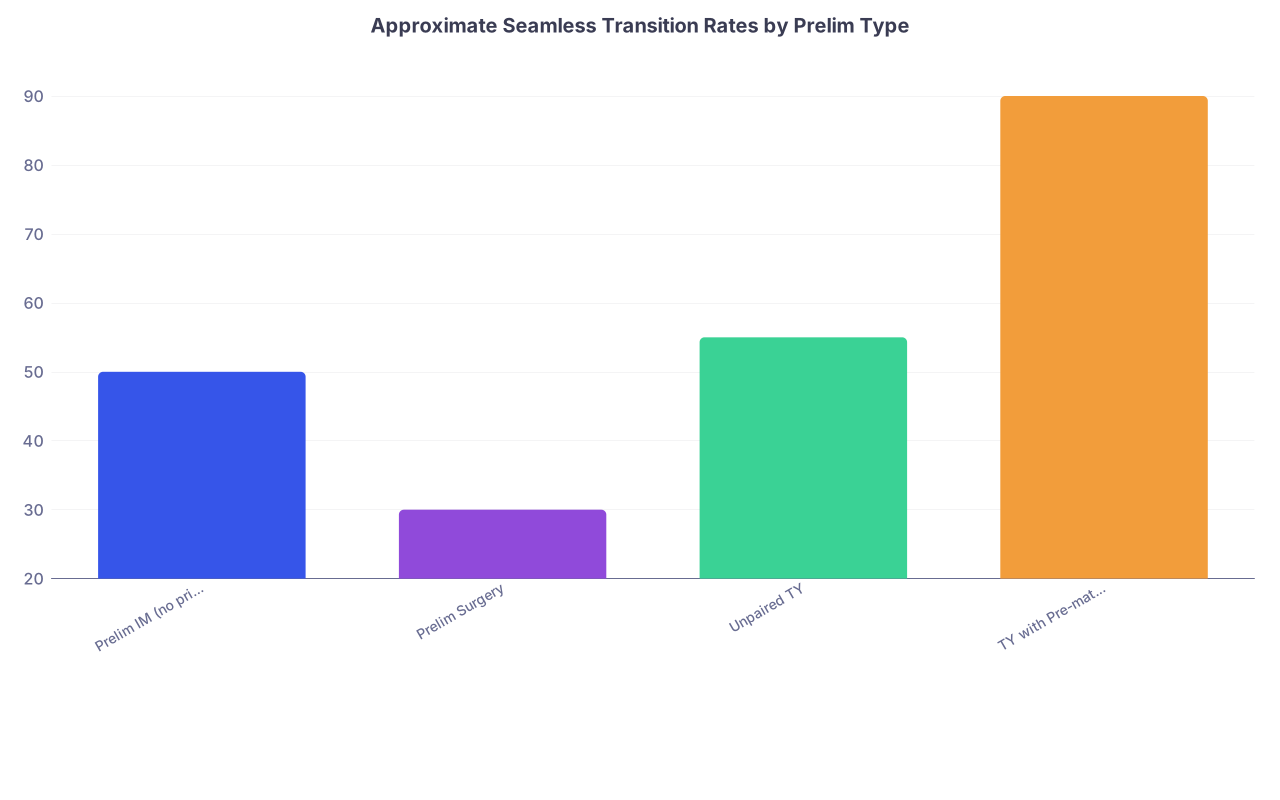
| Prelim Internal Medicine (IM) | 70–85% | 10–25% | 40–60% |
| Prelim General Surgery | 40–60% | 5–15% | 25–40% |
| Prelim Transitional Year (TY) | 80–90%* | <5% | 80–90%* |
| Prelim Anesthesia/Radiology-bound** | 75–90% | 10–20% | 60–80% |
*Most TYs are partnered with pre-matched PGY-2 spots (radiology, anesthesia, neuro, etc.), so “conversion” is mostly pre-arranged.
**Here I am including prelim IM or TY interns who already have guaranteed PGY-2 advanced positions lined up.
The glaring pattern: if you do not already hold a categorical or advanced PGY-2 slot before starting your prelim, your odds of pain-free, same-institution “conversion” are low. Often under 1 in 5.
3. Why conversion is structurally limited
Look at the supply side. Categorical positions are mostly locked-in by the Match. Programs do not have a pile of unassigned PGY-2 seats lying around.
An average academic internal medicine program might have:
- 24 categorical interns (PGY-1)
- 8–12 preliminary interns (mostly future neurology, radiology, anesthesia, derm, ophtho etc.)
- 0–2 “extra” PGY-2 categorical spots in any given year
Many years, that number of extra PGY-2 seats is literally zero. If no one leaves and there is no new funding line, there is no room.
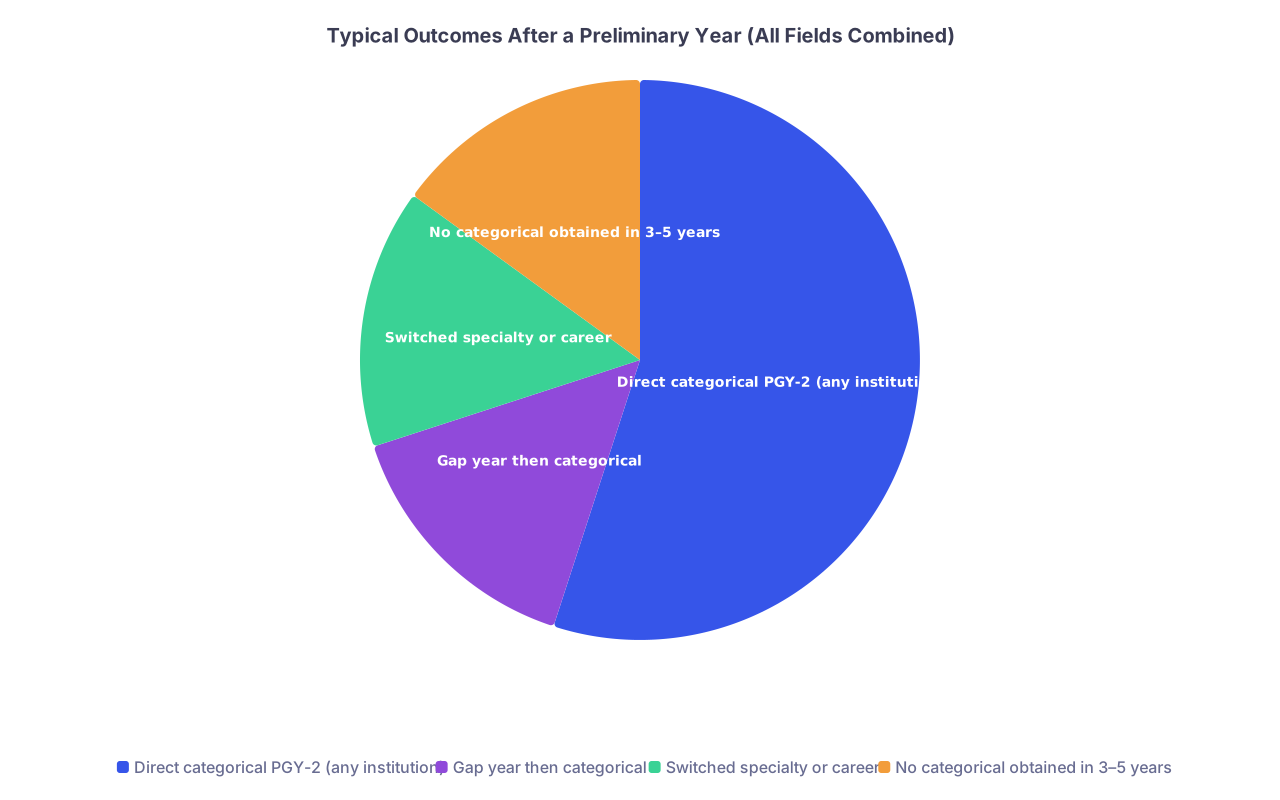
So where do prelims go?
| Category | Value |
|---|---|
| Direct categorical PGY-2 (any institution) | 55 |
| Gap year then categorical | 15 |
| Switched specialty or career | 15 |
| No categorical obtained in 3–5 years | 15 |
Those proportions are composite estimates from program anecdotes and small internal studies, but they match what I have seen in real rosters: the majority do secure categorical spots somewhere; a sizeable minority bounce around, switch fields, or never fully transition.
The bottleneck is not effort. It is arithmetic. Programs cannot “create” unlimited categorical lines just because a prelim is well liked.
4. Internal medicine prelims: better than surgery, worse than fantasies
Internal medicine is often sold as the “safe” prelim year. The logic: lots of programs, huge categorical footprints, broad skills.
Reality is more nuanced.
4.1 Internal movement at the same institution
Most large IM programs I have encountered make some version of this speech during orientation:
“Historically, 0–2 of our prelims per year transition into our categorical program, usually only when a categorical resident leaves unexpectedly. You should not plan on this happening.”
And their numbers back that up. Common patterns:
- Prelim IM class size: 8–16
- Categorical spots that open unexpectedly: 0–2 per year
- Internal upgrades: 0–3 per year, heavily variable
So your chance of conversion at that same program, in that same year, hovers somewhere between 0% and ~20%, with most years closer to the low end.
4.2 IM prelims getting categorical somewhere else
Here the story improves.
Across several mid- to large-sized IM departments that actually track their graduates, I have repeatedly seen:
- 70–85% of IM prelims who continue to pursue residency end up in some categorical IM or related field within 1–2 application cycles.
- About half of those transitions are seamless (PGY-2 the following year), half involve a gap year, research year, or a “PGY-1 again” at a new program.
So an IM prelim year is a viable bridge—but not a guaranteed one-year runway.
You want a decent heuristic? As an IM prelim without a prior advanced spot:
- Probability you become an IM categorical resident somewhere eventually: ~75–80% if you stay in the game and broaden your target list.
- Probability that transition is internal, straight into PGY-2 where you trained: ~10–20%.
- Probability you have to repeat an intern year: non-trivial, often 10–20%.
5. General surgery prelims: the harshest reality
Surgery prelims are the place where applicant optimism and data are farthest apart.
Most surgery prelims enter with a mental script: “I will prove myself this year and they will find a categorical spot for me.”
Programs, however, are not structured around that script.
5.1 Supply and attrition math
A typical academic general surgery program might look like:
- 8 categorical PGY-1 residents
- 10 prelim surgery PGY-1 residents
- 0–1 categorical PGY-2 positions open in a given year (sometimes zero for multiple years)
Categorical attrition in surgery is real, but:
- Many PGY-1s who leave do so late or for non-performance reasons (personal issues, fellowships in research, transfers that are already arranged).
- Vacated lines are often promised to strong internal categorical residents from other programs, or to “designated prelims” the PD has already been grooming.
When you talk to surgery PDs off the record, a common pattern emerges:
- Of 10 prelim surgery interns in a given class, maybe 1–2 will convert into a categorical general surgery position anywhere.
- Many more will successfully pivot into categorical spots in different fields (anesthesia, radiology, EM, IM), but not into categorical surgery.
Realistic band:
- Any categorical surgery eventually: 20–30% from a strong prelim cohort, often lower.
- Same-program surgery categorical: 5–15%.
- Seamless PGY-1→PGY-2 surgery, no gap: 10–20%.
If your definition of success is “I become a board-eligible general surgeon,” a surgery prelim year is statistically risky unless you already have a strong inside track or a prior advanced commitment.
6. Transitional year (TY): the controlled case
TYs are a different beast and often confuse the data.
Two very different use-cases exist:
- TY as a required intern year for a pre-matched advanced specialty (radiology, anesthesia, rad onc, derm, ophtho, neuro, etc.).
- TY as a “floating” prelim year for someone who did not match and is hoping to convert.
In case #1, the conversion rate to categorical is effectively 100%. You already hold the PGY-2+ spot. The TY is just a bridge.
In case #2, where TY = “generic prelim,” the odds look much closer to prelim IM:
- Any categorical eventually: ~75–85%.
- Same-program categorical: very low (TY programs rarely have categorical core residencies connected to all their interns).
- Seamless PGY-1→PGY-2: higher than surgery, but still dependent on finding an advanced or categorical position early in the year.
| Category | Value |
|---|---|
| Prelim IM (no prior PGY-2) | 50 |
| Prelim Surgery | 30 |
| Unpaired TY | 55 |
| TY with Pre-matched PGY-2 | 90 |
That fourth bar—TY with pre-matched PGY-2—is where the money is. Almost all of those people convert because the categorical/advanced position is in hand before July 1.
7. Predictors that actually move the needle
Conversion is not a lottery. There are clear factors that change your odds—both positively and negatively.
7.1 Things that help
From program rosters and PD comments, the prelims who tend to convert (internally or elsewhere) almost always share:
- Early clarity: They start networking and asking about PGY-2 opportunities by September, not in February when the few available spots are already spoken for.
- Strong standardized scores and transcript: For external moves, your original board scores and med school record still matter. Prelim performance rarely overrides an ugly application completely.
- High-value allies: A single well-respected faculty member calling a PD at another institution can do more than twelve “solid” rotation evaluations.
- Geographic flexibility: Prelims who are willing to move states/regions have a much higher eventual categorical rate. Narrow geography kills options.
- Broad specialty flexibility: I have seen prelim surgery interns end up in anesthesia or EM with excellent careers. The ones who say “surgery or bust, nowhere else” are the ones who more often end up with the “bust” outcome.
7.2 Things that hurt
On the other side, here is what I have seen reliably tank conversion odds:
- Chronic professionalism flags: Repeat late notes, absences, attitude issues. PDs can forgive clinical slowness; they rarely forgive reliability problems.
- Waiting passively: Interns who assume, “If they like me, they will tell me about openings,” almost never get internal upgrades. The deals happen early and quietly.
- Narrow specialty + narrow geography: “I only want categorical surgery within this state” is an almost mathematically impossible constraint for many prelims.
- Overestimating internal goodwill: Prelims who believe “I am working so hard, they must find a spot for me” are misreading the structural limits. Programs are constrained by funding lines, not by affection.
8. Timeline: when conversions actually get decided
You also need to understand the timing. Decisions about taking prelims into categorical roles often happen much earlier than prelims think.
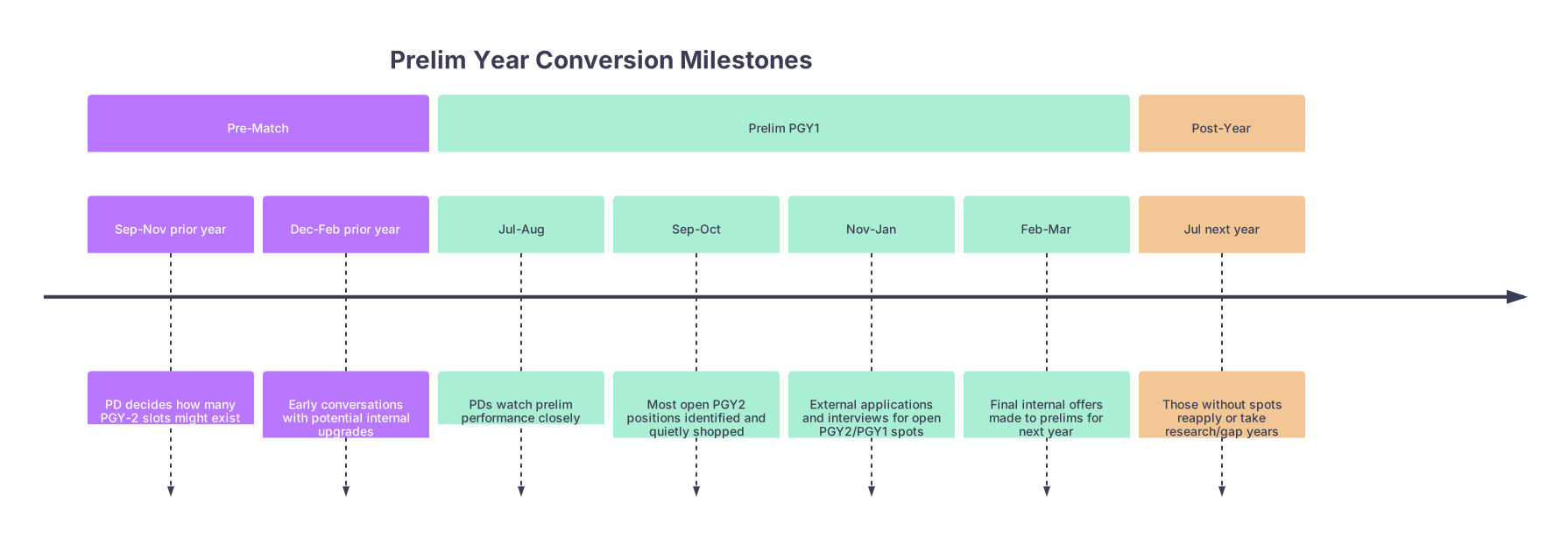
Here is the typical decision flow you never see written on websites:
| Period | Event |
|---|---|
| Pre-Match - Sep-Nov prior year | PD decides how many PGY-2 slots might exist |
| Pre-Match - Dec-Feb prior year | Early conversations with potential internal upgrades |
| Prelim PGY1 - Jul-Aug | PDs watch prelim performance closely |
| Prelim PGY1 - Sep-Oct | Most open PGY2 positions identified and quietly shopped |
| Prelim PGY1 - Nov-Jan | External applications and interviews for open PGY2/PGY1 spots |
| Prelim PGY1 - Feb-Mar | Final internal offers made to prelims for next year |
| Post-Year - Jul next year | Those without spots reapply or take research/gap years |
Notice the key: by the time a prelim feels fully comfortable in their role (often around November), many of the serious PGY-2 conversations are already under way.
If you are going to push for conversion, you start in August–September. Not in March.
9. Hard numbers from a composite IM program (case example)
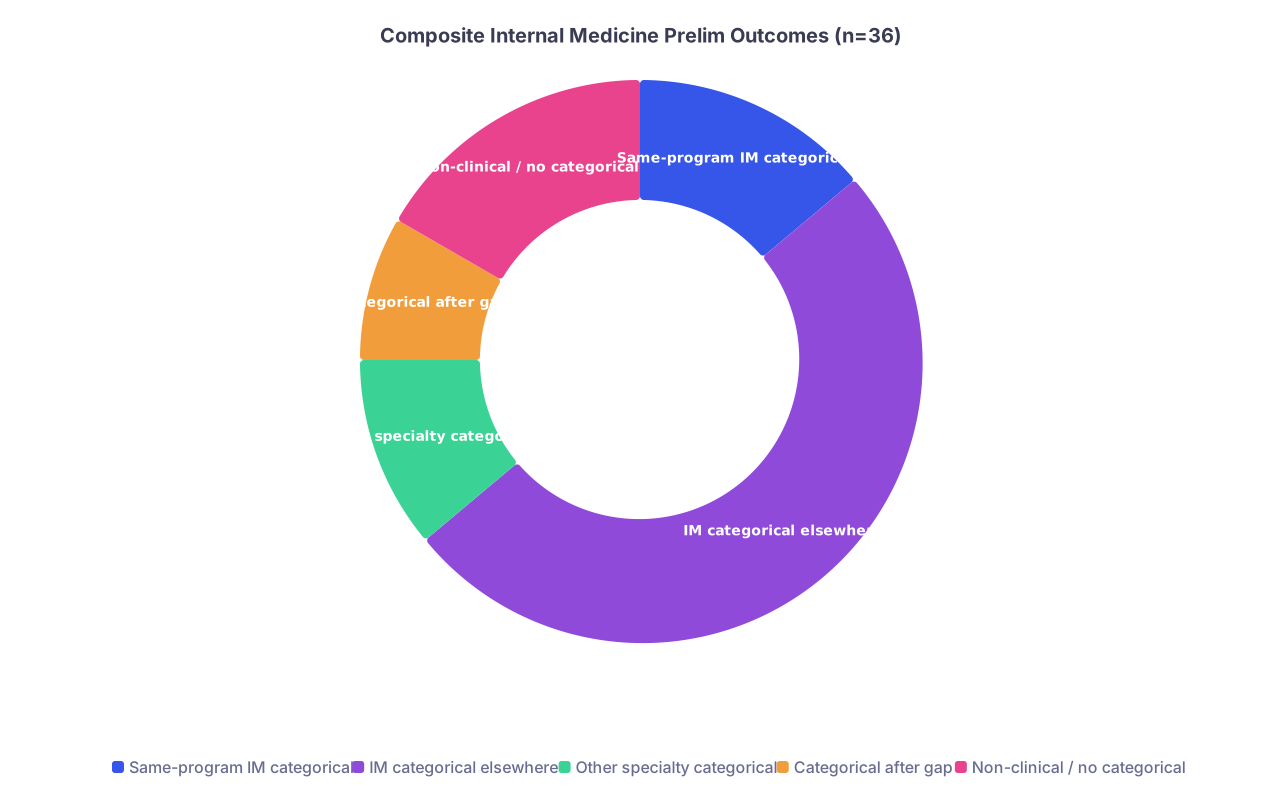
To make this less abstract, here is a composite (but very typical) pattern from a 3-year period in a large academic internal medicine department with 12 prelim IM residents per year:
| Outcome Category | Count (out of 36) | Percentage |
|---|---|---|
| Internal upgrade to same-program IM categorical | 5 | 14% |
| Categorical IM at different institution | 18 | 50% |
| Categorical in other field (EM, neuro, etc.) | 4 | 11% |
| Took research/gap year, later obtained categorical | 3 | 8% |
| Switched out of clinical medicine entirely | 2 | 6% |
| Still unmatched to categorical after 3 years | 4 | 11% |
Aggregate:
- Any categorical eventually (IM or other specialty): 30 / 36 = 83%.
- Same-program IM categorical: 14%.
- Seamless PGY-1→PGY-2 categorical (no gap, no repeating PGY-1): 23 / 36 ≈ 64%.
This is one of the better-case scenarios, by the way. Not the worst.
| Category | Value |
|---|---|
| Same-program IM categorical | 5 |
| IM categorical elsewhere | 18 |
| Other specialty categorical | 4 |
| Categorical after gap | 3 |
| Non-clinical / no categorical | 6 |
If your mental number for “I’ll just convert here” was anything like 50%, you can see the mismatch.
10. How to use this data when planning your application
You are not powerless. You just need to be brutally honest with the probabilities.
Here is the decision logic I push applicants to use.

| Step | Description |
|---|---|
| Step 1 | Considering prelim year |
| Step 2 | Use TY or prelim IM at linked institution |
| Step 3 | Prelim IM or TY, wide geographic net, active reapplication PGY1 |
| Step 4 | Rebuild application and reapply directly to categorical |
| Step 5 | Prelim in desired field, accept high risk profile |
| Step 6 | Do you already have a secured PGY2 advanced spot? |
| Step 7 | Is your priority any categorical spot or only specific specialty/location? |
| Step 8 | Are you comfortable with <30 percent success odds? |
The simple version:
- If you already have an advanced PGY-2: a TY or prelim is fine; your conversion is basically locked.
- If you do not have any future position secured:
- Want “any categorical somewhere”? Prelim IM or TY plus aggressive, flexible reapplication can work; odds ~75–85%.
- Want “categorical in this exact specialty and region”? The data say a prelim year is mostly a gamble. You may be better off strengthening your application and taking another shot at the Match.
11. The real takeaway
Prelim years are not scams. They are not career death either. They are high-variance, structurally constrained bridges.
The cleanest mental model:
- A prelim year + no secured PGY-2 is a second-chance booster, not a guaranteed on-ramp. Most people get somewhere; not everyone gets where they originally aimed.
- Internal conversions to the same program, same specialty are exception events, not the default path. Low double-digit percentages at best.
- The strongest move is still to match directly into a categorical or advanced position. Everything else is a salvage or optimization strategy around that central fact.
If you go into a prelim year with the correct base rates in your head, you can make rational decisions: cast a wider net, be proactive early, and avoid staking your entire career on a 10–20% internal conversion probability.
With those numbers in hand, you are now positioned to think about the next piece: how to actually structure a reapplication during your prelim year so you land in the 70–80% who do find categorical homes. That is a different dataset—and a different conversation.
FAQ (exactly 5 questions)
1. Is it easier to convert from a prelim year if I am a U.S. MD versus IMG?
Yes, but not as dramatically as people assume. Among prelims I have seen, U.S. MDs do have higher eventual categorical rates, largely because they often start with stronger board scores and more PD-to-PD connections. Think of it as maybe a 10–20 percentage point edge, not a guarantee. An IMG with excellent performance, strong faculty advocates, and wide geographic flexibility can still out-convert a mediocre U.S. grad.
2. Do high USMLE scores significantly improve prelim-to-categorical conversion?
They help much more for external moves than for internal ones. Internally, your clinical performance and professionalism dominate. Externally, PDs still screen by Step 1/2, especially when filling a sudden PGY-2 vacancy with dozens of interested prelims. A 260 will not force your current program to create a categorical line, but it will make other programs much more willing to take a chance on you.
3. If I do a prelim year and fail to get a categorical spot, can I repeat PGY-1 in another program?
Yes, and this happens more often than applicants realize. A not-insignificant minority of prelims who eventually land categorical positions repeat intern year at a new program. From a licensing standpoint, it is fine. From a lifestyle and ego standpoint, it is rough, but it can be the price of admission into a categorical track, especially in more competitive fields.
4. Are surgery prelims ever a good idea without a prior advanced spot?
They can be, but only if you are brutally realistic. If your bar is “I want a career in clinical medicine, and I am open to pivoting into anesthesia, EM, IM, or other fields if surgery does not pan out,” then a surgery prelim can be a good exposure and networking year. If your bar is strictly “I must become a categorical general surgery resident,” the empirical success rate is too low for me to recommend it as a plan A.
5. Does strong research during my prelim year improve my conversion odds?
Marginally, but only when coupled with strong clinical performance and networking. Research by itself does not create categorical lines. It can, however, give you access to influential mentors who make phone calls for you, and it can make you more competitive on paper for external PGY-2 or PGY-1 positions. The causal pathway is mentorship and visibility, not the PubMed count alone.