
The idea that “a prelim year always helps your second-cycle match odds” is lazy and wrong. The data show something much more uncomfortable: in some specialties a preliminary year is a powerful asset; in others it barely moves the needle—or even boxes you out.
You are not just “buying time” with a preliminary year. You are making a probabilistic bet, and the odds change sharply by specialty.
1. The Big Picture: What Actually Happens After a Prelim Year?
Before we drill into specialties, anchor on outcomes. Across the NRMP data and what I have seen in program review meetings, three patterns keep repeating:
- Categorical spots are still filled mostly by fresh graduates.
- A prelim year helps most when the specialty already requires a preliminary year (e.g., advanced programs).
- If you are changing specialties, your prelim narrative and performance matter more than the PGY-1 line on your CV.
Let’s quantify some key dynamics.
Where prelim-year applicants sit in the ecosystem
For advanced specialties (Dermatology, Radiology, Anesthesiology, PM&R, Radiation Oncology), the structure forces many applicants into either:
- Transitional Year (TY) PGY-1
- Prelim Medicine or Prelim Surgery PGY-1
Then they either:
- Match advanced PGY-2 in the same cycle (ideal),
- Or end up reapplying in the next cycle if they do not secure an advanced spot.
For categorical specialties (Internal Medicine, Pediatrics, Family, etc.), a prelim year is usually a backup or a pivot play.
Here is a simplified view of second-cycle odds and program behavior, combining NRMP data trends with typical internal program discussions.
| Specialty Type | Fresh Grad Dominance | Value of Strong Prelim Year | Willingness to Take Reapplicant |
|---|---|---|---|
| Advanced (e.g. Derm) | Very High | Moderate | Low–Moderate |
| Advanced (e.g. Anes/Rad) | High | High | Moderate–High |
| IM / Peds / FM | Moderate | High | High |
| Gen Surg Categorical | Very High | Moderate | Low–Moderate |
| EM (3–4 yr) | High (historic) | Moderate | Variable / declining |
The takeaway: You cannot talk about “prelim year effect” without specifying specialty. It is not a universal buff to your application.
2. Core Mechanism: Why a Prelim Year Helps or Hurts
Strip away anecdotes. Focus on the signal program directors actually use.
Quantitative signals that change after a prelim year
There are four major levers your prelim year can move:
Failure risk perception
- A clean, completed PGY-1 reduces perceived risk.
- No professionalism issues, no remediation, strong evals = lower risk.
Performance and rank relative to peers
PDs look for:- “Top 1–3 residents in the class” type comments
- In-service exam percentiles (e.g., ≥70th percentile vs <30th)
- Procedure logs and autonomy in surgery-heavy or procedure-heavy fields
Letters of Recommendation (LORs) with comparative language
Data point: Strong statements (“top 10% resident I have worked with”) correlate heavily with interview offers. Fluffy letters (“hard-working, pleasant”) do not move metrics.Specialty alignment and narrative coherence
- Did your prelim year clearly support the target specialty?
- Or does it read as “was not sure, tried this, now trying that”?
If your prelim year materially shifts these four inputs in your favor, your second-cycle odds improve. If it does not, you have added time but not probability.
3. Specialty-by-Specialty: How Much Does a Prelim Year Move the Odds?
Now to what you actually care about: specialty-level impact. I will break this into:
- Advanced specialties that inherently connect to prelim/TY years.
- Categorical specialties where prelim years are a pivot strategy.
- High-risk plays where a prelim year helps less than people think.
3.1 Dermatology, Radiation Oncology, and Other Ultra-Competitive Advanced Fields
Let me be blunt: a prelim year rarely “rescues” a sub-1st percentile applicant in these specialties.
Most successful second-cycle matches in Dermatology and Rad Onc after a prelim year share similar profiles:
- USMLE Step 2 CK or COMLEX Level 2 in the 250+/650+ range.
- Multiple publications or at least serious research engagement.
- Strong Derm/Rad Onc connections (research year, away rotations, faculty advocacy).
- Prelim year at a strong academic IM or TY program, sometimes in the same institution.
The prelim year’s function here is largely:
- To confirm you are safe to put in front of complex patients.
- To provide updated letters, ideally from subspecialists in the target field.
But the anchor remains your pre-residency metrics and research.
If we had to roughly categorize impact:
| Specialty | Baseline Odds (strong applicant, first cycle) | Increment from Excellent Prelim Year | PD Appetite for Reapplicants |
|---|---|---|---|
| Dermatology | Moderate | Small–Moderate | Low–Moderate |
| Radiation Onc | Moderate | Small–Moderate | Moderate |
| Plastic Surgery (Integrated) | Low–Moderate | Small | Very Low |
Translation:
- If you were already close to competitive, a stellar prelim year can tip a few programs toward “yes”.
- If your Step scores, class rank, and research are weak, the prelim year does not erase that deficit.
3.2 Radiology and Anesthesiology: Where a Strong Prelim Can Really Pay Off
Diagnostic Radiology and Anesthesiology sit in a sweet spot. Competitive but not Derm-level brutal, especially for solid candidates.
I have seen this pattern repeatedly:
- Applicant slightly underperforms on first cycle (few interviews, no match).
- Completes a Prelim Medicine or TY year with:
- Strong faculty letters.
- Above-average in-training exam scores.
- Good reputation as a reliable, efficient intern.
- Reapplies and sees a 1.5–2x increase in interviews.
Is that causal? Not perfectly. But the trend is consistent enough to treat it as real.
For these two specialties, the prelim year can:
- Signal maturity (especially if the first app cycle was messy).
- Provide hard data showing you function well in a hospital system.
- Generate institutional advocacy if your prelim site has the target specialty.
I would describe the effect like this:
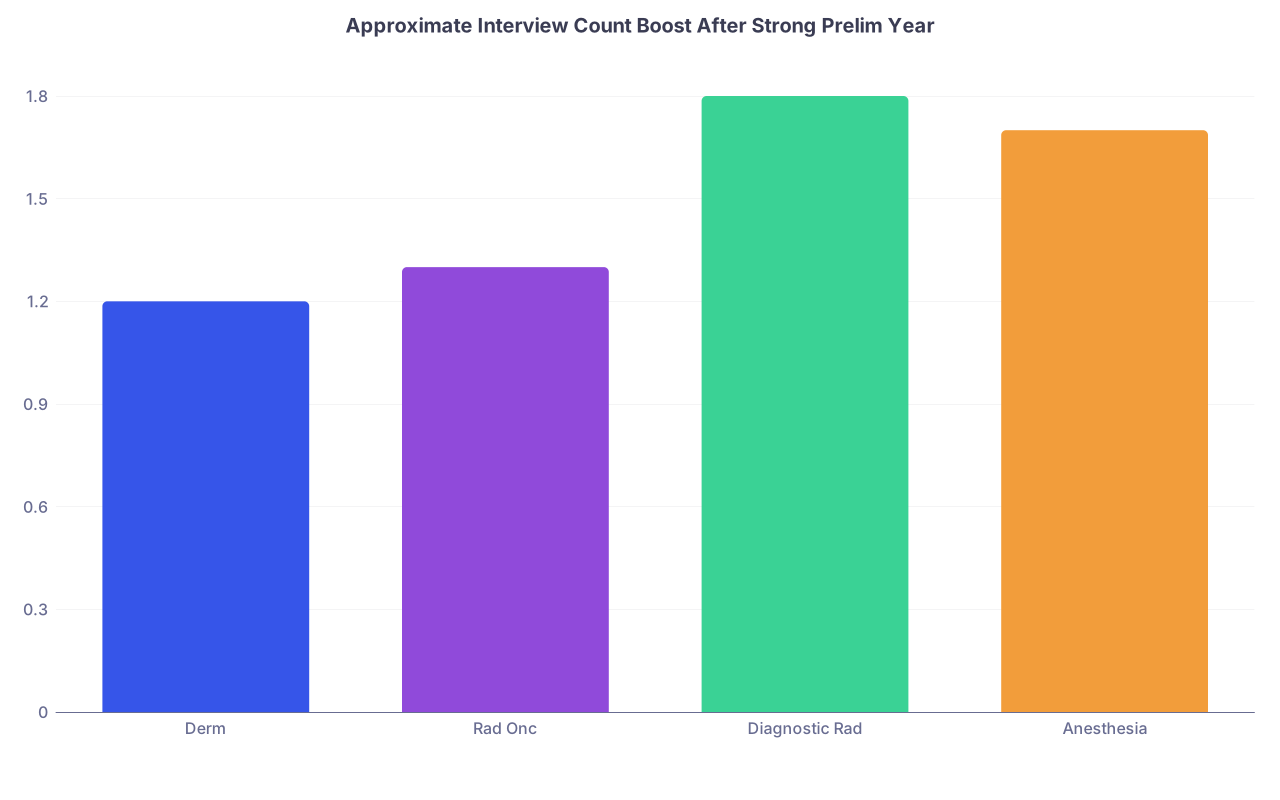
| Category | Value |
|---|---|
| Derm | 1.2 |
| Rad Onc | 1.3 |
| Diagnostic Rad | 1.8 |
| Anesthesia | 1.7 |
Interpreting that “boost factor”:
- 1.0 = no added help vs first cycle
- 1.8 = you might see nearly double the interviews, holding test scores constant, if your prelim performance is outstanding and your narrative is coherent.
Again, this assumes your baseline stats are not catastrophic.
3.3 Internal Medicine, Pediatrics, Family Medicine: Prelim as Pivot or Upgrade
For IM, Peds, and FM, a prelim year is often a pivot out of something more competitive (Surgery, Radiology, EM) or a geographic upgrade attempt.
Two very different scenarios show up in the data and in committee discussions:
- Applicant did a Prelim Surgery or TY and now wants Categorical IM or Peds.
- Applicant did a Prelim IM and wants a better IM program or different city.
In both cases, categorical programs look at:
- Did you complete the prelim year without issues?
- Do your letters explicitly endorse you for the new specialty?
- Are your steps/COMLEX and transcripts aligned with that field’s norms?
Because these fields have higher fill rates by non-elite candidates and are more willing to consider reapplicants, the prelim year can provide a substantial relative bump.
If a candidate comes from a solid prelim program with top-tier evaluations, the probability jump is significant. Programs like low-risk, already-trained interns who will hit the ground running.
For a typical candidate with mid-220s Step 2 CK aiming at IM:
- First cycle from med school: maybe 5–8 interviews at mid-tier IM programs if the rest of the app is average.
- After a strong prelim IM year: 10–15 interviews is not unusual, especially with good advocacy.
The limiting factor is not the prelim year. It is whether you fix the original weaknesses (weak personal statement, no clear commitment, poor letters).
4. Surgery and Emergency Medicine: Where Prelim Year Benefits Are Overestimated
This is where people get burned.
4.1 General Surgery Categorical
Prelim Surgery spots are numerous. Categorical spots are not. That mismatch warps the odds.
PDs in Surgery know the prelim applicant pool is flooded with:
- People who could not land a categorical spot initially.
- People trying to pivot from another field.
- People with red flags hidden under vague explanations.
So they screen aggressively. What helps?
- Strong ABSITE score (>=60–70th percentile makes PDs take notice).
- Letters from surgeons with real influence, explicitly recommending you for categorical.
- Documented operating room competence and reliability.
Even then, categorical surgery slots after PGY-1 are limited. You are competing for:
- Rare PGY-2 openings (attrition).
- Occasional PGY-1 re-entry at a different institution.
Realistically, for Surgery, a prelim year without standout performance and strong political backing improves your odds from “very low” to “low–moderate” for a categorical slot. It is not a clean 2nd shot at the Match. It is more like fishing for a few scattered vacancies.
4.2 Emergency Medicine
EM has been volatile. Recent cycles saw a surge of unfilled EM spots, then program and applicant adjustments, and shifting interest due to job market concerns.
Prelim IM or Transitional Year to EM is a known pivot path, but the benefits are mixed:
- Pros:
- Demonstrates inpatient competence and work ethic.
- Gives you time to rotate in EDs and get SLOE-equivalent letters.
- Cons:
- EM programs still heavily value dedicated EM rotations and SLOEs from the first cycle.
- They may see you as uncertain or late to decide.
I have seen prelim-year EM pivots work best when:
- The applicant invests in targeted EM rotations during PGY-1.
- They collect 2–3 strong EM-specific letters.
- They address the change in specialty clearly, not vaguely.
But again, if you had poor SLOEs or mediocre EM performance in med school, the prelim year only partially dilutes that history.
5. The “Same Specialty, Better Program” Strategy
A different angle: using a prelim year to reapply into the same specialty but aiming higher—either geographically or in program reputation.
This comes up often in IM, Peds, and Anesthesia.
Here’s the pattern that tends to work:
- You matched prelim at a community or mid-tier academic program.
- You reapply to the same specialty, but targeting:
- University-based or more competitive programs.
- Or specific cities for family reasons.
The data from actual match lists show that residents can move up-tier, but only with:
- Very strong letters explicitly comparing them favorably to current categorical residents.
- No professionalism issues. Not even small ones.
- Concrete contributions: QI projects, teaching, small research, or leadership.
Program directors are risk-averse. They compare you not just to random applicants, but to:
- Their own rising interns they already know and trust.
- Fresh graduates they can shape from day one.
So the threshold to “upgrade” is high. A prelim year makes the conversation possible; your performance determines whether it is persuasive.
6. Risk, Opportunity Cost, and When a Prelim Year Is a Bad Bet
Zoom out to the math you rarely see spelled out.
Each year you spend in a prelim spot:
- Delays your attending income by 1 year.
- Reduces your effective lifetime earning potential, especially in high-paying fields.
If your odds of significantly improving your Match outcome are low, the ROI on that prelim year collapses.
There are three situations where, statistically speaking, a prelim year is often a poor bet:
- Your Step/COMLEX scores are far below the mean for the target specialty, and you have no plausible way to offset that (research, connections, new test scores).
- You have serious professionalism red flags that a single prelim year will not erase.
- You are chasing an ultra-competitive specialty (Derm, Plastics, Ortho) from a very weak starting position, treating a prelim as a “hail Mary” rather than part of a clear, strategic plan.
In those cases, the data from program behavior show better odds with:
- Reframing to a less competitive but still satisfying specialty.
- Or focusing on categorical IM, FM, or Peds directly rather than doing a disconnected prelim and hoping.
7. Tactical Use of a Prelim Year: How to Maximize Second-Cycle Odds
If you have already committed to (or matched into) a prelim year, the question stops being philosophical. It becomes operational: how to convert that year into real probability gain.
Think in terms of levers you can actually move.
7.1 Program and Rotation Choices
Given any flexibility (e.g., for TYs and some prelim IM):
- Prioritize rotations that align with your target specialty.
- Get facetime with faculty who can write detailed, comparative letters.
- Avoid being invisible. PDs cannot rank you if they barely remember you.

| Step | Description |
|---|---|
| Step 1 | Start Prelim Year |
| Step 2 | Plan Rotations With Target Dept |
| Step 3 | Meet Advisors and Decide |
| Step 4 | Excel Clinically |
| Step 5 | Secure Strong Letters |
| Step 6 | Address Prior Weaknesses |
| Step 7 | Reapply Strategically |
| Step 8 | Target Specialty Chosen |
7.2 Quantitative Performance
Intern year generates new numbers:
- In-training exam scores
- Procedure counts (Surgery, Anesthesia, some IM subs)
- Duty hour compliance and schedule adherence (yes, this is tracked and discussed)
You want:
- Top-third performance on in-service exams if at all possible.
- To be the resident attendings trust for difficult admits, not the one they double-check.
When a PD says, “Objectively, this intern outperformed several of my categoricals,” your file moves into the serious consideration pile.
7.3 Narrative and Documentation
Your second-cycle application has to tell a clean story:
- Why you are in a prelim spot now.
- What you learned from that year.
- Why that experience makes you safer and more valuable in your chosen specialty.
Vague lines like “I have always been passionate about X” are weak when you are switching specialties after a prelim year. Program committees notice the contradiction.
Instead, data-oriented narrative works better:
- Concrete number of procedures or cases.
- Specific responsibilities you handled independently.
- Measurable outcomes (QI, teaching evals, research outputs).
8. Putting Numbers on It: A Rough Probability Framework
We cannot get perfect odds at an individual level, but we can create a useful framework.
Consider a simplified probability model for a competitive but not elite specialty (e.g., Anesthesiology, Diagnostic Radiology) for a mid-range US MD or DO:
- First cycle from med school:
- Baseline match probability: ~70–80% for reasonably qualified applicants.
- If unmatched and doing a prelim year:
- If prelim performance is mediocre, letters are generic:
- Second-cycle probability: maybe 50–60%. You are now a reapplicant with no new signal.
- If prelim performance is excellent, letters strong, narrative coherent:
- Second-cycle probability: can rise back toward 75–85%, particularly if you apply broadly and strategically.
- If prelim performance is mediocre, letters are generic:
Visually:
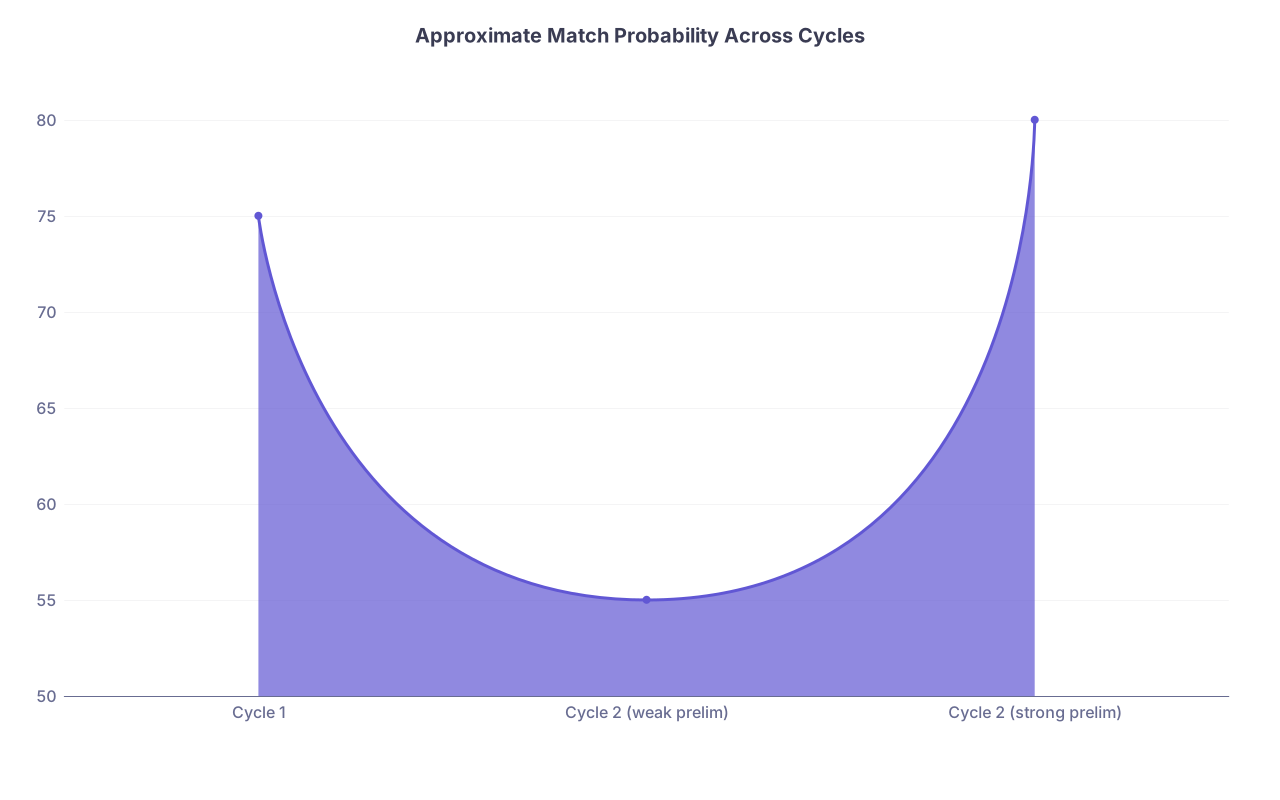
| Category | Value |
|---|---|
| Cycle 1 | 75 |
| Cycle 2 (weak prelim) | 55 |
| Cycle 2 (strong prelim) | 80 |
For ultra-competitive fields (Derm, Plastics):
- First-cycle strong candidate: maybe 40–60% chance.
- Second-cycle with prelim:
- Weak prelim: odds drop to 20–40%.
- Excellent prelim and added research: might nudge back up near 40–60%, but rarely higher than your original best-case scenario.
For IM / Peds / FM pivots:
- First-cycle (aiming at something too competitive, no backup match): result = unmatched.
- Second-cycle after strong prelim IM:
- Match probability into IM often >80–90% if letters and performance are solid and geographic preferences are flexible.
The data thread is clear: the prelim year does not magically lift your ceiling. It mostly raises your floor—if you perform.
9. Concrete Scenarios: Who Actually Benefits?
Let me be very specific. These are composite but realistic scenarios.
Scenario A: Prelim IM → Categorical IM (Upgrade/Rescue)
- US DO, Step 2 CK 232.
- Unmatched in Anesthesia first cycle.
- Prelim IM at a busy community hospital with university affiliation.
- In-service exam: 70th percentile.
- PD letter: “One of the top three interns I have trained in the last five years.”
Result I have seen: multiple categorical IM offers, sometimes at better programs than the original med school predicted. Prelim year clearly improved second-cycle odds massively.
Scenario B: Prelim Surgery → Categorical Surgery
- US MD, Step 2 CK 240, average med school performance.
- Prelim Surgery at a mid-level academic center.
- ABSITE: 45th percentile.
- Letters: “Hard-working, reliable, solid addition to the team” but nothing superlative.
- No big-name faculty champion.
Pattern outcome: often struggles to secure categorical. May end up pivoting to IM or Anesthesia. Prelim year did not materially change the probability curve for categorical Surgery.
Scenario C: TY → Dermatology
- US MD, Step 2 CK 258, two Derm publications, solid med school Derm rotations but unmatched in first cycle due to narrow geographic targeting.
- TY at institution with strong Derm department.
- Attends Derm clinic during elective time.
- Gets a letter from Derm chair: “We will rank this candidate very highly.”
Second-cycle result: often matches, but the key was the synergy of strong baseline stats, institutional Derm support, and strategic use of PGY-1. The prelim year refined a good application, it did not repair a bad one.
10. Key Takeaways: How a Prelim Year Really Affects Second-Cycle Odds
Strip it down to the essentials.
The impact of a preliminary year is highly specialty-dependent. Radiology, Anesthesia, and IM/Peds benefit the most; Surgery and ultra-competitive specialties far less so.
A prelim year raises your floor, not your ceiling. It reduces perceived risk and can fix narrative gaps, but it cannot erase fundamentally weak test scores or nonexistent specialty alignment.
Performance during the prelim year is the main lever. Strong in-service scores, top-tier evaluations, and targeted letters can approximately restore or slightly improve your original match odds. Mediocre performance often leaves you worse off as a reapplicant.
If you are going to spend a year as a prelim, treat it like a data-gathering and signal-boosting project. Because that is exactly how program directors will see it.