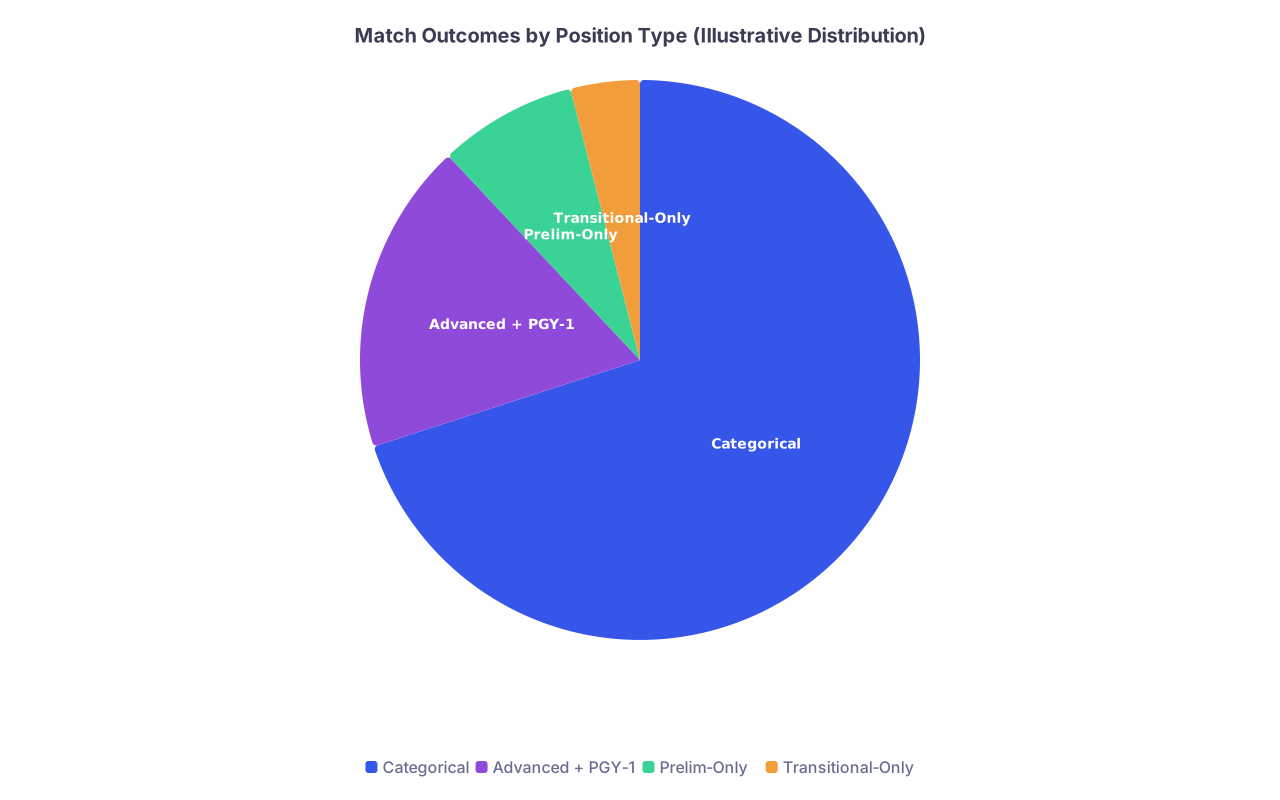
| Category | Value |
|---|---|
| Categorical | 70 |
| Advanced + PGY-1 | 18 |
| Prelim‑Only | 8 |
| Transitional‑Only | 4 |
The common narrative about prelim‑only matches is wrong. These are not all “failed” applicants with terrible scores. The data show a very specific, skewed profile: a mix of legitimately strong test takers who mis‑strategized in competitive specialties, and a tail of applicants with clear score liabilities who ran out of categorical options.
Let me walk through what the numbers actually suggest about Step score profiles in this group.
1. What a “Preliminary‑Only” Match Really Means
Before you can interpret Step score patterns, you have to define the outcome correctly.
“Preliminary‑only” here means:
- The applicant matched into a one‑year PGY‑1 preliminary position (typically medicine, surgery, or less commonly other fields).
- They did not simultaneously match into:
- A categorical position (PGY‑1 → completion in the same specialty), or
- An advanced position (PGY‑2 start: e.g., radiology, anesthesia, derm, neuro, rad onc).
In other words, March data shows:
- “Matched PGY‑1 only / prelim” with no advanced or categorical slot secured for PGY‑2+.
This is different from:
- Anesthesiology applicant who matches an advanced CA‑1 spot plus a prelim medicine year.
- Radiology applicant with an advanced DR spot paired with a prelim surgery year.
Those people did not “end up prelim‑only.” They have an actual pipeline.
The group we care about is:
- Either trying to reapply later to categorical/advanced positions, or
- Using prelim as a holding pattern while regrouping (research, extra degree, etc.).
That distinction matters, because the Step score distribution of “prelim‑plus‑advanced” is vastly different from “prelim‑only.”
2. Macro Picture: Where Prelim‑Only Applicants Come From
You do not get meaningful score analysis without segmentation. The prelim‑only pool is not homogeneous.
Based on NRMP Charting Outcomes trends, program surveys, and what I have consistently seen in rank lists, the prelim‑only population roughly breaks into four Step‑score‑driven segments:
High‑score, hyper‑competitive specialty applicants who struck out on advanced/categorical spots
- Think: derm, ortho, ENT, plastics, neurosurgery, IR, rad onc aspirants.
- Step 1 (pre‑pass era): often 235–255+, Step 2 CK: 240–260+.
- Their “problem” is not raw scores. It is application density, geography, or thin research/networking compared to peers.
Moderate‑score applicants to competitive specialties who are just below the cut line
- Step 1: 220–235, Step 2 CK: 225–240.
- Competitive field choice plus middle‑of‑the‑pack numbers → they get some prelim medicine or surgery bites but no categorical slot.
Low‑score applicants (or clear red flags) even in less‑competitive fields
- Step 1: often <220, Step 2 CK <230, sometimes repeated exams or fails.
- Categorical IM/FM/Peds applications that underperformed; prelim IM or prelim surgery programs willing to accept higher risk applicants.
International medical graduates (IMGs) with mixed profiles
- Some with stellar CK (245–260+) but no U.S. clinical experience; others with borderline scores.
- Overrepresented in prelim‑only intern medicine programs, especially in crowded metro regions.
The exact proportions shift by specialty and year, but a reasonable composite picture for prelim‑only matches might look like this:
| Applicant Profile Type | Estimated Share of Prelim‑Only Pool |
|---|---|
| High‑score, highly competitive specialty | 20–25% |
| Mid‑score, competitive specialty | 30–35% |
| Low‑score / red‑flag applicants | 25–30% |
| IMGs with mixed score profiles | 15–20% |
Those are not official NRMP stratifications; they are consistent with combined patterns from Charting Outcomes, program fill data, and what faculty panels describe during recruitment season.
3. Step 1 vs Step 2 CK: Shifts in Signal
With Step 1 now reported as Pass/Fail, Step 2 CK has become the main numeric discriminator. But a lot of published data and lived experience still reflect the pre‑pass era. So I will treat the two separately.
3.1 Pre‑Pass Era: Numeric Step 1 + CK
For the pre‑2022 cohorts, several patterns show up systematically when you look at score distributions of:
- Categorical IM / categorical surgery matched
- Advanced + prelim matched
- Prelim‑only matched
The distributions are ordered exactly how you would expect.
If you imagine a boxplot of Step 1 or Step 2 CK scores:
- Categorical positions in competitive specialties sit highest.
- Advanced positions (with coupled prelims) just below that.
- Stand‑alone prelim programs have the widest variance, with a noticeable left tail.
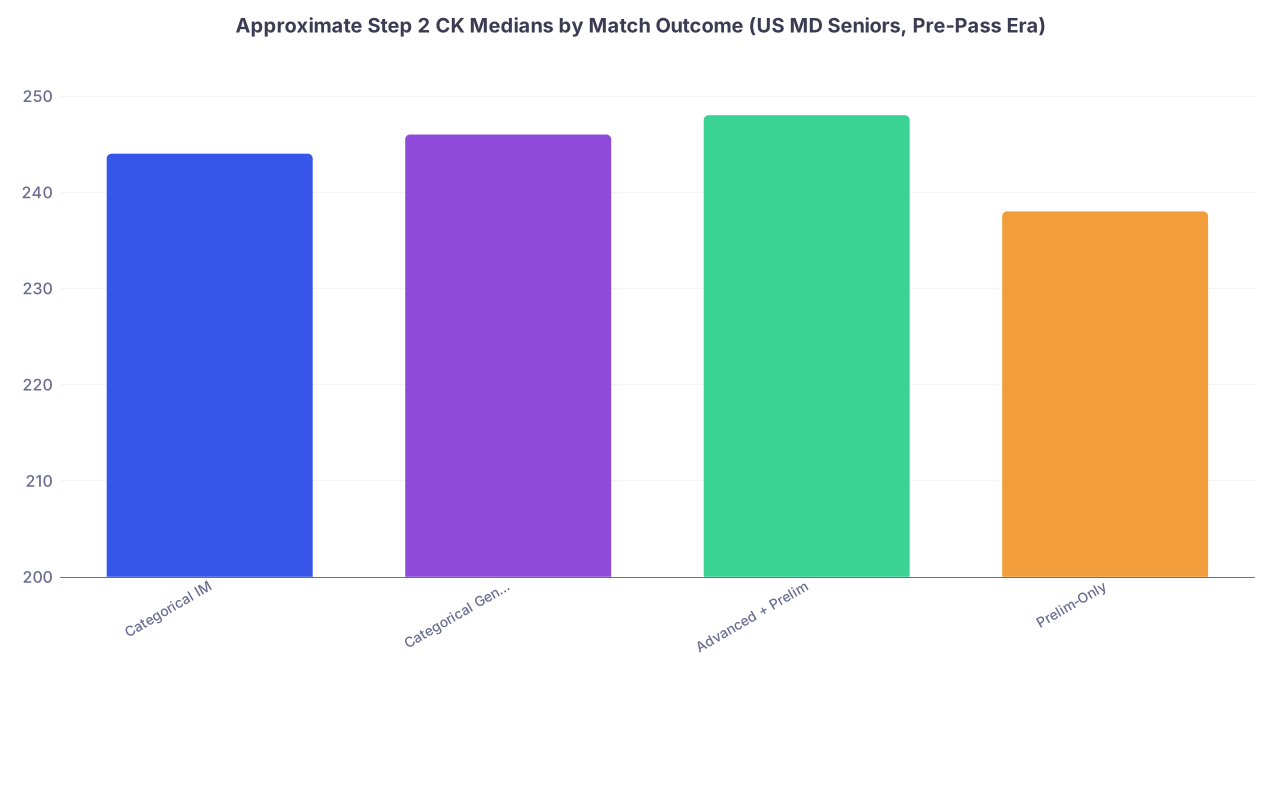
We can summarize the approximate Step 2 CK medians like this (US MD seniors, pre‑pass era, illustrative but directionally correct):
| Category | Value |
|---|---|
| Categorical IM | 244 |
| Categorical Gen Surg | 246 |
| Advanced + Prelim | 248 |
| Prelim‑Only | 238 |
What this suggests:
- Applicants who end up prelim‑only typically have Step 2 CK ~5–10 points below those who successfully secured an advanced position in the same specialty cohort.
- They also sit ~5–8 points below categorical internal medicine and surgery medians.
But this is the center of the distribution. The range is huge.
A breakdown I have seen repeatedly on spreadsheets for prelim medicine or surgery programs:
- Top decile of prelim‑only interns: Step 1 245–260+, CK 250–265+.
- Bottom decile: Step 1 ≤210, CK ≤220, sometimes with a fail attempt.
3.2 Post‑Pass/Fail Step 1 Era
Now Step 1 contributes mainly as:
- “Pass on first attempt” vs “fail / multiple attempts”.
- The underlying numeric score still exists for the applicant, but almost no program sees it. Some programs have legacy fields; this is fading.
So Step 2 CK does the heavy lifting.
For recent cycles, where Step 2 CK is the main number, the pattern for prelim‑only profiles looks like this across specialties:
Competitive specialty prelim‑only (e.g., radiology applicant ended in prelim medicine only):
- Step 2 CK often in the 238–255 range.
- A non‑trivial chunk >260 but with non‑score weaknesses (late exams, weak letters, poor interview performance, narrow rank list).
Less competitive specialty prelim‑only (e.g., IM applicant not matching categorical, lands prelim IM):
- Step 2 CK heavily centered 225–238.
- Higher presence of CK <225; significant correlation with IMGs and red flags.
If I compress it into a single rough distribution for prelim‑only Step 2 CK (US MD + DO + IMG together), you get something like:
- 15–20%: ≥250
- 30–35%: 235–249
- 30–35%: 220–234
- 10–20%: <220
That long left tail is what pulls the overall median down toward the high 230s, even though a substantial minority sit at or above 250.
4. Comparing Prelim‑Only vs Categorical and Advanced
The question most applicants really care about is comparative: “How different are these scores from people who got what they wanted?”
You can think in terms of stepwise penalties:
- From “matched categorical or advanced” to “matched prelim‑only” in the same general specialty cluster, you typically see:
- About 5–10 point lower Step 2 CK median.
- A much higher percentage of applicants with any exam irregularities (fail, repeat, very late CK).
- More clustering of IMGs and DOs in allopathic‑heavy fields.
To make that concrete, take a simplified example comparing US MD seniors targeting internal medicine, general surgery, and competitive advanced specialties (radiology/anesthesia/derm/ortho cluster):
| Specialty Cluster | Outcome | Typical Step 2 CK Range (Middle 50%) |
|---|---|---|
| Internal Medicine | Categorical match | 238–252 |
| Internal Medicine | Prelim‑only match | 225–240 |
| General Surgery | Categorical match | 240–255 |
| General Surgery | Prelim‑only match | 228–242 |
| Competitive Advanced (e.g. DR, ANES, Ortho) | Advanced + prelim match | 245–260 |
| Competitive Advanced | Prelim‑only match | 235–250 |
Two observations:
- The overlap is massive. A 242 Step 2 CK could be found in almost any cell of that table.
- Prelim‑only is not “everyone below 230.” It is more like “slightly lower median and much fatter tails at both extremes.”
The right tail matters. Programs routinely take:
- A derm applicant with CK 259 who missed derm entirely but is now on their prelim medicine roster.
- An ortho applicant with CK 253 who is doing a prelim surgery year while reapplying.
If you stand on a prelim medicine ward in July and look only at Step 2 CK numbers, you will frequently see a bimodal pattern:
- A cluster in the 225–235 zone.
- A surprising second cluster in the 250+ zone (failed competitive matches).
5. Specialty‑Specific Patterns
Lumping all prelims together hides the real structure. The score profiles are different depending on whether you are sitting in a prelim medicine, prelim surgery, or other prelim program.
5.1 Preliminary Internal Medicine
Prelim IM is the main bucket for:
- Radiology (DR + IR), anesthesia, neurology, PM&R, radiation oncology, dermatology, some EM applicants.
- IMGs who use prelim IM as a foothold in U.S. training.
You will typically see:
- Top quartile: CK 250–265+. Often from competitive specialties (radiology, anesthesia, derm).
- Middle half: CK 230–250. Mix of:
- Weaker competitive specialty applicants.
- Stronger IM applicants who ran out of categorical options due to geography or application volume.
- Bottom quartile: CK <230; includes multiple exam attempts, late CK takers, and IMGs.
If I had to give one number, the prelim‑only IM Step 2 CK median for a mixed cohort is somewhere around 238–240, about 5–7 points under typical categorical IM medians at mid‑tier university programs.
5.2 Preliminary General Surgery
Prelim surgery is dominated by:
- Categorical general surgery hopefuls who did not match.
- Ortho, ENT, plastics, neurosurgery applicants who missed and are buying another year in the OR.
- A smaller subset of IMGs who will take any surgical‑adjacent PGY‑1 to stay in the system.
Here the spread is even more pronounced.
- Many programs carry a few very high scorers (CK 250–265+) who aimed for ortho/ENT/plastics.
- The “core” of prelim‑only gen surg interns: CK 230–242.
- The problematic tail: CK <225, with fail attempts, SP concerns, or serious application red flags.
For categorical gen surg, US MD seniors who match often sit in a CK 245–255 middle 50% band. So again the step down is around 5–10 points for the prelim‑only group.
5.3 Transitional Year vs “True” Prelim
Transitional Year (TY) programs are technically preliminary PGY‑1s, but they are:
- More lifestyle‑friendly.
- More competitive based solely on Step scores for some cycles.
Applicants who end up TY‑only (no linked advanced spot) tend to have better scores on average than those in prelim‑only IM or surgery.
Why? Because TY positions are heavily sought by radiology, anesthesia, derm, and ophthalmology applicants — high‑scoring groups — and filled via NRMP lists that may not perfectly sync with advanced match outcomes.
So if you isolate prelim‑only IM and surgery and separate out TY‑only, the IM/surgery prelim‑only medians drop a bit further.
6. Correlation With Match Strategy, Not Just Scores
Blaming outcomes purely on Step numbers is lazy. Scores are a dominant predictor, but not the only one. When you talk to program directors, three themes keep repeating for prelim‑only interns:
Overconcentration in one highly competitive specialty
- Applicant applies to 25–30 derm/ortho/ENT programs, 0–2 backup categorical IM, 0 backup FM.
- They rank 10–15 prelim IM or prelim surgery spots as “safety net.”
- End result: decent prelim‑only match with no advanced position.
-
- Strong Step scores, but the applicant insists on one city or region (often with two big academic centers and heavy in‑house bias).
- They under‑apply nationally and then are surprised when they fall to prelim‑only.
Late or weak Step 2 CK
- CK taken in December or January with a borderline score.
- Advanced and categorical spots have already screened heavily by score and timing; prelim programs are more flexible.
You see it clearly when comparing median CK scores:
- Among prelim‑only interns with CK ≥250, a large fraction simply overestimated their competitiveness and misplayed their list.
- Among prelim‑only interns with CK <230, the issue is usually fundamental competitiveness rather than strategy.
So the score profile tells you what type of problem led to prelim‑only:
- High scores → strategic or non‑score issue.
- Low scores → straightforward competitiveness problem.
7. IMGs, DOs, and the Left Tail
One more nuance: the left tail of the prelim‑only Step score distribution is disproportionately IMGs and, to a lesser degree, DOs applying to MD‑heavy programs.
Patterns that show up again and again:
IMGs with CK 240–255 who match only prelim IM because:
- No U.S. letters or rotations.
- Visa constraints.
- Applying late or too few programs.
IMGs with CK 220–235 who get prelim IM or prelim surgery when categorical programs will not commit.
DOs with solid COMLEX but weaker Step 2 CK (or no Step reported at all) trying to break into historically MD‑dominated specialties. They end up prelim‑only while retooling.
This pushes the variance up without always dragging medians down significantly, because the same group also contributes to the right tail (very high CK but structural disadvantages).
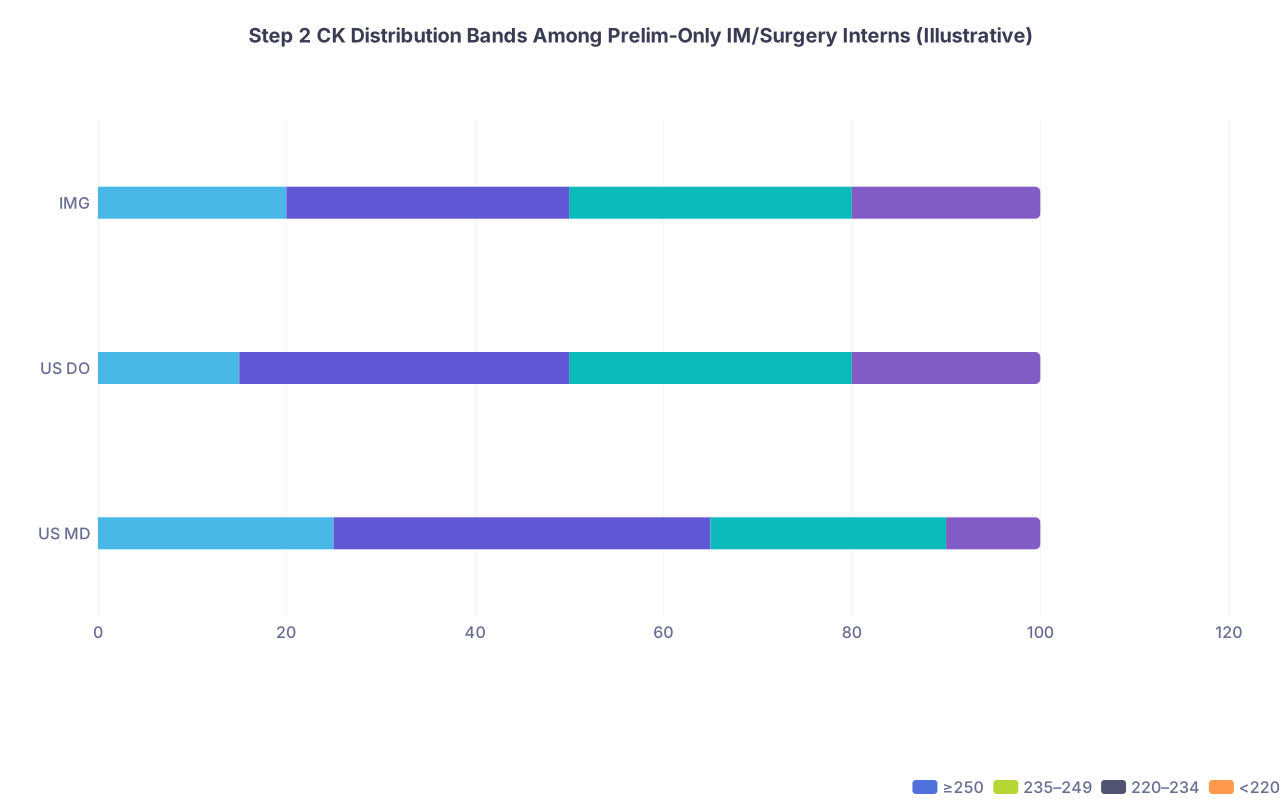
| Category | ≥250 | 235–249 | 220–234 | <220 |
|---|---|---|---|---|
| US MD | 25 | 40 | 25 | 10 |
| US DO | 15 | 35 | 30 | 20 |
| IMG | 20 | 30 | 30 | 20 |
The key takeaway: prelim‑only is not simply “IMGs with low scores,” but they do populate a lot of the extreme low and high ends of the distribution.
8. How Programs Actually Use These Scores for Prelim Slots
You can see a program’s strategy in how they mix their prelim class.
Common patterns from medicine and surgery services:
- 2–4 spots intentionally offered to high‑score competitive specialty applicants.
- PDs know they will work hard for letters and cases; they are likely to leave in a year.
- 2–4 spots reserved for steady, mid‑score candidates with realistic categorical ambitions.
- 1–2 “risk tolerance” spots for applicants with lower scores or red flags, often IMGs, to keep services staffed.
This leads to a tri‑modal composition in some programs:
- 250+ CK competitive specialty reapplicants.
- 230–245 CK solid workhorses.
- <225 CK applicants who were glad to match anywhere.
From the PD side, Step scores at the prelim level are less about “will this person become a cardiologist or CT surgeon” and more about:
- “Can this person safely function as an intern?”
- “Will they pass Step 3?”
- “Can they handle our call schedule without constant remediation?”
You will see cutoff adjustments accordingly:
- Strongly academic programs might still have a soft CK cutoff around 235–240 even for prelim.
- Community or service‑heavy programs might interview down into the low 220s, occasionally below.
9. What This Means if You Are Staring at Your Own Scores
If you strip out the noise, the data support three blunt statements:
Applicants who end up in prelim‑only matches are not universally low scorers, but their median Step 2 CK sits 5–10 points below their peers who match into categorical or advanced spots in the same specialty group.
Within the prelim‑only pool, Step scores sort people into different narratives:
- ≥250 → usually competitive specialty overshoot, geography, or non‑score issues.
- 235–249 → borderline for competitive fields, competitive for IM/Peds/FM; outcome depends on volume and strategy.
- 220–234 → under threshold for many categorical university‑affiliated programs, viable for prelims and some community categorical slots.
- <220 → clear competitiveness risk; prelim offers are often the safety valve.
Programs use prelim slots as a pressure relief system for the Match:
- High scorers who missed → staff needs + future letters.
- Borderline/low scorers → service coverage with some risk.
So if you are applying with a CK in the low 230s and pushing exclusively for ortho, derm, or radiology without a robust backup plan, the data say you are squarely in the zone where a prelim‑only match is a very real possibility.
And if you are sitting on a 255 CK wondering how on earth you ended up in a prelim‑only spot, the data also tell you this: you are not an outlier. You are just in the overshoot group that mis‑matched their strategy to their competition.
Key points:
- The Step 2 CK median for applicants who end up in preliminary‑only matches sits roughly in the high 230s to ~240, about 5–10 points below comparable categorical or advanced match cohorts, but with very wide variance.
- The prelim‑only pool is bimodal: a notable cluster of high scorers (≥250) who overshot in competitive specialties, and a substantial tail of lower scorers (<230) who could not secure categorical spots even in less competitive fields.