
The data shows that “I just had bad luck” is the weakest possible explanation for an unmatched year—and programs know it.
If you went unmatched, you are not alone and you are not doomed. But if you explain that year poorly, you might as well reapply with the same rank list and hope the algorithm has mercy. Programs are drowning in applicants. They use patterns. And the NRMP data is absolutely clear about which patterns look reassuring and which look radioactive.
Let’s walk through what the numbers say and how you translate that into a credible, data‑backed narrative when you talk to programs.
What the NRMP Data Actually Says About Being Unmatched
Start with the baseline: being previously unmatched is a negative signal. Denying that is delusional. The question is not “does it hurt?” The question is “how much, and can I offset it?”
From NRMP Charting Outcomes in the Match (U.S. MD, 2022 and prior years):
- For most core specialties, previous attempts are associated with lower match rates.
- Program directors consistently rate “failed or repeated attempts” (including prior unmatched) as a concern, but not an absolute disqualifier.
- What they care about next are:
- Updated board scores / new exam passes
- Additional clinical experience in the specialty
- Strong, recent letters of recommendation
- Time since graduation
So the structure is: previous unmatched = red flag; improvement + recency + clear direction = damage control.
Where it gets concrete is when you look at reapplicants.
NRMP’s “Charting Outcomes” and “Program Director Survey” consistently show:
- Reapplicants match at lower rates than first‑timers with the same stats.
- But reapplicants with clear improvements can approach first‑time match rates for less competitive specialties.
The story programs tell themselves when they see you is data‑driven: “Does this applicant now look like people who usually match from their category, or like people who usually fail again?”
You are not just explaining a gap year. You are arguing that your future performance will follow the trajectory of the group that succeeds, not the group that repeats the same outcome.
How Programs Actually Read an “Unmatched Year”
Program directors are not guessing. They sit with NRMP tables and their own internal applicant tracking spreadsheets open side by side.
They mentally sort repeat applicants into a few buckets. I have literally heard versions of these labels behind closed doors:
- “Improved and focused” – high salvage probability
- “Flat” – low ROI to interview
- “Damaged file” – will require exceptional advocacy
- “No insight” – easy decline
Your explanation of an unmatched year either moves you toward Bucket 1 or leaves you stuck in 3–4.
Programs look at three dimensions.
1. Objective change vs prior cycle
They compare “before unmatched” to “now”:
- USMLE/COMLEX:
- Step 1 pass/fail now, so attention shifts to Step 2 CK/Level 2 score and trend.
- A new solid Step 2 score (e.g., from 222 to 244) is a strong positive.
- Application breadth:
- Did you go from 25 applications in a competitive specialty to 120 with a realistic mix and some backup programs?
- Specialty targeting:
- Did you pivot from say, neurosurgery with marginal stats to internal medicine with aligned experiences?
If your narrative is “I was unlucky” and nothing has changed numerically, the data says you will underperform again.
2. What you did with the gap (capacity vs drift)
The data does not care that you “needed a break.” Programs frame an unmatched year as either:
- A capacity signal: this person can persist, self‑correct, and function in a quasi‑clinical environment.
- Or a drift signal: this person loses momentum when not carried by a curriculum.
What tends to look like capacity:
- Full‑time clinical work (research assistant with patient interaction, clinical fellowships, prelim/transitional positions, sub‑internships, observerships with robust documentation)
- Measurable outputs:
- X abstracts, Y publications, Z posters
- Concrete procedures observed or assisted
- Teaching hours logged, curriculum modules built
- New exams taken and passed during the year
What looks like drift:
- Vague “personal time”
- Sporadic volunteering without structure
- No new LORs, no new evaluations, no new scores
Programs connect those patterns straight back to the NRMP trend they know: time away from training without high‑quality engagement correlates with worse match odds.
3. Time since graduation and specialty choice
NRMP data is brutal on time from graduation:
- For many specialties, match rates decline steadily once you are >3 years from graduation.
- Older grads who succeed usually compensate with:
- Strong U.S. clinical experience
- Solid recent board scores
- Clear specialty alignment
If you are explaining an unmatched year at 1–2 years out, you are still in the “salvageable” statistical window for most fields, especially IM, FM, psych, peds.
If you are 4–5+ years post‑grad, your explanation must explicitly tackle “recency” and “clinical readiness” or you will be filtered out almost automatically in many programs.
NRMP Patterns Reapplicants Need to Exploit
You cannot change the fact that you are a reapplicant. You can change which reapplicant cohort you resemble.
Let’s pin down three datapoints that matter over and over:
- Board performance and improvement
- Specialty competitiveness vs your profile
- Application volume and strategy
1. Board performance: where you sit relative to matched cohorts
NRMP publishes distributions of Step/Level scores for matched vs unmatched applicants by specialty. Directors stare at these graphs every year.
- If your Step 2 CK is clearly below the median matched score in a high‑demand specialty, your “unmatched” is statistically predictable.
- Your best move is either:
- Raise your score (new exam, better performance), or
- Pivot specialty to a field where your current score is in the typical matched range.
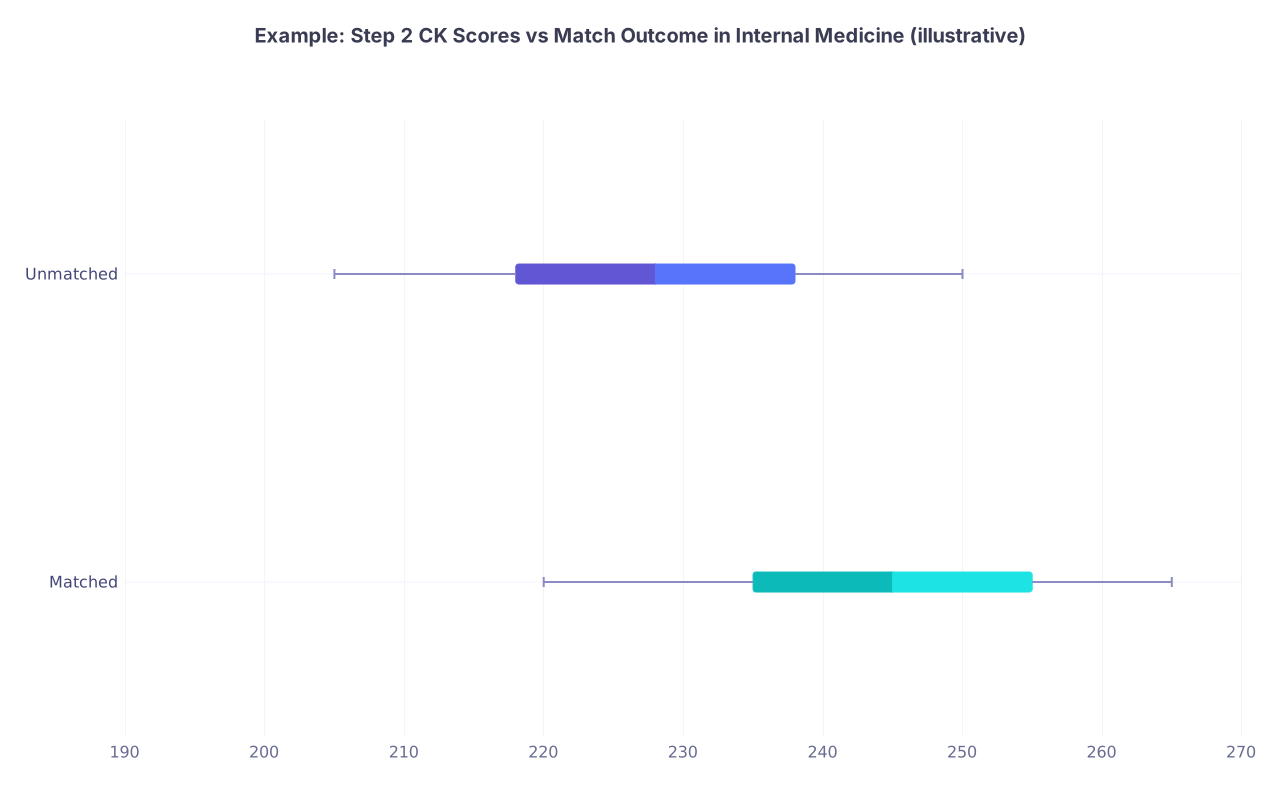
| Category | Min | Q1 | Median | Q3 | Max |
|---|---|---|---|---|---|
| Matched | 220 | 235 | 245 | 255 | 265 |
| Unmatched | 205 | 218 | 228 | 238 | 250 |
If your narrative is “I didn’t match but my score is fine,” programs mentally overlay your score on distributions like this. If you are clearly below the median matched band, “fine” is fantasy.
Your explanation should sound like someone who has looked at these distributions:
- “Last cycle my Step 2 CK was 225. Looking at NRMP data, that put me below the typical matched range for categorical general surgery, especially as a first‑time applicant. That mismatch contributed to my being unmatched. Since then, I have… [new exam, improved score, or specialty pivot].”
You show statistical awareness, not just feelings.
2. Specialty competitiveness: are you in the right race?
NRMP “Charting Outcomes” is blunt: even strong applicants miss in the most competitive specialties. For reapplicants with any red flag (unmatched, gap year, low score, older grad), the realistic path often involves recalibrating.
Here is the pattern many students refuse to see:
| Specialty | Approx. Match Rate (Reapplicants, illustrative) |
|---|---|
| Dermatology | Very low (<20%) |
| Orthopedic Surg | Very low (<25%) |
| General Surgery | Low–moderate (~40–50%) |
| Internal Medicine | Moderate–good (~60–70%) |
| Family Medicine | High (>80%) |
These are illustrative, not exact current numbers, but the gradient is real: some fields are unforgiving. Program directors know this intimately. If your explanation of an unmatched year ignores the competitiveness gap, you sound out of touch.
A more credible narrative:
- “I applied to 35 orthopedic programs with a Step 2 CK below the median matched range and limited ortho‑specific research. Reviewing NRMP data, I realized my probability of matching was low from the start. Over the past year I reassessed and redirected to internal medicine, where my scores and experiences align better with successful reapplicants.”
You are explaining strategy failure, not personal failure.
3. Application volume and timing: did you actually give yourself a chance?
Look at NRMP and specialty‑specific data on applications per matched applicant and interview yield. For many fields:
- Successful U.S. MD internal medicine applicants might apply to ~25–40 programs.
- For IMGs or reapplicants, that number often jumps to 80–120+ to keep probabilities reasonable.
If last year you applied “selectively” to 25 programs as an IMG or reapplicant, the data says you sabotaged yourself.
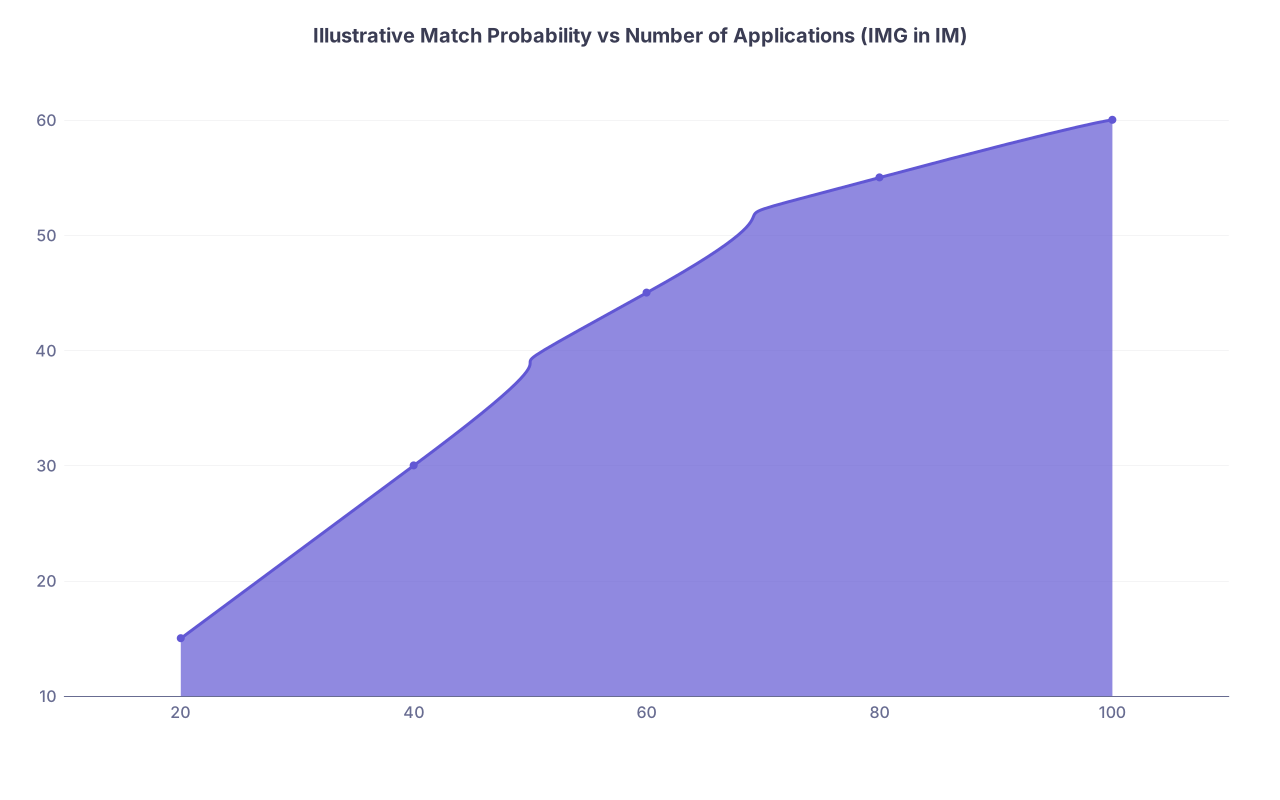
| Category | Value |
|---|---|
| 20 | 15 |
| 40 | 30 |
| 60 | 45 |
| 80 | 55 |
| 100 | 60 |
Again, these numbers are illustrative but the curve shape is real: low volume applications produce fragile match odds.
Your explanation can lean on this:
- “I applied far too narrowly—around 30 categorical internal medicine programs—mostly in highly competitive metro areas. Based on NRMP and specialty data for IMGs and reapplicants, I should have been closer to 80–100 applications with a mix of community and university‑affiliated programs. This year I have corrected that and applied more broadly and earlier.”
You show you have corrected a quantifiable error.
How to Build a Data‑Driven Story for Programs
Now the translation step: how to talk about an unmatched year in ways program directors actually trust.
Step 1: Categorize your core reasons using data, not ego
Most unmatched stories fall into one or more of these buckets:
- Underpowered objective profile for chosen specialty
- Poor application strategy (volume, geography, program selection)
- Weak or generic letters / lack of specialty‑specific support
- Red flags (exam failure, professionalism concerns, SOAP outcome)
- Timing and logistics (late applications, visa issues, incomplete files)
You should explicitly pick which ones apply—using numbers.
For example:
- “I applied to general surgery with a Step 2 CK of 230. NRMP data shows typical matched applicants in this specialty scoring in the mid‑240s and higher, often with significant research. My profile was underpowered.”
- “I submitted most of my applications 4–5 weeks after ERAS opened; many programs had already filled interview slots.”
Vague narratives sound like excuses. Numbers sound like analysis.
Step 2: Quantify what changed since then
Programs are scanning for delta.
Break it down:
- Exams:
- “Step 2 CK increased from 222 to 241 on retake.”
- “COMLEX‑Level 2 passed on second attempt with [score].”
- Clinical:
- “Completed 3 months of U.S. internal medicine sub‑internships, with new letters from program directors at X and Y.”
- Output:
- “Contributed to 2 posters and 1 manuscript under review in cardiology outcomes research.”
- Applications:
- “Last cycle: 35 IM programs. This cycle: 110 IM programs, with a higher proportion of community‑based and mid‑size programs.”
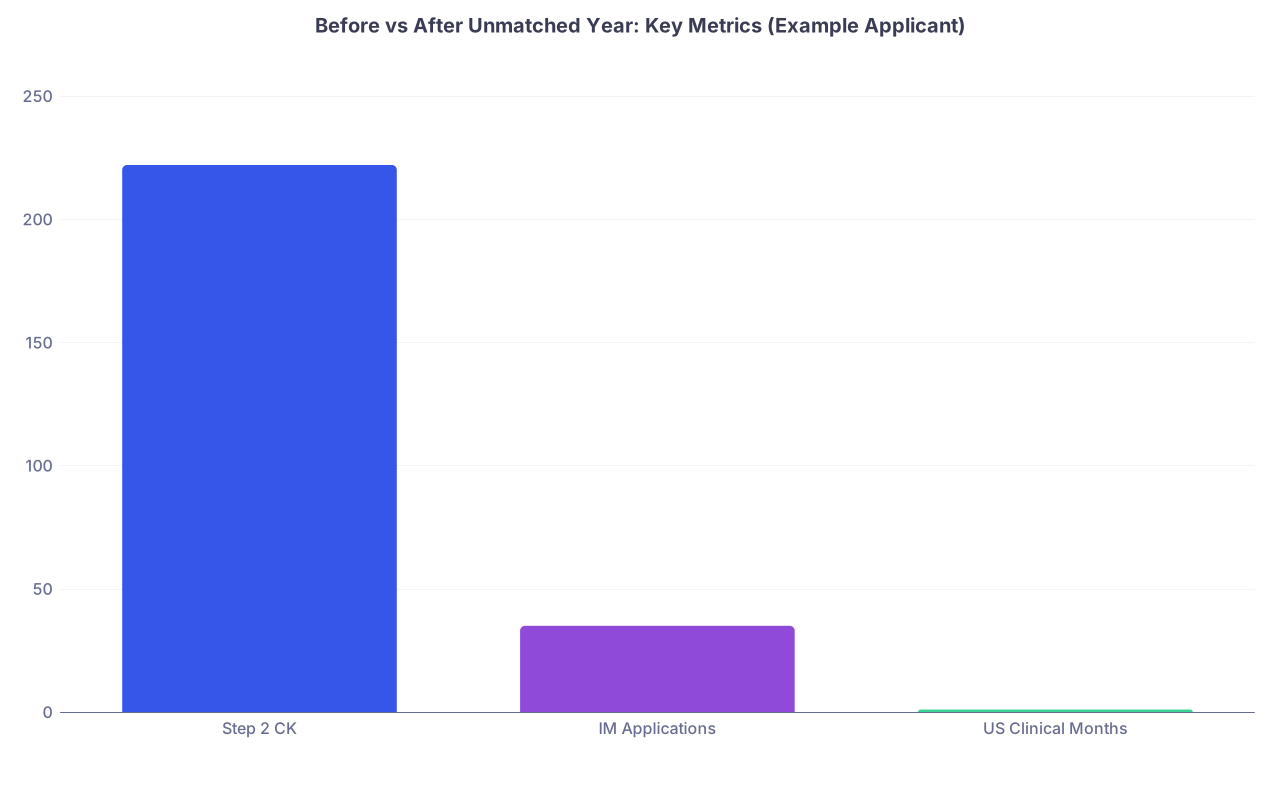
| Category | Value |
|---|---|
| Step 2 CK | 222 |
| IM Applications | 35 |
| US Clinical Months | 1 |
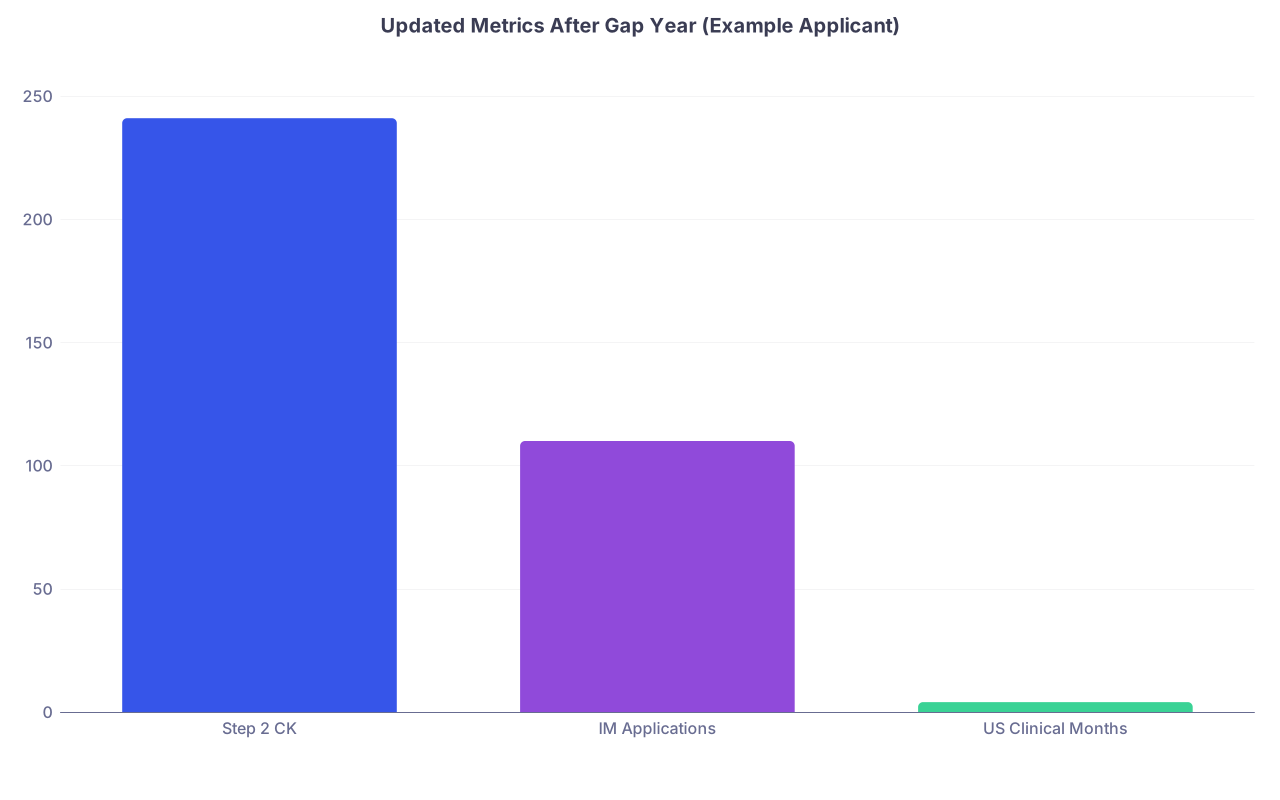
| Category | Value |
|---|---|
| Step 2 CK | 241 |
| IM Applications | 110 |
| US Clinical Months | 4 |
Presenting this in conversation:
- “Concretely, my Step 2 CK improved from 222 to 241, I increased my internal medicine applications from 35 to 110, and I expanded my U.S. clinical experience in IM from 1 to 4 months with strong new evaluations.”
That is what “growth” looks like numerically.
Step 3: Script a concise, honest explanation
Directors do not want a 10‑minute saga. They want a 30–60 second, structured answer that checks three boxes:
- You understand why you went unmatched.
- You took responsibility and specific action.
- You are now aligned with a realistic statistical pathway to matching.
Here is a template that actually tracks the data logic:
Context (1–2 sentences)
- “Last year I applied to [specialty] and did not match, and I also did not secure a position in SOAP.”
Data‑based reasons (2–3 sentences)
- “Looking back with NRMP and specialty data in mind, I can see several factors. My Step 2 CK of 225 was below the usual range for matched applicants in [specialty]. I applied to only 30 programs, mostly in competitive urban centers, which for a first‑time applicant from [school/IMG] gave me a relatively low statistical chance from the outset.”
Specific actions and improvements (3–4 sentences)
- “Over the past year I focused on addressing those issues. I improved my Step 2 score to 237, completed 3 months of U.S. clinical experience in [new specialty or same specialty], and obtained new letters from program directors who observed me closely. I also broadened my application strategy, submitting to 95 programs with a realistic mix of academic and community sites.”
Forward‑looking statement (1–2 sentences)
- “That experience has made me more deliberate and prepared. I am confident that with my updated profile, I resemble the applicants who typically match in [this specialty] and I am ready to contribute as an intern.”
You are not apologizing for the unmatched year. You are using it as evidence that you now think like someone who reads data instead of manifesting outcomes.
Common Explanations That Fail (And How the Data Undercuts Them)
I see the same failing narratives over and over. The numbers do not support them.
“I was unlucky; I had interviews.”
If you had 10–12 interviews in a core specialty and did not match, the NRMP match statistics say that is not just luck.
- With 10+ contiguous ranks in many core specialties, the probability of matching is typically very high (often >80–90%, depending on field and applicant type).
- Failing to match at that interview count raises questions about:
- Interview performance
- Rank list strategy
- Red flags revealed on interview day or in MSPE/letters
A better explanation:
- “I had 9 interviews last cycle but still did not match. Based on NRMP data, that suggested my interview performance or ranking strategy was a limiting factor. I worked directly with [advisor/mentor] on mock interviews and received specific feedback on [communication, answers about X], and this year I adjusted my rank strategy based on realistic program interest.”
“I took time for personal reasons, but I am back now.”
If that “personal” gap coincides with being unmatched, programs will interpret it as low resilience unless you anchor it.
You do not need to overshare, but you do need structure:
- “I had a family health situation that required my attention for several months during the last application cycle, which limited my ability to pursue additional interviews and backup options. That situation has been fully resolved, and over the last 8 months I have been working full‑time in [clinical/research role], maintaining clinical engagement and structure.”
Then quantify what you have done since. The data shows that unstructured time kills match rates; you must prove you are on the other side of that.
“I wanted to be sure about my specialty.”
This excuse is overused and rarely persuasive alone. Programs see the NRMP specialty‑switch data. Switching can work, but only when accompanied by:
- New specialty‑specific clinical time
- New letters in the new field
- Clear explanation of your decision
Use data logic:
- “I applied to [prior specialty] initially, but after reviewing my outcomes and NRMP data, I realized that my chances in that field given my scores and background were low. My strengths and experiences were more aligned with [new specialty]. Over the past year I have completed [X] months in [new specialty], obtained strong letters, and directed my research toward [relevant topics].”
How Programs Use NRMP Data Against (or For) You
Remember, you are not the only one reading NRMP PDFs.
Program directors use them to justify decisions:
- To their faculty
- To the DIO
- To themselves, when they decide to “take a chance” on someone
If you are a reapplicant with an unmatched year, you are a risk. The only question is whether your current numbers place you closer to the “safe risk” band.
Think about what that looks like from their side:

| Step | Description |
|---|---|
| Step 1 | Sees prior unmatched |
| Step 2 | Reject - high risk, no delta |
| Step 3 | Consider only if exceptional fit |
| Step 4 | Invite to interview |
| Step 5 | Any improvement? |
| Step 6 | Now within typical matched ranges? |
Your explanation has to do two things simultaneously:
- Move you from C to D/F in that flowchart.
- Give them language they can repeat to colleagues when someone asks, “Why did we rank this person who was unmatched last year?”
That language must sound like:
- “They recognized their Step 2 was low for [specialty] and improved it to within matched range.”
- “They added 4 months of strong U.S. experience in our specialty with excellent evaluations.”
- “They applied more broadly this year and show realistic insight about where they fit.”
Not:
- “They said last year was bad luck.”
Final Thoughts: Three Things the Data Actually Favors
Strip it down.
The NRMP data around unmatched applicants tells you three non‑negotiable truths:
Unmatched is not fatal, but unchanged is.
Reapplicants who look the same—or worse—statistically almost never suddenly outperform their cohort. Your explanation must be backed by new numbers: scores, months, letters, applications.Self‑awareness is a competitive advantage.
Programs respond better to candidates who can say, “Here is where I was below the typical matched range for my prior choices, and here is exactly how I adjusted.” That is the language of someone who understands risk and probability, not superstition.Your unmatched year must look like preparation, not drift.
Full‑time clinically relevant work, recent exams, tangible outputs—those align you with the subset of reapplicants who succeed. Anything less, and the charts are not on your side.
Use the data the way program directors use it. Not as a threat. As a map.