
The default reaction after not matching is mathematically wrong.
Most unmatched applicants try to fix a strategy problem with volume. “I’ll just apply to 150 programs next cycle.” The data says that is usually a waste of money, time, and emotional energy. What moves the needle is not “more” but “better.” And we can quantify that.
I am going to be blunt: if your underlying profile stays the same, adding 50–100 extra shotgun applications buys you far less benefit than people think. In many cases, you are paying thousands of dollars to chase a 2–5 percentage point bump in probability, while a targeted, data‑driven strategy can shift you 15–30 points.
Let’s walk through the numbers.
1. Baseline: What “No Match” Actually Predicts
You cannot decide between “spray and pray” vs “targeted and upgraded” unless you first understand what your last cycle tells you statistically.
The NRMP, ERAS, and specialty-specific reports are clear on a few points:
- Unmatched once ≠ doomed
- But unmatched once with no profile change ≈ high risk of repeating the outcome
Look at historical reapplicant outcomes (collapsed across several specialties and years):
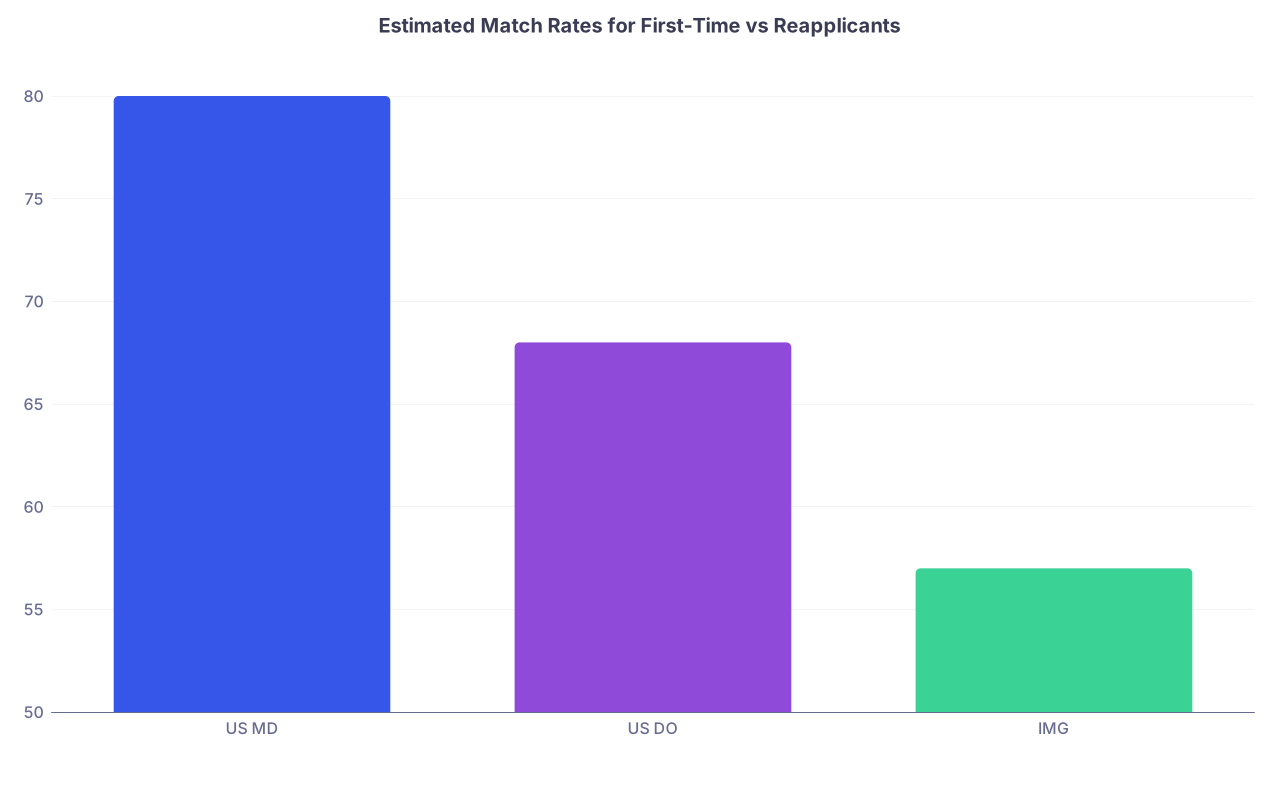
| Category | Value |
|---|---|
| US MD | 80 |
| US DO | 68 |
| IMG | 57 |
Those are illustrative but in line with public data patterns:
- First-time US MD senior match rate: ~92–94%
- Reapplicant overall match rate: far lower, often in the 40–70% range depending on specialty and profile
- IMGs can drop to 30–50% on reapplication without meaningful changes
So if you went unmatched, the data is already telling you:
- Your prior application “conversion rate” (apps → interviews → rankable programs) was too low.
- The system evaluated your profile and, for your chosen specialties, the market said “not competitive enough.”
If you repeat that exact profile and just add 40 more random programs, you are betting that those extra programs somehow ignore the same red flags everyone else saw. That is fantasy, not strategy.
2. The Conversion Funnel: Where Volume Actually Matters
Every residency application has the same core funnel:
Applications submitted → Interview invites → Interviews attended → Programs ranked → Match
You felt the pain at the end (“No match”), but the mathematically useful signal is earlier: your conversion rates.
Think of three core ratios:
- Applications → Interviews (A→I)
- Interviews → Rankable programs (I→R)
- Rankable programs → Match (R→M)
If your A→I is terrible, adding more applications can help some, but only until you hit diminishing returns. If your I→R and R→M are bad (poor interviewing, poor ranking strategy, late Step 2, etc.), then extra applications barely help at all.
Let’s make this concrete.
Suppose last cycle:
- You applied to 80 programs
- You received 4 interview invites
- You attended 4 interviews
- You ranked 4 programs and did not match
Your conversion metrics:
- A→I = 4 / 80 = 5%
- I→R = 4 / 4 = 100% (good)
- R→M = 0 / 4 = 0% (obviously)
A 5% A→I rate is low. For many mid-tier applicants in IM, FM, Peds, a healthier target is 10–20%. Competitive specialties are different, but if you are sitting at 5% in a relatively open specialty, you are underperforming.
Now compare two options:
- Option 1: Do nothing meaningful to your profile; next year apply to 140 programs instead of 80.
- Option 2: Improve your profile and targeting so A→I increases from 5% to 12%, even if you only apply to 90 programs.
Run the numbers.
Option 1: Volume Play (No Profile Change)
Assume A→I stays at 5%.
- 140 applications × 5% = 7 interviews
- Interpreting past behavior, you likely rank all 7
- Historically, match probability with 7 interviews in many primary care specialties might land ~70–85%, but for reapplicants it often sits lower due to clustering in weaker programs. Call it 60–70% to be realistic.
You went from 4 interviews to 7 for a huge cost in money and time. Your match probability might jump from, say, 35–40% to 60–70%. Not trivial. But expensive.
Option 2: Targeted + Upgraded Profile
Assume you fix actual deficits:
- New US clinical experience or sub-I in your chosen specialty
- Stronger LORs
- Addressed Step attempts (solid Step 2, good OET, etc.)
- Specialty pivot if appropriate
- Earlier, better organized applications
Now A→I improves to 12%.
- 90 applications × 12% = 10.8 ≈ 11 interviews
- 11 interviews in a reasonable specialty is usually >90% match probability, even for reapplicants, when programs are geographically and tier-diversified.
You applied to fewer programs than Option 1 and got more interviews and a substantially higher match probability. That is what a data‑driven, targeted strategy does. It improves the conversion rate, not just the input volume.
3. The Psychology Trap: Why “More Applications” Feels Safer
I see the same pattern every cycle:
- Applicant: “I’m going to apply to every single IM program in the country this time. Can’t hurt, right?”
- Reality: It can hurt, and it usually does.
There are three traps here:
Risk illusion
More applications feels like “hedging your bets.” In reality, you are often just duplicating failure across more programs that use similar filters: Step cutoffs, YOG limits, visa issues, or preference for US grads.Opportunity cost
Every extra 20–30 programs cost you:- Time to research, customize PS when needed, track responses
- Money for ERAS fees, USMLE transcript costs, etc.
That time and money could have gone into an observership, research, networking, or a second specialty application.
Signal dilution
When you apply everywhere in a specialty you barely fit, you risk scattering your efforts. Programs that might actually be realistic for you receive a generic, non-specific application because you are rushing through 200 others.
The data on match probabilities by number of interviews is brutal but clear: there is a steep benefit curve up to a certain number of interviews (often 8–12 in many specialties), then a plateau.
Throwing 150 applications just to go from 13 to 18 interviews is rarely rational. Throwing 150 to go from 1 to 2 interviews is even worse.
4. Quantifying Diminishing Returns
Let us model a simplified scenario.
Assume:
- You are a reapplicant to Internal Medicine.
- With a reasonable, targeted strategy, your A→I could be 10%.
- With a sloppy, mass-application approach, your effective A→I is 6% (due to poor targeting, weaker fit, less time per app).
Calculate expected interviews at different volumes.
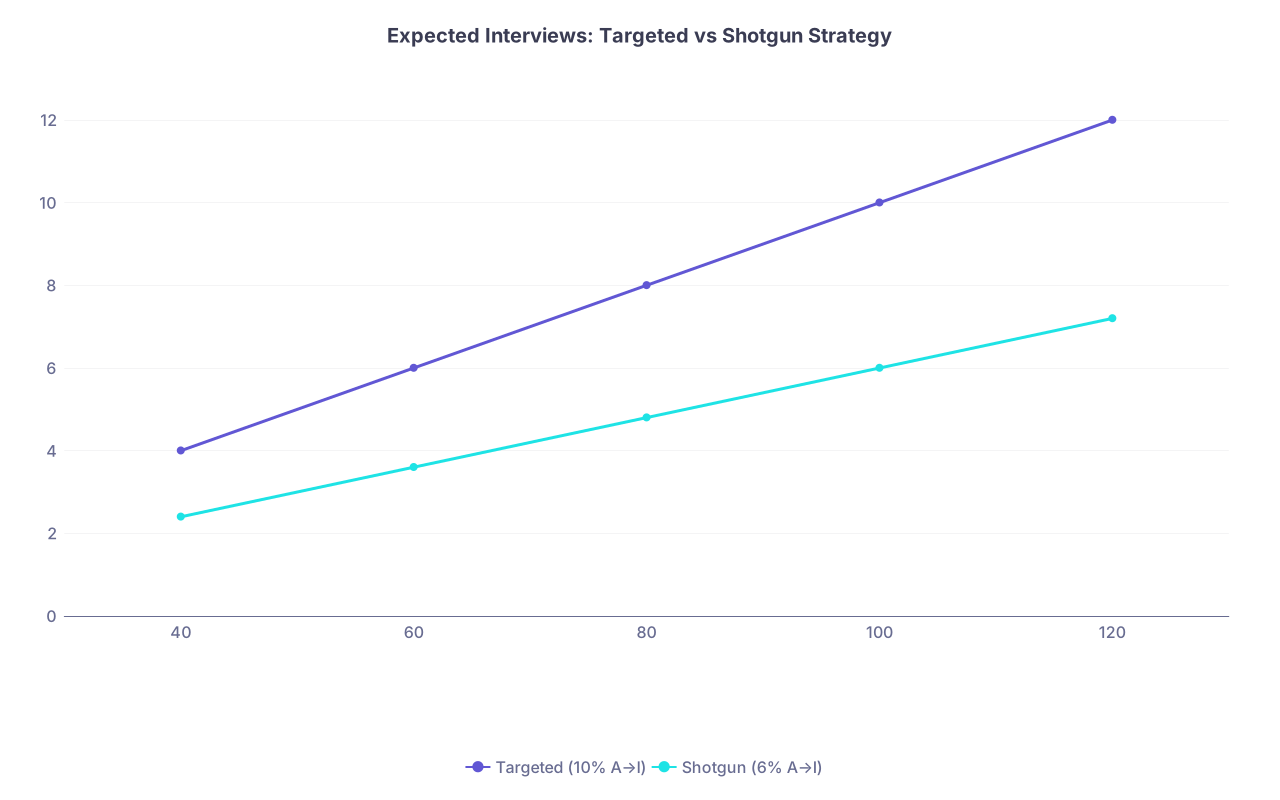
| Category | Targeted (10% A→I) | Shotgun (6% A→I) |
|---|---|---|
| 40 | 4 | 2.4 |
| 60 | 6 | 3.6 |
| 80 | 8 | 4.8 |
| 100 | 10 | 6 |
| 120 | 12 | 7.2 |
Rough takeaways:
- With 80 well-chosen applications and a 10% conversion, you get ~8 interviews.
- With 120 poorly chosen applications and a 6% conversion, you get ~7 interviews.
Same or more effort. Worse result.
The key variable is not “how many applications” but “what is your effective A→I rate.” Volume without targeting lowers that rate because you burn limited time and attention on low-yield programs.
5. When Extra Applications Are Rational
There are situations where extra applications make sense. The data is not anti-volume; it is anti-blind volume.
Extra applications are justified when:
- You are near a critical interview threshold.
In many specialties, the probability of matching jumps significantly between, say, 3 vs 6 interviews, or 6 vs 10.
Roughly (very general, varies by specialty):
| Interview Count | Estimated Match Probability (Broadly) |
|---|---|
| 0–1 | <10% |
| 2–3 | 15–35% |
| 4–5 | 40–60% |
| 6–8 | 65–85% |
| 9–12 | 85–95% |
If your realistic scenario is going from 3 to 6 interviews by expanding your application list within rationally chosen programs, that is worth the extra cost. A 20–30 point jump in match odds is not trivial.
Your target list is artificially constrained.
Example: you only applied within one state last cycle and got 2 interviews. Expanding to the region or nationally, while still maintaining profile fit, is rational.You pivot specialties but keep the first as a backup.
If you pivot from General Surgery (failed) to Internal Medicine as primary, you might still send a small batch of targeted Surgery applications while going broad but targeted in IM. That increases total volume, but it is tied to a strategic pivot.
What is not rational is doubling your applications within the exact same ill-fitting specialty and tier with the same weak profile.
6. Building a Targeted Strategy: A Quantitative Workflow
Here is the data‑driven approach I recommend to reapplicants deciding between extra applications and a targeted strategy.
Step 1: Analyze Last Cycle Like an Auditor
Pull your last-cycle data:
- Number of applications per specialty
- Number of interviews per specialty
- Which programs invited you (by state, program type, visa policy, etc.)
- Where you were auto-screened out (if evident)
Then categorize.
| Category | Count |
|---|---|
| Total Programs Applied | 85 |
| Total Interview Invites | 5 |
| Community / Non-University Invites | 4 |
| University / Academic Invites | 1 |
| Invites in Home State | 3 |
The pattern above screams: you are more competitive at community programs and closer to home. That should define your “targeted” bucket next cycle.
Step 2: Profile Reality Check
Be brutally honest with the data:
- USMLE/COMLEX: scores, fails, number of attempts
- Year of graduation
- Country of medical school
- Need for visa sponsorship
- Genuine clinical experience in the specialty (US vs non-US)
- Research (for competitive specialties)
Create a basic risk tier:
- Green: Likely acceptable for many programs (no fails, YOG ≤ 3–4 years, no visa, solid scores).
- Yellow: Some red flags (older YOG, visa needed, borderline scores, OR limited USCE).
- Red: Multiple red flags (Step fails plus visa plus 7+ years since graduation, etc.).
If you are yellow/red and trying to reapply to a hyper-competitive specialty with no real changes since last cycle, widening your application net inside that same specialty is correlation with continued failure.
Step 3: Program Targeting With Data, Not Hope
Use multiple data sources:
- NRMP Charting Outcomes
- Specialty-specific match reports
- Program websites / FREIDA filters (score cutoffs, YOG, visa policy, IMG friendliness)
The goal is to create a high-yield list where your profile is at least within the lower end of their typical matched residents.
I often see applicants with mid‑220s Step 2 scores blanketing university neurology programs that clearly state “preferred Step 2 > 240, YOG ≤ 3.” That is not strategy; that is denial.
Your program list should:
- Overweight historically IMG/DO-friendly or community programs if you are an IMG/DO.
- Avoid clear “no visa,” “YOG ≤ 3” when you need a visa and graduated 5 years ago.
- Match geography where you have real ties (family, school, work).
Step 4: Decide Volume After You See True High-Yield Options
Only once you have a rational list of programs where your profile is not an obvious outlier should you talk about volume.
Example Tiering:
- Tier A (High fit): 40–60 programs where your profile aligns well
- Tier B (Moderate fit): 30–50 programs where you are a bit below average but within range
- Tier C (Low fit): 20–30 programs that are stretch but not impossible
You should apply to all of Tier A. Then as much of Tier B as your budget/time allows. Tier C is optional, and this is where people waste most of their “extra” applications.
If your “extra applications” are mostly Tier C long shots, the expected ROI is tiny.
7. When a Specialty Pivot Beats Any Number of Extra Applications
Some of you are insisting on reapplying to a specialty where you are fundamentally below the bar: Ortho with 220 Step 2; Derm with no research and no home program; EM reapplicant in a collapsing job market.
There is a harsh but clear pattern in the data:
- Reapplicants who pivot to a less competitive specialty often multiply their match odds far more than those who stubbornly reapply with extra volume in the same specialty.
For example:
- Surgery reattempt with 200 total apps vs. pivot to Preliminary Surgery + IM with 90–100 targeted apps.
- Unmatched EM graduate pivoting to IM, FM, or IM-prelim year, then trying again for EM later when stronger.
A specialty pivot, executed well, often changes your A→I from 2–3% to 10–15%. No number of additional applications can compensate for a 5x difference in conversion rate.
8. Cost–Benefit: Money, Time, and Emotional Drain
Let us treat this like a real investment problem.
Rough cost estimate (using typical ERAS fee structures; simplified):
- First 30 programs in a specialty: baseline cost
- Each additional 10 programs: incremental fee (often $15–$26 per program depending on range)
Say you push from 80 to 140 programs.
- Extra 60 programs × ~ $20 average = $1,200
- Add transcript fees, NRMP, travel (if any), etc. You are quickly in the $1,500–$2,000 extra range.
Now ask:
What could that $1,500 buy instead?
- A month of USCE in your specialty (which can materially increase A→I by 2–5 percentage points)
- A targeted exam prep course that moves your Step 2 score from 225 to 240
- Time off work to do serious research and networking at specific programs
Those investments can literally double your effective A→I or open whole new tiers of programs. Extra applications rarely do that.
9. A Practical Decision Framework
If I had to turn all of this into a blunt checklist, it would look like this:
Did your last cycle yield ≥ 5 interviews in your primary specialty?
- Yes: Focus on interview skills / ranking strategy; moderate increase in applications may be enough.
- No: Your problem is profile + targeting, not volume.
Can you realistically improve key metrics before the next cycle? (USCE, exam scores, LORs, research, specialty pivot)
- Yes: Prioritize those improvements over expanding applications.
- No: Consider whether reapplying makes sense at all, or whether a major pivot (specialty, geography, country) is necessary.
Is your new application plan mostly adding programs that would have screened you out last year?
- Yes: You are just paying more for more rejections. Stop.
- No: Then extra applications might be reasonable, if grounded in program-specific data.
Can you define your current A→I from last year and set a specific target (e.g., “I want to move from 5% to 12%”)?
- If you cannot, you are guessing, not strategizing.
10. Visualizing Your Next Cycle
Here is a simple process view of what your reapplication cycle should look like if you want a targeted, data‑driven strategy instead of panic volume:

| Step | Description |
|---|---|
| Step 1 | Analyze Last Cycle Data |
| Step 2 | Identify Profile Gaps |
| Step 3 | Focus on Interview & Rank Strategy |
| Step 4 | Decide on Specialty Pivot |
| Step 5 | Build Targeted Program List |
| Step 6 | Set Application Volume by Tier |
| Step 7 | Submit Early, Complete Files |
| Step 8 | Monitor A→I in Real Time |
| Step 9 | Maintain Strategy |
| Step 10 | Selective Late-Season Add-ons |
| Step 11 | A→I < 8%? |
| Step 12 | Interviews >= 8? |
The critical fork is early: if your A→I is bad, you fix that before you touch application volume.
FAQs
1. I went unmatched with 3 interviews. Should I apply to 2–3 specialties next cycle or just apply to more programs in my original specialty?
The data favors a second, more attainable specialty over simply expanding volume in the failed specialty. With only 3 interviews, your A→I is likely weak or the specialty is overly competitive for your profile. Adding a compatible backup specialty (e.g., IM + FM, or Surgery + IM-prelim) often multiplies your realistic interview count at far less cost than shotgunning 50 more programs in the same specialty.
2. I am an IMG with a Step 1 fail but decent Step 2. Is a targeted strategy enough, or do I need to apply to 200+ programs?
A Step 1 fail pushes you into a high-risk cohort. That said, a purely volume-based strategy is inefficient. You need (1) hyper-focused targeting on IMG-friendly, fail-tolerant programs, (2) strong USCE and letters, and often (3) a less competitive primary specialty. For many such applicants, 100–140 well-chosen programs beat 200–250 random ones. If your budget is limited, prioritize profile improvement and granular targeting over extreme volume.
3. How many interviews should I aim for as a reapplicant to feel “statistically comfortable”?
For most non-ultra-competitive specialties, you want to be in the 8–12 interview range. Reapplicants with 8+ interviews in a reasonable mix of community and mid-tier university programs usually see match probabilities above 80–90%, provided they are not self-sabotaging in interviews or ranking only a tiny geographic zone. Under 5 interviews, your odds fall sharply, and no amount of post-interview magic compensates for that.
4. Can a perfectly executed targeted strategy make up for a very low Step 2 score (e.g., <215) without a retake or other major improvement?
For most US grads in less competitive specialties, an outstanding targeted strategy can partially compensate, especially with strong clinical performance and institutional connections. For IMGs or those aiming at more competitive fields, very low scores form a structural barrier. In those scenarios, the highest-yield moves are: (1) improving exam performance where possible (Step 3, strong COMLEX, etc.), (2) adding strong, recent USCE, and (3) pivoting specialties if needed. No amount of targeting or application volume turns a fundamentally noncompetitive profile into a strong one without some objective improvement.
With these numbers and frameworks in hand, you are ready to design a reapplication plan that is actually aligned with reality instead of fear. The next step is to map your specific profile against real program data and build that tiered target list—but that is a conversation measured in spreadsheets, not slogans.