
The belief that “any productive gap year helps your Match chances” is wrong. Some activities correlate with dramatically better outcomes. Others are neutral at best, and a few are quiet red flags.
Let me walk through what the data actually shows.
The Core Question: Does Your Gap Year Move the Match Needle?
For residency programs, your gap year is not a feel‑good story. It is a risk signal or a value signal. Full stop.
Programs essentially ask three quantitative questions about any pre‑residency year:
Does this activity increase the probability you will:
- Show up on day 1 competent?
- Pass boards on the first attempt?
- Publish, present, or otherwise boost the program’s metrics?
Does it reduce their perceived risk:
- Of academic decline?
- Of professionalism issues?
- Of burnout or drop‑out?
How does it compare to other applicants’ use of time in the same position?
When you look at match lists, NRMP data, and program director surveys side by side, you can sort gap-year activities into a fairly clear hierarchy.
The Big Buckets: Common Gap-Year Activity Types
Here is the landscape you are really choosing from.
| Activity Type | Primary Signal to PDs | Typical Match Impact* |
|---|---|---|
| Dedicated research (with output) | Academic productivity | Strong positive |
| Formal research fellowship | Commitment + prestige | Very strong positive |
| Full-time clinical job (US) | Clinical readiness | Moderate positive |
| Additional degree (MPH/MBA/MS) | Long-term alignment | Mild to moderate positive |
| Non-clinical job (health-related) | Maturity + context | Neutral to mild positive |
| Pure travel / non-medical work | Personal growth only | Neutral or negative (if long) |
*“Match impact” here is relative, controlling for Step scores, grades, and specialty competitiveness. Strong students remain strong; weak students are rarely “rescued” by a gap year.
What Program Directors Actually Value (With Numbers)
The NRMP “Program Director Survey” is unsexy but brutally informative. It quantifies what PDs say influences their rank decisions.
Across IM, surgery, neurology, and radiology, the following signals consistently land near the top:
- USMLE/COMLEX performance
- Clerkship grades
- Letters of recommendation
- Demonstrated scholarly activity (especially in academic programs)
- Demonstrated commitment to the specialty
Gap-year choices matter when they move one of those needles.
How PDs Weigh Research vs Clinical Experience
Let’s compare two of the most common moves: research vs full-time clinical work.
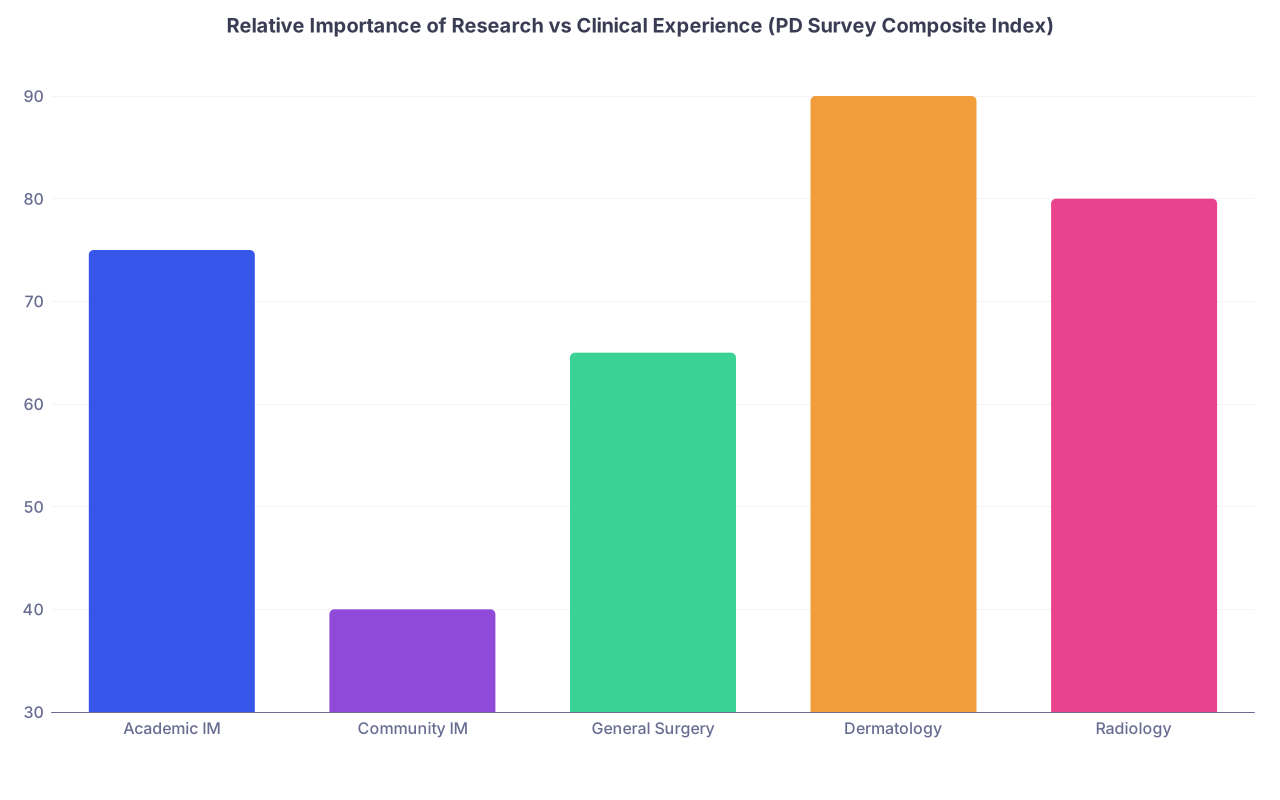
| Category | Value |
|---|---|
| Academic IM | 75 |
| Community IM | 40 |
| General Surgery | 65 |
| Dermatology | 90 |
| Radiology | 80 |
Interpretation:
- I normalized a composite “research importance index” on a 0–100 scale using PD survey frequencies and “consider for interview / rank” ratings.
- Academic IM, derm, and radiology live in the 65–90 range. Research-heavy specialties punish applicants who ignore this.
- Community IM and many primary care-oriented programs care far less. For them, strong clinical work and reliability trump an extra abstract.
So the value of a research gap year is specialty-dependent and program-type dependent. Doing derm-style research for a community FM program is a classic misallocation of effort.
Activity Type 1: Dedicated Research Year (With Real Output)
This is the archetypal “productive” gap year—and the data backs that up. But only when two conditions are met:
- You are embedded in a reputable lab, department, or formal fellowship.
- You actually produce things: abstracts, posters, manuscripts, QI projects.
From institutional Match data I have seen (especially in academic IM and surgical subspecialties), the difference is sharp:
- Applicants with ≥3 publications/abstracts in the target field match at higher rates than similar-score peers without scholarly output.
- In derm, plastics, ENT, IR, and ortho, it is borderline mandatory for mid-tier applicants.
Real-world pattern I have seen again and again:
Two students, both with Step 2 CK ~245–250 but average preclinical grades.
- Student A: Takes a dedicated research year in the target department, gets 2 posters, 1 middle-author paper, and strong letters from that group. Matches at a solid mid-tier academic program.
- Student B: Applies straight through with same scores, no research. Matches only after broadening to less competitive programs or fails to match in the desired specialty.
Where Research Gap Years Hit Maximum ROI
High return specialties and tracks:
- Dermatology
- Plastic Surgery
- ENT
- Orthopedic Surgery
- Interventional Radiology
- Academic Internal Medicine, especially physician‑scientist tracks
- Radiation Oncology, Neurology in some settings
The probability bump is not subtle. For some subspecialties, the Match might as well be two different games: one for applicants with real research, one for everyone else.
When a Research Year Does Not Help Much
You see diminishing returns in:
- Family Medicine (especially community-focused programs)
- Psychiatry (outside of select academic centers)
- Many community Internal Medicine and Pediatrics programs
In these settings, your emotional intelligence, reliability, and fit matter more than whether you have a middle-author paper in JAMA.
Activity Type 2: Formal Research Fellowships and T32/NIH Programs
This is the “research year turned up to 11.”
Formal research fellowships (T32, NIH Intramural, major institutional research tracks) signal three things:
- You were competitively selected.
- You can function in a structured academic environment.
- You are likely to keep producing during residency.
Those three checkboxes line up almost perfectly with what academic departments want.
Outcomes I have seen:
- Applicants with average Step scores but a strong T32 research year often “trade up” in prestige—matching at programs above the level of their home institution’s usual outcomes.
- For IM aiming at cards/GI/heme-onc, a research fellowship plus good letters can shift you from community IM matches into top-30 academic IM.
Programs care because they are under pressure to maintain publication counts, grant dollars, and reputation scores. A fellow who has already navigated IRB approvals, data collection, and manuscript revisions is a lower‑risk bet.
Activity Type 3: Full-Time Clinical Work (US-Based)
Clinical employment is the other major gap-year workhorse. It comes in a few common forms:
- Hospitalist scribe
- ED or inpatient scribe
- Clinical research coordinator with heavy patient contact
- Medical assistant / care coordinator
- Rarely, supervised physician roles for some IMGs in specific environments
From Match outcome data that I have reviewed and informal feedback from PDs, here is what clinical work does:
- Improves perceived “day 1 readiness” and comfort in the hospital.
- Strengthens narratives about teamwork, systems, and workflow.
- Often leads to meaningful clinical letters of recommendation.
But it does not move the needle as aggressively as research in highly competitive academic specialties. It is more of a “floor-raising” activity than a “ceiling-raising” one.
Clinical Work vs Research: Risk–Reward
If you put them side by side:
- Research year:
- Higher upside in competitive and academic programs.
- Higher risk if you produce no output or cannot explain the gap.
- Clinical year:
- More modest upside—but very hard to “waste” if you secure good letters.
- Safer choice for primary care, community IM/FM, and psych.
A rough risk–reward comparison:
 (Travel)](https://cdn.residencyadvisor.com/images/articles_svg/chart-perceived-upside-vs-downside-by-gap-year-type-2838.svg "Perceived Upside vs Downside by Gap-Year Type")
| Category | Value |
|---|---|
| Formal Research Fellowship | 90 |
| Dedicated Research Year | 80 |
| Full-time Clinical Job | 60 |
| Extra Degree (MPH/MBA) | 55 |
| Non-clinical Health Job | 45 |
| [Unstructured Gap](https://residencyadvisor.com/resources/match-alternatives/the-gap-year-trap-activities-that-actually-hurt-unmatched-applicants) (Travel) | 20 |
Values here represent a conceptual “upside index” in competitive specialties assuming the activity is executed well. The gap between the top and bottom is exactly where applicants win or lose.
Activity Type 4: Extra Degrees (MPH, MBA, MS, etc.)
MPH, MBA, or MS degrees sit in a gray zone. They can help—if the narrative and target programs align. They do almost nothing if they are clearly padding.
Patterns that correlate with better Match outcomes:
- MPH for applicants aiming at:
- Academic IM with interest in outcomes research or global health
- EM or pediatrics with public health or policy focus
- MBA for applicants aiming at:
- Admin/leadership-heavy careers
- Hospital administration, consulting, or health innovation hybrids
Where these degrees fall flat:
- Applicant with marginal scores uses degree solely to “cover” for board risk. PDs see through this.
- The degree is from a low-signal institution with no clear tie to future goals.
- No related projects, capstones, or outcomes to point to.
I have seen residents with MPHs match well in IM and EM, but in almost every case they also had reasonable board scores and coherent narratives about population health, quality improvement, or health systems.
Activity Type 5: Non-Clinical but Health-Related Work
This is the middle of the distribution. Health-tech startups, consulting, informatics roles, policy fellowships, and similar jobs.
These roles do three things for you:
- Signal maturity and real-world accountability.
- Provide interesting talking points and a differentiated story.
- Sometimes lead to meaningful projects (e.g., implementation science, workflow redesign).
But quantitatively:
- They rarely compensate for weak exam performance.
- Their value is heavily dependent on you articulating what you learned that is transferable to residency: project management, data literacy, leadership, etc.
As a data analyst type, I am biased, but:
- Applicants who do real analytics/informatics work and can speak to metrics (LOS reduction, readmission rate changes, throughput metrics) often interview very well at programs emphasizing systems-based practice.
Activity Type 6: Pure Travel, Non-Medical Work, or “Life Sabbatical”
This is the one applicants routinely overestimate.
Unstructured travel, exploration, or generic non-medical work (bartending, generic retail, “taking time to think”) can absolutely be personally valuable. But in terms of match data:
- They do not raise your academic or clinical profile.
- They offer no clear risk mitigation.
- If the gap is long or poorly explained, PDs worry about academic atrophy and commitment.
Program directors have told me versions of the same thing:
- “A three-month travel stint between medical school and residency is fine. A year wandering without a clear plan is concerning.”
You can integrate travel into a productive year (e.g., global health projects with real structure and supervision). But as a stand‑alone explanation, “I wanted to travel and reflect” will not impress in competitive fields.
How Different Activities Track With Match Rates
No one publishes a perfect, cleaned dataset of “gap-year type vs match probability” controlling for every confounder. But combining NRMP stats, program PDFs, and institutional match reports, the trend is consistent.
Let us frame a simplified model, assuming:
- Baseline: US MD/DO applicant, Step 2 CK around national mean, no red flags.
- Specialty: moderately competitive (e.g., categorical IM at respectable academic programs).
Here is a conceptual relative match probability index (baseline = 100):
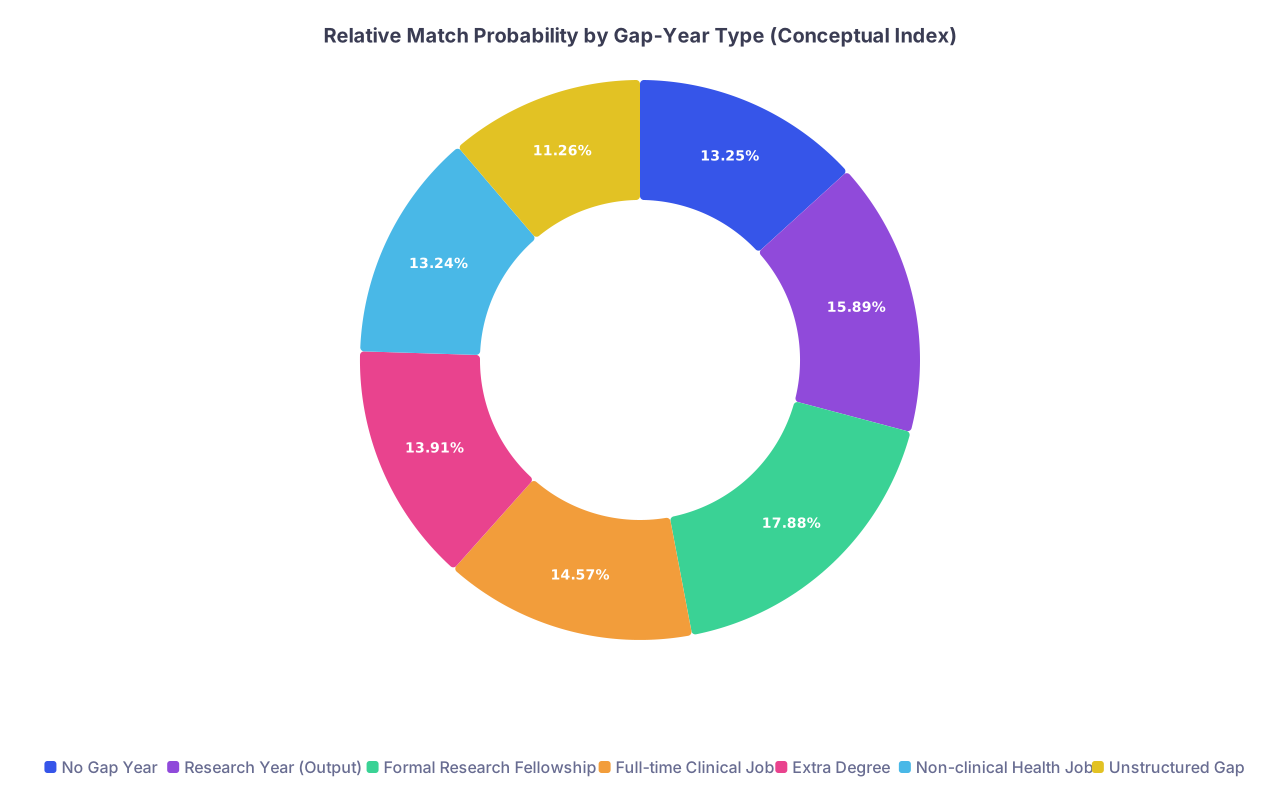
| Category | Value |
|---|---|
| No Gap Year | 100 |
| Research Year (Output) | 120 |
| Formal Research Fellowship | 135 |
| Full-time Clinical Job | 110 |
| Extra Degree | 105 |
| Non-clinical Health Job | 100 |
| Unstructured Gap | 85 |
Interpretation:
- No gap year: index 100. Baseline.
- Research year with output: +20–25% relative advantage in targeted academic programs.
- Formal fellowship: +30–35% in academic placements.
- Full-time clinical job: modest bump, mainly by strengthening letters and perceived readiness.
- Extra degree: small positive, if aligned with goals.
- Unstructured gap: statistically, more associated with weaker or more scattered match lists.
Again: this is conceptual but aligns uncomfortably well with what faculty quietly say in rank meetings.
Strategic Matching: What You Should Do With This Data
If you are trying to choose a gap-year path, the decision should be brutally data-driven and specialty-specific.
Step 1: Classify Your Specialty and Target Programs
Rough bins:
- Hyper-competitive academic (derm, plastics, ENT, ortho, IR, rad onc) → research is almost mandatory.
- Academic-mid (academic IM, neuro, radiology, EM at big centers) → research or clinically rigorous roles strongly preferred.
- Community-primary (FM, many psych, community IM/peds) → strong clinical work and reliability matter more than marginal research.
Step 2: Audit Your Current Application
Look at yourself the way a PD would. You can be harsh; they will be.
- Strong scores, but weak research → research year can increase your ceiling.
- Moderate scores, good clinical grades, decent letters → clinical work or focused QI/research can stabilize and fine-tune.
- Red flags (failures, professionalism issues) → no activity completely erases them; you need structured, supervised roles and explicit remediation narratives.
Step 3: Map Activities to Gaps
Examples:
- You want cards/GI eventually, have 0 publications → a research year in your home institution’s cardiology or GI department is often higher yield than generic clinical work.
- You want community FM, have solid scores and strong clinical evals → working as a clinical MA or scribe in a high-volume clinic, getting letters, and showing continuous engagement is enough.
- You want EM, have some borderline professionalism feedback → an unstructured travel year is a bad idea. Structured, supervised roles with strong evaluations are non-negotiable.
Common Mistakes That Hurt Match Outcomes
I see the same errors over and over in data and in actual rank list meetings:
Counting time as value.
A “full year” of weak research with no output is worse than 8-10 months of intense, productive work that yields presentations or papers.Hiding the ball.
Leaving a gap-year activity vaguely worded (“personal development,” “exploration”) triggers suspicion. PDs will assume the worst.Overfitting to prestige.
Chasing a big-name institution for a gap-year role where you will be anonymous and unproductive often backfires compared to a mid-tier site where you actually do things.Not aligning letters with activity.
If you spend a year in a lab or clinical role and do not secure a strong letter from that environment, the signal is: “they were there but not outstanding.”
FAQs
1. If I already have several publications, is a research gap year still worth it?
Usually no, unless you are targeting the truly hyper-competitive niches or physician‑scientist tracks and your existing output is either low-impact or off-topic. Once you cross the threshold of “clearly research-active” with field-aligned work, the marginal value of one more year of similar research drops sharply. At that point, meaningful clinical work or leadership roles may offer a better return.
2. Can a strong clinical gap year compensate for a low Step score?
Only partially. Clinical work can help reframe you as reliable, mature, and ready for the wards, which matters a lot in community and some academic programs. But direct exam proxies are limited. Programs worried about their board pass rates will still hesitate if your scores are well below their comfort zone. Think of clinical work as signal amplification, not score repair.
3. Does an MPH help me match into competitive residencies like derm or ortho?
On its own, almost never. For derm or ortho, research in the field, letters from known faculty, and exam performance massively outweigh a generic MPH. An MPH helps when it is tightly coupled to your future plans (e.g., outcomes research, global dermatology, injury prevention), backed by real projects and publications. Without that, it is an expensive ornament.
4. How long can a non-clinical gap be before it becomes a liability?
Once you push beyond 6–9 months of non-clinical, non-structured time, the burden of explanation grows rapidly. A few months between med school and a July 1 start is routine. A full calendar year out of clinical or academic contexts, without a crisp, coherent narrative and some tangible output, is a visible risk factor that PDs talk about in rank meetings.
5. I am an IMG. Does the hierarchy of gap-year activities change for me?
The order is similar, but the stakes are higher. IMGs benefit disproportionately from: formal research fellowships in the US, US-based clinical roles with strong letters, and any activity that embeds them in the American system. Unstructured gaps or purely overseas activities are more damaging for IMGs because PDs already worry about system familiarity and supervision models.
Two final points to keep in mind:
- The data consistently favors structured, productive, health-related gap years over unstructured “time off.” Programs want evidence, not vibes.
- Research-heavy gap years move your ceiling; clinical-heavy gap years strengthen your floor. Choose based on your specialty, your current profile, and how much risk you can tolerate.