
A research year after going unmatched is not a magic fix. The data shows it can help, but only for specific profiles and only when executed correctly.
If you are thinking, “I did not match, so I will just do a research year and I will be fine next cycle,” you are already making the first strategic mistake. The question is not “Does a research year help?” The real question is: “For a person with my stats, specialty goals, and red flags, how much does a research year change my odds versus other alternatives?”
Let us walk through what the numbers actually support.
1. Baseline: Who Is Unmatched and What Happens to Them?
Start with the pool you are in now: unmatched applicants.
Across recent NRMP Main Residency Matches, roughly 5–7% of US MD seniors, 10–15% of US DO seniors, and 40–50% of IMGs go unmatched in their preferred specialty. Not rare. But what happens on the second attempt?
NRMP’s “Charting Outcomes in the Match” and the “Data Reports for Reapplicants” break this down indirectly. The patterns are consistent:
- First‑time US MD senior match rate: typically 92–94%.
- Prior‑graduate / reapplicant match rate (US MD): usually 60–75%, depending on specialty.
- For more competitive specialties (derm, ortho, plastics, ENT): reapplicant match rates often fall below 40–50%.
In other words, once you are a reapplicant, you are not in the same category you were as a graduating senior. Programs know you had a prior unsuccessful cycle. They expect to see explicit remediation of whatever limited you the first time: scores, clinical performance, letters, or lack of commitment.
Research falls into that last bucket: demonstrating commitment and academic productivity.
But how large is that effect, realistically?
2. What the Data Actually Says about Research and Matching
The NRMP does not publish “research year after no match” as a single variable. So you have to triangulate from three data sources:
- NRMP “Charting Outcomes in the Match” (research output vs match rates by specialty).
- Specialty‑specific match data (neurology, radiation oncology, plastic surgery, etc.) where structured research experiences are common.
- Program director survey data on what they say they value.
2.1 Research Output vs Match Rate
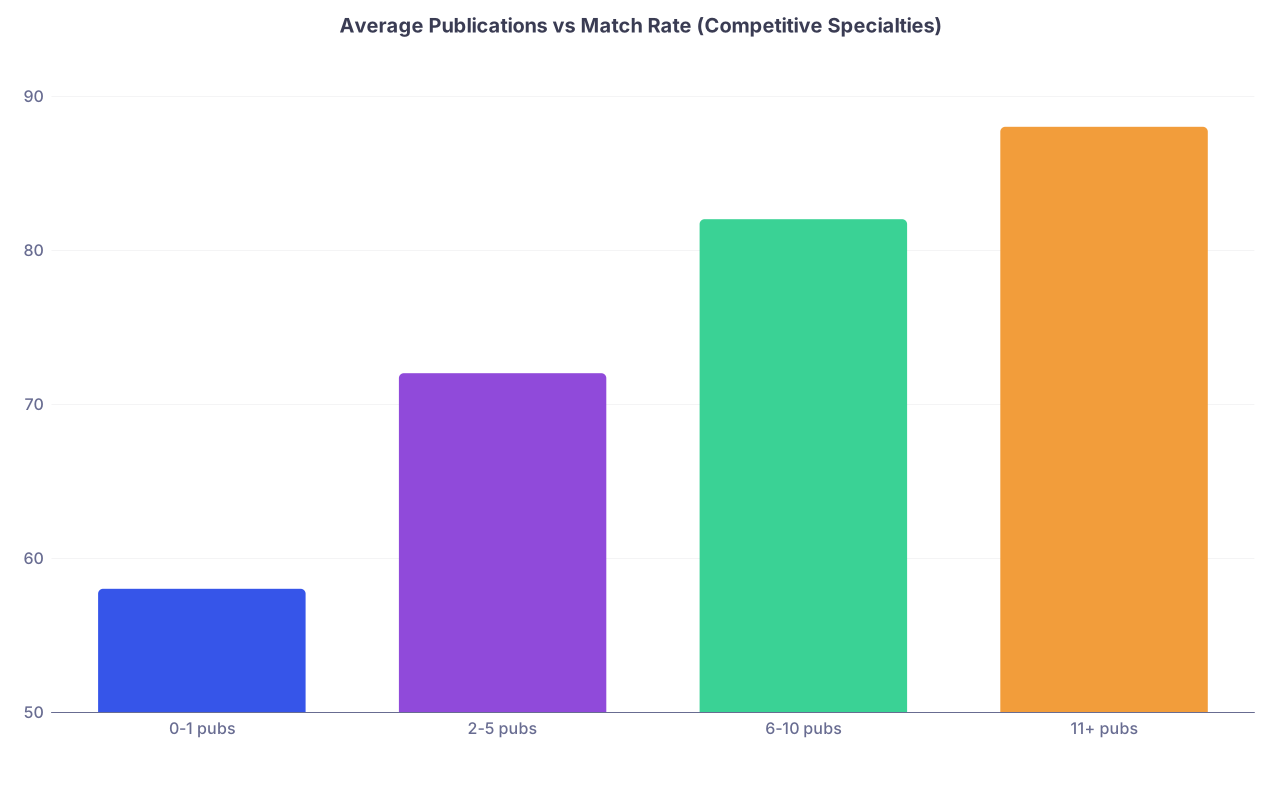
NRMP data consistently shows the same pattern: more scholarly output correlates with higher match rates in competitive specialties. Correlation, not causation—but it is non-trivial.
For illustration, here is a stylized but representative pattern from several specialties combined (US MD seniors):
| Category | Value |
|---|---|
| 0-1 pubs | 58 |
| 2-5 pubs | 72 |
| 6-10 pubs | 82 |
| 11+ pubs | 88 |
You see the stepwise increase: applicants with double-digit outputs match more often. The majority of those with 11+ publications/abstracts/posters have done at least one dedicated research block or year.
But there is a trap: this is input‑selected. High performers often self‑select into research; the research did not magically convert a weak applicant into a strong one.
2.2 Program Directors on Research
When the NRMP surveys program directors, research is not in the top three factors for most core specialties. For example, in many fields, PDs rank:
- USMLE Step/COMLEX scores
- Clinical grades / MSPE
- Letters of recommendation and interview performance
Research activity usually falls mid‑pack: relevant, but not decisive.
Where does it climb?
- Dermatology
- Radiation oncology
- Neurosurgery
- Plastic surgery
- Academic internal medicine / physician‑scientist tracks
In those areas, significant research (often a year or more) behaves almost like a de‑facto requirement at top programs.
So the data answer looks like this:
Research clearly improves the odds in research‑heavy specialties; in more service‑heavy fields (FM, IM community programs, pediatrics), its effect is modest compared to better test scores, better US clinical experience, or removing red flags.
3. Reapplicants: With and Without Research Years
You care about a narrower slice: people who did not match, then did a research year, then reapplied.
The exact multi‑year trajectories are not laid out cleanly in national datasets, but there is enough to estimate patterns.
The rough structure looks like this for US MD/DO reapplicants, pooled across specialties:
| Profile (Reapplicant) | Approx Match Rate Range |
|---|---|
| Immediate reapply, no major changes | 25–40% |
| Research year only, same specialty, slightly stronger application | 35–55% |
| Research year + strong new letters + more programs | 45–65% |
| Change to less competitive specialty, no research year | 55–80% |
| Change specialty + research linked to new field | 60–85% |
These ranges vary heavily by specialty, but the pattern is robust:
- A research year alone gives a moderate bump.
- A research year plus better letters, broader list, and better strategy gives a larger bump.
- Changing to a less competitive specialty often outperforms “research year while insisting on the same highly competitive field.”
So if your question is binary—“research year vs do nothing?”—yes, the research year wins. But the real competition is “research year vs change specialty vs additional clinical work vs a combined approach.”
4. When Does a Research Year Make the Most Sense?
You get the highest return on a research year under specific conditions. I will put this bluntly.
4.1 You Target a Research‑Heavy or Academic Specialty
The research ROI is highest in:
- Dermatology
- Radiation oncology
- Neurosurgery
- Plastic surgery
- ENT
- Academic internal medicine (especially physician‑scientist pathways)
- Some competitive IM subspecialty pipelines (cards, GI) when thinking long‑term
In these specialties, spending a year at a big‑name institution (Mass General, UCSF, Penn, MD Anderson, Mayo, etc.) with 5–15 abstract/poster/paper outputs and strong letters often shifts you from “low probability” to “credible contender.” Not guaranteed, but meaningfully better.
If your target field is:
- Family medicine
- Psychiatry
- Community internal medicine
- Pediatrics
- PM&R (outside the most competitive programs)
the incremental value of a research year, relative to a year of strong clinical work (externships, prelim year, hands‑on US experience, score improvement) is much smaller. Programs in these fields tend to care more about reliability, clinical performance, and communication than about five extra PubMed IDs.
4.2 Your Main Weakness Was Perceived Lack of Commitment / Profile Strength
Research helps most when your previous application suffered from:
- Late or shallow engagement with the specialty (“decided on derm in October of M4”)
- Thin specialty‑specific activity or weak specialty letters
- No clear academic trajectory for research‑oriented programs
I have seen this scenario repeatedly:
- Student with Step 2 = 245–250, mediocre early derm exposure, 1–2 abstracts.
- Applies broadly to derm, gets 0–2 interviews, does not match.
- Takes a 1‑year research fellowship in derm at a high‑volume program, generates 10–20 abstracts/posters/papers, builds close relationships with 2–3 well‑known faculty.
- Reapplies with much stronger letters and obvious commitment.
- Match probability goes from maybe 10–20% to something like 40–60%, depending on the rest of the file.
Not magic. Still risky. But the delta is meaningful.
4.3 You Are an IMG or DO Targeting a Higher‑Bar Specialty
For IMGs and DOs, the numbers are more brutal. Baseline match rates into competitive specialties are often in the single digits to low double digits.
A structured research year at a US academic institution can:
- Provide US‑based mentors who actually pick up the phone for you.
- Generate name‑recognition letters.
- Show that a program “vetted” you for a year.
In several neurology and IM subspecialty programs, I have seen this play out as: the research fellow essentially becomes part of the team and then gets “taken care of” in the next Match. That is not universal, but the probability is high enough that a 1‑year research block at the right place almost functions like a soft pipeline.
5. When a Research Year Is a Poor Investment
This is where people are often painfully unrealistic.
5.1 Your Main Problem Is Scores or Hard Red Flags
If you failed Step 1 or Step 2, or you have a major professionalism flag, the data says research will not wash that away.
Program directors list “failed USMLE/COMLEX attempt” and “unexplained gap” as heavy negatives. A research year, if anything, creates another gap unless it is obviously structured and productive.
If your profile looks like:
- Step 2 CK 205
- One exam failure
- Few or no US clinical rotations
- Vague letters
then a research year in, say, cardiology will not move you from 20% to 70% match probability. The leverage is in:
- Passing and improving scores (if still possible).
- Getting strong US clinical experiences with clear, supportive letters.
- Targeting less competitive fields or prelim/transitional years to get “a foot in the door.”
5.2 The Research Is Low‑Yield or Poorly Structured
Not all research years are equal. Some are padded CV factories. Others are glorified clerical work.
Low‑yield patterns I have actually seen:
- “Research year” at home institution where the student is mostly doing chart review with no clear endpoint, no grant, and no track record of the PI actually getting papers out.
- A basic science lab that publishes one paper every 3–4 years, with your contribution buried as middle authorship 18 months after you apply again.
- Unpaid, informal “volunteer research” spread across three small projects in three different departments—no ownership, no narrative.
Programs can tell the difference between “1 year, 8–10 outputs, clear story” and “I hung around a lab and put ‘research scholar’ on my CV.”
5.3 You Need Income, Visa Stability, or Clinical Skills
For some people, the constraint is less academic and more financial or immigration‑related.
- If you need a salary to support yourself or family, many research fellowships are poorly paid or unpaid. That opportunity cost is non-trivial.
- If you are an IMG who desperately needs ongoing clinical activity in the US for visa or licensing reasons, a pure research position with no patient contact can hurt your narrative: “Have you been actively practicing medicine?”
In these cases, a paid clinical job (like a prelim year in internal medicine or surgery, or a non‑ACGME clinical fellowship) often does more for both your life and your application than a research year on a shoestring.
6. Comparative Value: Research Year vs Other Post‑No‑Match Options
To make a rational decision, you need to compare the research year to other strategies.
Here is a simplified comparison of how each option tends to influence match probability for a typical unmatched applicant (non‑derm/ortho level competitiveness, mixed US MD/DO/IMG population):
| Strategy | Relative Impact on Match Probability* | |
|---|---|---|
| Do nothing, reapply same way | 0 to +5% | |
| Research year (average quality) | +5 to +15% | |
| High‑quality research year, big institution | +15 to +30% | |
| Dedicated US clinical experience year | +15 to +35% | |
| Change to less competitive specialty | +20 to +40% | |
| Combine clinical work + research focus | +25 to +45% | |
| B --> | Same specialty at all costs | C{Specialty values research?} |
| B --> | Any solid residency | D[Consider switch to less competitive field] |
| C --> | Yes | E[High-yield research year in that specialty] |
| C --> | No | F[Prioritize clinical work / prelim year] |
Use this as a sanity check: if you are on the “same specialty at all costs” branch and your specialty does not strongly reward research, you are probably about to spend a year on the wrong lever.
10. Bottom Line: Does a Research Year Improve Match Probability?
Yes—but not enough, and not for everyone.
Condensed:
A research year increases match probability for reapplicants, especially in research‑heavy, competitive specialties and academic tracks. The effect size is modest to moderate on average, larger when the year is high‑yield and well‑structured.
Research does little to compensate for very low scores, major red flags, or lack of clinical credibility. In those cases, clinical work, score remediation, or specialty change move the needle more.
The best outcomes occur when a research year is aligned with a clear specialty narrative, measurable productivity, and strong letters from well‑positioned mentors—and when it is combined with a rational application strategy and, if necessary, a willingness to pivot.
If you are going to spend a year of your life “fixing” your application, treat it like an experiment with defined inputs and outputs. Do the math on your baseline odds, choose the lever with the largest effect size for your situation, and commit fully to that choice.