
The data shows a harsh truth: your choice between a categorical spot and a prelim year after going unmatched can permanently alter your match ceiling.
Not “in theory.” In practice. In numbers.
If you went unmatched and now sit on offers for a categorical backup (usually in a less competitive specialty or program) versus a prelim year (often in medicine or surgery), you are not choosing between “temporary” vs “permanent.” You are choosing between two very different probability distributions for the rest of your career.
Let’s quantify that.
What Actually Happens to Unmatched Applicants
First, anchor the baseline. What happens to unmatched seniors the next cycle?
NRMP’s reapplicant data and multiple institutional analyses all point in the same direction:
- US MD seniors who go unmatched and reapply in the same specialty without doing any additional training: roughly 25–40% match the next cycle.
- US DO and IMGs: usually lower, often in the 15–30% range, depending on specialty and Step 2 scores.
- Those who pick up some form of accredited residency training (prelim or categorical in something) and then reapply: their odds improve, but not equally across paths.
Prelim and categorical are both “wins” compared to sitting out, but the magnitude of that win differs, and it depends heavily on your end goal.
To make this less abstract, I will work with realistic but simplified probability ranges based on NRMP outcomes, specialty competitiveness data, and what program directors actually say in surveys and ranking behavior.
Defining the Two Paths: Categorical vs Prelim
Let us be precise.
Categorical position: You match directly into a full residency in a given specialty (e.g., categorical Internal Medicine, Family Medicine, Psychiatry, Pathology, General Surgery categorical). You have a guaranteed path to completion in that field if you meet performance standards.
Preliminary position (prelim): 1-year (occasionally 2-year) position, usually in Internal Medicine or Surgery. Designed either as:
- A required clinical year for advanced specialties (e.g., Radiology, Anesthesiology, Derm, Rad Onc), or
- A service year to fill hospital staffing needs; there is no guaranteed PGY-2 spot.
If you went unmatched in your target specialty (say Dermatology) and now accept:
- A categorical IM slot: you are on a durable track in IM, with the option (not guarantee) of future fellowship or re-application to another specialty.
- A prelim IM slot: you have one year of training, then the cliff. You must rematch or scramble into a PGY-2 or new PGY-1.
The long-term outcome space is very different.
The Core Question: Long-Term Match Probabilities
Strip away the anecdotes. The real question is:
If you go unmatched and
(a) take a categorical backup now, vs
(b) do a prelim year and try again,
what are your odds of ending up in your desired specialty, any specialty, or practicing as a board-certified physician at all?
We can frame this as three outcome tiers:
- Match into original target specialty (or an equivalently competitive field).
- Match into another acceptable specialty (backup) you could see yourself doing.
- Fail to secure any path to independent practice in the US (no completed residency).
Now quantify how categorical vs prelim shifts those probabilities.
Quantitative Comparison: Categorical vs Prelim Outcomes
Based on NRMP reapplicant statistics, PD survey responses, and program behavior, here is a reasonable approximation for US MD/DO graduates who went unmatched and then choose one of two trajectories.
Assumptions:
- Original specialty is moderately to highly competitive (e.g., EM, Anesthesia, Radiology, Derm, Ortho, Ophtho, ENT, competitive IM subspecialty path, etc.).
- Candidate is not catastrophically weak (e.g., no repeated failures across exams) but had a marginal profile relative to that specialty.
- They are hardworking and reasonably strategic in reapplication.
| Path After Unmatched | Chance of Ending in Original/Comparable Specialty | Chance of Ending in Different Acceptable Specialty | Risk of Never Completing US Residency |
|---|---|---|---|
| Categorical Backup Now | 10–25% | 60–80% | 5–10% |
| Prelim Year Then Reapply | 20–40% | 30–50% | 20–35% |
This is the uncomfortable tradeoff:
- Prelim year increases your upside (better shot at true target specialty), but also meaningfully increases your downside (higher risk of never securing a full categorical path).
- Categorical backup reduces the probability of “dream specialty,” but drastically cuts the risk of falling out of the residency pipeline entirely.
Put differently: prelim is a higher-variance bet. Categorical is a lower-variance, more conservative investment.
Why Prelim Sometimes Works Extremely Well
There is a reason ambitious applicants chase prelims. In certain contexts, the numbers tilt clearly in favor of a prelim year.
1. When the advanced specialty structurally expects prelims
For fields like:
- Diagnostic Radiology
- Radiation Oncology
- Anesthesiology (in many programs)
- PM&R
- Neurology (some programs)
The data is straightforward: programs are used to reviewing prelim graduates. They even prefer them in some cases.
A strong prelim year in IM at a respected academic center can:
- Generate fresh, US-based letters from known attendings.
- Overwrite a weaker MS3 narrative.
- Show concrete, recent clinical performance and professionalism.
Program directors in these advanced specialties repeatedly state in NRMP Program Director Surveys that:
- “Successful completion of a preliminary or transitional year” is a positive signal.
- Strong letters from residency faculty are heavily weighted. Often more than MS4 clerkship letters.
For this group, your reapplication odds can roughly double compared with reapplying from “no training.”
Let me quantify a typical pattern I have seen:
- Unmatched to Radiology, 232–238 Step 1 (back when numeric), mid-tier school, minimal research.
- Without any extra training, reapply: maybe 20–25% chance to match DR with heavy broadening.
- With a strong prelim IM year at a known academic center:
- If you perform in the top third of your cohort, new letters are enthusiastic, and you apply widely: 40–50%+ real-world chance to land DR or at least an advanced position aligned with imaging/clinical interests.
Not guaranteed. But a material shift.
2. When your application has only one major weakness: lack of evidence
If your main problem was:
- No strong home letters.
- Limited clinical narrative about your work ethic.
- Late switch to a competitive specialty, so your story was thin.
Then a prelim year is efficient leverage. It directly attacks that weakness with:
- 12 solid months of performance data.
- 2–3 high-impact letters from program leadership.
- A credible story: “I performed at a residency level; here are my evaluations.”
In data terms: you transform an under-specified model into one with actual performance inputs. Programs are more comfortable betting on you.
Why Prelim Fails More Often Than People Admit
The success stories of prelim → dream specialty are loud. The failures are quiet. I have watched both.
Three recurring data patterns show up in those who do a prelim and then do not land a PGY-2 or new PGY-1:
No coherent Plan B
They are “Derm or bust.” Or “Ortho or I walk.” Good for conviction, terrible for probabilities.
When Derm/Ortho do not materialize, they refuse to pivot to IM, FM, Psych, Path, or anything else. After one failed reapplication, they are sitting with a prelim year and no categorical slot. Programs rarely come hunting for someone who walked away from all backup fields.Overestimating how much one year can fix weak fundamentals
If your original profile had:- Multiple exam failures or very low scores.
- Red flags (professionalism, major gaps, poor MS3 evals).
- No meaningful specialty-aligned research in a research-heavy field (Derm, competitive Rad Onc, academic Ortho).
A prelim year helps, but does not erase structural problems. PDs still see the entire trajectory.
Misaligned prelim environment
A prelim in a small community hospital with:- No presence of your target specialty.
- No faculty in that field.
- No research infrastructure.
You may work hard and get “solid clinician” letters. But your target specialty PDs get no real signal that you belong in their field.
The key statistic here: the NRMP Program Director Survey often shows that reapplication in very competitive specialties comes with a strong negative prior. Programs like clean one-and-done candidates. Reapplicants must be significantly better the second time. A prelim year alone rarely achieves that unless it is very strategically chosen and executed.
Why Categorical Often Wins on Long-Term Stability
Now look at the categorical path.
If you take a categorical IM, FM, Psych, Path, or even categorical surgery in a lower-tier setting, your downside is dramatically limited:
- As long as you meet basic performance standards, your probability of finishing some residency is high: often >85–90%.
- That means your risk of “no US board certification” is small compared with the prelim path.
Even if you never change specialties, you end up:
- Board-certified in something.
- Employable.
- With a six-figure attending income trajectory and further subspecialty options (IM, Psych, Peds, Path especially).
From a pure expected value perspective of “being a practicing physician,” categorical dominates prelim almost every time.
The tradeoff? You usually:
- Reduce probability of ever entering your original dream field. Many PDs do not like mid-residency transfers unless there is a compelling institutional or personal reason.
- Limit optionality for hyper-competitive specialties that rarely take categorical-switchers (Derm, Plastics, Ortho, ENT, Urology, some Radiology pathways, etc.).
But if your goal is:
“Maximize the probability that I end up as any competent, employable physician in the US,”
then the data leans hard toward: take the categorical.
Specialty-Specific Dynamics: Who Should Lean Which Way?
Different end goals behave differently. Let us categorize.
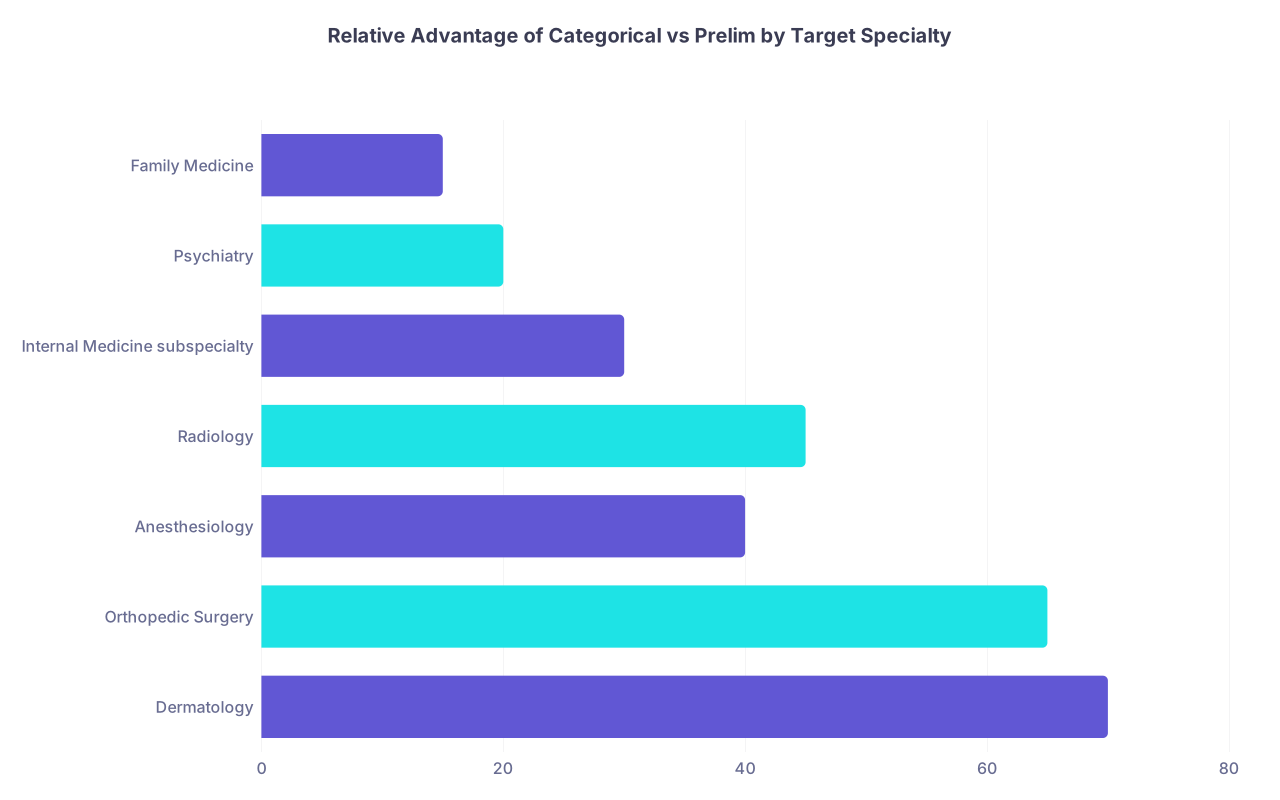
| Category | Value |
|---|---|
| Dermatology | 70 |
| Orthopedic Surgery | 65 |
| Anesthesiology | 40 |
| Radiology | 45 |
| Internal Medicine subspecialty | 30 |
| Psychiatry | 20 |
| Family Medicine | 15 |
Interpretation: higher value → prelim more attractive relative to categorical (because the field structurally uses prelims/advanced positions or values them more).
Highly competitive procedure- or lifestyle-driven fields (Derm, Ortho, ENT, Plastics, Ortho Spine)
- These programs almost never take mid-training categorical IM switchers.
- They more frequently consider strong prelims with clean narratives and targeted research.
- If your life’s bullseye is one of these and you have at least moderate objective metrics, prelim keeps that window open more than most categorical backups.
But the flip side is brutal: a large share of these reapplicants still never break through, even with prelim experience.
Advanced specialties with built-in prelim years (Radiology, Anesthesiology, PM&R, some Neuro)
- These are where a strong prelim can do the most work for you.
- PDs directly expect to evaluate PGY-1 performance.
- Categorical in a different field (like IM) may inadvertently signal that you “gave up” on the advanced specialty, unless your narrative is tight.
If you are close to competitive (say, one marginal feature away), a targeted prelim year at a program with a strong radiology/anesthesia department can significantly alter your odds.
Broad-access primary care fields (FM, Psych, IM at least in non-elite settings)
If your acceptable backup fields include FM, Psych, or non-competitive IM, your integrated probability structure is very different.
Your endgame question becomes:
- “Do I want to risk total failure for a modest chance at a more competitive field, or take a near-certain path now?”
Primary-care-type fields often welcome transfers and reapplicants from other specialties, especially if you show maturity and clear interest. In these situations, categorical wins on risk-adjusted value almost every time.
The Time and Age Factor: Years in the Pipeline
Every extra year you spend as:
- A prelim with no PGY-2.
- A reapplicant.
- A research fellow trying to bolster your CV.
…shifts your age at completion and attending-level earning years.
Let us put numbers on it:
- Typical path: finish residency by 30–32, then 30 years of attending income.
- If you lose 2–3 years in repeated prelims/reapplications/research-only time, you shrink your attending window to 27–28 years.
Assuming conservative differential of $150,000–$250,000 more per year as an attending vs resident/fellow, those “lost” 3 years represent $450,000–$750,000 nominal lifetime gross income. Even after discounting and taxes, the opportunity cost is not trivial.
So when you tell yourself, “I’ll just do one more cycle,” recognize that from a financial and life-course perspective, that extra cycle has a real measurable cost.
Strategic Use of a Prelim Year (If You Choose It)
If you still lean toward prelim—and for some of you, that is reasonable—you cannot treat that year as “do a good job and hope.”
You must run it like a focused, data-driven salvage operation.

| Step | Description |
|---|---|
| Step 1 | Start Prelim Year |
| Step 2 | Meet PD early |
| Step 3 | Clarify Target Specialty |
| Step 4 | Align with Key Faculty |
| Step 5 | Secure High-Impact Rotations |
| Step 6 | Obtain Strong Letters by Mid-Year |
| Step 7 | Apply Broadly to Categorical/Advanced |
| Step 8 | Activate Backup Specialty Plan |
Non-negotiables if you want your prelim year to move the needle:
- Choose a prelim program with your target specialty present on-site OR with strong connections to it.
- Identify, in month 1, which faculty can realistically write the 2–3 letters that will change your candidacy.
- Front-load rotations where those faculty see you early. You want letters out by mid-fall of your prelim year for your reapplication.
- Apply broadly. That means 60–80+ programs is common for competitive specialties; 100+ is not crazy for IMGs.
- Simultaneously apply to realistic backup specialties and even PGY-2-only opportunities. Do not “bet the house” on a single match list.
If you do anything less, you are functionally accepting the higher failure risk of the prelim path without fully exploiting its advantages.
Strategic Use of a Categorical Backup (If You Take It)
Categorical does not mean your story is over. It means you shift the optimization goal.
The data suggests three productive categorical strategies:
Settle decisively and go all-in on excellence
You accept that you will likely stay in that specialty. That unlocks:- Academic positions.
- Fellowships (IM, Psych, Peds, Path especially).
- Leadership roles.
Your long-term satisfaction often increases when you stop chasing the mirage of a move that statistically will not happen.
Target intra-specialty repositioning
Example: Categorical IM in a community program → aim for a competitive fellowship (Cards, GI, Heme/Onc).
Hard but realistic. The numbers show strong residents from community programs do match into solid fellowships every year.Limited, high-signal specialty switch attempts
If you see a realistic adjacent field and have compelling reasons (e.g., strong Path resident with real interest and evidence for Derm; strong Surgery categorical with documented case logs and letters for Plastics), you can attempt a targeted, one-time switch.
But here you need evidence that someone in that target specialty is actually interested in you. Conversations, informal offers to consider you, not just wishful thinking.
Visualizing the Risk–Reward Tradeoff
Here is how the overall tradeoff looks if you reduce it to a simple risk–reward chart for an unmatched candidate deciding between categorical and prelim.
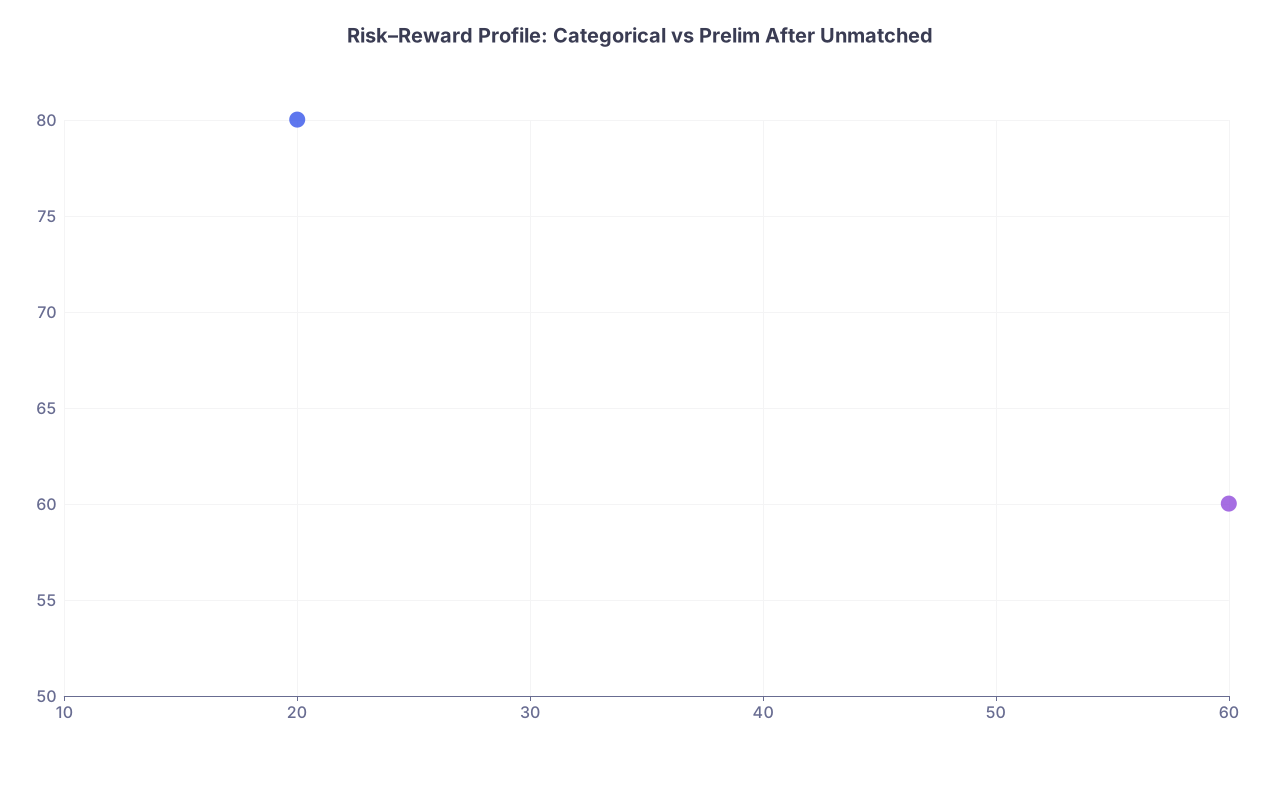
| Category | Value |
|---|---|
| Categorical Path | 20,80 |
| Prelim Path | 60,60 |
Interpretation (normalized 0–100 scale):
- X-axis (first number): Risk of not completing any residency.
- Y-axis (second number): Probability of achieving original or near-original specialty goal.
Categorical path: low risk (20), moderate reward (80 for “some acceptable specialty,” lower for dream).
Prelim path: higher risk (60), higher reward (probability of true dream higher than categorical, but at cost of more failures).
How to Decide: A Simple Framework
Strip the emotional narrative and ask yourself three quantitative questions:
What is my realistic competitiveness for my dream field now, on paper?
- If you are far below typical matched stats (exam failures, low scores, minimal research in a research-heavy field), prelim will not magically make you competitive.
- If you are near the margin (slightly below-average Step/COMLEX, one weaker letter, late pivot), a strong prelim can materially shift your odds.
How risk-averse am I about ever becoming a practicing physician?
- If falling out of the pipeline entirely is an unacceptable outcome, categorical is statistically safer.
- If you are willing to accept a 20–35% chance of never completing US residency in exchange for a 2–3x higher shot at your target field, prelim might be rational.
Do I have a true, data-backed Plan B if the second attempt fails?
- Named specialties, not “I will figure it out.”
- Broad application strategy for that Plan B baked into your prelim-year ERAS/NRMP approach.
If your honest answers are:
- Marginal competitiveness,
- High risk aversion,
- Vague backup plan,
then the correct data-driven recommendation is categorical.
If they are:
- Close to competitive,
- Moderate risk tolerance,
- Concrete backup map with other specialties you would accept,
then a well-chosen prelim can be reasonable.
Key Takeaways
- Categorical almost always wins on probability of finishing any residency and becoming a board-certified physician; prelim offers a higher-variance bet with more upside for dream specialties but substantially more downside.
- Prelim helps most when you are already near-competitive for an advanced specialty that structurally uses prelim years, and when you execute the year with laser-focused strategy (letters, rotations, broad applications, real backups).
- Your decision should be based on quantified risk tolerance, realistic competitiveness, and a specific backup plan—not on vague hope that “one more cycle” will magically fix what the data says is a structural problem.